Battle of France
- Dates:
- 10 May – 25 June 1940
- Front:
- Western Front
- Location:
- The Netherlands, Belgium, Luxembourg and France: the Belgian and Dutch lowlands, the Ardennes, the Meuse valley (Sedan, Monthermé, Dinant), Picardy and Flanders (Arras, Abbeville, Boulogne, Calais, Dunkirk, Lille), the Somme and Aisne line, Normandy, Brittany, Lorraine and Alsace (the Maginot Line), the Rhône valley and the AlpsOn the battle map →
- Sides:
- Nazi GermanyGerd von Rundstedt, Fedor von Bock, Wilhelm von Leeb, Heinz Guderian, Ewald von KleistFranceMaurice Gamelin, Maxime Weygand, Alphonse GeorgesUnited KingdomLord GortBelgiumLeopold IIINetherlandsHenri WinkelmanPolandWładysław SikorskiItalyBenito Mussolini
- Result:
- German victory. The Netherlands capitulated on 15 May and Belgium on 28 May. France signed armistices with Germany on 22 June and with Italy on 24 June; the fighting ended on 25 June. More than three-fifths of France came under German occupation.
- Author:
- Łukasz
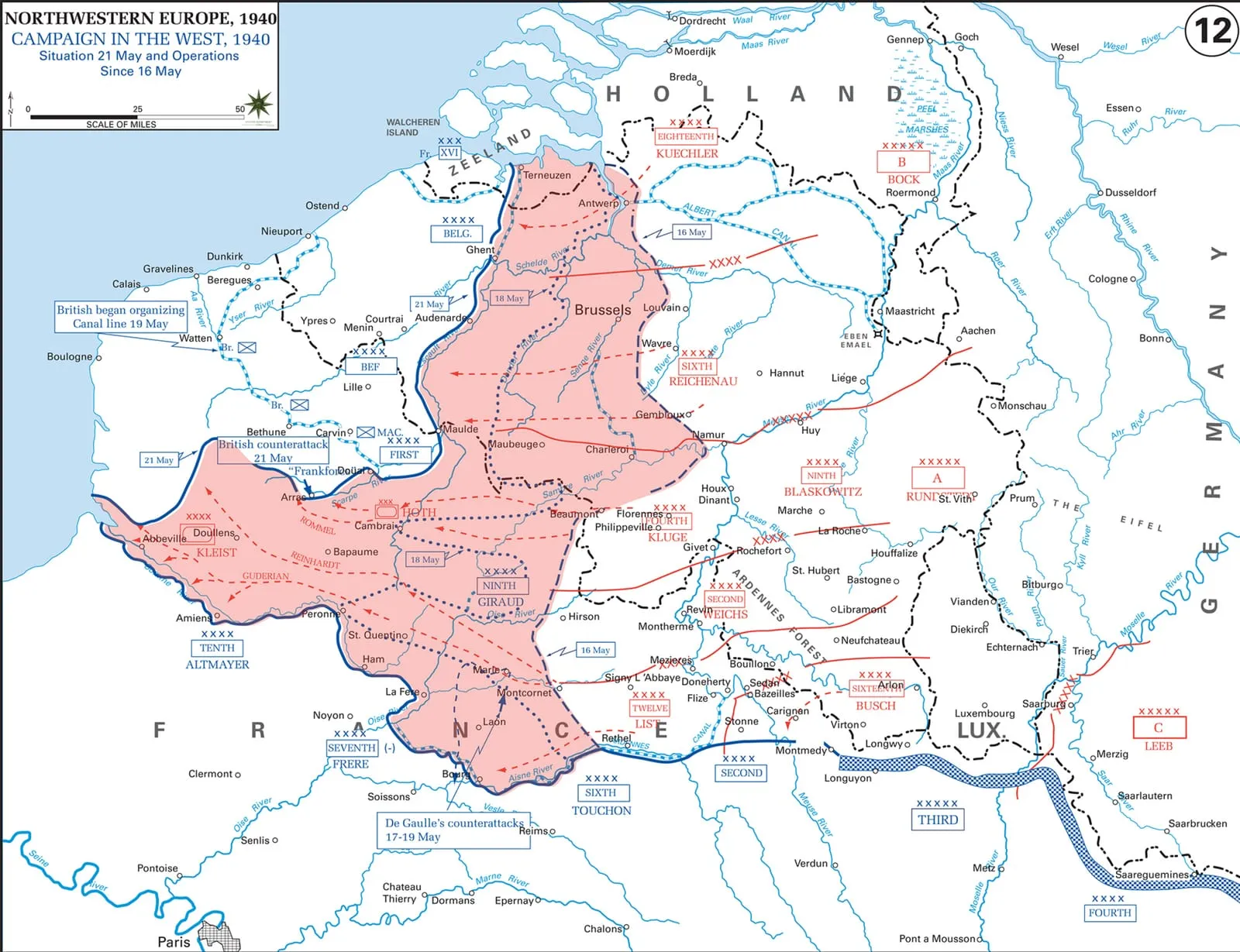
The Battle of France was the largest and most consequential campaign of the first period of the Second World War. On 10 May 1940 the Wehrmacht brought the Phoney War to an end by attacking the Netherlands, Belgium, Luxembourg and France. The best French armies and the British Expeditionary Force advanced into Belgium as planned to help the Belgians, while the German panzer divisions passed through the wooded Ardennes, forced the Meuse at Sedan on 13 May and within a week reached the English Channel, cutting off the Allied forces in Belgium and Flanders. The Netherlands capitulated after five days and Belgium after eighteen, and more than 338,000 soldiers were evacuated from Dunkirk to England, though without their equipment. In June the Germans broke through the new line of defence on the Somme and the Aisne, entered Paris on 14 June, and on 22 June, in the forest near Compiègne, France signed an armistice. An army regarded before the war as the strongest in Europe had been beaten in six weeks. The defeat changed the balance of power across the world and left Britain to face Germany alone.
Name and dates
Polish historians call it the “French campaign of 1940” or the “campaign in the west”; German writers speak of the Western Campaign (Westfeldzug), and French ones of the Battle of France (bataille de France). The campaign fell into two parts, named after the German plans. Case Yellow (Fall Gelb) covered the offensive against the Netherlands, Belgium, Luxembourg and northern France from 10 May to the fall of Dunkirk on 4 June. Case Red (Fall Rot) covered the offensive against the rest of France from 5 June. Since the fighting in the Netherlands, Belgium and Luxembourg was part of a single operation which the Allies conducted jointly, it is treated as part of the same campaign.
The campaign is taken to have begun at dawn on 10 May 1940, when German troops crossed the borders of three neutral states and the Luftwaffe attacked airfields in the Netherlands, Belgium and France. It ended on 25 June, when at 0.35 a.m. both armistices came into force: the Franco-German one, signed on 22 June at Rethondes near Compiègne, and the Franco-Italian one, signed on 24 June at the Villa Incisa near Rome. The campaign thus lasted 46 days. Some forts of the Maginot Line, cut off from the rest of the country, surrendered only in the last days of June and in early July, on the orders of the French command.
Background
On 3 September 1939 Britain and France declared war on Germany, but gave Poland no real help. The French Saar Offensive halted after a few kilometres, and in October the troops returned to their starting positions. The Allies prepared for a long war: a naval blockade was to weaken the German economy, while their armies, shielded by the Maginot Line, were to make ready for decisive operations in 1941 or 1942. For eight months the land front was quiet. During that time Lord Gort’s British Expeditionary Force took over a sector on the Belgian border and grew to more than a dozen divisions.
Adolf Hitler wanted to strike in the west as early as the autumn of 1939. On 9 October he signed Directive No. 6, but his generals, convinced that the Wehrmacht was not ready to fight France, managed to delay the offensive, and bad weather forced it to be postponed dozens of times. The first plans of the Army High Command (OKH) envisaged the main thrust through central Belgium, much as in 1914. From 31 October General Erich von Manstein, chief of staff of Army Group A, argued that such an offensive would push the Allies back but not destroy them, and proposed instead to strike through the Ardennes towards Sedan and on to the mouth of the Somme. After the Mechelen incident of 10 January 1940, when documents concerning the offensive fell into Belgian hands, Hitler postponed the attack until the spring, and on 17 February he heard Manstein out. On 24 February the OKH adopted a new plan whose core was the thrust through the Ardennes.
On the other side, the French Commander-in-Chief, General Maurice Gamelin, assumed that the Germans would attack across the Belgian plains. In November 1939 he adopted the Dyle Plan: as soon as the Germans entered Belgium, the best French armies and the BEF were to advance to the line of the Dyle between Antwerp and Namur, so as to fight far from the French frontier. In March 1940 he extended it with the “Breda variant”, sending his main reserve, General Henri Giraud’s Seventh Army, as far as the Netherlands. Belgium and the Netherlands held to their neutrality to the end and would not let the Allies onto their territory before they were attacked, so no joint plans were agreed. The sector facing the Ardennes, which the French regarded as difficult country for large formations, was held by the weak Second and Ninth Armies, made up largely of reserve divisions.
Forces and plans
In their final deployment the Germans committed some 135–141 divisions, around 2,400 tanks and more than 3,500 combat aircraft in the west. Colonel General Fedor von Bock’s Army Group B, with the Eighteenth and Sixth Armies and three panzer divisions, was to attack the Netherlands and northern Belgium, seize the fortresses and bridges there with landings by General Kurt Student’s paratroops, and draw the Allies onto itself. Colonel General Gerd von Rundstedt’s Army Group A, with the Fourth, Twelfth and Sixteenth Armies, was to pass through the Ardennes and Luxembourg and force the Meuse between Dinant and Sedan. Its spearhead was General Ewald von Kleist’s panzer group, with General Heinz Guderian’s XIX Corps and General Georg-Hans Reinhardt’s XLI Corps; on its right advanced General Hermann Hoth’s XV Corps with General Erwin Rommel’s 7th Panzer Division. Seven of the ten panzer divisions were concentrated in Army Group A. Colonel General Wilhelm von Leeb’s Army Group C stood on the defensive opposite the Maginot Line. In the air the offensive was supported by General Albert Kesselring’s Luftflotte 2 and General Hugo Sperrle’s Luftflotte 3.
The Allies had slightly more divisions in all (some 140–150 including the Belgian and Dutch ones), more tanks (the French alone had over 3,000, among them the heavy B1 bis, better armoured and armed than most German tanks) and more guns. Their numerical superiority counted for nothing, however, because it was so dispersed. Most French tanks were parcelled out among infantry divisions and had no radios, and the four armoured divisions were still being formed. The French air force and the British air units in France were weaker than the Luftwaffe, especially in modern fighters and dive bombers, while communications and command remained at the level of 1918. Gamelin directed the war from his headquarters at Vincennes, which had no radio, and command of the North-Eastern Front was exercised by General Alphonse Georges. The key 1st Army Group, which was to move into Belgium, was commanded by General Gaston Billotte. The Belgian army numbered 22 divisions and some 600,000 men under the personal command of King Leopold III; the Dutch army, commanded by General Henri Winkelman, some 280,000. A reconstituted Polish army was also forming in France, numbering more than 80,000 soldiers in the spring of 1940.
Course: the breakthrough (10–20 May)
Before dawn on 10 May the Germans attacked along the whole front from the North Sea to the Moselle. In the Netherlands paratroops and air-landed infantry seized the bridges at Moerdijk, Dordrecht and Rotterdam, although the attempt to take The Hague and capture the Queen and the government failed. In Belgium gliders landed on Fort Eben-Emael, which surrendered the next day, and took the bridges over the Albert Canal. Luxembourg was occupied within the day. Gamelin, as planned, ordered the Dyle–Breda manoeuvre: the 1st Army Group and the BEF advanced into Belgium, and the Seventh Army raced into the Netherlands. The Luftwaffe, busy attacking airfields and railway junctions, scarcely interfered with them, which ought to have alarmed the French. That same day Winston Churchill became Prime Minister in London.
In Belgium General René Prioux’s French Cavalry Corps fought the first great tank battle of the war at Hannut on 12–13 May against General Erich Hoepner’s XVI Panzer Corps, buying time for the infantry to take up its positions. On 14–15 May the French First Army repulsed the Germans at Gembloux. The Netherlands could not wait for help: the Seventh Army failed to link up with the Dutch, who lost the Grebbeberg on 13 May. On 14 May, while negotiations for the surrender of the city were under way, the Luftwaffe bombed Rotterdam, killing 800–900 civilians according to various estimates, and the German command threatened Utrecht with the same fate. That evening Winkelman announced the capitulation, which was signed on 15 May. The Queen and the government had been in London since 13 May.
Meanwhile the columns of Kleist, Hoth and the infantry were winding westwards through the Ardennes, one of the greatest concentrations of motorised forces in history up to that time. Light Belgian units and French cavalry merely delayed them, and Allied aircraft barely detected them. On the evening of 12 May the Germans reached the Meuse. On 13 May Rommel crossed the river at Dinant, and in the afternoon, after a bombardment lasting several hours by hundreds of aircraft that broke the defenders’ spirit, Guderian’s infantry crossed at Sedan and by evening had taken the heights on the southern bank. That evening panic swept through the rear of the French 55th Division at Bulson. On 14 May French and British bombers tried to destroy the pontoon bridges at Sedan and met with disaster: of some 70 British aircraft, about 40 failed to return. French counter-attacks were late and piecemeal. At Monthermé Reinhardt’s corps was unable to break through for two days, but on 15 May it too burst out westwards.
The French front was torn open across some 80 kilometres. General André Corap’s Ninth Army disintegrated, and its new commander, General Giraud, was taken prisoner on 19 May. On the southern shoulder of the breach, at Stonne, a hill changed hands more than a dozen times in several days of bitter fighting. Guderian, in spite of the hesitation of Kleist and of Hitler himself, who feared a French blow against the exposed flank, raced west along the Somme valley. On the morning of 15 May Prime Minister Paul Reynaud telephoned Churchill: “We are beaten; we have lost the battle.” On 16 May in Paris Gamelin admitted to Churchill, who had flown in from London, that he had no strategic reserve at all, while archives were being burned in the courtyard of the Foreign Ministry. The Allied armies in Belgium, now threatened with encirclement, began to withdraw from the Dyle on 16 May. On 17 May the Germans entered Brussels, and Antwerp the next day. The counter-attack by Colonel Charles de Gaulle’s 4th Armoured Division, still being formed, at Montcornet on 17 May was no more than a pinprick.
On 18 May Reynaud brought Marshal Philippe Pétain into the government as deputy prime minister, and on 19 May he dismissed Gamelin and gave the supreme command to the 73-year-old General Maxime Weygand, summoned from Syria. Gamelin’s last order, for attacks on the breach from the north and the south, fell into oblivion, and Weygand lost several days before framing a plan of his own. On the evening of 20 May the 2nd Panzer Division took Abbeville and reached the sea at Noyelles. Ten days after the offensive began, the Allied armies had been cut in two.
Course: the Flanders pocket and Dunkirk (21 May – 4 June)
North of the German wedge were the Belgian army, the BEF, the French First Army and the remnants of the Seventh and Ninth Armies, more than a million men in all. Weygand wanted to extricate them with a thrust southwards, combined with an attack from the Somme line. On 21 May British tanks attacked at Arras and caused momentary alarm in Rommel’s division and in the German command, but there was not enough strength for more. That same evening General Billotte, the only man who knew Weygand’s intentions and who coordinated the operations of three armies, was fatally injured in a car accident. His successor, General Georges Blanchard, was unable to restore cooperation. Gort, convinced that the counter-attack could not be carried out and that the Belgians were collapsing, halted preparations for the southward attack on 25 May and sent two divisions to plug the gap on the northern flank. On 26 May the British Cabinet agreed to an evacuation.
The Germans meanwhile wheeled north along the coast. Boulogne fell on 25 May, and Calais on 26 May after a stubborn defence. On 24 May Hitler, on Rundstedt’s advice, halted the panzer divisions on the line of the Aa Canal, some fifteen kilometres from Dunkirk, while Hermann Göring promised that the Luftwaffe alone would destroy the encircled forces. The halt order, rescinded on 26 May, gave the Allies two or three days to strengthen the perimeter around the port. Historians still debate its reasons: concern for worn-out tanks ahead of the second part of the campaign, the marshy terrain of Flanders, a wish to leave the glory to the Luftwaffe, and finally disputes within the army command. Early on 28 May the Belgian army, shattered in several days of fighting on the Lys, capitulated. King Leopold III remained in the country as a prisoner, and the Belgian government, already in France, repudiated his decision. On the eastern side of the pocket part of the French First Army, surrounded at Lille, tied down several German divisions until 31 May.
The evacuation, Operation Dynamo, directed from Dover by Vice-Admiral Bertram Ramsay, lasted from 26 May to 4 June. From the harbour and beaches of Dunkirk, under ceaseless air attack, Royal Navy warships, merchant vessels and hundreds of small civilian craft carried 338,226 soldiers to England: some 198,000 British and some 140,000 French, Belgian and other Allied troops. RAF Fighter Command, flying from bases in England, fought fierce large-scale battles with the Luftwaffe for the first time in the war. The British and French lost six British and three French destroyers and more than two hundred other vessels. The perimeter was held to the end by French units, of which some 35,000–40,000 men were taken prisoner on 4 June. The BEF left almost all its heavy equipment on the beaches. The fighting in the pocket saw war crimes: on 27 May at Le Paradis SS men of the Totenkopf Division shot some 97 British prisoners (the Le Paradis massacre), and on 28 May near Wormhoudt soldiers of the Leibstandarte SS Adolf Hitler regiment murdered some 80 prisoners. In the Belgian village of Vinkt Wehrmacht soldiers killed 86 civilians on 25–28 May.
Course: Case Red and the fall of France (5–25 June)
Weygand still had some 60 divisions, including two British ones, holding a new line from the mouth of the Somme along the Somme and the Aisne to the Maginot Line. Many of them were battered or under strength, and the strongpoints hastily set up in villages and woods (the so-called hedgehogs) did not form a continuous front. On 5 June Army Group B attacked on the Somme, and on 9 June Army Group A on the Aisne. The first days cost the Germans heavy losses: the French infantry, having learned how to fight tanks, defended itself better than in May. By 8 June, however, the front had cracked. On 10 June Rommel reached the sea near Fécamp, and on 12 June at Saint-Valery-en-Caux he accepted the surrender of the British 51st (Highland) Infantry Division and the French IX Corps. Guderian, now commanding a panzer group of his own, broke through the front in Champagne and drove south-east.
On 10 June, with the outcome already close, Benito Mussolini declared war on France and Britain. That same day the French government left Paris for the Loire, near Tours, and on 14 June moved on to Bordeaux. Paris was declared an open city, and German troops marched in on the morning of 14 June. That day Army Group C opened its attack on the Maginot Line in the Saar, and on 15 June it crossed the Rhine near Colmar. On 17 June Guderian’s tanks reached the Swiss border near Pontarlier, trapping the 2nd Army Group with several hundred thousand men in Lorraine and Alsace. On 19 June Rommel took Cherbourg, and other units took Brest. In the second half of June the British evacuated nearly 200,000 more soldiers and civilians from the ports of western France in Operation Aerial. On 17 June off Saint-Nazaire German aircraft sank the troopship Lancastria, with the loss, according to various estimates, of between some 3,000 and more than 5,000 lives; it was the greatest disaster in the history of British shipping.
The government had been divided for several days. Reynaud, backed by de Gaulle, who had been appointed under-secretary of state at the Ministry of Defence at the beginning of June, wanted to carry on the war from North Africa. Weygand and Pétain demanded an armistice. The government was bound by the pledge of 28 March that France would not conclude a separate armistice without Britain’s consent, but the conferences with Churchill at Briare (11–12 June) and Tours (13 June) found no way out. On 16 June the government rejected the British proposal for a union of the two countries, and that evening Reynaud resigned. The new Prime Minister, Pétain, asked the Germans for armistice terms through Spain that night, and on 17 June told the French in a radio broadcast that “we must stop fighting”. In many places the army ceased to resist, although some units, especially in Lorraine and on the Loire, fought to the end. On 18 June de Gaulle, who had flown to London the day before, called on the French over the BBC to continue the fight. On 20–21 June the Italians opened an offensive in the Alps, but the French Army of the Alps held its positions despite the enemy’s manifold superiority, and the Italians took only scraps of borderland, including Menton.
The Poles in the campaign
Units of the Polish Army reconstituted in France under the supreme command of General Władysław Sikorski fought in the campaign, committed to battle one by one and under French command. Brigadier General Bolesław Bronisław Duch’s 1st Grenadier Division fought in Lorraine, on 17–18 June it fought the action at Lagarde on the Marne–Rhine Canal, and on 21 June, surrounded, it was disbanded. Its soldiers were to make their way south in small groups. Brigadier General Bronisław Prugar-Ketling’s 2nd Rifle Division, covering the retreat of the French XLV Corps, crossed into Switzerland on the night of 19/20 June, where some 12,000–13,000 of its soldiers were interned. Brigadier General Stanisław Maczek’s 10th Armoured Cavalry Brigade fought in mid-June in Champagne and Burgundy, at Champaubert and Montbard, after which it destroyed its equipment and dispersed. Polish fighter squadrons and flights defended French skies. The Independent Podhale Rifles Brigade, just back from Narvik, was no longer able to play a part in Brittany. Only part of the army could be evacuated to Britain – according to various tallies, from some 20,000 to more than 27,000 men, including most of the airmen. In June the Polish government and President also moved from France to London.
The armistice
On 21 June, in a clearing at Rethondes in the forest of Compiègne, Hitler received the French delegation in the same railway carriage in which, on 11 November 1918, Marshal Foch had presented the armistice terms to the Germans. On the evening of 22 June General Charles Huntziger and General Wilhelm Keitel signed the agreement. German troops were to occupy the northern and western part of the country, including Paris and the entire Atlantic coast, some three-fifths of French territory, and France was to pay the costs of the occupation. In the south an unoccupied zone remained under the authority of the French government. The army was to be demobilised except for the units needed to maintain order (in metropolitan France eventually some 100,000 men), the fleet was to be disarmed in port under German and Italian supervision, and some 1.5–1.8 million prisoners of war were to remain in captivity until a peace was concluded. Article 19 obliged France to surrender, on German demand, political refugees on its territory. On 24 June Huntziger signed the armistice with Italy at the Villa Incisa near Rome, which gave the Italians a small occupation zone in the Alps and around Menton, together with demilitarised zones. At 0.35 a.m. on 25 June the guns fell silent along the whole front.
Losses
The figures vary with the source and the method of counting. According to German returns cited by the historian Karl-Heinz Frieser, the Wehrmacht lost 27,074 killed, 111,034 wounded and 18,384 missing in the campaign. The Luftwaffe lost between about 1,240 and more than 1,400 aircraft, and the army about 800 tanks destroyed beyond repair, roughly a third of those committed. French losses were formerly put at 90,000–100,000 killed; more recent French research gives some 55,000–60,000 killed and some 200,000 wounded. Between 1.5 and more than 1.8 million French soldiers were taken prisoner, most of whom spent five years in German camps. The French air force lost some 1,270 aircraft. According to British figures the BEF lost more than 66,000 men, including some 11,000 killed and died of wounds and more than 41,000 missing and taken prisoner, while the Royal Air Force lost 931 aircraft between 10 May and 22 June. The Belgians lost some 6,000 killed, the Dutch some 2,300, the Poles, according to various tallies, some 5,500 killed and wounded, and the Italians, in four days of fighting in the Alps, some 630–640 killed. The campaign also claimed tens of thousands of civilian lives: people killed in air raids, on the roads along which several million Belgians and French fled before the Germans, and in war crimes, among them the black French colonial soldiers murdered after being taken prisoner, whom the historian Raffael Scheck puts at 1,500–3,000.
Significance
The Battle of France brought Germany the greatest victory in its history, won at small cost and against the fears of its own generals. It was the product neither of crushing material superiority nor of a carefully thought-out doctrine of “lightning war”, but of a bold plan that struck at the Allies’ weakest point, the initiative of the panzer commanders, the Luftwaffe’s command of the air, and the mistakes of the enemy: antiquated command, dispersed tanks, a lack of reserves and the belief that the war would again be a slow one. Hitler came to believe in his own military genius, and the myth of the invincible Wehrmacht weighed a year later on the decision to attack the Soviet Union.
France ceased to be a great power. On 10 July 1940 the National Assembly at Vichy granted Marshal Pétain full powers, bringing the history of the Third Republic to an end. The French State (Vichy France) set out on the road of collaboration, while in London de Gaulle gathered the Free French. On 3 July the British fleet, fearing that the French warships would fall into German hands, attacked them at Mers-el-Kébir (Operation Catapult). Britain was left alone, but thanks to Dunkirk it kept the cadres of its army, and that summer, in the Battle of Britain, it repelled the German air offensive. The fall of France emboldened other states: Italy entered the war, the Soviet Union occupied the Baltic states in mid-June and Bessarabia on 28 June, Japan forced the French and British to close the supply routes to China through Indochina and Burma, and the United States began to rearm on a vast scale and to support Britain. For the Poles the defeat of France meant the loss of the second base on which they had been rebuilding their army after the September Campaign. The Polish authorities and the soldiers who reached Britain continued the fight alongside the British, and Polish airmen were already taking part in the defence of British skies in the summer of 1940.