- Category:
- Military
- Front:
- Western Front
- Date:
- 10 January 1940
- Author:
- Łukasz
- Tags:
- Belgium, Phoney War, Luftwaffe, neutrality
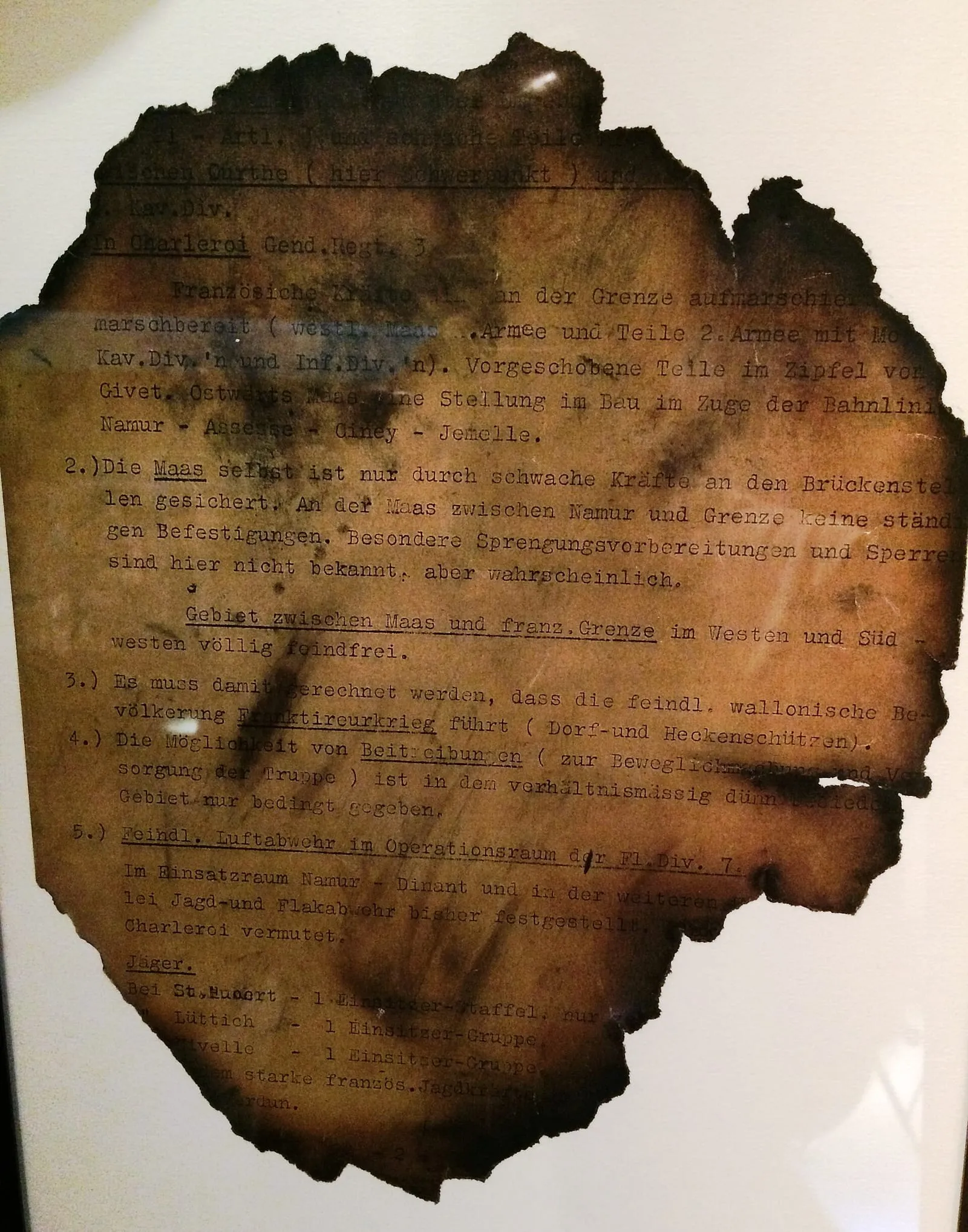
At about half past eleven on 10 January 1940 a small German liaison aircraft, a Messerschmitt Bf 108 “Taifun”, came down on a frozen field near the village of Vucht in Belgian Limburg, close to the Dutch border. The pilot had lost his way in the fog and then, it seems, cut off the fuel supply to the engine by mistake. The aircraft shot between two poplars, which tore off its wings, and came to rest a wreck, but both airmen climbed out unhurt. One of them was carrying, in a yellow pigskin briefcase, secret orders concerning the German offensive against Belgium and the Netherlands, which Adolf Hitler had that very day fixed for 17 January. He tried to burn them, but Belgian soldiers snatched the charred pages from his hands. So began the episode known, after the nearby village of Mechelen-aan-de-Maas (today part of the municipality of Maasmechelen), as the Mechelen incident, which for several days held four countries in suspense and had a lasting influence on the course of the 1940 campaign.
It is often said that a German aircraft carrying the plans for Case Yellow (Fall Gelb) crashed in neutral Belgium. This is accurate, with two corrections. The aircraft did not crash but made a forced landing, and no one was killed. Nor was it carrying the entire plan of the campaign, only the documents for one part of it: orders for air units and airborne troops, from which, however, the general outline of the German offensive could be deduced.
The flight to Cologne
Since October 1939, when Hitler signed Directive No. 6, the Wehrmacht had been preparing an offensive through the Netherlands, Belgium and Luxembourg. The date had been set and cancelled many times. According to a list read out at Nuremberg, the attack was to begin successively on 12, 19, 22 and 26 November, on 3, 9 and 11 December and on 1 January, but each time it was postponed because of the weather or the state of the troops. On 10 January, after a favourable forecast from the meteorologists, Hitler ordered the operation to begin on 17 January, a quarter of an hour before sunrise. Under the version of the plan then in force, the main blow was to be struck by Army Group B through central Belgium, and one of its novelties was to be an airborne landing.
On the morning of that same day a Bf 108 took off from Loddenheide airfield near Münster for Cologne, piloted by the airfield commandant, the 52-year-old Major Erich Hoenmanns. His passenger was Major Helmuth Reinberger, the officer responsible for supplies in the 7th Air Division (PL) – the German paratroopers (PL) who were to land behind the Belgian lines on the day of the attack. Reinberger was travelling to a staff conference and carrying the documents intended for it. Normally he would have had to make the journey by night train, but the previous evening in the officers’ mess Hoenmanns had offered to fly him: he needed flying hours and also wanted to take his laundry to his wife in Cologne. He did not know what his passenger had in his briefcase. In doing so both men broke an explicit ban in force in the Luftwaffe with the approval of Hermann Göring: secret orders were not to be carried by air without express permission.
The weather was bad, and the winter of 1939/1940 was one of the coldest in decades. Banks of fog hung over the ground. Hoenmanns, who had failed to notice the ice-bound Rhine, lost his bearings and turned west, hoping that the river would allow him to find his position. In reality he had already flown over it and carried on until he reached the Meuse, which at that point divides Belgium from the Netherlands. Circling over Vucht, he moved a lever in the cockpit; the engine spluttered and died, and the pilot had no choice but to land in the nearest field.
The briefcase in the fire
Only when a farmhand from a nearby farm, Engelbert Lambrichts, told the airmen that they were in Belgium did Reinberger realise what had happened. He rushed to the wreck for his briefcase, shouting that he had secret documents which he had to destroy immediately. Hoenmanns walked away from the aircraft to draw the attention of the people running up. Reinberger’s lighter failed, so he borrowed a match from the farmhand, hid behind some bushes and set fire to the papers he had laid on the ground. Moments later two Belgian border guards arrived on bicycles, Sergeant Frans Habets and Corporal Gerard Rubens. Rubens saw the smoke, ran over and pulled the charred papers out of the fire. Reinberger tried to run, but surrendered after two warning shots.
Both Germans were taken to the border guard post at Mechelen-aan-de-Maas. There they were questioned by a Belgian officer, Arthur Rodrique, who laid the recovered pages on the table. Hoenmanns asked to go to the lavatory, and when the guards’ attention wandered, Reinberger seized the documents and thrust them into the red-hot stove. Rodrique turned round, pulled the papers out of the fire, burning himself in the process, and locked them in another room. Reinberger, convinced that he would be shot for losing the plans, tried to snatch the Belgian’s revolver to shoot himself. Wrestled to the floor, he burst into tears. A few hours later officers of Belgian military intelligence arrived and took the documents to Brussels.
What the Belgians read
By the evening of 10 January the pages were in the hands of the Second Section (intelligence) of the Belgian General Staff. Most were charred, some almost completely destroyed, and they did not give the date of the attack. Most of the text concerned the tasks of the air force and the 7th Air Division. Even so, a surprising amount could be reconstructed from the fragments. The offensive was to cover the whole front from the Moselle to the North Sea, and the German Sixth Army was to deliver the main blow in the area of Maastricht, which meant that this time, unlike in 1914, the Germans would not spare the Netherlands. One surviving passage stated that part of the forces was to occupy Dutch territory with the exception of so-called Fortress Holland, the heavily defended area containing Amsterdam, Rotterdam and The Hague. The documents also described something not yet seen in Western Europe: an airborne landing intended to seize the bridges over the Meuse between Namur and Dinant.
A first, cursory analysis judged the documents to be genuine. The Belgian officers reasoned that no intelligence service would hand such unusual details to an opponent, even to deceive him. They also tallied with the warnings the Belgians had been receiving for several weeks, including from the Italian Foreign Minister Galeazzo Ciano, that Germany would strike around the middle of January. On the morning of 11 January General Raoul Van Overstraeten, the King’s military adviser, was informed, and shortly after noon King Leopold III himself, who commanded the Belgian army.
Warnings from Brussels
The King decided to act quickly but discreetly. Of the ministers, only the Minister of Defence, General Henri Denis, was to learn what the documents contained. On the evening of 11 January Van Overstraeten passed a summary of the captured material, without explaining where it had come from, to the French liaison officer Lieutenant Colonel Hautcœur for General Maurice Gamelin; to the British military attaché for Lord Gort, commander of the British Expeditionary Force; and to the Belgian attaché in The Hague, Lieutenant Colonel Pierre Diepenrijckx, for the Dutch Commander-in-Chief, General Izaak Reijnders. According to later accounts, Leopold III also personally telephoned the heir to the Dutch throne, Princess Juliana, and Grand Duchess Charlotte of Luxembourg, warning them in pre-arranged phrases of the approaching danger.
At the same time the Belgians decided to convince the Germans that the plans had been destroyed. Reinberger’s interrogators let him understand that they had been unable to read anything from the remains, and on 12 January they allowed both airmen to meet the German air attaché in The Hague and Brussels, Generalleutnant Ralph Wenninger, and the military attaché in Brussels, Colonel Friedrich-Carl Rabe von Pappenheim. The conversation was secretly recorded. Reinberger assured the attachés that he had burned the documents and that only palm-sized fragments were left, and the Reich’s ambassador in Brussels passed this on to Berlin.
Panic in Berlin
Berlin learned of the crash late on the evening of 10 January from press reports. In the High Command of the Wehrmacht (OKW) it caused consternation, as it was quickly established who had been on board and what he might have been carrying. Hitler flew into a rage. Göring had to endure harsh reproaches and, according to later accounts, not knowing whether to believe Reinberger’s assurances, had experiments carried out in burning similar bundles of paper and even consulted clairvoyants. On 12 January (according to some sources as early as 11 January) the commander of Air Fleet 2, to which the 7th Air Division belonged, General Hellmuth Felmy, and his chief of staff, Colonel Josef Kammhuber, were relieved of their posts. Command of Air Fleet 2 was soon taken over by General Albert Kesselring.
The chief of the OKW operations staff, General Alfred Jodl, noted in his diary on 12 January what he had told Hitler: if the enemy had all the files, the situation was catastrophic. The next day, after the report on the attachés’ conversation with the airmen, he recorded with relief that the briefcase had “certainly been burned”. For the time being the Belgian ruse had worked. The incident itself did not lead Hitler to change his intentions: the attack was still set for 17 January. Hitler did, however, draw a general conclusion. On 11 January he signed a “Basic Order” on secrecy, which from then on applied throughout the Wehrmacht: no office and no officer was to learn of a secret matter unless it was absolutely necessary for their task, nor to learn more than was necessary, nor earlier than was necessary, and the thoughtless distribution of secret orders according to general distribution lists was forbidden.
The alarm of 13–15 January
On the evening of 13 January, at around 5 p.m., the Belgian military attaché in Berlin, Colonel Georges Goethals, heard from his Dutch colleague Major Gijsbertus Sas that the aircraft that had come down in Belgium had been carrying plans for the attack in the West, and that in view of their loss the Germans would attack the following morning in order to forestall countermeasures. For months Sas had been receiving such information from Colonel Hans Oster of the Abwehr, an opponent of Hitler who warned the neutral states in the hope that failure in the West would bring down the regime. Goethals passed on the message with explicit reservations. In Brussels it reached Van Overstraeten at around 8 p.m. and shook him, because no newspaper had reported the capture of the documents. The informant had to have access to German headquarters.
The Belgian Chief of the General Staff, Lieutenant General Édouard Van den Bergen, went further than the King wished. Without consulting Leopold III or Van Overstraeten, he had all soldiers on leave – some 80,000 men – recalled to their units by radio and ordered the penultimate stage of mobilisation, the so-called Phase D, to take effect from 14 January. He also ordered the barriers on the border with France to be removed, so that Allied troops could enter quickly when called upon. Belgium took on the atmosphere of the eve of battle. Divisions moved towards the German border, and refugees left the Eupen and Malmedy area. The King, however, regarded the Chief of Staff’s unauthorised action as a serious infringement of his authority and as a mistake that revealed to the Germans that the Belgians knew their plans. At the end of January Van den Bergen was forced to resign.
The Dutch reacted far more calmly. General Reijnders, who since the autumn had dismissed Sas’s warnings, asked the Belgian attaché whether he himself believed the information, and declared that he did not believe it at all. Only on the night of 13/14 January was rail traffic in the military zone restricted, and at noon on 14 January leave was stopped and bridges were prepared for demolition. The Dutch high command wanted above all to avoid giving the impression that it was acting in concert with the Belgians.
Gamelin waits for an invitation
For the French the alarm was both a threat and an opportunity. Since the autumn Gamelin had been waiting for the moment when Belgium would allow his troops onto its territory before the Germans got there. His Dyle Plan envisaged an advance as far as the Antwerp–Namur line, but only after a German invasion. At a conference on 12 January the head of French intelligence, Colonel Louis Rivet, expressed scepticism, but Gamelin judged that even a false alarm could be used to put pressure on the Belgians and ordered the 1st Army Group and the neighbouring Third Army to prepare to move.
On the morning of 14 January King Leopold, through Admiral Roger Keyes, his unofficial link with London, asked Winston Churchill for certain guarantees, among them that the Allies would not make peace without Belgium’s participation. Keyes added on his own account that once they were received the King might persuade the government to call in the Allies. On the way to Paris the qualification that this was merely the admiral’s private opinion got lost. The Prime Minister, Édouard Daladier, concluded that the Belgians had in principle agreed to a French entry and in the afternoon asked Gamelin whether he was ready. Gamelin judged that with heavy snow along the Belgian–German border the Germans could not move quickly, and ordered the Allied forces, the British included, to advance to the Belgian frontier during the night of 14/15 January, ready to cross at the first signal. The commander of the North-Eastern Front, General Alphonse Georges, fearing that such a move might provoke a German attack before the French army was ready, protested by telephone, but Gamelin shouted him down.
On the morning of 15 January it turned out that the British reply to the King’s request was much more cautious than expected, and the Belgian border guards had stopped dismantling the barriers. Daladier, urged on by Gamelin, told the Belgian ambassador that if France did not receive an invitation by 8 p.m., the Allied forces would withdraw from the frontier and, in the event of further alarms, would not come before a German attack. The government of Paul van Zeeland did not take such a decision. The attack expected on 14 January had not come, and the King and Van Overstraeten, committed supporters of neutrality, had no intention of drawing the country into the war until it became unavoidable. Around midday Van Overstraeten ordered the barriers to be rebuilt and reiterated the order to repel by force any foreign unit, of whatever nationality, that violated the Belgian frontier. In the evening Daladier told a disappointed Gamelin that he could not take responsibility for a pre-emptive entry into Belgium.
On the German side, on 13 January, because of poor weather forecasts, the date of the attack was postponed – according to the diaries of Jodl and Franz Halder, to 20 January. During the night of 13/14 January reports began to arrive of Belgian and Dutch preparations, which made it clear that there would no longer be any surprise. The snow and frost did not let up, and on 16 January Hitler postponed the offensive indefinitely.
Accident or ruse?
From the very first hours many Allied and neutral officers suspected that the landing had been staged. The head of Dutch intelligence, Colonel van de Plassche, considered it a set-up and the documents forgeries by German intelligence. Lieutenant Colonel Diepenrijckx, who had himself previously headed Belgian intelligence, recalled the British ruse in Palestine in 1917, when a bag of false documents dropped “by accident” misled the Turks before the Battle of Beersheba. French intelligence and some of the British were sceptical. The idea that the Germans could have so recklessly entrusted secret orders to a courier aircraft seemed improbable.
German documents released after the war settled the matter. The panic in the OKW, Jodl’s notes, the dismissal of Felmy and Kammhuber, the secrecy order of 11 January and, finally, the death sentences passed in absentia on both majors leave no doubt that this was a genuine accident and not a disinformation operation. Such is the unanimous view of the historians who have studied the affair, from Hans-Adolf Jacobsen to the Belgian scholar Jean Vanwelkenhuyzen. Allied suspicion nonetheless had consequences: the inclination to see a German ruse in the captured papers later made it easier to believe that the plan revealed in them was still in force.
Hoenmanns and Reinberger were interned in Belgium, in a camp at Huy. In May 1940 they were evacuated to Britain and from there to Canada. In Germany they were sentenced to death in absentia, but the sentences were never carried out. They returned home in prisoner exchanges, Hoenmanns in 1943 and Reinberger in 1944. Brought to trial, Hoenmanns was partially pardoned and Reinberger acquitted.
Place in the war
In the short term the incident did little damage. The alarm passed when the dates named in the plans went by without an attack, and Belgium held to strict neutrality. The crisis showed, however, how far Allied strategy depended on decisions taken in Brussels, and how much the Belgians, mindful of German guarantees, feared provoking Hitler. It also showed the Germans what the Allies would do: French and British troops moved up to the Belgian frontier, ready to advance deep into the country, which confirmed the assumptions of the Dyle Plan.
Historians still argue over whether Mechelen changed the course of the 1940 campaign. According to the traditional view, the loss of the documents forced Hitler to demand a plan built on new principles and opened the way for the concept of Erich von Manstein, who since October had been pressing for the main effort to be shifted to the Ardennes. On 13 February 1940 Jodl recorded Hitler’s words that the blow should be struck towards Sedan, because the enemy did not expect it there, and that the airmen’s documents had convinced the enemy that the Germans wanted only to seize the coast of Holland and Belgium. Other historians stress that the revealed plan was predictable in any case, that the further delay was caused above all by the weather, and that the turn came only when Manstein reached Hitler in mid-February. They agree that what the Germans read from the Allied reaction mattered more than what the Belgians read from the German plans.
Gamelin did not change his plan. In March 1940 he even extended it with an advance by the Seventh Army into the Netherlands. On 10 May 1940 the Wehrmacht attacked the Netherlands, Belgium and Luxembourg, and the best Allied armies advanced, as planned, deep into Belgium to meet the blow they were expecting. The main blow, meanwhile, fell through the Ardennes on Sedan and cut them off from France. The paratroopers of the 7th Air Division did indeed land, but in the Netherlands and on the forts on the Albert Canal, not on the Meuse near Namur, as the orders burned at Mechelen had foreseen.
Sources
Meanwhile
(03)Elsewhere, within a week.
- 7 January 1940 · ScandinaviaTimoshenko takes command in FinlandOn 7 January 1940 Moscow formed the North-Western Front under Komandarm Timoshenko. After the defeats of December, he was to break the Mannerheim Line.
- 7 January 1940 · ScandinaviaThe destruction of Soviet divisions on the Raate roadIn the first week of January 1940 Colonel Siilasvuo’s Finns cut the Soviet 44th Division into pockets on the Raate road and destroyed it, taking tanks and guns.
- 17 January 1940 · ScandinaviaSoviet air raids on Finnish townsIn mid-January 1940 Soviet bombers struck Turku, Tampere, Helsinki and dozens of other towns, while north of Lake Ladoga the Finns encircled two divisions.
Related events
(04)The same battle, people or subject.
- 9 November 1939 · Western FrontThe Dyle PlanOn 9 November 1939 at Vincennes Gamelin won approval for the Dyle Plan. If Belgium were attacked, the Allies would advance as far as the Antwerp–Namur line.
- 10 May 1940 · Western FrontGermany attacks in the WestOn 10 May 1940 the Wehrmacht struck the Netherlands, Belgium and Luxembourg. The Allies advanced into Belgium as Kleist's tanks entered the Ardennes.
- 24 May 1940 · Western FrontThe halt order before DunkirkOn 24 May 1940 Hitler approved halting the tanks before Dunkirk. By 26 May the Allies had strengthened their defence, and the Germans took Boulogne and Calais.
- 17 February 1940 · Western FrontManstein presents his plan to HitlerOn 17 February 1940 Manstein, removed from planning, put his Ardennes idea to Hitler. On 24 February the OKH shifted the main thrust to Army Group A.