Austria
Arthur Seyss-Inquart
Minister of the Interior and Chancellor of Austria (1938), Reich Governor in Austria (1938–1939), Deputy Governor-General (1939–1940), Reich Commissioner for the Netherlands (1940–1945)
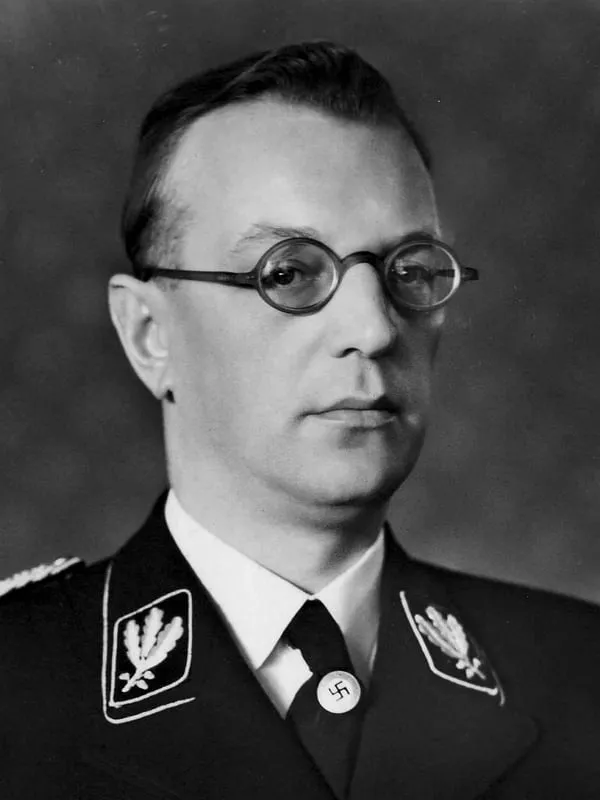
- Born:
- 22 July 1892, Stannern (Stonařov), Moravia (Austria-Hungary)
- Died:
- 16 October 1946, Nuremberg
- Author:
- Łukasz
- Photo:
- autor nieznany, CC BY-SA 4.0, Wikimedia Commons

Arthur Seyss-Inquart was a Viennese lawyer, a Catholic and a German nationalist who became Hitler’s Trojan horse in Austria. In February 1938 Adolf Hitler forced through his appointment as Minister of the Interior; on 11 March, under the threat of invasion, he was made chancellor, and on 13 March he signed the law that abolished the Austrian state. He went on to serve as Reich Governor in Vienna and as deputy to Hans Frank in occupied Poland, and for five years he ruled the occupied Netherlands, from which more than a hundred thousand Jews were deported to their deaths. The International Military Tribunal at Nuremberg sentenced him to death. Historians describe him as an efficient and ruthless administrator of crime.
Early life
He was born on 22 July 1892 in Stannern (Stonařov), a German-speaking village near Iglau (Jihlava) in Moravia, the youngest of the six children of the grammar-school teacher Emil Seyss. According to some biographers the family’s surname was originally the Czech Zajtich, though others dispute this. The family adopted the double name Seyss-Inquart around 1906, after a related official, Heinrich von Inquart. Moravia was then the scene of fierce rivalry between Germans and Czechs, and the young Arthur, like many Germans from the linguistic islands, grew up an ardent nationalist. In 1907 the family moved to Vienna, where Arthur later went on to study law.
In 1914 he joined the Austro-Hungarian army. As an officer of the Tyrolean Kaiserjäger Regiment he fought in Russia, Romania and Italy, was wounded and was decorated several times. While convalescing in 1917 he obtained his doctorate in law. In 1916 he married Gertrud Maschka, with whom he had three children. From 1921 he ran his own law practice in Vienna, specialising in labour law. In 1928 he badly injured his leg on a mountain excursion and walked with a limp for the rest of his life.
Between the Catholics and the Nazis
Seyss-Inquart belonged to a milieu that combined Catholicism with German nationalism and a desire to unite Austria with Germany. He was active in the secret society Deutsche Gemeinschaft, to which the young Engelbert Dollfuss also belonged, in the Austro-German People’s League, which campaigned for the Anschluss, and in the Styrian Heimatschutz, which allied itself with the Nazis in 1933. He never formally joined the NSDAP, but from 1931 he kept close contacts with it and was friends with many of its activists. After the party was banned in June 1933 these contacts grew even closer.
In the summer of 1934 Dollfuss, seeking an understanding with the moderate wing of the nationalist camp, twice met his old acquaintance. A few days later the chancellor was killed in the July Putsch, while Seyss-Inquart sat out the unrest in Styria. In the years that followed he became one of the most important “go-betweens” through whom Berlin, instead of coups, chose a slow infiltration of the Austrian state. He was a confidant of the German envoy in Vienna, Franz von Papen. After the agreement of 11 July 1936, in which Chancellor Kurt Schuschnigg undertook to admit the “national opposition” to power, Seyss-Inquart joined the Council of State in 1937 with the task of reconciling the nationalist camp with the state. In reality he was opening semi-legal avenues of activity for the Nazis within the structures of the Fatherland Front. Some of the radical Austrian Nazis distrusted this elegant lawyer with his Church connections. Yet his very asset was that he passed for a moderate.
The Anschluss
Before Schuschnigg’s meeting with Hitler at the Berghof on 12 February 1938, Seyss-Inquart helped the chancellor prepare a list of concessions and at the same time, without his knowledge, passed it on to the German side. Hitler’s first demand was that Seyss-Inquart be appointed Minister of the Interior and Security, with authority over the police. He took office on 16 February and a few days later travelled to Berlin for instructions. Under his protection the Austrian Nazis took to the streets.
When on 9 March Schuschnigg announced a plebiscite on independence, Seyss-Inquart and the minister Edmund Glaise-Horstenau declared that he was violating the constitution. On 11 March, on orders from Berlin, they presented the chancellor with an ultimatum. That evening, after Schuschnigg’s resignation and under the threat of a Wehrmacht invasion, President Wilhelm Miklas appointed him chancellor at around midnight. A telegram requesting the dispatch of German troops was sent from Berlin in his name; he approved it only after the event. According to several accounts he tried during the night to persuade Berlin to halt the invasion, since its demands had been met. He hoped that Austria would retain a degree of separate identity, with himself at its head. Hitler refused, and on the evening of 12 March in Linz, impressed by his enthusiastic welcome, he decided on immediate and complete annexation. Seyss-Inquart, who had greeted him in Linz that day, submitted without resistance.
On 13 March his government passed the law on the “reunification of Austria with the German Reich”. President Miklas refused to sign it and stepped down, and Seyss-Inquart, having assumed his powers, himself signed the law that abolished his state and both of his offices. That same day he formally joined the NSDAP, and Heinrich Himmler made him an SS general. He had worked towards the Anschluss all his adult life. After the war he admitted that in those days he had merely been pushed forward and then shunted aside by the people who really made the decisions.
Reich Governor and Frank’s deputy
On 15 March 1938 Seyss-Inquart became Reich Governor in Austria, heading a provincial government whose task was to dismantle the former state offices. More and more power, however, passed to Josef Bürckel, appointed Reich Commissioner for Reunification in April. Under Seyss-Inquart’s rule Jewish property was confiscated, Jews were forced to emigrate and sent to concentration camps, and the Gestapo locked political opponents away in camps. In November 1938 the Jews of Vienna lived through the pogrom of Kristallnacht. On 11 March 1939 Seyss-Inquart went to Bratislava, where he urged the Slovak government to declare independence, which made it easier for Hitler to break up Czechoslovakia a few days later. When the post of Reich Governor was abolished in 1939, he became a Reich Minister without Portfolio.
In September 1939, after the invasion of Poland, he was appointed head of the civil administration in southern Poland, and in October deputy to Governor-General Hans Frank in the General Government. He held office in Kraków until May 1940. According to the Nuremberg judgment he supported a harsh occupation policy. During an inspection in November 1939 he said that Poland was to be governed so as to exploit its resources for Germany, he advocated the persecution of the Jews, and he was kept informed about the start of the AB-Aktion, in which the Germans murdered thousands of members of the Polish intelligentsia.
Reich Commissioner for the Netherlands
On 18 May 1940, a few days after the surrender of the Dutch army, Hitler appointed him Reich Commissioner for the occupied Netherlands. He answered directly to Hitler and for five years was the highest civil authority in the country. At first he tried to win over the Dutch as a “kindred Germanic people”, but he soon turned to terror. He banned the political parties, except for Anton Mussert’s Nazi National Socialist Movement, subordinated the economy to the Reich and from 1942 introduced forced labour. More than 500,000 Dutch people were sent to work in Germany. Strikes – such as the February Strike in Amsterdam in 1941 in defence of the persecuted Jews, and the wave of strikes in 1943 – were put down by force. Hostages were shot in reprisal for acts of resistance. Some 800 people were executed under his rule, and according to some findings more than 1,500.
The gravest crime of his rule was the Holocaust of the Dutch Jews. Seyss-Inquart, a professed antisemite, excluded them from society step by step: first he removed them from public office and economic life, then he ordered them to register, confined them to a Jewish quarter in Amsterdam and forced them to wear the Star of David. From July 1942, at the request of Reinhard Heydrich, trains from the Westerbork transit camp carried them to Auschwitz and Sobibór. Of the roughly 140,000 Jews registered in the Netherlands, only about a quarter survived the war – the highest proportion of victims in Western Europe. One of them was Anne Frank. At Nuremberg Seyss-Inquart admitted that he had known the Jews were being deported to Auschwitz, but claimed he had believed they were being held there pending resettlement after the war. The tribunal found this not credible.
In the final months of the war, during the Hunger Winter of 1944–1945, when some 20,000 people in the western Netherlands died for lack of food, Seyss-Inquart threatened to flood the country, but in the end, together with Albert Speer, he limited the execution of the scorched-earth orders. At the end of April 1945 he agreed to Allied food drops for the starving population, and on 30 April he discussed this and a possible surrender with the American general Walter Bedell Smith. In his testament of 29 April Hitler named him Foreign Minister in the government of Karl Dönitz. At the beginning of May Seyss-Inquart was detained by British soldiers in Hamburg.
Nuremberg
Before the International Military Tribunal at Nuremberg (PL) he was charged on all four counts of the indictment. He argued in his defence that the SS and the police, answerable directly to Himmler, were responsible for the worst crimes, and he regarded the Hague Convention as outdated. On 1 October 1946 the tribunal acquitted him of conspiracy against peace but found him guilty of crimes against peace, war crimes and crimes against humanity. The judges acknowledged that he had sometimes moderated the extreme measures of other agencies, but concluded that he had been a knowing and willing participant in the crimes. He was sentenced to death. Before his execution he returned to the Catholic Church. He was hanged on 16 October 1946 in the Nuremberg prison, the last of the ten condemned men. In his final words he expressed the hope that his execution would be the last act of the tragedy of the Second World War. He ended with the words: “I believe in Germany.”
Significance
Seyss-Inquart’s career shows how Hitler conquered states without war. In Austria he needed neither a fanatic nor an assassin, but a respected, outwardly moderate man who would undermine the country’s independence from inside the government and lend the annexation a veneer of legality. Hitler soon applied the same model – local allies and an ultimatum produced at the right moment – to Czechoslovakia, and during the war in the occupied West. In the Netherlands Seyss-Inquart’s name became a byword for the occupation. The Dutch mockingly twisted it into “Zes-en-een-kwart”, “six and a quarter”. For Poles he was one of the first administrators of the General Government, and for Austrians a reminder that the men who handed their country over to Hitler came from the very heart of the Austrian elite.
Sources
Mentioned in battles
(01)Often appears with
People who appear in the same events.