1941–1944: The Continuation War
Vyborg–Petrozavodsk offensive
- Dates:
- 9 June – 9 August 1944
- Front:
- Scandinavia
- Location:
- The Karelian Isthmus between the Gulf of Finland and Lake Ladoga (Viipuri/Vyborg, Tali, Ihantala, Vuosalmi, the Bay of Viipuri) and Soviet East Karelia between Lake Ladoga and Lake Onega (the Svir River, Olonets, Petrozavodsk, Pitkäranta, Ilomantsi)On the battle map →
- Sides:
- Soviet UnionLeonid Govorov, Kirill MeretskovFinland (with German support)Carl Gustaf Mannerheim, Karl Lennart Oesch, Erik Heinrichs
- Result:
- A partial Soviet victory. The Red Army took Viipuri (20 June) and Petrozavodsk (28 June) and recovered East Karelia, but it did not break through the Finnish VKT line, did not reach the Kymi River and did not destroy the Finnish army. From mid-July the front froze, and the offensive led Finland to agree to a ceasefire on 4–5 September 1944.
- Author:
- Natalia
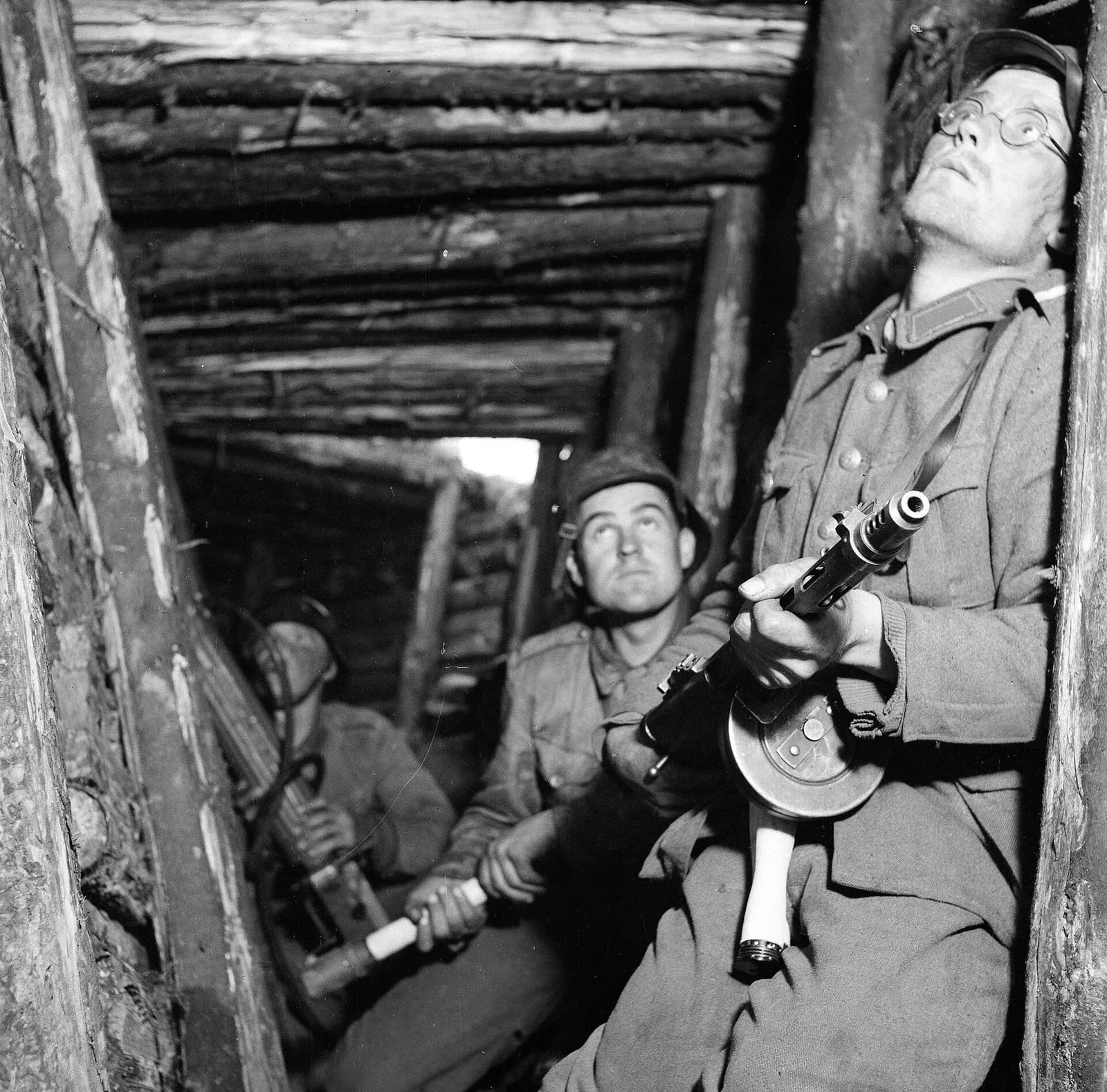
The Vyborg–Petrozavodsk offensive (Russian Выборгско-Петрозаводская наступательная операция, Finnish suurhyökkäys, “the great offensive”, also known in the literature as the “Karelian operation”) was the last great campaign of the Continuation War. In the summer of 1944 two Soviet fronts – the Leningrad Front on the Karelian Isthmus and the Karelian Front between Lake Ladoga and Lake Onega – attacked the Finnish army in order to force Finland out of the war. Within ten days the Red Army broke through two lines of fortifications and took Viipuri (Vyborg), Finland’s second-largest city, and in East Karelia it recovered Petrozavodsk, the capital of the Karelo-Finnish SSR. Then the advance stalled: at Tali and Ihantala, on the Vuoksi, in the Bay of Viipuri and in the border forests, the Finns, supported by German weapons and a few German units, stopped the enemy. The offensive did not destroy the Finnish army, but it convinced Finland’s commanders and politicians that the war had to be ended.
Name and dates
Soviet and Russian historiography treats this fighting as a single strategic operation made up of two separate actions divided by Lake Ladoga: the Leningrad Front’s Vyborg operation (10–20 June 1944) and the Karelian Front’s Svir–Petrozavodsk operation (PL) (21 June – 9 August 1944). To these must be added smaller actions: the continued advance on the Isthmus towards Lappeenranta and Virojoki (from 21 June to mid-July), the landings on the Koivisto islands (20–25 June) and the Ladoga Flotilla’s landing at Tuloksa (23–27 June). Some accounts describe the whole as the Vyborg–Petrozavodsk operation; Finnish historiography speaks of the “great offensive” or of the defensive battles of the summer of 1944.
Russian tallies date the operation to 10 June – 9 August 1944. Its start can, however, be placed on 9 June, because on that day the aircraft and artillery of the Leningrad Front and the ships of the Baltic Fleet bombarded the Finnish positions for many hours; the actual infantry and tank assault began on the morning of 10 June. The end date, 9 August, is the conventional end of the Svir–Petrozavodsk operation in Soviet tallies, when the Karelian Front went over to the defensive. The fighting at Ilomantsi went on for a few days longer, and fire ceased along the whole front only on 4 September (a day later on the Soviet side).
Background
Finland entered the war against the Soviet Union in June 1941 to recover the territory lost in the Winter War and under the Moscow Peace Treaty of 1940. In the autumn of 1941 its army halted on the old border on the Karelian Isthmus, a few dozen kilometres from Leningrad, and in East Karelia it took Petrozavodsk and the shore of Lake Onega as far as the Svir River and Medvezhyegorsk. From the spring of 1942 the front was almost static, and Marshal Carl Gustaf Mannerheim refused to take part in a German assault on Leningrad.
In the winter of 1944 Finland’s position deteriorated sharply. In January the Red Army lifted the siege of Leningrad and drove Army Group North back to the Narva River and Lake Peipus, and in February Soviet long-range aviation carried out three great raids on Helsinki. The government of Risto Ryti and Prime Minister Edwin Linkomies put out peace feelers through Stockholm, and at the end of March Juho Kusti Paasikivi went to Moscow. The terms he heard there – the 1940 border, the internment of the German troops within a few weeks, demobilisation and 600 million dollars in reparations – were judged impossible by Helsinki, which finally rejected them in April.
After this refusal the Stavka began preparing a blow intended to force Finland out of the war. The plan envisaged two thrusts: General Leonid Govorov’s Leningrad Front was to break through the fortifications of the Isthmus, take Viipuri and push on towards the Kymi River (Kymijoki), while General Kirill Meretskov’s Karelian Front was to force the Svir, recover Petrozavodsk and advance through Olonets and Sortavala to the 1940 border. The Finnish army was to be destroyed on the Isthmus and its remnants pinned against Lake Ladoga and the Saimaa lakes. Intermediate objectives included pushing the front back from Leningrad, recovering the White Sea–Baltic Canal and the Murmansk railway, and freeing forces before the summer offensive against Germany. The blow fell three days after the Allied landings in Normandy and less than two weeks before the start of the great offensive in Belarus.
Govorov moved the 21st Army of General Dmitri Gusev (PL) from the Stavka reserve to the Isthmus, where it took its place alongside the 23rd Army, which had been stationed there for years. According to figures compiled in Finnish and Russian historiography, the two fronts together had about 450,000 men, close to 10,000 guns and mortars, about 800 tanks and self-propelled guns and more than 1,500 aircraft; in the breakthrough sector at Valkeasaari up to 220 guns were concentrated per kilometre of front, and fire support came from heavy railway guns and the ships of Admiral Vladimir Tributs’s Baltic Fleet. The entire Finnish army numbered about 268,000 men in mid-June, after reinforcements had arrived, and its modern tanks, assault guns and aircraft could be counted in dozens.
The fortifications of the Isthmus consisted of three belts. The main line ran along the 1941 front. Some 20 kilometres behind it lay the VT line (Vammelsuu–Taipale), strengthened with concrete bunkers but still unfinished. The third, the VKT line (Viipuri–Kuparsaari–Taipale), existed in June mainly on maps – work near Viipuri had begun only at the end of May. Far to the rear, on the Finnish side of the 1940 border, ran the Salpa Line. The Finnish command did expect an attack, but not on such a scale: most of its divisions were in East Karelia, and some of the soldiers were on leave.
Course: the breakthrough on the Isthmus and the fall of Viipuri (9–20 June)
On the morning of 9 June several hundred aircraft of the 13th Air Army and naval aviation bombed the Finnish positions in the western part of the Isthmus, while the Leningrad Front’s artillery and the warships kept up their fire for about ten hours. The next day the 21st Army, led by the 30th Guards Rifle Corps, attacked at Valkeasaari, along the road and railway to Viipuri, in the sector held by the Finnish 10th Division. The main line gave way within a few hours. The defenders were stunned by the sheer weight of the shelling and bombing; some units fell back in disorder, and Finnish sources record numerous cases of soldiers abandoning their positions without orders during these days. On 11 June the 23rd Army joined the attack in the central part of the Isthmus.
The Finns fell back to the VT line. On 12 June Mannerheim asked the Germans for help, and in mid-month General Karl Lennart Oesch took command of all troops on the Isthmus. The Chief of the General Staff, General Erik Heinrichs, coordinated the movement of reserves. Fighting flared up on the VT line on 13 June. At Siiranmäki Finnish units, armed for the first time with German Panzerfausts and Panzerschrecks, repulsed the 23rd Army’s attack, but on 14 June Soviet tanks and infantry broke into the positions at Kuuterselkä, on the Viipuri road. A counter-attack by General Ruben Lagus’s Finnish Armoured Division on the night of 14/15 June failed to close the breach and cost it heavy losses. By 15 June the VT line had been breached, and the Leningrad Front reported that on 14 June alone it had lost almost 4,000 men.
On 16 June Mannerheim took a decision that determined the further course of the fighting: he ordered the withdrawal of his troops from most of East Karelia to a shorter line and the transfer of divisions from there to the Isthmus. In doing so he gave up without a fight much of what had been won in 1941, but gained the forces needed to defend the VKT line. Meanwhile the Finnish units fell back, fighting delaying actions. On 18 June Govorov was promoted to Marshal of the Soviet Union, and his troops took the coastal town of Koivisto (Primorsk). On 19 June the spearheads of the 21st Army reached Viipuri.
The city, scene of the last battles of the Winter War in March 1940, fell on 20 June almost without a fight. The Finnish 20th Brigade defending it panicked and withdrew before the promised reinforcements arrived; the loss of Viipuri was both a military and a moral blow to the Finns. The Leningrad Front had carried out its task within the deadline set by the Stavka, advancing more than 100 kilometres in ten days. It had not, however, managed to encircle any sizeable Finnish grouping: the units had withdrawn, and fresh divisions from Karelia were beginning to gather on the VKT line, anchored on the waters of the Bay of Viipuri, the lakes and the Vuoksi River. Between 20 and 25 June the Baltic Fleet seized the islands of the Koivisto archipelago, whose garrisons the Finnish navy had evacuated; this opened the way into the Bay of Viipuri for Soviet warships and motor boats.
Course: German aid and the Ryti–Ribbentrop Agreement
Mannerheim’s request of 12 June quickly bore fruit. In mid-month a German air detachment under Lieutenant Colonel Kurt Kuhlmey – several dozen Ju 87 dive bombers and Fw 190 fighters – flew into Finland, and a few days later the 303rd Assault Gun Brigade with Sturmgeschütz IIIs and the 122nd Infantry Division arrived. Thousands of anti-tank weapons and shipments of grain also came. For this aid Berlin demanded a political price.
Shaken by the fall of Viipuri, the Finnish government asked through Stockholm on 21–22 June what the Soviet peace terms were. Moscow replied that it first expected a statement of readiness to surrender. In Helsinki this was read as a demand for unconditional surrender; the Soviet side denied this interpretation only at the beginning of July, and historians still argue over how far its intentions at the time extended. On the night of 21/22 June the Reich Foreign Minister, Joachim von Ribbentrop, flew into Helsinki and made further deliveries conditional on a formal undertaking that Finland would not conclude a separate peace. As parliament would not have approved such an agreement, President Ryti signed it on 26 June in the form of a personal letter to Adolf Hitler, taking the commitment upon himself. On 30 June the United States broke off diplomatic relations with Finland.
Course: Tali-Ihantala, the Bay of Viipuri and Vuosalmi (25 June – 17 July)
After taking Viipuri the 21st Army tried to push further north, but at Tienhaara it ran into strong defences and had to look for another place to break through the VKT line. It found one in the neck of land between the Bay of Viipuri and the Vuoksi, near Tali station. There, on 25 June, began the Battle of Tali-Ihantala, regarded as the largest battle in the history of the Nordic countries. Soviet divisions drove several kilometres deep into the Finnish positions, but the Finns, bringing up more and more units from Karelia, sealed off the breaches. On 28 June the Leningrad Front reported losses of more than 5,000 men, including about 1,800 killed – the heaviest of the whole operation. That same day General Oesch ordered a withdrawal to a shorter line at Ihantala, which the Finns held until the end of the battle.
The outcome was decided largely by the Finnish artillery. Thanks to accurate maps, radio communications and new fire-control methods, the command could within a few minutes concentrate the fire of dozens of batteries – according to Finnish studies as many as about 250 guns – on a small area where reconnaissance or radio interception had detected a concentration of enemy troops. The terrain of lakes and forests forced the Soviet tanks onto narrow roads, where anti-tank guns and Panzerfausts destroyed them, while German Stukas and Finnish bombers struck at troop concentrations. Soviet attacks at Ihantala continued into the first days of July; on 9 July the battle died down. According to Finnish figures the defenders lost about 8,500 killed, wounded and missing in this battle; the Finnish historian Ohto Manninen estimates Soviet losses at 18,000–22,000.
When the attack at Ihantala stalled, Govorov tried to outflank the defenders. From 4 July the 59th Army occupied the islands of the Bay of Viipuri, but its attempt to cross to the northern shore was repulsed, in part by the German 122nd Division. At the same time the 23rd Army took the Äyräpää ridge and seized a bridgehead across the Vuoksi at Vuosalmi, but the Finns managed to contain it; the fighting ended around 17 July. As early as 12 July the Stavka ordered the Leningrad Front to give up some of its forces, and a few days later the troops on the Isthmus went over to the defensive. Tanks and artillery were transferred to Narva and Estonia.
Course: the Svir–Petrozavodsk operation (21 June – 9 August)
Between Lake Ladoga and Lake Onega the line was held by General Paavo Talvela’s Finnish Aunus (Olonets) Group, while further north, on the Maaselkä Isthmus, other units guarded the roads to Medvezhyegorsk and the White Sea–Baltic Canal. Because of Mannerheim’s decision of 16 June, by the time the Karelian Front finally moved, the Finns were already abandoning their bridgehead on the southern bank of the Svir and part of their front line. Indeed, the Stavka ordered Meretskov to speed up his attack precisely because the enemy was moving troops to the Isthmus.
On 21 June, after a heavy artillery preparation, the 7th Army attacked at Lodeynoye Pole and, with the help of amphibious vehicles, forced the Svir, establishing within a day a bridgehead more than ten kilometres wide. That same day the 32nd Army went over to the attack in the north: its units crossed the canal, took Povenets and, on 23 June, Medvezhyegorsk. On 23 June the Ladoga Flotilla landed the 70th Naval Infantry Brigade between the Tuloksa and Vitele rivers, in the rear of the Finnish forces; the landing force cut the coastal road and the railway and, although it found itself in a difficult position, held out until reinforcements arrived and it linked up with the 7th Army. On 25 June Soviet troops took Olonets.
The Finns no longer defended the approaches to Petrozavodsk. On 28 June units of the 7th Army entered the city, which for almost three years had borne the Finnish name Äänislinna, while a landing force of the Onega Flotilla came in from the lake. During the occupation the Finns had run camps in Petrozavodsk for the Russian civilian population, in which, according to various studies, several thousand prisoners died, mainly of hunger and disease; their liberation became one of the images of this campaign most often invoked in the Soviet Union.
The further advance along the northern shore of Lake Ladoga was slower. The Finns fell back from one line to the next, destroying roads and bridges, and around 10 July the exhausted Soviet divisions reached the U line, running north from Pitkäranta towards Loimola. Attempts to break through it at Nietjärvi ended on 17 July with a Finnish counter-attack and heavy losses for the Soviet 114th Division, and attempts to outflank the line from the north, through the border forests, also failed.
The last act was played out still further north, around Ilomantsi. Two divisions of the 32nd Army, the 176th and 289th, reached the 1940 border on 21 July – the only Soviet units in this operation to do so – and crossed it. Finnish units, hastily formed into battle groups, moved onto their flanks and, from the end of July into the first ten days of August, encircled them in the wilderness. The Soviet divisions managed to break out, but abandoned much of their artillery and equipment and lost, by some estimates, several thousand men. The Finnish victory at Ilomantsi, in fighting that lasted until about 13 August, showed that after two months of combat the Finnish army was still capable of offensive action. On 9 August the Karelian Front went over to the defensive.
Losses
Casualty figures vary with the source and with the period counted. According to the Russian survey edited by Grigori Krivosheev, the two fronts lost 23,674 killed, dead of wounds and missing and 72,701 wounded and sick in the Vyborg–Petrozavodsk operation, a total of more than 96,000 men; some Finnish and Russian historians regard these figures as too low, because the reports of some units have not survived. Finnish losses for the period from 9 June to 15 July have been calculated at about 9,300 killed and 32,400 wounded on the Isthmus and about 3,600 killed and 12,100 wounded in East Karelia; some 3,000 soldiers were taken prisoner. Other tallies give about 12,000 dead and more than 50,000 wounded and missing for the summer as a whole.
The civilian population of Karelia bore other costs. Tens of thousands of Karelians who had returned to their homes on the Isthmus and around Lake Ladoga after 1941 had to flee west once again, this time for good. In East Karelia the war swept for a second time through villages and towns already devastated in 1941.
Significance
The Vyborg–Petrozavodsk offensive did not achieve all the objectives set by the Stavka. The Red Army recovered East Karelia, the White Sea–Baltic Canal and the Murmansk railway, pushed the front back from Leningrad and took Viipuri, but it did not break through the VKT line, did not reach the Kymi River and did not destroy the Finnish army – it failed to encircle a single sizeable grouping. By the end of the summer the Finnish army was larger and better armed than in June. In the Soviet Union the operation was counted among the “ten blows of Stalin” of 1944, and Soviet historiography was reluctant to deal with its unsuccessful stages.
For Finland, however, the most important consequence was political. The Finnish command judged that under a full-scale Soviet offensive the army could hold out for a few months at most, while Germany’s western front was collapsing after the Normandy landings and in Belarus Army Group Centre was ceasing to exist. Ryti’s undertaking to Hitler had to be annulled in the only way possible: on 1 August Ryti resigned, and on 4 August parliament passed a law electing Mannerheim president. When Field Marshal Wilhelm Keitel came to Helsinki on 17 August, he was told that the personal undertaking of the former president did not bind the new one. At the end of August Finland approached Moscow again, and at 7 a.m. on 4 September its troops ceased fire; the Soviet side did so a day later.
On 19 September the armistice was signed in Moscow. Finland returned to the 1940 border, ceded Petsamo with its access to the Barents Sea, leased the Porkkala peninsula near Helsinki to the Soviet Union as a military base, and agreed to pay reparations and to remove the German troops from the country, which led to the Lapland War. The terms were harsh, but they involved neither capitulation nor occupation. Many historians believe that the resistance at Tali-Ihantala and Ilomantsi, which showed Moscow how costly a further advance into the country would be, helped Finland – the only one of the European states that fought alongside Germany – to avoid occupation and preserve its independence and its democratic system. For the Red Army the end of the fighting in the north freed troops for the offensive in the Baltic states.