- Category:
- Diplomacy
- Date:
- 12 March 1940
- Author:
- Natalia
- Tags:
- Finland, Soviet Union, Winter War, Vyacheslav Molotov
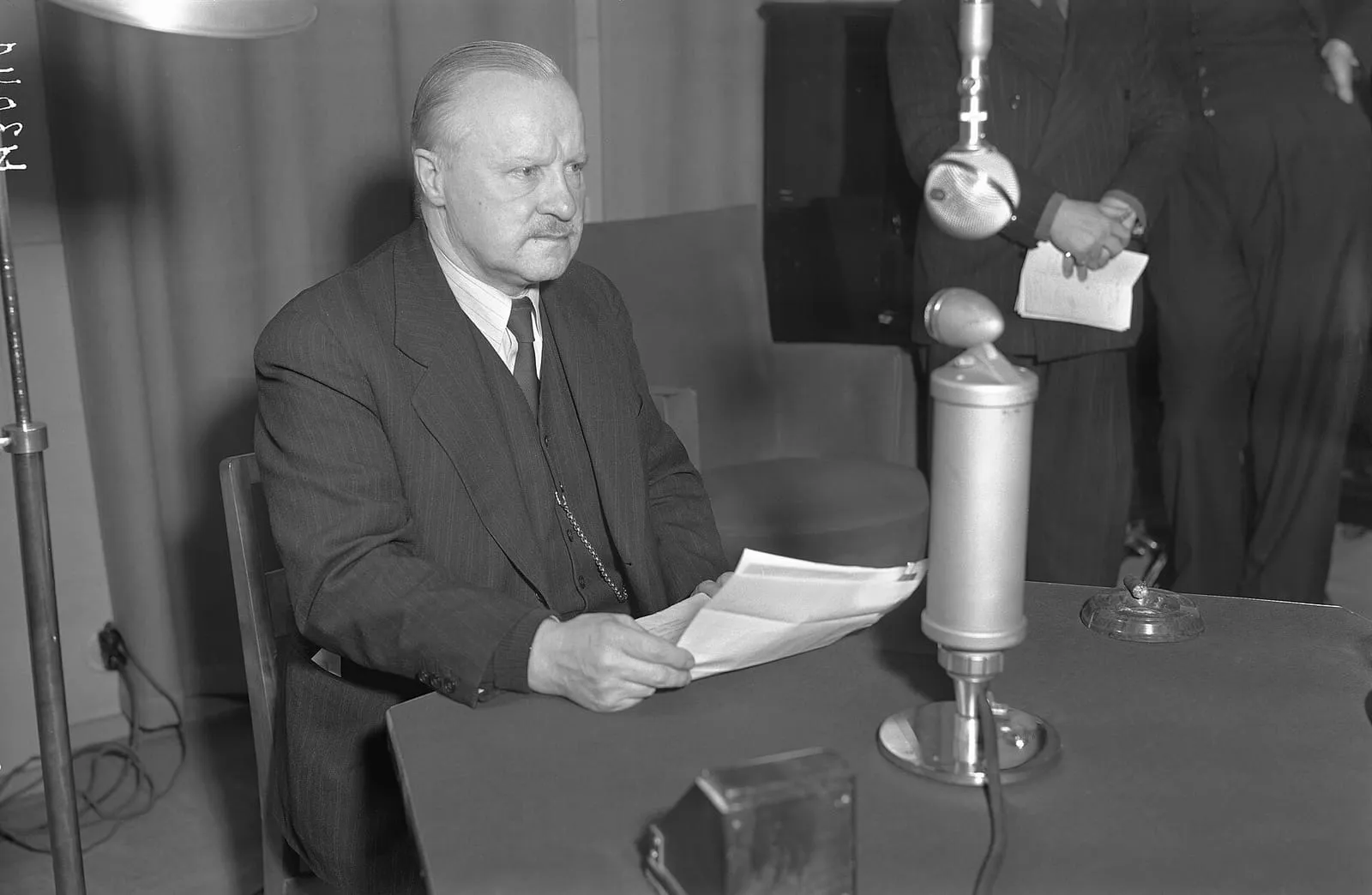
Late in the evening of 12 March 1940, in the Kremlin, a Finnish delegation headed by Prime Minister Risto Ryti signed a peace treaty with the Soviet Union. On the Soviet side the signatures were those of the Chairman of the Council of People’s Commissars and People’s Commissar for Foreign Affairs, Vyacheslav Molotov, the Leningrad party secretary Andrei Zhdanov, and Aleksandr Vasilevsky of the Red Army General Staff. Finland ceded the whole of the Karelian Isthmus with Viipuri (Vyborg), the northern and western shores of Lake Ladoga, strips of land in the far north and islands in the Gulf of Finland, and leased the Hanko peninsula to the USSR as a naval base. The next day, 13 March, the guns fell silent at 11 a.m. Finnish time. The Winter War had lasted 105 days.
Three steps led to this peace: on 5 March Finland informed Moscow that it accepted its terms, on 6 March it sent a delegation to Moscow, and on 12 March it signed the treaty. Each of these dates needs some qualification. The government in Helsinki had already decided on 29 February to accept the terms “in principle”, but did not send its reply, because at the last moment it wavered in the face of promises from Britain and France. Only on 5 March did it give Moscow its final answer. And the terms that the delegation found waiting in the Kremlin proved harsher than those accepted on 5 March.
The Stockholm channel
From the first day of the war Moscow refused to recognise the government in Helsinki. It dealt only with the puppet “people’s government” of the Finnish Democratic Republic, which it had set up on 1 December 1939 in the border town of Terijoki under the communist Otto Kuusinen. Ryti’s cabinet, formed on the same day, and with it the Foreign Minister Väinö Tanner and the minister without portfolio Juho Kusti Paasikivi, sought contact with the Kremlin from the outset. In January 1940 they found it in Stockholm. The Finnish writer and businesswoman Hella Wuolijoki, who knew the Soviet envoy to Sweden, Alexandra Kollontai, personally, met her almost daily from 10 January at the Grand Hotel in Stockholm. On 29 January Molotov let it be known through the Swedes that the USSR did not rule out an agreement with Ryti’s government. With that, Kuusinen’s “government” lost its raison d’être, although for several more weeks Moscow threatened the Finns that it might make peace with it instead.
From then on Sweden acted as intermediary, but with an interest of its own. Its Foreign Minister, Christian Günther, feared that the Finnish war would draw Allied troops into Scandinavia, and German troops after them, and he pressed the Finns to accept almost any terms. At the beginning of February a great Soviet offensive began on the Karelian Isthmus, and on 11 February the Red Army broke through the Mannerheim Line. On 23 February Molotov passed on his minimum terms through the Swedish envoy in Moscow: the lease of Hanko; the whole Karelian Isthmus with Viipuri; the north-eastern shore of Lake Ladoga with Sortavala, roughly along the border of Peter the Great’s time; and a pact for the joint defence of the Gulf of Finland. In return the USSR would withdraw its troops from Petsamo, which it had occupied in December. Moscow added that if the Finns did not accept these terms, they would later hear harsher ones.
In Helsinki the terms were thought terrible, because they broke up the geographical unity of the country. The government wanted first to find out whether there was any alternative. Sweden replied on 24 February that it would not send regular troops and would not allow Allied troops through, and on 27 February Prime Minister Per Albin Hansson repeated this to Tanner in Stockholm. On 28 February Kollontai demanded, through Günther, an answer within two days. That same day Tanner told the government that Finland was alone and had to accept the terms, however harsh. Ryti backed him without reservation, and on 29 February, after a report from the ministers who had gone to General Headquarters and heard from Marshal Carl Gustaf Emil Mannerheim that the situation was “more than critical”, the government approved a reply late in the evening: Finland regarded the terms as a basis for negotiation and accepted them in principle. Only the Minister of Defence, Juho Niukkanen, and the Minister of Education, Uuno Hannula, were against.
Between Moscow and Paris
The reply of 29 February, however, was not sent. That same night telegrams arrived from Paris and London that changed everything. The French Prime Minister, Édouard Daladier, promised 50,000 soldiers and a hundred bombers by the end of March if Finland officially asked for help, while London warned that if the Finns entered into negotiations, preparations for the expedition would be halted and arms deliveries would cease. On the morning of 1 March the government changed its mind and, instead of accepting the terms, asked Moscow to clarify where the new border was to run and what compensation Finland would receive.
The answers from both sides disappointed. Günther warned that in Moscow the questions would be read as a refusal. On 2 March Britain and France formally asked Norway and Sweden for the right of passage and were sent away empty-handed. On 3 March the envoys of the two powers in Helsinki explained that if Finland asked for help by 5 March, the first troops would put to sea on 11 March, reach Narvik on 20 March and Finland in the first half of April, some 6,000 men strong, with more to follow. Asked what would happen if the Swedes and Norwegians still refused passage, they had no answer. Most of the government nevertheless preferred to wait a little longer.
5 March: Finland accepts the terms
The situation at the front decided the matter. From 3 March the Red Army had been attacking Viipuri and advancing across the ice of Viipuri Bay to its western shore, into the rear of the Finnish defences. On the morning of 5 March General Rudolf Walden, an industrialist and Mannerheim’s confidant in the government, reported to the cabinet on a conversation with General Headquarters. The sick and exhausted marshal had said over the telephone that the situation on the ice of the bay was hopeless, because there were no reserves left, and that Western help would be too little and come too late. Tanner urged the government to make a decision at last, and Ryti backed him, adding only a request for a halt to the fighting during the negotiations. All the ministers except Hannula agreed that Finland would accept the terms and, if Moscow refused, would turn to the West for help.
At 11.30 a.m. Tanner telephoned Günther and learned that a reply had come from Moscow: Molotov insisted on Viipuri and Sortavala and was willing to wait a few more days, but threatened that after that the demands would grow and the USSR would make a treaty with Kuusinen. Tanner answered that Finland accepted the terms and that the details could be settled in negotiation. The Finnish note reached the Soviet embassy in Stockholm before noon. The Swedes proposed on their own account a ceasefire from 6 March. Molotov’s reply arrived on the night of 5–6 March: the USSR, “considering that the Finnish government has accepted the terms”, agreed to peace negotiations and awaited a delegation in Moscow, but would not agree to an armistice while the talks were under way, because the situation at the front was “indeterminate”.
6 March: the delegation leaves for Moscow
On the morning of 6 March Tanner argued to the government that Finland would lose nothing by sending a delegation, whereas if it chose the Western road it might share the fate of Poland. The government decided unanimously to go to Moscow and at the same time asked London and Paris to extend the deadline for an appeal for help to 12 March. In the afternoon the composition of the delegation was settled. Paasikivi insisted that the Prime Minister himself should head it, because only that would convince the Russians that the Finns were serious and give the treaty authority at home. So to Moscow went Ryti; Paasikivi, who in the autumn of 1939 had conducted talks in the Kremlin with Joseph Stalin; General Walden, who spoke good Russian; and the Social Democratic member of parliament and historian Professor Väinö Voionmaa. Mannerheim objected to Walden’s going, but was overruled.
On the evening of 6 March the delegation drove to Turku, from where it flew to Stockholm. There passports in false names and an aircraft provided by the Swedish government were waiting. On the morning of 7 March the Finns flew via Riga to Moscow, arriving in the evening. To their disappointment, Stalin took no part in the negotiations.
A diktat in the Kremlin
The first meeting took place at 7 p.m. on 8 March. Molotov and Zhdanov adopted an accusatory tone towards the Finns and presented terms much harsher than those of February. The new border was to run west of the line of Peter the Great, cutting Finland off from the industrial plants at Enso and Värtsilä. Added to this were demands for parts of the municipalities of Salla and Kuusamo in the north, ostensibly to protect the Murmansk railway; for parts of the Rybachy and Sredny peninsulas on the Barents Sea; and for the construction of a railway from Kandalaksha to Kemijärvi for the transit of Soviet goods to Sweden. Ryti proposed that the inhabitants of the ceded lands be allowed to stay. According to the memoirs of Minister Niukkanen, Molotov and Zhdanov flatly refused: Moscow wanted the land without its people, empty as it had become during the war.
On 9 March the government learned of the new demands and received them with indignation. Niukkanen and Hannula called for the talks to be broken off and for an appeal to the West, and President Kyösti Kallio leaned the same way. In the evening Tanner read out a report that Mannerheim had forwarded from the commander of the Army of the Isthmus, Lieutenant General Erik Heinrichs. Heinrichs wrote that further fighting could bring only further weakening of the army and new territorial losses, that battalions numbered fewer than 250 men, that losses ran into thousands a day and that the corps commanders gave the front no more than a week. After this report the government, on the night of 9–10 March, gave the delegation a free hand. The second meeting took place at 2 p.m. on 10 March. The Russians did not give way. On 11 March the government and the parliamentary foreign affairs committee agreed to accept the terms. That evening, at the third meeting, Molotov rejected the last Finnish requests for adjustments to the border, as well as for a ceasefire before the treaty was signed. Ryti was later convinced that the Russians’ rigidity had been reinforced by a premature dispatch from the Finnish news agency to Stockholm, which on 11 March announced that the committee had accepted the terms before the delegation had finished bargaining.
On 12 March in Helsinki the government approved the delegation’s full powers. Kallio, signing them, is said to have declared: “May the hand wither that signs such a document.” The full powers were sent to Moscow by telegraph, in plain text. In the evening the treaty and a protocol on the cessation of hostilities were signed in the Kremlin. The news reached Helsinki after midnight, first via German radio; towards morning the text of the protocol arrived through Stockholm.
The terms of the treaty
The treaty had nine articles. The preamble spoke of ensuring the security of Leningrad, Murmansk and the Murmansk railway. Article 2 moved the border so that the USSR received the whole Karelian Isthmus with Viipuri and Viipuri Bay and its islands; the western and northern shores of Lake Ladoga with the towns of Kexholm (Priozersk), Sortavala and Suojärvi; islands in the Gulf of Finland, including Suursaari; an area east of Märkäjärvi with Kuolajärvi in the municipality of Salla; and the Finnish part of the Rybachy and Sredny peninsulas. Altogether this came to some 35,000 square kilometres – by various calculations 9 to 11 per cent of the country’s territory, and more than the USSR had demanded before the war. According to Finnish estimates, Finland lost about one eighth of its fields and forests, nearly one third of its hydroelectric power and about one fifth of its industrial and transport capacity. Much of the ceded land was still in the hands of the Finnish army at the moment of signature.
Article 3 bound both parties to refrain from attacking each other and not to enter alliances directed against the other. Article 4 leased the Hanko peninsula, with the surrounding islands and waters, to the USSR as a naval base for 30 years at 8 million marks a year, with the right to maintain land and air forces there. The Finns were to leave Hanko within ten days; the Russians had at first demanded three. Article 5 returned Petsamo to Finland, with limits on armaments on the Arctic coast like those in the Treaty of Tartu of 1920; Article 6 gave the USSR free transit through Petsamo to Norway; and Article 7 obliged both parties to build, if possible still in 1940, a railway from Kandalaksha to Kemijärvi. The treaty came into force on signature and was subject to ratification within ten days. The protocol laid down that hostilities would cease on 13 March at noon Leningrad time, i.e. 11 a.m. Finnish time, and that from 15 March the troops of both sides were to withdraw to the new border at a rate of at least seven kilometres a day. The Red Army was to leave Petsamo by 10 April. There were no reparations, but Moscow soon demanded the handover of rolling stock and equipment from the ceded lands.
13 March: the end of the fighting
Fighting continued to the last moment at Viipuri, on the bay and on the Vuoksi. According to Finnish accounts, at a quarter to eleven Soviet artillery opened a violent barrage on the Finnish positions, killing and wounding several hundred soldiers, and at Salla aircraft were still bombing the Finnish lines at noon. At noon Tanner read out the peace terms on the radio. For the Finns, who for three months had heard of victories, it was a shock. In his order of the day Mannerheim paid tribute to the soldiers and the fallen.
On 15 March, in a secret session, the Eduskunta, the Finnish parliament, ratified the treaty by 145 votes to 3, with 9 abstentions. The opponents of the peace, Niukkanen and Hannula, left the government, and Walden became Minister of Defence. On 16 March Kallio ratified the treaty, and on 20 March Paasikivi and Voionmaa exchanged the instruments of ratification in Moscow (some sources give 21 March). Paasikivi soon became envoy in Moscow. The gravest consequence of the peace was the evacuation. Almost the entire population of the ceded lands chose to leave for Finland. Within a few weeks some 420,000 people – about 11–12 per cent of the country’s population – left Karelia and Hanko, taking whatever they could carry and leaving behind their homes, farms and graves.
The toll of the war
According to the findings of Finnish historians published in 2005, Finland lost 25,904 soldiers killed and missing and 43,557 wounded in the war. Between 800 and 1,100 Finns were taken prisoner by the Soviets. Soviet air raids killed 957 civilians.
Soviet losses remain a matter of dispute. At the end of March 1940 Moscow gave a figure of just under 49,000 killed and about 159,000 wounded and sick. A team of Russian military historians led by Grigoriy Krivosheev established in the 1990s a figure of 126,875 killed, died and missing, and more recent archival research gives between about 135,000 and 168,000 killed and missing. More than 5,500 Red Army men were taken prisoner by the Finns, and on their return to the USSR many of them were sent to the Gulag.
The intervention that never came
The peace was concluded in the last hours before the deadline by which London and Paris were waiting for a Finnish appeal. In Paris, where the Finnish question had become a matter of domestic politics, the expedition was genuinely being prepared. The plan agreed on 5 February envisaged a passage through Narvik and the Swedish iron-ore mines, but Norway and Sweden consistently refused transit, and the figures the Finns were given changed from day to day: from 50,000 men in Daladier’s announcements to 12,000–13,000 in the British plans, of whom about 6,000 were to reach Finland in April. On 11 March Prime Minister Neville Chamberlain assured the House of Commons that Britain and France were ready to help Finland with all their resources if she asked for it. On 12 March France gave the order to begin the operation, and that evening the British cabinet approved the instructions for the commanders. A few hours later the treaty was signed. On 14 March London called off the preparations.
Stalin, however, took the threat of intervention seriously. Finnish historians such as Kimmo Rentola argue that fear of war with Britain and France, including the Allied plans to bomb the Soviet oilfields at Baku, persuaded him to make peace with Ryti’s government rather than fight the war to the end and install Kuusinen in Helsinki. Germany too urged the Finns to make peace, fearing above all an Allied landing in Scandinavia. According to the account of the former Prime Minister Toivo Kivimäki, who sounded out opinion in Berlin at the end of February, Hermann Göring advised him to accept peace even on the harshest terms, because Finland would later recover the lost lands “with interest”. The influence of this advice on the government’s decision cannot, however, be proved.
Place in the war
The Moscow peace ended a war that the Soviet Union had begun in order to install an obedient government in Helsinki and ended with an agreement with a government it had refused to recognise for two months. Finland lost Karelia, but alone among the states to which Stalin had presented demands in 1939 on the strength of the Molotov–Ribbentrop Pact, it kept its independence, its army and its government. A few months later, in June 1940, Estonia, Latvia and Lithuania were occupied by the Red Army without a fight, and Romania gave up Bessarabia.
The defeat of Finland, which the Allies had promised to save, struck at their governments. In France the Daladier cabinet fell as early as 20 March 1940. The Allies did not, however, abandon the idea of cutting Germany off from Swedish ore, and in Berlin preparations for Operation Weserübung continued. On 9 April 1940 Germany attacked Denmark and Norway. The course of the Winter War strengthened Adolf Hitler in his conviction that the Red Army was weak. In Moscow lessons were drawn from it: in May 1940 Semyon Timoshenko replaced Kliment Voroshilov as People’s Commissar for Defence.
For the Finns the fifteen months that followed 13 March became known as the “Interim Peace” (Finnish: välirauha). Moscow made further demands: it opposed plans for a Finnish–Swedish defensive alliance, demanded the demilitarisation of the Åland Islands and a share in the nickel mines at Petsamo, and in November 1940 Molotov asked in Berlin whether the USSR might “settle the Finnish question”. Finland, isolated, drew closer to Germany. In September 1940 it agreed to the transit of German troops to Norway, and in June 1941 it entered the Continuation War alongside the Reich in order to recover the lands ceded in Moscow. It held them again for three years. In 1944 the Moscow Armistice restored the 1940 border, and instead of Hanko the USSR leased the Porkkala peninsula near Helsinki. With the exception of Petsamo, which Finland gave up in 1944, the border drawn on 12 March 1940 has survived to this day.
Sources
Meanwhile
(01)Elsewhere, within a week.
Related events
(04)The same battle, people or subject.
- 15 February 1940 · ScandinaviaThe Red Army breaks the Mannerheim LineOn 11 February 1940 the Red Army broke the Mannerheim Line at Lähde. On 15 February Mannerheim ordered a retreat and the Russians entered Summa.
- 7 January 1940 · ScandinaviaTimoshenko takes command in FinlandOn 7 January 1940 Moscow formed the North-Western Front under Komandarm Timoshenko. After the defeats of December, he was to break the Mannerheim Line.
- 17 January 1940 · ScandinaviaSoviet air raids on Finnish townsIn mid-January 1940 Soviet bombers struck Turku, Tampere, Helsinki and dozens of other towns, while north of Lake Ladoga the Finns encircled two divisions.
- 30 November 1939 · ScandinaviaThe Soviet Union invades FinlandOn 30 November 1939 the Red Army attacked Finland without a declaration of war, and Soviet aircraft bombed Helsinki. The Winter War had begun.