Poland
Władysław Raczkiewicz
Minister of the Interior (1921, 1925–1926, 1935–1936), Marshal of the Senate (1930–1935), President of Poland in exile (1939–1947)
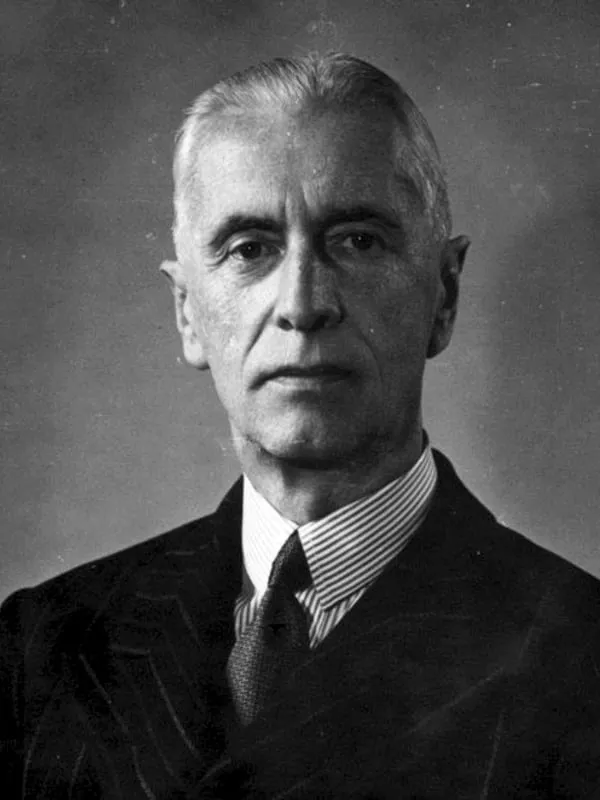
- Born:
- 28 January 1885, Kutaisi (Russian Empire)
- Died:
- 6 June 1947, Ruthin (Wales)
- Author:
- Natalia
- Photo:
- Czesław Datka, domena publiczna, Wikimedia Commons

Władysław Raczkiewicz was President of the Republic of Poland in the most difficult years of its history. A lawyer from a family of the eastern borderlands, brought up in Russia, he was one of the most experienced administrators of the interwar state: he served as provincial governor (voivode) in the eastern borderlands and in Pomerania, three times as Minister of the Interior and as Marshal of the Senate. In September 1939, when Ignacy Mościcki, interned in Romania, could no longer exercise his office, it was Raczkiewicz who took it over in Paris. As a result Poland, whose territory had been occupied by Germany and the Soviet Union, kept a lawful government recognised by the Allies. Raczkiewicz appointed the government of General Władysław Sikorski, handed him a large part of his own powers and throughout the war defended the integrity of Poland’s borders. He died in exile in 1947, two years after the great powers had withdrawn recognition from his government. He is sometimes called the last president of the Second Polish Republic.
Youth in Russia
He was born on 28 January 1885 in Kutaisi in Georgia, then part of the Russian Empire, into the Polish family of Józef Raczkiewicz, a judge, and Ludwika, née Łukaszewicz. He finished secondary school in Tver and in 1903 began studying law and mathematics at the University of St Petersburg. There he was active in Polish youth organisations, both open and clandestine, linked to the National Democratic camp, among them the Polish Youth Association “Zet”. To escape repression he moved to Dorpat (now Tartu), where he graduated from the university in 1911. He settled in Minsk and practised there as an advocate. In 1912 he married Jadwiga Niesłuchowska.
War and the struggle for a Polish army
Before the war he had served as a volunteer in the Russian horse artillery and obtained the rank of reserve officer. In August 1914 he was mobilised into the Russian army, in which he rose to the rank of lieutenant. After the February Revolution of 1917 he became involved in forming Polish units in Russia. At the First General Congress of Polish Servicemen in Petrograd in June 1917 he was elected president of the Supreme Polish Military Committee (PL) (Naczpol), which organised Polish corps within the Russian army, including the I Polish Corps of General Józef Dowbor-Muśnicki. At that time he belonged to the current close to the National Democrats and favoured building a Polish armed force in the east. After the Bolshevik coup, in early 1918 he headed the Supreme Council of the Polish Armed Force in Kiev, which dissolved itself after the Treaty of Brest-Litovsk and handed its powers to the Regency Council.
At the end of 1918 he arrived in Warsaw and turned to the defence of the eastern borderlands, heading the military department of the Committee for the Defence of the Borderlands. In 1919 he joined the Polish Army and worked in the Civil Administration of the Eastern Lands, which governed the territory taken by Polish troops in the east. During the Polish–Soviet War of 1920 he commanded a volunteer borderland unit that fought for Wilno (Vilnius). He ended his service as a major of artillery and received the Silver Cross of the Virtuti Militari for his part in the fighting.
Administrator of the borderlands and Sanation politician
In independent Poland Raczkiewicz made his career in the administration. From December 1920 he was the government’s delegate to the authorities of Central Lithuania, created after General Lucjan Żeligowski’s action, and in 1921 he became Minister of the Interior for the first time. He was then Voivode of Nowogródek (1921–1924) and the government’s delegate in Wilno, and in 1925–1926 Minister of the Interior again. In the eastern borderlands, inhabited by Poles, Belarusians, Lithuanians and Jews, he pursued a policy of strengthening the Polish state, relying on administration and security.
At first associated with the National Democratic camp, after the May Coup of 1926 he went over to the camp of Józef Piłsudski. From 1926 to 1930 he was Voivode of Wilno. In the 1930 elections he entered the Senate on the list of the Nonpartisan Bloc for Cooperation with the Government and in December that year became Marshal (Speaker) of the Senate, an office he held until 1935. During this period the Senate took part in drafting the April Constitution, which strengthened the powers of the president and which, through its Article 24, was to make him head of state in 1939.
After Piłsudski’s death in 1935 he was briefly Voivode of Kraków, in 1935–1936 Minister of the Interior for the third time, and from July 1936 Voivode of Pomerania in Toruń. Pomerania, with its access to the sea and the port of Gdynia, was a region whose belonging to Poland Germany had disputed since 1919, and in 1939 Hitler made the “Corridor” one of his pretexts for war. Raczkiewicz belonged to the so-called Castle group gathered around President Mościcki. From 1934 he chaired the World Union of Poles from Abroad (PL) (Światpol), which gave him contacts with the Polish diaspora around the world. He was not a front-rank politician, but he was regarded as a loyal, calm and experienced official, acceptable even outside the ruling camp.
September 1939
In the first days of the war Pomerania lay in the path of the opening blows, and the Polish Corridor was cut as early as 3–4 September. On 12 September the government entrusted Raczkiewicz with the task of organising aid from the Polish community in the United States for the population at home. After the Soviet invasion he crossed the Romanian border at Kuty together with other representatives of the authorities, but he was not interned and reached Paris on 27 September.
Meanwhile in Romania a dispute was under way over the succession to the interned president. Mościcki first named the ambassador in Rome, General Bolesław Wieniawa-Długoszowski, but this candidacy was opposed by the French and by the Polish opposition gathered in Paris. Wieniawa renounced the nomination, and the president designated Raczkiewicz, who was in Paris, had long experience of public office and was not, like Wieniawa, a symbol of the team blamed for the defeat. On 30 September 1939 Raczkiewicz took the oath of office at the Polish Embassy in Paris. The same day he asked General Władysław Sikorski, the best-known opponent of the Sanation regime, to form a government. This choice, made under pressure from the French and the opposition, determined the character of the Polish wartime emigration.
President in exile
Raczkiewicz was president by virtue of a constitution that Sikorski’s camp regarded as illegitimate. The compromise was the so-called Paris Agreement, announced in a radio address on 30 November 1939: the president declared that he would exercise the powers that the constitution allowed him to use on his own authority “in close agreement with the Prime Minister”. On 16 October he named General Kazimierz Sosnkowski as his successor, on 2 November he dissolved the Sejm and Senate, and on 9 December he established the National Council, a substitute parliament headed by Ignacy Jan Paderewski. From early December he lived at the Château de Pignerolle near Angers, where the government had been granted an extraterritorial seat.
When France fell in June 1940, the president crossed to Britain aboard a British cruiser, and the government and part of the army were evacuated after him. In July 1940 came the most serious crisis of his presidency. On 18 July Raczkiewicz, influenced by Sanation politicians and opponents of Sikorski, dismissed the Prime Minister, charging him over a memorandum to the British on raising a Polish army in the USSR, and asked August Zaleski to form a government. This was in keeping with the constitution but broke the Paris Agreement. Faced with opposition from the army, the National Council and the British, he withdrew the decision two days later. From then on his relations with Sikorski remained cool.
He opposed the Sikorski–Mayski Agreement of 30 July 1941, which contained no Soviet recognition of Poland’s eastern border, and threatened to resign, but in the end he did not block it. On 18 December 1942, after the reports of the courier Jan Karski, he wrote to Pope Pius XII asking him to condemn publicly the crimes being committed against Poles and Jews. After Sikorski’s death at Gibraltar in July 1943 he appointed Stanisław Mikołajczyk Prime Minister and Sosnkowski Commander-in-Chief. In August 1944, once the office of the president’s successor had been separated from that of Commander-in-Chief, he named as his successor the socialist Tomasz Arciszewski, who had flown out of occupied Poland in July. On 30 September 1944, during the Warsaw Uprising, he removed Sosnkowski as Commander-in-Chief under British pressure, and in November, after Mikołajczyk’s resignation, he made Arciszewski Prime Minister.
After Yalta
The Yalta Conference in February 1945 sealed the fate of the government-in-exile. On 5 July 1945 Britain and the United States recognised the communist-dominated Provisional Government of National Unity in Warsaw and withdrew recognition from the government in London. Raczkiewicz and his ministers refused to accept this decision and carried on, regarding themselves as the lawful authorities of the Republic. Gravely ill, suffering from leukaemia since 1939, on 26 April 1947 he changed his successor, naming August Zaleski in place of Arciszewski. The decision provoked a protest from the Polish Socialist Party (PPS) and a lasting split in the emigration that weighed on it for decades.
He died on 6 June 1947 in Ruthin in Wales. He was buried in the Polish airmen’s cemetery at Newark-on-Trent, next to General Sikorski. In November 2022 his remains, together with those of Presidents August Zaleski and Stanisław Ostrowski, were brought back to Poland and laid in the Mausoleum of the Presidents of Poland in Exile in the Temple of Divine Providence in Warsaw.
Significance
Raczkiewicz was not an outstanding leader and seldom shaped the policy of the Polish emigration. The most important wartime decisions were taken by Sikorski and, after him, by successive prime ministers, and his only serious attempt to seize the initiative, in July 1940, ended in failure. His importance lay elsewhere. Because he took office in accordance with the constitution in September 1939, the Polish state did not vanish with the loss of its territory. A president and government recognised by the Allies, an army fighting on every front and an underground movement at home meant that Poland was a party to the war, and not merely an occupied area that Germany and the Soviet Union wanted to wipe off the map. The continuity he secured outlived him: the lawful authorities in exile survived until 1990, when the last president in exile, Ryszard Kaczorowski, handed over the insignia of office to Lech Wałęsa.
Sources
Mentioned in battles
(02)Often appears with
People who appear in the same events.