Poland
Kazimierz Sosnkowski
Commander of the Union of Armed Struggle (1939–1941) and Commander-in-Chief of the Polish Armed Forces (1943–1944)
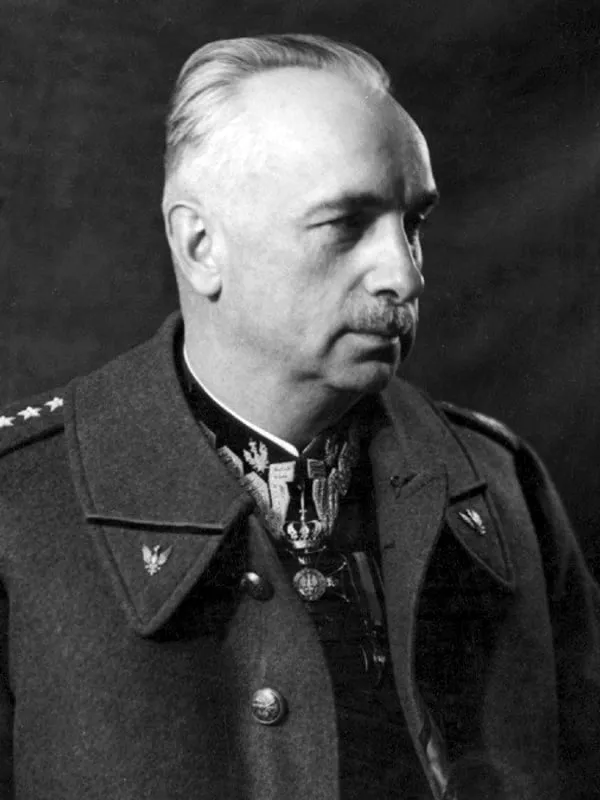
- Born:
- 19 November 1885, Warsaw (Congress Poland, Russian Empire)
- Died:
- 11 October 1969, Arundel (Canada)
- Author:
- Łukasz
- Photo:
- autor nieznany, domena publiczna, Wikimedia Commons

For three decades Kazimierz Sosnkowski stood right beside Józef Piłsudski: he was a PPS fighter, founder of the Union of Active Struggle, chief of staff of the First Brigade of the Legions, Piłsudski’s fellow prisoner at Magdeburg and Minister of Military Affairs during the Polish–Soviet War. In the Second World War he twice stood at the head of Poland’s underground and regular forces. In the autumn of 1939, as the first commander of the Union of Armed Struggle, he directed from Paris the building of a clandestine army, and from July 1943 to September 1944 he was Commander-in-Chief. An opponent of concessions to the USSR and of an uprising in Warsaw without agreement with the Red Army, he was dismissed under British pressure after his order of 1 September 1944, in which he accused the Allies of leaving Warsaw without help. He spent the rest of his life on a farm in Canada.
Fighter, rifleman, Legionnaire
He was born on 19 November 1885 in Warsaw, into a noble family of the Godziemba coat of arms; his father, a chemical engineer, died when the boy was ten. Suspected of belonging to an illegal self-education circle, he had to take his school-leaving examinations in St Petersburg, where he graduated from a gymnasium with a gold medal. From 1905 he was active in the Polish Socialist Party as “Ryszard”, and in 1906, at the height of the revolution, he was commander of the Warsaw district of the PPS Combat Organisation (PL). Wanted by the police, he went abroad and from 1907 studied architecture at the Lwów Polytechnic.
In Lwów in 1908 he founded the Union of Active Struggle – a secret organisation meant to train the cadres of a future Polish army – and helped create the open Riflemen’s Association. From 1912 he was Piłsudski’s chief of staff and deputy; his colleagues simply called him “the Chief”. In August 1914 he coordinated the mobilisation of the riflemen and the departure of the First Cadre Company, and then, as chief of staff of the First Brigade of the Polish Legions, followed its whole campaign: he commanded it at the Battle of Łowczówek in December 1914, was in the front line at Kostiuchnówka in July 1916, and after Piłsudski stepped down that autumn took command of the brigade. After the Oath Crisis the Germans arrested him on 22 July 1917 together with Piłsudski; the two spent the rest of the war in the fortress at Magdeburg and on 10 November 1918 returned to Warsaw together.
War minister and general of the Second Republic
In November 1918 Sosnkowski took command of the Warsaw General District and became a general. From March 1919 he was Deputy Minister of Military Affairs; in May 1920, as the northern front was collapsing, Piłsudski gave him the task of forming the Reserve Army, and in August 1920, in the critical days before the Battle of Warsaw, he became Minister of Military Affairs. He helped coordinate the defence of the capital on the line of the Vistula, Wkra and Narew. As minister he then ordered the creation of the camp at Jabłonna, where about a thousand soldiers and officers of Jewish origin, collectively suspected of Bolshevik sympathies, were interned. He headed the ministry, with a break in 1923, until February 1924; he was the chief negotiator of the Franco-Polish military convention of 19 February 1921.
In 1925 he took command of Corps District No. VII in Poznań and represented Poland at the League of Nations on disarmament; at the Geneva conference he helped extend the ban on chemical weapons in the protocol of 17 June 1925 to bacteriological weapons as well. In May 1926, during the May Coup, torn between loyalty to Piłsudski and the oath he had sworn to the state, he tried to take his own life. He survived, but some of Piłsudski’s followers never forgot that moment of hesitation. From 1927 he was an army inspector, stood in for the Marshal as General Inspector of the Armed Forces during his leave, and in 1936 was promoted to general of arms. He was, however, kept out of the war preparations in 1939 – the Commander-in-Chief was Edward Rydz-Śmigły.
The Southern Front in September 1939
When Germany invaded Poland, Sosnkowski spent the first ten days as a general at the Commander-in-Chief’s disposal. He turned down the post of deputy prime minister for the war economy, and his operational proposals – a retreat to the south and the merging of the armies fighting around Warsaw and Kutno into a single group – were not accepted. On the evening of 10 September he was given command of the Southern Front. Of the forces formally placed under him, in practice he could command only the encircled Army “Małopolska”, which he reached by aircraft near Przemyśl.
In the second half of the September Campaign he led his divisions to the relief of Lwów. In fighting near Jaworów and Sądowa Wisznia, on the night of 15–16 September, his troops defeated the motorised SS regiment “Germania” at Mużyłowice and Czarnokońce; the general himself, his biographers say, at times fought rifle in hand. Exhausted by the fighting in the Janów forests, the group did not break through to the city. On 22 September, as Lwów capitulated to the Red Army following the Soviet invasion, Sosnkowski, cut off from the remnants of his forces near Brzuchowice, ordered his soldiers to disperse and make their way to Hungary. He himself, in civilian clothes and posing as an official named Wacław Stelmaszczuk, crossed the Soviet-occupied Eastern Carpathians and on 4 October crossed the Hungarian border.
Commander of the ZWZ
On 11 October 1939 he was in Paris. President Władysław Raczkiewicz, whose office might have gone to Sosnkowski had he been found earlier, wanted to cede it to him; the general refused, not wanting a second change of head of state within a few weeks. He joined the government of Władysław Sikorski as minister without portfolio, on 16 October he was designated the President’s successor, and on 8 November he became chairman of the Committee of Ministers for Home Affairs, which oversaw the underground under both occupations. After the government moved to Angers, on 13 November Sikorski appointed him commander of the newly created Union of Armed Struggle, which replaced General Michał Karaszewicz-Tokarzewski’s Service for Poland’s Victory. Some historians see the appointment as a way of neutralising the prime minister’s most dangerous rival, others as an attempt to rise above divisions.
As “Józef Godziemba”, Sosnkowski drew up the ZWZ’s ideological principles, regulations, plan of action and system of communication with Poland; the organisation’s aim was to be an armed uprising behind the occupiers’ lines at the moment Polish troops entered the country. Instruction No. 2 of January 1940 divided the underground between a command in Warsaw under Colonel Stefan Rowecki and a command in Lwów. Directing the underground from Paris, through couriers crossing occupied Europe, proved impracticable, however, and in the government hostility to the Piłsudskiite was growing, especially on the part of Stanisław Kot. On 21 February 1940 Sosnkowski resigned, but Sikorski did not accept the resignation. After the fall of France the general, who had himself favoured moving the command to Poland, reached London on 21 June, and on 30 June Rowecki took over the ZWZ Main Command in Warsaw. Sosnkowski kept oversight of the organisation from London for another year; this is why his term as commander is dated differently – to June 1940 or to July 1941.
In July 1940 he rejected Raczkiewicz’s offer to make him prime minister in Sikorski’s place and helped defuse the crisis between president and prime minister. In May 1941, during a German air raid on London, where he and his wife had volunteered for the auxiliary fire service, he was badly wounded; a bomb fragment lodged in his cervical spine. On 25 July 1941, in protest against the Sikorski–Mayski agreement, which did not guarantee the eastern border, he left the government together with August Zaleski and Marian Seyda. Sikorski then also took away his oversight of the ZWZ. For two years the general remained without an assignment, turning down successive ambassadorial posts conditional on supporting the government’s policy, and became the informal leader of the opposition to it.
Commander-in-Chief
After Sikorski’s death, on 8 July 1943 Raczkiewicz appointed Sosnkowski Commander-in-Chief, while Stanisław Mikołajczyk, with whom the general disagreed on the most important questions, became prime minister. The British government received the appointment with reluctance, and Moscow regarded Sosnkowski as an implacable enemy; in October 1943 Molotov criticised him in talks with Anthony Eden. From July 1943 the Home Army was headed by the successor of the arrested Rowecki, General Tadeusz Bór-Komorowski. In the spring of 1944 Sosnkowski opposed giving the 2nd Corps a frontal assault on Monte Cassino, but General Władysław Anders accepted the task without consulting him, and the Battle of Monte Cassino brought the Poles glory and heavy losses.
The Commander-in-Chief was distrustful of Operation Tempest – the Home Army’s revealing itself to the advancing Red Army. On 3 July 1944 he warned in London that an uprising without agreement with the USSR would be “politically unjustified”, and without genuine cooperation with the Red Army “in military terms nothing other than an act of despair”, and that it could end in a massacre of the population. On 11 July, however, he left for the 2nd Corps in Italy, from where he had no direct communication with Poland, and in the decisive days at the turn of July and August he was in practice cut out of the decisions. His telegrams advising against an uprising reached Warsaw late: the one of 28 July arrived on 1 August, the one of 29 July only on 6 August. Historians also point out that his instructions contained no categorical ban: he allowed for the seizure, even briefly, of Wilno, Lwów or another large centre between the Germans’ departure and the Soviets’ arrival. The outbreak of the Warsaw Uprising on 1 August came without his consent, but with the authorisation of Mikołajczyk’s government.
Order No. 19 and dismissal
After the outbreak of the Warsaw Uprising, Sosnkowski returned to London and pressed the British for supply drops and for the 1st Independent Parachute Brigade to be sent to Warsaw. On 20 August he wrote to the President that he wished to parachute into the fighting city himself. On 1 September 1944, the fifth anniversary of the outbreak of war, he issued Order No. 19 to the soldiers of the Home Army. “Warsaw is waiting. Not for empty words of praise, not for expressions of recognition, not for assurances of pity and sympathy. It is waiting for arms and ammunition,” he wrote, accusing the Western Allies of failing to honour their commitments. The order, read out on the radio, caused outrage among the British; Mikołajczyk called it grist to the mill of German propaganda and demanded the Commander-in-Chief’s dismissal, and the government announced that it did not identify itself with its introduction.
Sosnkowski refused to step down voluntarily. On 30 September 1944 Raczkiewicz, under pressure from the government and Winston Churchill, dismissed him; according to accounts, in handing him the dismissal he said he was doing something “highly immoral” but had no choice. Bór-Komorowski was appointed Commander-in-Chief and a few days later, after the capitulation of the uprising, went into German captivity. Sosnkowski’s dismissal was badly received by the senior commanders in the West, including Anders and Kopański.
Exile in Canada
In November 1944 Sosnkowski sailed with his wife to America and settled in Canada. The stay, conceived as a few months’ leave, turned into a de facto exclusion: until 1949 Britain and the United States refused him visas because of his criticism of the USSR. At the turn of 1946 and 1947 he bought a farm at Arundel, about 115 km north-west of Montreal, where he and his wife raised livestock and later let rooms to tourists. He was discharged from the Polish Armed Forces with effect from 1 May 1947. In the early 1950s he tried to unite the quarrelling London émigrés; the Act of Unification signed in March 1954 was to make him President of Poland in exile, but August Zaleski did not step down, and the split lasted into the 1970s.
To the end of his life he opposed recognising the decisions of the Yalta Conference and called for the restoration of the pre-1939 eastern border. He suffered from serious heart disease and lost almost all his sight. He died at Arundel on 11 October 1969. The urn with his ashes was placed in the church of St Stanislaus in Paris, and on 12 November 1992 it was brought to Poland and laid in the crypt of St John’s Archcathedral in Warsaw.
Assessment
Sosnkowski was regarded as one of the ablest Polish generals of his generation and as a man respected even by opponents of the Sanation regime; in 1922 Piłsudski judged him, alongside Rydz-Śmigły, the only candidate for commander-in-chief. His wartime career, however, was a series of conflicts: with Sikorski, with Mikołajczyk and with the British, and finally with the Home Army command, which he could not control from Italy and London in the summer of 1944. His supporters see him as a politician who rightly foresaw that neither concessions to Stalin nor an uprising without outside help would save Poland’s independence. His critics, including some historians of the uprising, fault him for ambiguous instructions and for his absence in the most important days, when the decision to fight was being taken in Warsaw. Order No. 19 has gone down in history as one of the most moving indictments a Polish commander ever addressed to his allies.
Sources
Mentioned in battles
(05)Often appears with
People who appear in the same events.