Russia
Mikhail Alekseyev
Chief of Staff to the Supreme Commander-in-Chief (1915–1917), Supreme Commander-in-Chief of the Russian army (1917), founder of the Volunteer Army (1917–1918)
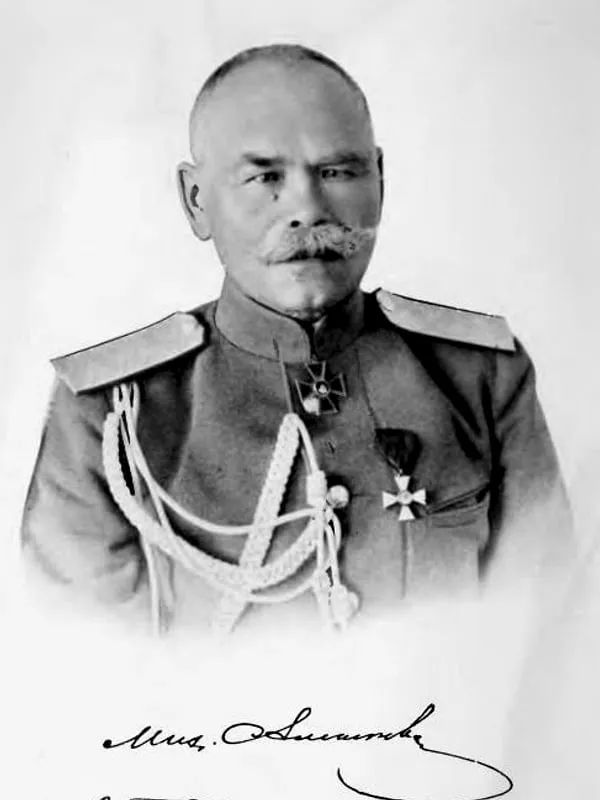
- Born:
- 15 November 1857, Vyazma (Russian Empire)
- Died:
- 8 October 1918, Yekaterinodar (Russia)
- Author:
- Łukasz
- Photo:
- autor nieznany, domena publiczna, Wikimedia Commons

General Mikhail Vasilyevich Alekseyev was the most important staff officer of the Russian army in the First World War. In 1914 he helped to win the victory in Galicia, in 1915 he led the Russian armies out of the Kingdom of Poland, and from September 1915, as chief of staff to Tsar Nicholas II, he in effect directed all of Russia’s operations. In March 1917 his telegrams to the front commanders sealed the Emperor’s abdication. After the Bolshevik coup he created on the Don the nucleus of the White Volunteer Army, whose existence marked the start of the civil war. The son of a soldier who had risen to officer rank, modest and extraordinarily hard-working, he was one of the few Russian generals to reach the top without connections at court. His decisions of 1915–1917 helped to close the era of empire and open the one in which Russia became a Bolshevik state.
Origins and the road to the General Staff
He was born on 15 November 1857 (3 November by the Julian calendar) in Vyazma in Smolensk Governorate. His father, a veteran of the defence of Sevastopol, had begun his service as a private and risen to the rank of captain. Mikhail joined the army as a volunteer and in 1876 graduated from the Moscow cadet (junker) school. In the Russo-Turkish War of 1877–1878 he was an orderly to General Mikhail Skobelev and was wounded at Plevna. He served for well over a decade with his regiment before graduating top of his year from the Nicholas General Staff Academy in 1890. He later taught the history of Russian military art there and worked on the General Staff.
The war with Japan
When the Russo-Japanese War broke out, Alekseyev went to Manchuria. In October 1904 he became quartermaster general of the 3rd Manchurian Army, in other words its chief planner. His army fought in the great Battle of Mukden in February and March 1905, which ended in a Russian retreat northwards. For his service in Manchuria he received a golden sword and decorations. The war convinced him of how badly the army lacked an efficient staff, communications and reserves, and its commanders independence. He drew on this experience later when preparing plans for a war in Europe.
Planner of the war against Austria-Hungary
After his return he worked on the General Staff on plans for war with Austria-Hungary. From 1908 he was chief of staff of the Kiev Military District, commanded by General Nikolai Ivanov. From 1912 he commanded XIII Corps in Smolensk. He was considered a brilliant theorist and organiser who did everything himself and was reluctant to share work with his subordinates.
Galicia and the Great Retreat
In August 1914 Alekseyev became chief of staff of Ivanov’s South-Western Front. The Russian plan, which he had helped to devise, aimed to encircle the Austro-Hungarian armies in Galicia. After setbacks in the north, at Kraśnik and Komarów, the armies of the front won the Battle of Galicia and at the beginning of September took Lwów (Lviv). For this Alekseyev received the Order of St George, 4th class, and promotion to General of Infantry. Many contemporaries, such as the future General Anton Denikin, considered him the real author of this victory. In the winter he and Ivanov argued to the high command that the road to victory led across the Carpathians into Hungary, which cost the Russians bloody fighting in the mountains.
In March 1915 he took command of the North-Western Front, the largest grouping of the Russian army, which defended the Kingdom of Poland. When, after the breakthrough at Gorlice in May, the Germans and Austrians drove the Russians out of Galicia and in July struck at the projecting “Polish salient” simultaneously from the south and from the north, from the Narew, Alekseyev obtained the consent of the Supreme Commander-in-Chief, Grand Duke Nicholas Nikolaevich, to withdraw the armies from the Vistula. The retreat proceeded in stages. The Russians gave up Warsaw at the beginning of August, suffered enormous losses and lost the fortresses of Kovno and Novogeorgievsk, but the Germans failed to encircle their main forces. It was for this above all that Alekseyev was most highly regarded. For the Poles the consequences of the retreat proved decisive: the lands of the Kingdom passed under German and Austro-Hungarian occupation, and the Polish question became the object of a game between the powers that ended in 1918 with the recovery of independence.
Chief of staff to the Tsar
When in September 1915 Nicholas II took over the supreme command himself, Alekseyev became his chief of staff at General Headquarters (the Stavka) in Mogilev. The Tsar had no experience of command; every morning he listened to a report and usually approved the general’s proposals. In practice Alekseyev was the Commander-in-Chief. In his very first weeks he had to rescue the situation near Wilno (Vilnius), where German cavalry had broken through into the rear of the front. The Russians gave up the city but closed the gap, and in the autumn the front stabilised.
In 1916 Russia kept its commitments to its allies, but at a high price. The March offensive at Lake Naroch, launched to relieve the French at Verdun, collapsed in mud and German artillery fire. For the summer Alekseyev gave the main thrust to General Alexei Evert’s Western Front and only a supporting role to General Aleksei Brusilov’s South-Western Front. Yet it was Brusilov who broke the Austro-Hungarian front, while Evert moved late and was defeated at Baranovichi. Alekseyev shifted reserves southwards, but the Brusilov Offensive petered out in the autumn in the marshes of the Stokhid. For a long time he had preferred Romania neutral rather than allied, and when she entered the war in August and was quickly defeated, Russia had to defend a new, long front.
Alekseyev was a monarchist, but the state of the home front worried him more and more. He proposed to the Tsar the appointment of a single minister to run the war economy, but the Tsar refused. He made no secret of his dislike of Grigori Rasputin. The Empress distrusted him, especially when copies of letters sent to him by the Octobrist leader Alexander Guchkov began to circulate in Petrograd. Historians still argue over whether in the autumn of 1916 the general knew of the conspiracies against the Tsar. What is certain is that in November he fell seriously ill with a kidney complaint and left for treatment in the Crimea. General Vasily Gurko stood in for him. He returned to Mogilev at the beginning of March 1917, a few days before the revolution.
The abdication
When on 12 March the Petrograd garrison mutinied and the February Revolution broke out, Alekseyev at first carried out the Tsar’s orders and prepared to send troops from the front to the capital. He soon concluded, however, that only an agreement with the Duma would save the army from disintegration. The President of the Duma, Mikhail Rodzianko, assured him that the new government would be formed by the Duma leaders and not by the soviets, and Alekseyev believed him. He halted the expedition against the capital and drafted a manifesto on a government responsible to the Duma. When Rodzianko replied that this was not enough and that abdication was needed, on 15 March Alekseyev sent the front commanders the transcript of that conversation and asked their opinion, wording the question in a way that suggested the answer. All of them, including Grand Duke Nicholas Nikolaevich and General Nikolai Ruzsky, came out in favour of the Tsar’s departure, and he abdicated that same day. According to the memoirs of General Alexander Lukomsky, Alekseyev later told him that he would never forgive himself for having believed in the sincerity of certain people and sent out that telegram.
Commander-in-Chief in the revolution
The Provisional Government did not appoint him Supreme Commander-in-Chief until April. Alekseyev tried to save discipline and opposed the soldiers’ committees that Order No. 1 of the Petrograd Soviet had spread through the army, but the army was falling apart ever faster. In June the war minister, Alexander Kerensky, had him replaced by Brusilov, who was to lead the summer offensive.
In September, after the revolt of General Lavr Kornilov, he accepted Kerensky’s request to become chief of staff, so that the revolt could be wound up as mildly as possible for those involved. On 14 September he arrested Kornilov and his officers in Mogilev, and some two weeks later he resigned. The episode weighed on relations between the two generals for good.
The Volunteer Army
After the October Revolution Alekseyev left Petrograd in disguise and in mid-November reached Novocherkassk, the capital of the Don Cossacks. Ataman Alexei Kaledin received him coolly but allowed him to recruit volunteers. From a few hundred officers, cadets and students arose the so-called Alekseyev Organisation, and after Kornilov’s arrival in December, the Volunteer Army. Kornilov took military command, while Alekseyev dealt with politics, finance and contacts with the Allies. His money came from, among others, Moscow industrialists and Guchkov.
After Kaledin’s suicide the volunteers left Rostov during the night of 22–23 February 1918 and set off for the Kuban. The gravely ill Alekseyev made this Ice March in a carriage. After Kornilov’s death near Yekaterinodar in April, Denikin took over military command, while Alekseyev remained formally the army’s supreme head. In the summer the army retook the Kuban and captured Yekaterinodar. Alekseyev died there on 8 October 1918, a few weeks before the end of the Great War in which he had been one of the most important commanders. Sources speak of heart failure in a man who had been seriously ill with kidney disease for years. In 1920, before the Bolsheviks arrived, his family moved his remains to Belgrade.
Assessment
Alekseyev is regarded as the ablest staff officer of the Tsarist army. His supporters stress that in 1915 he saved the army from encirclement in Poland, and that in 1915–1916 he rebuilt it after its defeats and coordinated the fronts better than the previous high command. His critics point out that he could not impose his will on the front commanders, that in 1916 he failed to exploit the Russian army’s only great success, and that he lost himself in details he could have left to his staff.
His role in March 1917 remains the most controversial. Some writers, especially among Russian monarchists, saw him as a participant in a plot against the Tsar. Most scholars, however, believe that he belonged to no conspiracy and that he came out in favour of abdication because he trusted Rodzianko’s assurances that only abdication would allow the war to go on. The disintegration of the army after the fall of the monarchy showed that he was wrong, and his later struggle against the Bolsheviks was also an attempt to make amends for that mistake.
On the road to the Second World War Alekseyev is a figure of the turning point. His decision of March 1917 hastened the end of the monarchy, and the army he failed to save did not later defend the Provisional Government against the Bolsheviks. The White army he created lost the civil war, and its defeat consolidated the power of Vladimir Lenin and his successor Joseph Stalin. Thousands of its soldiers scattered across Europe as émigrés, and during the Second World War some of them found themselves on different sides of the front.