Russia
Lavr Kornilov
Commander-in-Chief of the Russian army (July–September 1917), co-founder and commander of the White Volunteer Army (1917–1918)
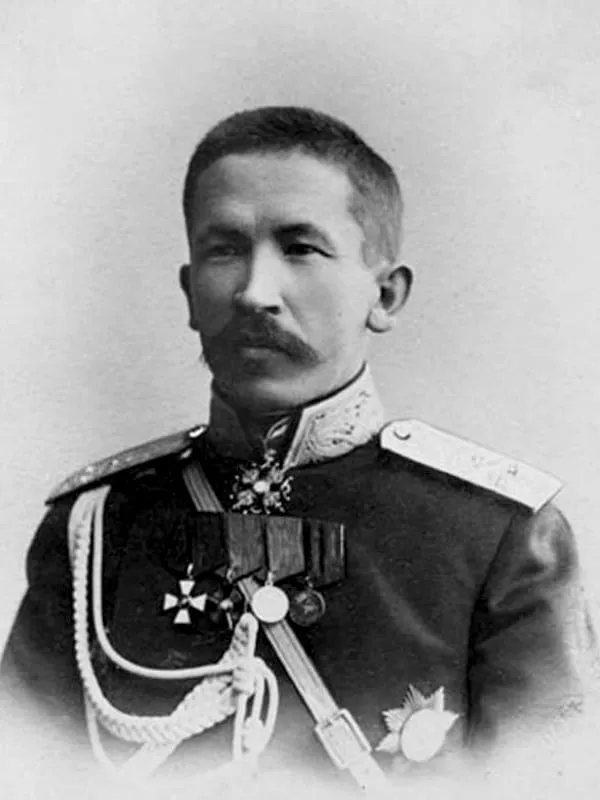
- Born:
- 30 August 1870, Ust-Kamenogorsk (Russian Empire)
- Died:
- 13 April 1918, near Yekaterinodar (Russia)
- Author:
- Łukasz
- Photo:
- autor nieznany, domena publiczna, Wikimedia Commons

General Lavr Georgiyevich Kornilov was one of the most controversial Russian commanders. An intelligence officer and traveller in Central Asia, a hero of the retreat from Mukden in 1905 and of a celebrated escape from Austro-Hungarian captivity in 1916, in the summer of 1917 he became Commander-in-Chief of a disintegrating Russian army. The right and the officer corps saw him as the man who would restore order; the left saw a would-be dictator. His clash with Prime Minister Alexander Kerensky in September, known as the Kornilov affair or the Kornilov revolt, ended in defeat for the general, but it weakened the Provisional Government still further and helped the Bolsheviks seize power two months later. After the October Revolution Kornilov co-founded the White Volunteer Army and was killed at its head in the spring of 1918. On the road to the Second World War, therefore, his name is tied to the moment when Russia ceased to be a democratic ally of the Entente and began to turn into a Bolshevik state.
Origins and Central Asia
He was born on 30 August 1870 (18 August in the Julian calendar) in Ust-Kamenogorsk on the Irtysh, today in eastern Kazakhstan. His father was a Siberian Cossack who had risen to a junior officer’s rank and worked as an interpreter. Various versions circulated about his mother’s origins: she was said to have Kazakh, Kalmyk or Altai roots, and the general’s sister also spoke of Polish ancestors. Kornilov’s Asiatic features later attracted attention and gave rise to legends. He had neither wealth nor patrons; he owed everything to the army. He graduated from the cadet corps in Omsk and the Mikhailovsky Artillery School in St Petersburg, and in 1897, as a captain, from the Nicholas General Staff Academy.
He turned down a post in the capital and returned to the Turkestan Military District. For several years he served as an intelligence officer in Central Asia, at a time when Russia and Britain were competing for influence there. He led reconnaissance expeditions to Eastern Turkestan and Kashgar, to Afghanistan and eastern Persia, learned several of the region’s languages and wrote lengthy reports. This earned him a reputation as a brave, tough and self-reliant officer, but also as one inclined to act on his own initiative.
The war with Japan and the Far East
In the Russo-Japanese War Kornilov was chief of staff of a rifle brigade. He fought at Sandepu in January 1905 and in the great Battle of Mukden in February and March. During the retreat, as the Japanese were closing the ring, he broke out with the bayonet and led the brigade to safety together with its wounded and its colours. For this he received the Order of St George, 4th Class, and promotion to colonel. The defeat, in which his unit was one of the few bright spots, showed him at close quarters the weakness of the tsarist army and its leadership, including the Commander-in-Chief, Aleksey Kuropatkin.
From 1907 to 1911 he was military attaché in China. He learned Chinese, travelled widely and sent reports to St Petersburg on the reform of the Chinese army and on the growing influence of Japan, which had established itself in southern Manchuria after the war. He then commanded a regiment and a brigade in the Far East. When the First World War broke out, he was a major general commanding a Siberian rifle brigade in Vladivostok.
The First World War and the escape from captivity
At the front he took command of the 48th Infantry Division in the 8th Army of General Aleksei Brusilov. Within a few months he turned a mediocre division into one of the best units on the front, later known as the “Steel Division”. He fought in the closing phase of the Battle of Galicia and in the Carpathians. Brusilov, who disliked him, wrote that Kornilov did not spare his men, yet the soldiers loved him because they always saw him in the front line. In November 1914, against orders, he led his division down from the mountains onto the Hungarian plain, was cut off and had to fight his way back, losing thousands of men. He got off with a reprimand.
In the spring of 1915, after the German–Austrian breakthrough at Gorlice, the division covered the retreat from the Carpathians and at the beginning of May was encircled in the Dukla area. The wounded general hid in the forests for several days with a handful of soldiers until he too was taken prisoner. His corps commander blamed him for the destruction of the division, but the Tsar awarded him the Order of St George, 3rd Class, because some of his soldiers had managed to break out. As a prisoner, Kornilov eventually ended up in a camp for senior officers at Kőszeg in western Hungary. In the summer of 1916, disguised as an Austrian soldier and helped by a Czech pharmacist’s assistant, František Mrňák, he escaped and made his way across the mountains to Romania, which was still neutral. In Russia he was received as a hero, the newspapers printed his portrait and the Tsar received him in person. Some historians believe that the press, hungry for good news, inflated his fame out of all proportion. In the autumn of 1916 he took command of a corps on the South-Western Front.
1917: from Petrograd to the supreme command
After the February Revolution the Provisional Government appointed him commander of the Petrograd Military District on 15 March 1917. The popular front-line general was supposed to restore order in the mutinous garrison. On 21 March it was he who informed Empress Alexandra Feodorovna at Tsarskoye Selo that she was under arrest; the monarchists never forgave him for it. But he could find no common language with a garrison that listened to the Petrograd Soviet more than to its officers. During the April Crisis, at the beginning of May, he wanted to bring out troops with artillery against the demonstrators, but the Soviet forbade soldiers to leave barracks without its consent. Kornilov resigned. The war minister, Alexander Guchkov, wanted to give him the Northern Front, but the Commander-in-Chief, Mikhail Alekseyev, objected. Kornilov was given the 8th Army in Galicia.
In the July Kerensky Offensive his army achieved the only clear success: it broke through the Austro-Hungarian front west of Stanisławów (Ivano-Frankivsk), took some 10,000 prisoners and captured Halicz and Kałusz. After a few days the soldiers refused to advance further, and when the Germans broke through the front at Złoczów, the Russian defence in Eastern Galicia began to fall apart. Kerensky gave Kornilov the whole South-Western Front. The general ordered his men to fire on units abandoning their positions without orders and to shoot stragglers without trial, and he demanded that the government restore the death penalty at the front. The government agreed. The front came to a halt at the state border, and Kornilov emerged from the July disaster as a strongman.
On 31 July (18 July Old Style) Kerensky appointed him Commander-in-Chief in place of Brusilov. Kornilov immediately set conditions: he would answer only “to his own conscience and to the whole nation”, the government would not interfere with his operational orders or appointments, and the measures to restore discipline would extend to the rear as well. His programme, supported by the commissar at General Headquarters (Stavka), Boris Savinkov, provided for the death penalty in the rear, curbs on the role of soldiers’ committees and the militarisation of the railways and the arms industry. Kerensky, who had to reckon with the soviets, played for time. At the State Conference in Moscow at the end of August, officers carried the general out of the railway station on their shoulders, and the right side of the hall gave him an ovation. He was backed by industrialists, by Pavel Milyukov’s Kadets and by former leaders of the Duma such as Mikhail Rodzianko. Kornilov warned that without a change of policy Russia would lose Riga. On 3 September the Germans did indeed enter Riga.
The Kornilov affair
At the beginning of September Kornilov and Kerensky, through Savinkov, agreed that a cavalry corps would be brought up to Petrograd to defend the government against the Bolsheviks if need be. Kornilov gave command to General Aleksandr Krymov, known for his monarchist views, and also sent the Savage Division, made up of Caucasian highlanders. At General Headquarters in Mogilev there was already talk of a new government. At this point the former Procurator of the Holy Synod, Vladimir Lvov, intervened, presenting himself to the general as the Prime Minister’s envoy. Kornilov told him that the way out was martial law in the capital and the concentration of all power in the hands of the Commander-in-Chief. On 8 September (26 August Old Style) Lvov passed this on to Kerensky in a form resembling an ultimatum. The Prime Minister regarded it as a coup d’état, dismissed the Commander-in-Chief and declared him a traitor.
Kornilov refused to give up his command and called on the nation to save the fatherland from a government that, in his view, was acting under Bolshevik pressure. He was supported by the commanders of several fronts, including Anton Denikin, but the army did not follow him. Railwaymen tore up the tracks, agitators from the soviets persuaded the Cossacks and the Caucasian horsemen that they were being led against the lawful government, and the workers of Petrograd were given arms. The revolt collapsed without a fight. Krymov shot himself on 13 September, and on 14 September Alekseyev, who had accepted the post of chief of staff so that the revolt could be wound up as gently as possible, arrested Kornilov in Mogilev. The general and a group of officers were confined in a former monastery at Bykhov, guarded by the Tekke Regiment, which remained loyal to him.
The consequences were the opposite of what had been intended. The Bolsheviks, hunted since July, emerged from the affair as defenders of the revolution, with an armed Red Guard. Their leaders, including Leon Trotsky, were released from prison, and within a few weeks the Bolsheviks had won majorities in the soviets of both capitals. The officers never forgave Kerensky for first summoning the cavalry himself and then imprisoning the Commander-in-Chief, and in November almost no one came to the defence of his government.
The Volunteer Army and death
After the Bolshevik coup the Bykhov prisoners were at risk of lynching. As the troops of the new Bolshevik Commander-in-Chief, Ensign Nikolai Krylenko, approached Mogilev, General Nikolai Dukhonin ordered the prisoners released on 2 December 1917. The next day he himself was killed by soldiers and sailors. Kornilov set out for the Don at the head of the Tekke Regiment, but after a gruelling march under fire he sent the horsemen away and continued alone by train, disguised as a peasant and with a false passport. On 19 December he reached Novocherkassk.
There, out of officers, cadets and students gathered by Alekseyev, the Volunteer Army was taking shape. Kornilov took military command, Alekseyev dealt with politics and finance, and the ataman of the Don Cossacks, Aleksei Kaledin, with the affairs of the Don. The two generals – the former Commander-in-Chief and his recent jailer – barely tolerated each other. The Cossacks did not want to fight the Bolsheviks, and the army numbered only a few thousand men. After Kaledin’s suicide, with the Reds closing in on Rostov, Kornilov led the volunteers out into the Kuban steppe on the night of 22–23 February 1918. Thus began the Ice March, the founding legend of the White movement. It was also a cruel march: both sides shot prisoners, and according to many accounts the volunteers carried out bloody reprisals against the inhabitants of villages that had fired on them.
The objective was Yekaterinodar, the capital of the Kuban, but the city had been taken by the Bolsheviks. Kornilov joined forces with Kuban units and in April began an assault, despite the doubts of some of his generals. On the morning of 13 April 1918 (31 March Old Style) a shell hit the farmhouse outside the city that housed his headquarters and killed the general in his room. Command passed to Denikin, who broke off the assault and withdrew the army. Kornilov’s body was buried in secret in the German colony of Gnadau. The Bolsheviks found the grave, took the remains to Yekaterinodar, today’s Krasnodar, desecrated them and burned them.
Memory and significance
To the Whites, Kornilov was a patriot, the only one who had tried to save the army from disintegration. His name was borne by the most famous regiment, and later division, of the Volunteer Army, whose soldiers went into exile after defeat in the Civil War in 1920 and joined the Russian All-Military Union. One of the Kornilovite commanders of the Civil War, General Nikolai Skoblin, turned out in the 1930s to be an agent of Soviet intelligence, and in 1937 he helped to kidnap the union’s chairman, General Yevgeny Miller, in Paris. Soviet historiography spoke of “Kornilovshchina”, an attempted counter-revolutionary dictatorship, and used the word as a bogey for decades.
September 1917 remains the most disputed episode. To the end of his life Kerensky maintained that he had foiled a carefully prepared right-wing conspiracy. George Katkov and Richard Pipes argued, on the contrary, that it was the Prime Minister who had exploited a misunderstanding to rid himself of an awkward rival. Many scholars accept an intermediate version: Kornilov preferred to act with the government’s consent but was ready to do without it, and a coup really was being prepared in his entourage. The general himself, as even his supporters admitted, was a brave soldier but politically naive and easily swayed by his advisers.
On the consequences everyone agrees. The failed march on Petrograd discredited both the right and Kerensky, and the greatest beneficiaries were Vladimir Lenin’s Bolsheviks, who seized power in November, took Russia out of the war and built the state from which Joseph Stalin’s Soviet Union grew. The movement that Kornilov co-founded lost the Civil War. Its defeat entrenched the Bolshevik dictatorship and left in Eastern Europe a great power that in 1939 came to terms with Adolf Hitler over the partition of Central and Eastern Europe.