Iran
Mohammad Reza Pahlavi
Crown Prince of Iran (1926–1941), Shah of Iran (1941–1979)
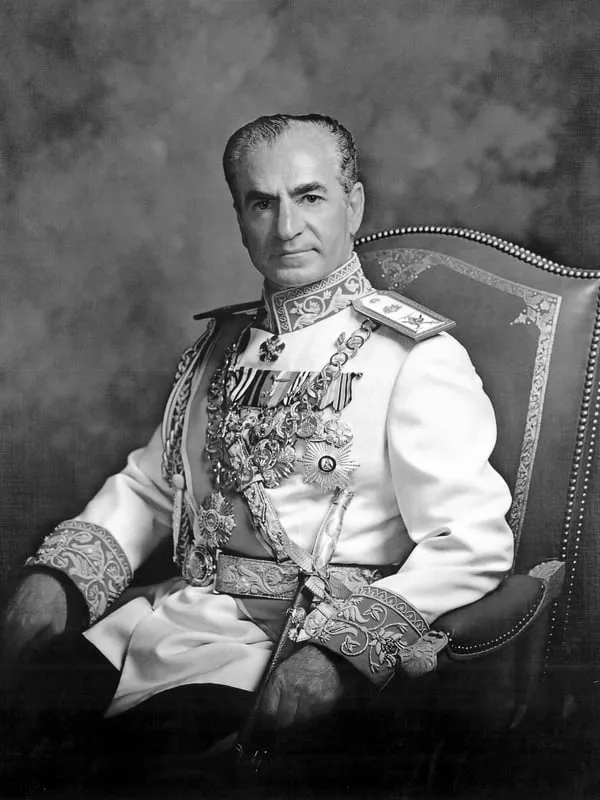
- Born:
- 26 October 1919, Tehran (Persia)
- Died:
- 27 July 1980, Cairo (Egypt)
- Author:
- Łukasz
- Photo:
- Ghazarians, domena publiczna, Wikimedia Commons

Mohammad Reza Pahlavi was the second and last ruler of the Pahlavi dynasty. He came to the throne in September 1941, a young man of twenty-one, in a country occupied by British and Soviet troops, who had forced his father, Reza Shah, to abdicate. In his first years he was a monarch by the grace of the occupiers, and only nominally the host when the leaders of the Big Three met in his capital in 1943. The humiliation he experienced during the war shaped his entire reign: the drive for a strong army, reliance on the United States and increasingly authoritarian rule, which ended with the Islamic Revolution in 1979.
Son of a Cossack officer
He was born on 26 October 1919 in Tehran, together with his twin sister Ashraf. His father, Reza Khan, was then an officer of the Persian Cossack Brigade, and a year and a half later he carried out a coup that opened his way to power. His mother, Tadj ol-Molouk, came from an officer’s family settled in Baku. Mohammad Reza was Reza’s eldest son. When his father became Shah in December 1925, the boy became heir to the throne; he was formally proclaimed Crown Prince in April 1926, on the eve of his father’s coronation.
The Crown Prince’s upbringing was entrusted to officers, and the child was separated from his mother and sisters. His relations with his stern and unapproachable father were cool and formal. Years later Mohammad Reza wrote in his autobiography that Reza Shah was one of the most frightening men he had ever known. In 1931 he became the first Persian Crown Prince to be sent abroad for his education, to Le Rosey, an elite boarding school in Switzerland. He spent five years there, learned to speak fluent French and English and acquired a taste for European culture. After returning in 1936 he graduated from the officers’ school in Tehran and in 1938 was commissioned as a second lieutenant; he then travelled around the country as an army inspector, and his father increasingly consulted him on affairs of state.
The Crown Prince’s marriage became a matter of politics. On the advice of the Turkish President Mustafa Kemal Atatürk, who wanted to bring Egypt closer to the pact concluded in 1937 between Iran, Turkey, Iraq and Afghanistan, Mohammad Reza married Fawzia, sister of King Farouk of Egypt, in Cairo on 15 March 1939. Their daughter Shahnaz was born in 1940. The marriage was unhappy and formally ended in divorce in 1948.
September 1941
When in the summer of 1941 Britain and the USSR demanded ever more insistently that the Germans be expelled from Iran, the Crown Prince, as his biographers later claimed, reassured his father that nothing would happen. On 25 August the troops of both powers invaded Iran. Mohammad Reza watched as the army his father had spent twenty years building fell apart within days, and soldiers in Tehran threw off their uniforms and fled before they had even seen the enemy. When the Shah learned that his generals were discussing capitulation, he beat and demoted General Ahmad Nakhjavan in a fit of rage and very nearly had him shot; according to his son’s account, it was he who persuaded his father to court-martial the general instead.
The humiliation of those days stayed with him for ever. The British considered restoring the Qajar dynasty, but their pretender did not speak Persian, and Moscow cared above all about quiet in its rear. The Prime Minister, Mohammad Ali Foroughi, although kept out of power by Reza Shah for years, concluded that the only way to save the monarchy and the state was a swift succession. On 16 September 1941 Reza Shah abdicated in favour of his son and left Tehran. The following afternoon Mohammad Reza took the oath before parliament, and British and Soviet troops entered the capital. He never saw his father again: Reza Shah died in exile in Johannesburg in July 1944.
Shah under occupation
The first years of his reign were a period of weakness for the young Shah. He declared an amnesty for his father’s political prisoners, promised to govern in accordance with the constitution and allowed women to wear the chador again. Real power, however, lay with the prime ministers, parliament and above all the occupiers: the north of the country was held by the Red Army, the south by the British and, from 1942, also by the Americans, who expanded the supply route to the USSR through Iran. On 29 January 1942 Iran concluded a treaty of alliance with Britain and the Soviet Union, in which the powers promised to withdraw their troops six months after the end of the war. In the same year more than 100,000 Polish soldiers and civilians passed through Iran from the USSR with the army of General Władysław Anders; Polish camps, schools and hospitals were set up in Tehran, Isfahan and Ahvaz.
The country suffered from inflation, food shortages and hunger, and in December 1942 bread riots broke out in Tehran. The Shah sought support from the United States, the only great power without colonial interests in Iran; American military and financial advisers arrived in the country. On 9 September 1943 Iran declared war on Germany. At the end of November that year Joseph Stalin, Franklin Delano Roosevelt and Winston Churchill met in Tehran at the Tehran Conference. In a declaration of 1 December 1943 they gave assurances of Iran’s independence and territorial integrity, but their host took no part in the deliberations, and when Stalin visited him at his palace, he came guarded exclusively by Soviet soldiers.
After the war the Soviet Union did not withdraw its troops on time and backed separatist governments in Iranian Azerbaijan and in Kurdish Mahabad. Only Iran’s complaint to the UN Security Council, pressure from the United States and the skilful negotiations of Prime Minister Ahmad Qavam persuaded Moscow to give way in May 1946. In December that year the Iranian army entered Tabriz, and the Iran crisis brought the Shah his first success of his own and drew him closer to Washington.
Mosaddegh and the coup
On 4 February 1949, at the University of Tehran, a gunman fired several shots at the Shah at close range and wounded him slightly. Mohammad Reza regarded his escape as a sign of providence, outlawed the communist Tudeh Party, which was blamed for the attack, and increased his powers. In 1951 Mohammad Mosaddegh, leader of the National Front, became Prime Minister and nationalised the British-owned oil industry. The dispute with London, the British embargo and the power struggle between the Prime Minister and the court came to a head in August 1953. When the first attempt to dismiss Mosaddegh failed, the Shah fled to Baghdad and Rome. On 19 August a coup d’état prepared by British intelligence and the American CIA together with Iranian officers and supporters of the monarchy overthrew the Prime Minister, and General Fazlollah Zahedi took power. A few days later the Shah returned to the country.
The White Revolution and personal rule
After 1953 Mohammad Reza ruled more and more personally. In 1957 the secret police, SAVAK, was set up; it hunted down, imprisoned and tortured opponents. Iran tied itself to the West through the Baghdad Pact and became one of the chief allies of the United States in the Middle East. In 1963 the Shah announced a reform programme called the White Revolution: land reform, votes for women, a literacy campaign and profit-sharing for workers. The Shia clergy came out against the reforms and against autocracy; riots in June 1963 were bloodily suppressed, and their leader, Ruhollah Khomeini, was expelled from the country in 1964.
In his private life the Shah married twice more: in 1951 Soraya Esfandiary-Bakhtiary, whom he divorced in 1958 because she could not have children, and in 1959 Farah Diba, who bore him an heir, Reza, and three other children. On 26 October 1967 he crowned himself Shahanshah, and in October 1971 he staged lavish celebrations of 2,500 years of the Persian monarchy at Persepolis. The rise in oil prices in 1973 brought Iran enormous revenues, which the Shah spent on rapid industrialisation and on arms; the Iranian army became one of the best-equipped in the world. At the same time corruption, inequality and resentment of the court grew, and in 1975 the Shah replaced the façade of a two-party system with a single state party, Rastakhiz.
Downfall and exile
In 1978 protests against the Shah, led by the clergy but backed by the bazaar, students, the left and the liberals, spread across the whole country. On 8 September 1978 troops opened fire on demonstrators in Tehran; “Black Friday” destroyed any chance of compromise. Already suffering from lymphatic cancer, which few people knew about, the Shah wavered between repression and concessions. On 16 January 1979 he left Iran, and two weeks later Khomeini returned from Paris; in February the monarchy fell. The exiled Shah wandered from Egypt to Morocco, the Bahamas, Mexico, the United States and Panama. His admission to New York for medical treatment became the pretext for the seizure of the American embassy in Tehran on 4 November 1979. He died on 27 July 1980 in Cairo, where he was the guest of President Anwar Sadat, and was buried in the al-Rifa’i Mosque, where his father’s body had once been laid temporarily.
Significance
Mohammad Reza Pahlavi was a ruler whose reign began under foreign occupation and who was haunted all his life by the question of whether he was master in his own country. September 1941 taught him that Iran, left to itself, could be overrun in a few days and its ruler removed at a single demand from two powers. From this lesson grew both his ambitions – a modern, strong Iran with a large army – and his dependence on the United States, which in his opponents’ eyes made him a puppet of the West, just as his father had once been regarded as Britain’s man. In Poland his image was fixed by Ryszard Kapuściński’s 1982 reportage Shah of Shahs, a study of the mechanisms of power and its collapse. For the history of the Second World War he remains above all the young monarch whom the British and the Russians placed on the throne so that aid for the embattled Red Army could flow through his country.
Sources
Mentioned in battles
(01)Often appears with
People who appear in the same events.