1941: The Middle East campaign
Anglo-Soviet invasion of Iran
- Dates:
- 25 August – 17 September 1941
- Front:
- Middle East
- Location:
- Iran: in the south, Khuzestan with Abadan, Khorramshahr, Bandar Shahpur and Ahvaz; in the west, the road from Khanaqin in Iraq over the Pai Tak Pass to Kermanshah and Hamadan; in the north, Iranian Azerbaijan with Tabriz, the Caspian coast (Gilan) and Khorasan with Mashhad; Qazvin and TehranOn the battle map →
- Sides:
- United Kingdom and British India (with the Royal Australian Navy) and the Soviet UnionEdward Quinan, William Slim, Dmitry Kozlov
- Result:
- Victory for Britain and the USSR. The Iranian army collapsed within four days; on 28–29 August the new government of Mohammad Ali Foroughi ordered resistance to cease and accepted the Allies' terms. British troops occupied the oilfields and ports in the south and west, Soviet troops the north of the country. On 16 September Reza Shah Pahlavi abdicated in favour of his son, and on 17 September the forces of both powers entered Tehran. From then on, war supplies for the USSR flowed through Iran.
- Author:
- Łukasz
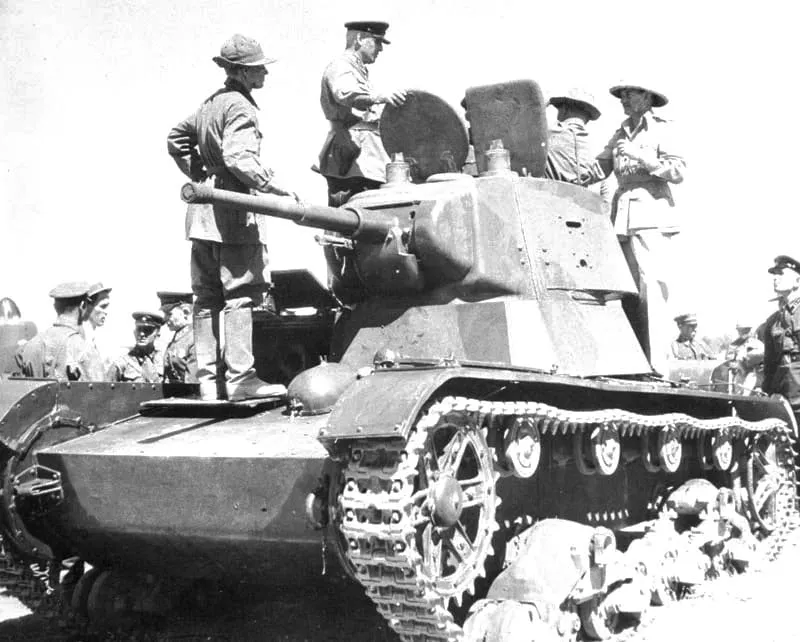
The invasion of Iran was the shortest and most one-sided of the three campaigns the British fought in the Middle East in the spring and summer of 1941, and the only one they waged together with the Soviet Union. Before dawn on 25 August, without a declaration of war, British and Indian troops crossed the frontier of Iran from Iraq and the Persian Gulf, while three Soviet armies entered the country from Transcaucasia and Turkmenistan. Iran was not a party to the war and had no intention of becoming one. Its ruler, Reza Shah Pahlavi, had proclaimed neutrality in 1939 but refused to expel the few hundred Germans working in his country, and London and Moscow decided that they could not leave in uncertain hands the refinery at Abadan, the approaches to India and the only overland route from warm seas to the USSR that did not pass through belligerent territory.
The army the Shah had spent twenty years building fell apart in four days. The British lost about twenty killed and the Russians several dozen; the Iranians, according to the most frequently cited estimates, lost about eight hundred soldiers and several hundred civilians. On 28 August the new government in Tehran ordered the army to cease resistance. Three weeks later Reza Shah abdicated in favour of his son, and British and Soviet troops entered the capital together.
Name and dates
The British gave the operation the code name Countenance. Russian literature speaks of the Iranian operation or of the Red Army’s “Iranian march”; the name “Concord” (Russian “Soglasie”), found in more recent publications, is more likely a later rendering than a code name from 1941. Some accounts describe these events as the British–Soviet invasion of Iran.
The beginning is not in doubt: the early morning of 25 August 1941, when at 4.10 a.m. a British sloop opened fire in the port of Abadan and Soviet columns crossed the frontier rivers in the north. The end is dated in different ways. The fighting itself lasted until 28–29 August, when the order to cease resistance reached the troops; many Western studies close the campaign on 30 or 31 August, when the Iranian government formally accepted the ceasefire and the British and Soviet spearheads met at Sanandaj and near Qazvin. Russian historiography counts the operation as lasting until 17 September, the day the troops of both powers entered Tehran, and this date may be regarded as the true end, because only then, after the Shah’s abdication, were the political aims of the intervention achieved. British information on the course of the fighting in the west and south comes mainly from the dispatch submitted after the war by General Archibald Wavell as Commander-in-Chief in India (published in 1946); Soviet and Iranian figures are less reliable and often contradict one another.
Background
Reza Shah’s Iran
Reza Khan, an officer of the Persian Cossack Brigade, carried out a coup d’état in Tehran in 1921, and in 1925 he deposed the Qajar dynasty and became Shah himself. Within little more than a decade he imposed on the country a modernisation on the Turkish model: he built a conscript army, schools, roads, factories and, above all, the Trans-Iranian Railway, a line of almost 1,400 kilometres running from the Persian Gulf through Tehran to the Caspian Sea, completed in 1938 without foreign loans. In 1935 he demanded that his state be called Iran abroad rather than Persia.
In foreign policy the Shah wanted above all to free the country from the two neighbours that for a hundred years had divided Persia into spheres of influence: Russia and Britain. He was bound to the USSR by the treaty of 26 February 1921, whose Article 6 gave Russia the right to send troops into Persia if a third power tried to use its territory as a base against Russia and the Persian government was unable to prevent it. With the British he quarrelled over oil: in 1932 he cancelled the concession of the Anglo-Persian Oil Company (from 1935 the Anglo-Iranian Oil Company), although as early as 1933 he signed a new and somewhat more favourable one. As a counterweight to both powers the Shah chose Germany. In the 1930s the Reich became Iran’s most important trading partner; German engineers and technicians worked on the railway, in factories, in communications and in the ports, and Lufthansa aircraft flew across Iran to Asia. In 1929 Iran acceded to the Litvinov Protocol, and in 1937 it signed the Saadabad non-aggression pact with Turkey, Iraq and Afghanistan.
In September 1939 Iran declared its neutrality. As long as Germany and the USSR were bound by the Molotov–Ribbentrop Pact, the British feared Moscow rather than Berlin: in the spring of 1940 they planned to bomb the Soviet oilfields and photographed Baku from aircraft flying from Iraq, and in the autumn of that year Stalin demanded that Hitler recognise the area “south of Batum and Baku in the general direction of the Persian Gulf” as a Soviet sphere of interest.
Summer 1941
The spring of 1941 brought the war right up to Iran’s borders. In April a pro-German government under Rashid Ali al-Gaylani seized power in Baghdad; the British landed troops at Basra, and in May they defeated the Iraqi army. Rashid Ali, the Grand Mufti of Jerusalem Mohammed Amin al-Husseini and the colonels of the Golden Square fled to Iran of all places, where they were received as political refugees. In June and July the British and the Free French occupied Syria and Lebanon. Iran remained the last state in the region that London did not trust.
On 22 June Germany attacked the USSR, and on 12 July the Anglo-Soviet Agreement on joint action in the war was signed in Moscow. Iran’s importance changed overnight. The Trans-Iranian Railway was the shortest route by which equipment from Britain, India and the United States – the latter covered since March by the Lend-Lease Act – could reach the Red Army, avoiding both the Arctic convoys to Archangel and distant Vladivostok. The Wehrmacht’s rapid progress in the east also raised the fear that the Germans, once they reached the Caucasus, would reach through Iran for the Persian Gulf, and that German agents in Iran would strike at the refineries and the railway, as had been attempted earlier in Iraq. On 12 August Hitler had Directive No. 34 supplemented, naming the Crimea and the Donets Basin as the nearest objectives in the south; beyond them lay the Caucasus and its oil.
Demands and decision
Tehran had heard the first warnings as early as June and July. On 19 July the Iranian government received a note in which the British Minister, Reader Bullard, demanded the expulsion of most of the Germans; the Soviet Ambassador, Andrei Smirnov, made similar demands. How many Germans there were is hard to say. The British legation estimated them in 1940 at fewer than a thousand, the Iranian press gave 690 citizens of the Reich (against 2,590 Britons), and historians speak of at most about three thousand; their influence, however, was out of all proportion to their numbers, because they worked in key plants, transport and communications. Among them were also agents of German intelligence, although the Allies greatly overestimated their number and capabilities.
The government of Prime Minister Ali Mansur temporised. The Shah agreed to the departure of some of the Germans and restricted trade with the Reich, but refused to hand them all over: he believed that concessions made under threat would mean the end of neutrality, and besides, he needed the German specialists. Meanwhile preparations in London and Moscow were going ahead at full steam. The British staff had begun considering the seizure of the Iranian oilfields even before 22 June. From 18 June the command of the troops in Iraq was once again subordinate to India, where at the beginning of July Wavell became Commander-in-Chief, having been replaced in the Middle East by General Claude Auchinleck. On 22 July the commander of the troops in Iraq, Lieutenant General Edward Quinan, was ordered to prepare to seize Abadan and the Naft-e Shah oilfields near the Iraqi border, and on 24 July the British government approved a plan of diplomatic pressure backed by a show of force; should pressure fail, the army was to be used. On the Soviet side the plans were drawn up by the staff of the Transcaucasian Military District, whose chief of staff was General Fyodor Tolbukhin. According to research based on archives in Baku, Moscow also prepared a group of more than 3,800 party activists, officials and specialists from the Azerbaijan SSR who were to take over the administration of Iranian Azerbaijan.
Prime Minister Winston Churchill pressed for swift action. The joint Anglo-Soviet note was postponed several times; it was finally delivered on 16–17 August (Wavell’s dispatch gives 17 August). Mansur regarded it as a veiled ultimatum. The Iranian reply, ready after a few days, promised a gradual reduction in the number of Germans but did not meet the demands. On 21 August London judged it unsatisfactory and set the start of the operation for 22 August; at the Soviet side’s request it was postponed to 25 August. The delay cost the Allies strategic surprise – the Iranians were sending reinforcements, including tanks, to Khuzestan – but not tactical surprise.
Forces
According to British pre-invasion assessments, in the south-west, in the area of Ahvaz, Abadan and Khorramshahr, stood the 6th Khuzestan Division and a division made up of units sent from Tehran, with a dozen or so light tanks and ten armoured cars; in the area of Sanandaj and Kermanshah stood the 5th Kurdistan Division, the 12th Kermanshah Division, another division made up from Tehran and a brigade from Isfahan. On paper the whole Iranian army numbered nine infantry divisions and several independent brigades; its strength is given very variously, from about 125,000 to 200,000 men. Its weapons were mainly Czechoslovak, and its air force consisted of obsolete biplanes. The small navy in the Persian Gulf, with two Italian-built sloops, Babr and Palang, and several gunboats, was commanded by Rear Admiral Gholamali Bayandor.
The British troops in Iraq were divided into two groups. In the south Major General Charles Harvey had the 8th Indian Infantry Division with three brigades (the 18th, 24th and 25th), the 13th Lancers and a squadron of the Guides Cavalry. Operations in the west, along the road from Khanaqin over the Pai Tak Pass to Kermanshah, were taken over on 23 August by Major General William Slim, commander of the 10th Indian Infantry Division, who had just returned from Syria. Under his command were Brigadier J. A. Aizlewood’s 2nd Indian Armoured Brigade, the British 9th Armoured Brigade (until recently the 4th Cavalry Brigade, and in fact still without tanks, riding in lorries), the 21st Indian Infantry Brigade and two battalions of Gurkhas. The RAF assigned three squadrons and transport aircraft in support. In the waters of the Persian Gulf Commodore Cosmo Graham assembled the British sloops Shoreham and Falmouth, the Australian sloop Yarra, the Indian sloop Lawrence, the gunboat Cockchafer, the corvette Snapdragon and the armed merchant cruiser Kanimbla with its Australian crew.
On the Soviet side, on 23 August the Transcaucasian Military District was converted into the Transcaucasian Front under Lieutenant General Dmitry Kozlov. Two of its armies entered Iran: Major General Vasily Novikov’s 47th Army, formed on the basis of the 28th Mechanised Corps, with two tank divisions (the 6th and 54th) equipped with T-26 tanks, and Major General Alexander Khadeyev’s 44th Army with mountain and cavalry divisions. From the Central Asian Military District in Turkmenistan struck the 53rd Army of Major General Sergei Trofimenko. They were supported by several hundred aircraft and by Rear Admiral Fyodor Sedelnikov’s Caspian Flotilla. The often repeated figure of a thousand tanks is probably exaggerated, but the Red Army’s superiority in armour and air power was overwhelming.
Course of the campaign
Notes at dawn
At about four in the morning on 25 August, as the troops were already moving into the attack, Bullard and Smirnov called on Prime Minister Mansur with their governments’ notes. The Soviet note invoked Article 6 of the 1921 treaty: the activity of German agents threatened the security of the USSR, the Iranian government had been unwilling to curb it, and so the Soviet Union was sending in troops. The British note justified the entry by the same Germans and gave assurances that Britain had no designs on Iran’s independence or territory and that its troops would leave once the threat had passed. The Shah summoned both diplomats and asked whether the invasion would stop if he handed over the Germans; he received no answer. He also sent a telegram to President Franklin D. Roosevelt, invoking the principles of the Atlantic Charter announced two weeks earlier. Roosevelt replied belatedly and confined himself to an assurance that London and Moscow respected Iran’s independence and territorial integrity.
Khuzestan: Abadan, Khorramshahr and Bandar Shahpur
The most important British objective was the refinery at Abadan, which lay on an island between the Shatt al-Arab and the Karun and was in 1940 one of the largest in the world. During the night of 24–25 August the 24th Indian Infantry Brigade sailed down the river from Basra in warships and boats. At 4.10 a.m. the sloop Shoreham opened fire on the Iranian sloop Palang, lying alongside the quay, and sank her, and the troops went ashore. Most of the Iranian garrison was asleep in its barracks and fled in lorries, but well-sited machine-gun nests by the quays put up resistance. The street fighting lasted all day, because the defenders had to be winkled out from among installations that must not be destroyed; the refinery was cleared only at about 5 p.m., and the rest of the island the following day.
At the same hour the 18th Indian Infantry Brigade, which had marched during the night across the desert from Tanuma, opposite Basra, burst into Khorramshahr, the headquarters of the Iranian navy. The Australian Yarra surprised the sloop Babr alongside the quay and sank her, and boarding parties captured two gunboats. Rear Admiral Bayandor was killed in the fighting for the town while trying to reach his headquarters; Commodore Graham later wrote that his death was regretted by all who had known him, for he had been “intelligent, capable and loyal to Persia”. By midday the 25th Brigade had taken Qasr-e Sheikh, north of Basra, and was covering the flank.
Farther east the armed merchant cruiser Kanimbla, carrying two companies of the 3rd Battalion, 10th Baluch Regiment, sailed up the Khor Musa inlet to Bandar Shahpur, the southern terminus of the Trans-Iranian Railway. The troops landed at about 7.15 a.m. and by 8.30 a.m. had taken the port against slight resistance. Eight German and Italian merchant ships, stranded there in 1939 and 1940, lay in the harbour. Their crews tried to scuttle or set fire to them, but most were saved; the British also captured two Iranian gunboats and a floating dock. An infantry company was also flown in transport aircraft to the Haft Kel oilfields to protect the British employees.
On 26 August the sappers got a ferry working on the Karun, and on 27 August the 18th Brigade crossed to the eastern bank. On the morning of 28 August both brigades advanced along both banks of the river on Ahvaz, where General Mohammad Shahbakhti had assembled the strongest Iranian force in the south, with tanks and artillery. As the spearheads were approaching the town, word arrived that the Shah had ordered a ceasefire. According to Wavell’s dispatch the Iranian general sent his troops back to barracks; some Iranian studies claim that the defenders of Ahvaz had earlier repulsed a British attack, which British sources do not confirm. According to some accounts, under a local agreement the Iranians kept their weapons and in return escorted the foreigners living in the town to the British.
The west: Naft-e Shah, Gilan and the Pai Tak Pass
In the west the objectives were the Naft-e Shah oilfields just over the border and the road from Khanaqin in Iraq through the Zagros mountains to Kermanshah, the main route from Mesopotamia onto the Iranian plateau, leading on to Hamadan and Tehran. Slim, who reached Khanaqin only on the evening of 24 August, left Aizlewood’s plan in force: one column was to take the oilfields and the small town of Qasr-e Shirin, a second was to outflank the strong Iranian position on the Pai Tak Pass from the north, by way of Gilan (Gilan-e Gharb), and the 21st Brigade was to pin it frontally.
Before dawn on 25 August the Naft-e Shah fields were taken against slight resistance. After a difficult night march the 14th/20th Hussars cut off Qasr-e Shirin, which was taken during the morning by the column coming up from the south; at 3.30 p.m. its spearhead stood at Sar-e Pol-e Zahab, eight kilometres from the pass. The outflanking column advanced unopposed as far as Gilan, where the Iranians halted it with rifle, machine-gun and anti-tank fire. Three attempts to break through with light tanks failed, and the defenders withdrew only before noon on 26 August.
On the evening of 26 August the RAF bombed the positions on the Pai Tak Pass. During the night of 26–27 August the Iranians abandoned it in haste, and the 21st Brigade passed through it without a fight to Karand, where it met patrols of the 9th Armoured Brigade, which had taken Shahabad (today Eslamabad-e Gharb) that morning. On 27 August reconnaissance located a new Iranian position on the hills above the village of Zibiri on the road to Kermanshah, and on the morning of 28 August Iranian artillery shelled the road accurately. An attack was prepared for 10 a.m., but just before it an Iranian officer arrived under a white flag asking for a truce. General Quinan, who reached the spot while the talks were under way, approved the terms and ordered Kermanshah and its refinery to be occupied. A detachment entered the town on 29 August, and the rest of the armoured brigades on 30 August. In the fighting in the west the RAF shot down several Iranian fighters without losing a single aircraft.
The north: the Soviet armies
In the north the Red Army struck at dawn on 25 August on several sectors of the frontier, from Transcaucasia to Turkmenistan, after air raids on Iranian airfields. The 47th Army crossed the Aras near Jolfa and advanced on Tabriz, Iran’s second city, and towards Lake Urmia. The Iranian 3rd Division in Tabriz did not manage to occupy the passes or blow the bridges in time; according to Iranian accounts, the commander of the 15th Division at Ardabil abandoned his troops. Some soldiers fought, but both divisions disintegrated within two days. According to most sources, by 26–27 August the Russians had taken Tabriz, Ardabil and almost the whole of Iranian Azerbaijan, then Dilman and Urmia, and then advanced through Mianeh on Qazvin.
Along the Caspian coast advanced the 44th Army, supported by the Caspian Flotilla. A landing force quickly took Astara on the border. The heaviest fighting of the whole operation was for the port of Bandar-e Pahlavi (today Bandar-e Anzali) and Rasht: the Iranians sank barges at the harbour entrance, and batteries of 75 mm guns prevented a landing on the first day. On 26 August Soviet aircraft bombed Gilan, including residential districts; according to Iranian estimates at least two hundred civilians were killed. Under pressure from the 44th Army advancing overland, the defenders surrendered on 27–28 August, although some withdrew eastwards to fight on.
In the east the 53rd Army advanced from Turkmenistan into the Gorgan area and into Khorasan, where aircraft bombed the airfield and barracks at Mashhad. Little is known of the course of the fighting with the Iranian 9th Division, which defended the province; Mashhad was occupied at the end of August.
The ceasefire
By 27–28 August the situation in Tehran had become desperate. The Allies had command of the air, Soviet aircraft were dropping leaflets over the capital announcing a great bombing raid, the city was short of food, and soldiers were deserting their barracks. When the Shah learned that his generals were conferring about capitulation, he beat the Chief of Staff, General Ahmad Nakhjavan, with his cane, according to eyewitnesses, and had him imprisoned. Reza Shah also refused to destroy the roads and bridges he had built himself, which made the invaders’ advance considerably easier.
On 27 August the Shah dismissed Mansur’s government, accusing the Prime Minister of undermining the army’s morale, and entrusted the office to Mohammad Ali Foroughi, a seasoned politician who had already twice been Prime Minister but had been in disfavour since 1935. On 28 August the new government announced to parliament that the army was ceasing resistance and asked the Allies for a truce. The order reached the troops on 28 and 29 August, here and there later. The Red Army kept advancing: on 30 August it occupied Qazvin, which had been declared an open city, some 150 kilometres from Tehran. At 10 p.m. on 29 August British patrols met the Russians at Sanandaj, and on the afternoon of 31 August on the road just south of Qazvin. The line where they met marked, roughly, the future boundary of the zones: the Russians in the north, the British south of Qazvin and Hamadan. On 31 August in Baghdad Wavell approved Quinan’s plan: to hold the road from Khanaqin to Hamadan and Khuzestan with the smallest possible forces and to withdraw the rest to Iraq.
September: the Germans, the abdication and Tehran
The terms the Allies presented to Foroughi provided for the departure of the German Minister, Erwin Ettel, with his staff, the closure of the legations of Germany, Italy, Hungary and Romania, the handing over of all citizens of the Reich, freedom of transit for troops and supplies, and the retention of British and Soviet troops in the zones they had occupied. Foroughi accepted them without much resistance; in conversations with the British he let it be understood that he and a considerable part of the elite would not defend the Shah. Reza Shah played for time. He allowed some of the Germans, especially women and children, to leave via Turkey, and several German intelligence agents went into hiding in the country. Several hundred German men were nevertheless interned; the British shipped more than five hundred of them to camps in Australia, and others were taken over by the Russians. Rashid Ali also made his way to Europe via Turkey, and the Grand Mufti was smuggled out by Italian intelligence.
The Allies concluded that the Shah was sabotaging the terms of the truce, and the BBC’s Persian-language service began broadcasting programmes about his despotism and his wealth. On 14 September London informed the command that the troops of both powers would enter Tehran as soon as this had been agreed with the Russians. On 16 September, as Soviet units set off from Qazvin towards the capital, Reza Shah signed an act of abdication prepared by Foroughi in favour of his eldest son, the 21-year-old Mohammad Reza Pahlavi, and left for Isfahan. On 17 September Mohammad Reza took the oath before parliament, and at 3 p.m. British troops entered Tehran from the south and Soviet troops from the west and east. Relations between the allies, as Wavell noted, were “most cordial”.
Losses
British losses are well documented. According to Wavell’s dispatch, 22 soldiers were killed in the land fighting between 25 and 28 August, including five British officers and fifteen Indian other ranks, and 42 were wounded; Compton Mackenzie’s British history of the Indian forces gives 22 killed and about 50 wounded. Soviet losses are given variously: most often 40 killed and about 150 wounded, according to other Russian tallies about 50 killed and about 100 wounded, plus several thousand soldiers evacuated sick and several aircraft lost. Iranian losses are known only from estimates: the literature repeats a figure of about 800 soldiers, sailors and airmen killed, as well as several hundred civilians killed and wounded, victims of bombing in Gilan, Urmia, Tabriz and other towns. The Iranian navy lost both its sloops, and most of the air force was destroyed on the ground.
Significance
The invasion ended more quickly than anyone in London or Moscow had foreseen and gave the Allies everything they wanted. The Abadan refinery went on working for Britain, Germany lost its last foothold in the Middle East, and the belt of territory from Syria to India came under Allied control. Above all, however, the route to the USSR was opened. The troops of both powers left Tehran on 18 October after a joint parade, but remained in their zones. On 29 January 1942 Iran signed a treaty of alliance with Britain and the USSR, in which both powers undertook to withdraw their troops no later than six months after the end of the war and to respect the country’s independence. The Trans-Iranian Railway and the roads across Iran, expanded by the British and, from 1942, by the Americans as well, became the so-called Persian Corridor, through which more than five million tons of supplies reached the USSR – by various calculations between a quarter and a third of all Western aid.
Iran was also a way out for Poles. In 1942 about 115,000 soldiers of General Władysław Anders’s army and civilians, among them thousands of children, arrived in Iran from the Soviet Union through the ports on the Caspian Sea and partly overland via Ashgabat to Mashhad; many of those who died lie buried in Tehran and Bandar-e Pahlavi.
For Iran itself the occupation meant humiliation and poverty. Inflation, grain requisitions and the paralysis of transport led to famine in 1942–1943 and, in December 1942, to bread riots in Tehran. Reza Shah, taken by the British to Mauritius and then to South Africa, died in Johannesburg on 26 July 1944. In September 1943 Iran declared war on Germany, and in November that year Roosevelt, Churchill and Joseph Stalin met in Tehran at the Tehran Conference. After the war the British left on time, in March 1946, while the Soviet Union delayed and backed separatist governments in Iranian Azerbaijan and Mahabad. The Iran crisis of 1946, the first matter brought before the UN Security Council, was one of the first confrontations of the Cold War. The memory of August 1941, when two great powers occupied a neutral state and changed its ruler, long shaped Iranian distrust of both.