- Category:
- Military operations
- Front:
- Middle East
- Date:
- 25 August 1941
- Author:
- Natalia
- Battle:
- Anglo-Soviet invasion of Iran
- Tags:
- Iran, Reza Shah, United Kingdom, Soviet Union
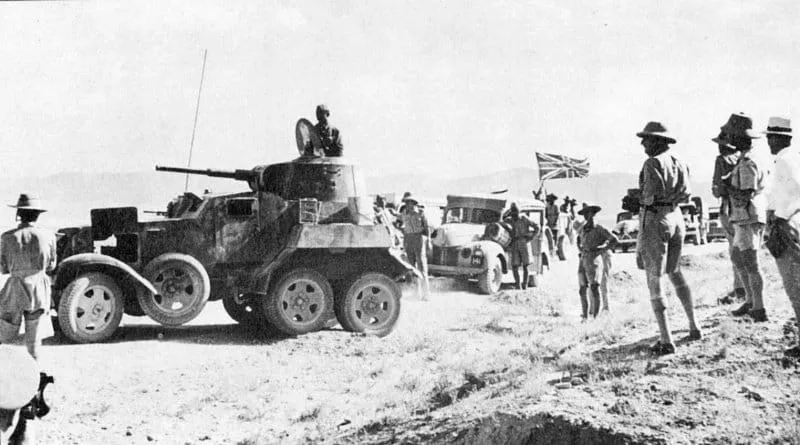
Before dawn on 25 August 1941, without a declaration of war, the forces of two great powers crossed the borders of neutral Iran. From the west and south, from Iraqi territory and from the waters of the Persian Gulf, British and Indian troops attacked, supported by ships of the Royal Navy and the Royal Australian Navy. From the north, from Transcaucasia and Soviet Turkmenistan, came three Soviet armies with the Caspian Flotilla and air support. Early in the morning the two countries’ ambassadors in Tehran, the Briton Reader Bullard and the Soviet envoy Andrei Smirnov, handed the Iranian government notes explaining that their states were compelled to take “military measures” because Iran had not removed the Germans from its territory. The British operation was code-named Operation Countenance.
It is often written that British and Soviet troops entered Iran “to secure the oil fields at Abadan and the important railways and roads to the Soviet Union along which war material was to flow”. The description is broadly accurate but needs two qualifications. There were no oil fields at Abadan; there was the largest refinery in the world at the time, owned by the British Anglo-Iranian Oil Company. The oil reached it by pipeline from the fields deep inside Khuzestan province, around Masjed Soleyman and Haft Kel. Secondly, the official reason for the invasion was neither the oil nor the supply route but the presence in Iran of German specialists and agents. All three motives were intertwined, and on top of them came each invader’s own aims.
The Shah between the powers
Since 1925 Iran had been ruled by Reza Shah Pahlavi, a former officer of the Persian Cossack Brigade who had built a centralised state, an army that was modern by the standards of the region, and a railway. Throughout his reign he manoeuvred between the two neighbours he feared most: Britain, which dominated the Persian Gulf and Iranian oil, and the Soviet Union. He sought a counterweight in Germany. In the 1930s the Reich became one of Iran’s chief trading partners; German firms built factories and bridges, and German engineers worked on the Trans-Iranian Railway, which from 1938 linked the Caspian Sea with the Persian Gulf. Reich propaganda was fond of writing about the “Aryan” kinship of Germans and Iranians.
In September 1939 Iran declared its neutrality. The number of Germans in the country was disputed from the start. The Iranian press gave a figure of just under 700 in 1940, the British legation estimated about 1,000, and reports from 1941 spoke of two or three thousand. Most were technicians, merchants and their families, but among them operated men of the Abwehr and the SS security service. Their influence caused concern not because of their numbers but because of where they worked: the railways, communications, industry, the ports. In the spring of 1941, when war with the British broke out in Iraq, Iran became a refuge for the defeated. After the surrender of Baghdad the prime minister, Rashid Ali al-Gaylani, and the Mufti of Jerusalem, Mohammed Amin al-Husseini, fled across the Iranian border, and London and Delhi concluded that Tehran might become the next centre of danger.
What decided everything was the German attack on the USSR on 22 June 1941. Britain and the Soviet Union, bound from 12 July by an agreement on joint action, began to treat Iran as a single problem. For Moscow it was the hinterland of the Caucasus and of oil-rich Baku, through which Axis armies might pass in the event of a German breakthrough in the south. For London it was the glacis of India and the shield of the Persian Gulf, and the refinery at Abadan supplied fuel to the fleet and the army in the Middle East. For both, the Trans-Iranian Railway, running from the Gulf ports to the Caspian Sea, could become the route by which British, and later American, equipment would flow to the embattled Red Army. The northern route, across the Barents Sea to Arkhangelsk, was exposed to U-boats and aircraft, and in winter to ice.
Notes and an ultimatum
The British staff had been planning the seizure of the Iranian oil fields as early as June. On 19 July Britain and the Soviet Union presented the first notes in Tehran demanding the expulsion of most of the Germans; Moscow had already sent a similar note on 26 June. Prime Minister Ali Mansur’s government promised to reduce their numbers but refused to expel them all, holding that it could not give way to pressure from one power without forfeiting its neutrality. The Shah, convinced that his neighbours would not dare go to war and that Germany would soon defeat the USSR, played for time.
On 22 July the commander of British forces in Iraq, Lieutenant General Edward Quinan, was ordered to prepare the seizure of Abadan and of the Naft-e Shah oil field near the Iraqi border. He answered to the Commander-in-Chief in India, General Archibald Wavell, who, together with his successor in Cairo, General Claude Auchinleck, pressed for a firm line towards Tehran. A joint note was announced for 12 August, but its delivery was postponed several times and took place only on 16–17 August. Formally it was not an ultimatum, but Prime Minister Mansur read it as an ultimatum in disguise. The evasive Iranian reply was judged inadequate in London and Moscow. The British were ready to strike on 22 August. At the Soviet side’s request the date was put back to 25 August, and the successive delays cost the attackers some of their surprise: in Khuzestan the Iranians reinforced the garrison at Ahvaz with tanks.
The Soviet note of 25 August invoked Article 6 of the Soviet–Persian treaty of 26 February 1921, which allowed Russia to send troops into Persia if its territory were to be used as a base for an attack on the Soviet state and the Persian government proved unable to prevent it. Iran had long maintained that this provision applied only to White émigrés from the Civil War period; in 1929, together with the USSR, it had acceded to the Litvinov Protocol, renouncing war as an instrument of policy. The British did not have even that much of a legal basis. Winston Churchill wrote after the war that this use of “overwhelming force against a weak and ancient State” was accompanied by the sense that “inter arma silent leges” – amid the clash of arms, the laws fall silent.
In the south: Abadan and Bandar Shahpur
British forces in Iraq comprised two Indian divisions and several brigades. In the south command lay with Major General Charles Harvey, commander of the 8th Indian Infantry Division, to whom a brigade of the 10th Division was also attached. The task was to seize the refinery at Abadan, the port of Khorramshahr, the oil port of Bandar Shahpur (today Bandar Imam Khomeini) and the roads to the oil fields.
The attack began on the water. At 4.10 a.m. the British sloop HMS Shoreham, lying on the Shatt al-Arab opposite Abadan, opened fire on the Iranian sloop Palang and sank her. At the same time the 24th Indian Infantry Brigade was landed from boats and ships. Most of the Iranian soldiers were asleep in their barracks and fled in lorries, but machine-gun nests along the waterfront put up resistance. The fighting took place among storage tanks and installations that the attackers did not want to damage, and according to the British report the refinery area was not cleared until 5 p.m.; the town and island of Abadan were secured the following day. At Khorramshahr the Australian sloop HMAS Yarra caught the Iranian sloop Babr alongside the quay and sank her. Ashore, the commander of the Iranian navy, Rear Admiral Gholamali Bayandor, was killed while trying to organise the defence. Commodore Cosmo Graham, commanding the British ships in the Gulf, later wrote that his death was regretted by all who had known him.
The armed merchant cruiser HMAS Kanimbla, carrying two companies of Indian infantry, entered Bandar Shahpur at dawn. The port was taken against weak resistance by 8.30 a.m. Eight German and Italian ships had been lying there since the start of the war; the crew of one managed to set her on fire, and the British seized the rest. That same morning six transport aircraft flew an infantry company to Haft Kel to protect the oil fields and the British employees and their families.
On land the 18th Indian Infantry Brigade, which had worked its way round the water obstacles during the night, entered Khorramshahr at dawn, where the fighting dragged on because armed Arabs from the palm groves joined the Iranians. The 25th Brigade took Qasr-e Sheikh. Crossing the Karun river took two days, and only on 28 August did both brigades advance on Ahvaz, which was defended by Iranian divisions with tanks. No assault took place: as the British were approaching the town, news arrived of the Shah’s order to cease fire.
In the west: the Pa-i Tak Pass
The second thrust came from the area of Khanaqin in Iraq towards the Naft-e Shah oil field and on through the Zagros Mountains towards Kermanshah and Hamadan. On 23 August command was taken over by Major General William Slim, commander of the 10th Indian Infantry Division, which had just been brought from Syria, where in June and July it had fought the Vichy forces. He had at his disposal the 2nd Indian Armoured Brigade and the British 9th Armoured Brigade – which, despite their names, travelled mainly in lorries, with a handful of light tanks of the 14th/20th Hussars – and the 21st Indian Infantry Brigade.
On 25 August the Naft-e Shah field was taken almost without a fight, and the Hussars, after a night march, cut off and captured the border town of Qasr-e Shirin. Before the town of Gilan-e Gharb the column was held up until dusk by machine-gun and anti-tank fire. The strongest Iranian position was the Pa-i Tak Pass on the road to Kermanshah. Slim did not want to assault it frontally and outflanked it via Gilan. During the night of 26–27 August the defenders, who had been bombed by the RAF the previous evening and were threatened with encirclement, abandoned the pass, and on the morning of 27 August the British entered Shahabad. The next day the Iranians occupied the hills above the village of Zibiri and brought accurate fire to bear on the road. An attack was set for 10 a.m., but just beforehand an Iranian officer arrived under a white flag asking for a truce. The British occupied Kermanshah, with its refinery, on 29–30 August without a fight.
In the north: three Soviet armies
The Soviet forces were far larger. The attack was made by the 44th and 47th Armies of the Transcaucasian Front, formed from the Transcaucasian Military District and commanded by Lieutenant General Dmitry Kozlov, and by the 53rd Army from the Central Asian Military District. They were supported by hundreds of aircraft and by Rear Admiral F. S. Sedelnikov’s Caspian Flotilla. Figures for the strength of the Soviet forces vary widely; estimates in the literature run to some 150,000 men or so and more than 1,000 tanks, mostly light T-26s.
The 47th Army crossed the Aras river at Jolfa and advanced on Tabriz, the chief city of Iranian Azerbaijan. The Iranian divisions in the area, taken by surprise and badly led, neither blew the bridges nor blocked the roads, and some commanders abandoned their men. By 26 August the Red Army held Tabriz, Ardabil and almost the whole of Iranian Azerbaijan, and later also the area around Lake Urmia. The 44th Army moved along the Caspian coast via Astara, supported by landings from the sea. At the port of Pahlavi (today Bandar-e Anzali) the Iranians scuttled barges in the harbour entrance and prevented a landing; their resistance was broken only by aircraft, which also bombed Rasht. According to some sources, some 200 civilians were killed in the air raids on Gilan province. In the east the 53rd Army entered Khorasan from Turkmenistan and took Mashhad. Soviet aircraft bombed Iranian airfields and barracks, and over Tehran they dropped leaflets warning of a massive air raid.
The collapse of the Shah’s army
Iran mobilised nine infantry divisions against the invaders. The whole army numbered, depending on the source, from over 100,000 to 200,000 men; it had about a hundred Czech light tanks, only some of them modern, and an air force made up mostly of obsolete biplanes. The army that the Shah had been building for twenty years was prepared for suppressing tribal revolts rather than for war with a great power, let alone two at once. Reza Shah refused to allow the destruction of the roads and bridges he had built himself, which made it easier for the invaders to march deep into the country.
Panic broke out in Tehran. The royal family, apart from the Shah and the Crown Prince, left for Isfahan. Military men discussed capitulation behind the monarch’s back, and when the Shah learned of it he demoted General Ahmad Nakhjavan, one of the most senior commanders, and very nearly had him shot. On 27 August Ali Mansur’s government resigned. The new prime minister was Mohammad Ali Foroughi, a veteran politician who had fallen out of favour with the Shah a few years earlier. As early as 28 August the order to cease resistance reached the units in front of Ahvaz and Kermanshah, and on 29 August firing stopped in the north as well. According to the British report, the first British patrol met the Red Army near Senneh (Sanandaj) on the evening of 29 August, and a second on 31 August near Qazvin, which Soviet troops had occupied the day before. Iran had been cut into two zones.
The losses were unequal. According to Wavell’s report, the British and Indians lost 22 killed and 42 wounded. Russian publications put Soviet losses at about forty killed. On the Iranian side, according to the most frequently cited estimates, some 800 soldiers, sailors and airmen were killed, plus several hundred civilians in air raids. The Iranian navy lost both its sloops and several gunboats.
America’s answer
On the day of the invasion Reza Shah received both ambassadors and asked why their countries had attacked Iran without declaring war. He was told that it was because of the Germans; to his question whether the troops would withdraw if the Germans were expelled, he received no answer. The Shah then made a personal appeal to Franklin Delano Roosevelt, invoking American declarations on the right of nations to independence. Only eleven days earlier the world had learned of the Atlantic Charter, in which Roosevelt and Churchill declared that their countries sought no territorial aggrandisement. At the beginning of September the President replied that he understood the Shah’s concern but accepted the assurances of London and Moscow that they had no designs on Iran’s independence or territorial integrity. The United States, still neutral, had neither the means nor the will to stand up to two states it was just beginning to support.
Place in the war
The invasion was over in a few days, but its political consequences came only in September. Foroughi’s government accepted the Allies’ terms: the closure of the German, Italian, Hungarian and Romanian legations, the handing over of Axis nationals, freedom of transit and the division of the country into a Soviet zone in the north and a British zone in the south. The Shah delayed handing over the Germans, and some of them escaped through Turkey. Soviet and British troops then advanced on Tehran. On 16 September 1941 Reza Shah abdicated in favour of his son Mohammad Reza Pahlavi; the next day the Allies entered the capital, and the new Shah took his oath before the Majlis. The British took the old monarch to Mauritius and then to Johannesburg, where he died in 1944. Several German agents, however, went into hiding in the country: Bernhard Schulze-Holthus of the Abwehr spent the following years trying to stir up the Qashqai tribe against the occupiers, while Franz Mayr of the SD built up an underground network in Tehran.
On 29 January 1942 Iran, Britain and the USSR concluded a treaty of alliance in which the powers undertook to respect Iran’s territorial integrity and to withdraw their troops no later than six months after the end of the war. Through the so-called Persian Corridor, expanded by the Americans from 1942, millions of tons of equipment, food and fuel flowed to the USSR – depending on how it is counted, between about a quarter and nearly half of the tonnage of American Lend-Lease deliveries to the Soviet Union. For Iranians the occupation meant soaring prices, food shortages and famine in 1942. Along the same route, only in the opposite direction, more than 100,000 soldiers of General Władysław Anders’s army and civilians left the USSR in the spring and summer of 1942 across the Caspian Sea to Pahlavi; for them Iran became the first refuge after years of labour camps and exile. In November and December 1943 Joseph Stalin, Roosevelt and Churchill met in Tehran for the first Big Three conference.
After the war the British withdrew in accordance with the treaty, while the Soviet Union dragged its feet and backed separatist republics in Iranian Azerbaijan and Kurdistan. It withdrew its troops only in May 1946, under pressure from the United States and after Iran had complained to the UN Security Council. The Iran crisis became one of the first disputes of the Cold War. The memory of August 1941, when two great powers broke the Shah’s army in a few days and removed him from the throne, long weighed on Iranians’ attitudes towards the British and the Russians.
Sources
Meanwhile
(04)Elsewhere, within a week.
- 28 August 1941 · Eastern FrontThe fall of TallinnOn 28 August 1941 the Germans took Tallinn. The Baltic Fleet broke through to Kronstadt via the Juminda minefields, losing dozens of ships and thousands of men.
- 20 August 1941 · Eastern FrontThe Blue DivisionOn 20 August 1941 Spain’s Blue Division, the Wehrmacht’s 250th Infantry Division, left Grafenwöhr in Bavaria by rail for the Eastern Front.
- 30 August 1941 · ScandinaviaThe first Shetland Bus voyageOn 30 August 1941 the boat Aksel sailed from Shetland for occupied Norway – the first voyage of the secret transport service known as the Shetland Bus.
- 30 August 1941 · Eastern FrontThe Yelnya offensiveOn 30 August 1941 Zhukov’s Reserve Front struck the German salient at Yelnya. A week later the Germans abandoned it – the Red Army’s first such success.
Related events
(04)The same battle, people or subject.
- 16 September 1941 · Middle EastThe abdication of Reza ShahOn 16 September 1941, as the Red Army marched on Tehran, Reza Shah abdicated for his son. The Allies then entered the capital and the new shah took his oath.
- 31 May 1941 · Middle EastBaghdad surrendersOn 31 May 1941 an armistice ending the Anglo-Iraqi War was signed outside Baghdad. Rashid Ali and the Mufti had fled to Iran; the Regent returned on 1 June.
- 18 April 1941 · Middle EastThe British land at BasraOn 18 April 1941 the 20th Indian Infantry Brigade landed at Basra; the day before, aircraft had begun flying a British infantry battalion into Shaibah.
- 1 April 1941 · Middle EastThe Iraqi coup d’étatOn 1 April 1941 the colonels of the “Golden Square” overthrew the pro-British government and regent Abd al-Ilah in Baghdad. Rashid Ali al-Gaylani took power.