Iran
Reza Shah
Minister of War (1921–1925), Prime Minister of Persia (1923–1925), Shah of Iran (1925–1941)
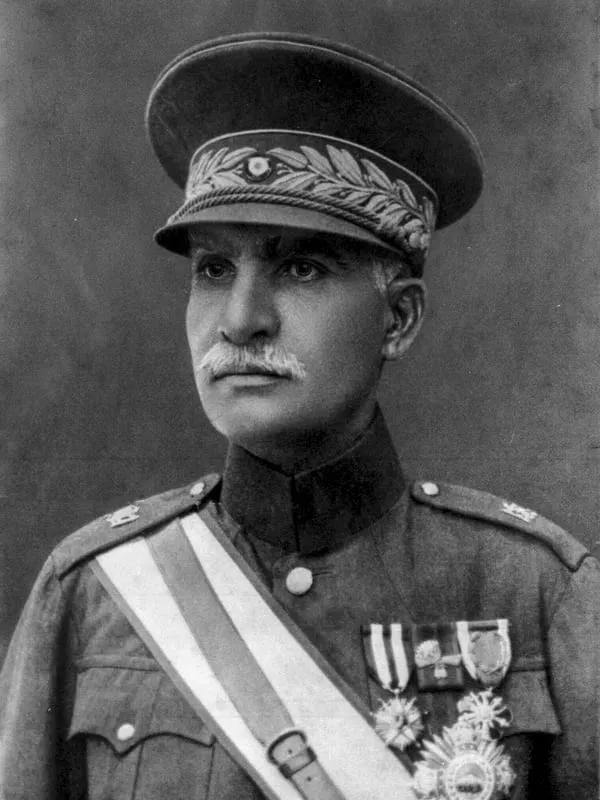
- Born:
- 15 March 1878, Alasht, Mazandaran (Persia)
- Died:
- 26 July 1944, Johannesburg (Union of South Africa)
- Author:
- Łukasz
- Photo:
- autor nieznany, domena publiczna, Wikimedia Commons

Reza Shah Pahlavi rose from a common soldier of the Persian Cossack Brigade to the throne of the shah. His coup d’état of 1921 ended a period of state collapse; in 1925 he overthrew the Qajar dynasty, and for sixteen years he ruled Iran with an iron hand, building a centralised state, a modern army, the Trans-Iranian Railway and secular schools, while crushing the resistance of the clergy, the tribes and every kind of opposition. In foreign policy he tried to free the country from British and Russian influence, and he looked to Germany as a counterweight to both. This policy turned against him when, in June 1941, Iran’s two neighbours became allies. In August 1941 their troops entered the country, and in September the shah was forced to abdicate; he died in exile.
A soldier from Mazandaran
He was born on 15 March 1878 (some sources give 16 March) in the village of Alasht in the mountainous district of Savadkuh in the province of Mazandaran on the Caspian Sea. His father, an officer of the local regiment, died a few months after his son’s birth. His mother came from a family of émigrés from the Caucasus, and after her husband’s death she moved with the child to Tehran. The boy grew up in the homes of relatives and family friends, received no proper education and wrote only with difficulty for the rest of his life.
In his early teens he joined the Persian Cossack Brigade, the only effective military formation of the Qajar state, organised and commanded by Russian officers. Tall, strong and ruthless, he excelled as a machine-gunner and was promoted quickly, although as a Persian he could not hope for the highest posts, which were reserved for Russians. During the First World War neutral Persia was a battleground for Russian, British and Turkish troops, and after the revolution in Russia it sank into chaos. In 1920 the Bolsheviks landed at the port of Enzeli and backed a Soviet republic in the province of Gilan, while the government in Tehran controlled less than half the country. At the end of 1920 the British secured the removal of the Russian officers from the brigade. In January 1921 the commander of British forces in Persia, General Edmund Ironside, judged Reza Khan to be the man who could keep the country in order after the British troops withdrew, and helped to have him given command of the Cossacks stationed at Qazvin.
Coup d’état and the road to the throne
On the night of 20–21 February 1921 Reza Khan led some three thousand Cossacks on Tehran and took the capital almost without a fight. Ahmad Shah of the Qajar dynasty had to appoint the journalist Sayyid Zia al-Din Tabatabai as prime minister, and Reza became commander of the army. Five days later the Soviet–Persian Treaty of Friendship was signed in Moscow, in which Soviet Russia renounced the tsarist privileges but reserved the right, in Article 6, to send troops into Persia should its territory be used as a base for an attack on the Soviet state. Soviet units left Gilan before the end of 1921.
Tabatabai lasted only three months; the real master of the country was Reza, from the spring of 1921 Minister of War with the title of Sardar Sepah, or commander of the army. He merged the Cossacks, the gendarmerie and other units into a single army, and over the following years broke one after another the forces that divided the country: the revolution in Gilan, the revolts in Azerbaijan and Khorasan, the Kurdish, Lur and Turkmen tribes, and finally, in 1924, the autonomy of Sheikh Khazal in Khuzestan, who had British backing. At the end of October 1923 he became prime minister, and Ahmad Shah left for Europe, never to return. In 1924 Reza tried, on the model of Mustafa Kemal Atatürk’s Turkey, to proclaim a republic, but backed down under pressure from the clergy, who saw a republic as the prelude to a secular state. He therefore chose the crown. On 31 October 1925 the Majlis declared the Qajars deposed; on 12 December a constituent assembly conferred the throne on Reza, and on 15 December he took the oath as shah. He crowned himself on 25 April 1926. As the name of the new dynasty he chose the word Pahlavi, the name of the Middle Persian language, thus recalling Iran’s pre-Islamic past.
Modernisation at bayonet point
Reza Shah wanted to turn Persia into a modern nation state within a single generation. In 1925 he introduced universal conscription and built up an army that absorbed a large share of the budget. In 1927 work began on the Trans-Iranian Railway, financed without foreign loans, mainly from taxes on sugar and tea; completed in 1938, it linked the Caspian Sea with the Persian Gulf. Thousands of kilometres of roads were built, along with state factories, a national bank, modern courts and codes on the European model, civil registration and surnames. In 1928 Persia abolished the capitulations, the legal privileges of foreigners. In 1934 the University of Tehran opened, admitting women as well. On 21 March 1935 the shah demanded that the name Iran be used abroad instead of Persia.
Reform went hand in hand with coercion. In 1928 men were ordered to wear European dress, and on 8 January 1936 a decree was issued banning women from covering their faces and heads, enforced by police who tore chadors off women in the streets. The shah took control of education and the courts away from the clergy, and when in July 1935 a crowd gathered in the mosque at the shrine of Imam Reza in Mashhad to protest against the new regulations, troops opened fire and killed dozens of people. Nomadic tribes were forcibly settled, bringing hunger and disease in their wake. The Majlis became mere decoration, the press was censored, and the shah’s closest associates ended up in prison: the Minister of Court, Abdolhossein Teymourtash, the architect of foreign policy in the 1920s, died in his cell in 1933. The shah also amassed enormous landed estates, much of them taken from their rightful owners.
Between London, Moscow and Berlin
The chief aim of the shah’s foreign policy was to curb the influence of the two powers that for a century had decided Persia’s fate. With the USSR he concluded a treaty of guarantee and neutrality in 1927, and in 1929 he acceded to the Litvinov Protocol, but he regarded Soviet trade policy as predatory and imprisoned communists at home. With Britain he quarrelled over oil. In November 1932 he unilaterally cancelled the D’Arcy concession, under which the Anglo-Persian Oil Company exploited Iran’s oilfields. The dispute went to the League of Nations, and in 1933 a new agreement was concluded that was more favourable to Iran but extended the concession until 1993, which many Iranians saw as a defeat. In 1934 the shah visited Turkey and met Atatürk, and in 1937 Iran, Turkey, Iraq and Afghanistan concluded a non-aggression pact at Saadabad.
He looked for a counterweight to London and Moscow first in the United States and, from the 1930s, above all in Germany. On the eve of the war the Reich was Iran’s main trading partner. German engineers worked in industry and on the railway, Lufthansa flew to Tehran, and Nazi propaganda stressed the “Aryan” kinship of the two peoples; the German authorities exempted Iranians from the Nuremberg Laws. Yet the shah was no ally of Hitler: he admired German technology and order, and he saw in the Reich above all a state that had no colonial interests in Iran. In September 1939 he declared neutrality.
Invasion and abdication
After the German attack on the USSR and the conclusion of the Anglo-Soviet Agreement, Iran’s neutrality became an obstacle for both powers. They wanted to secure the refinery at Abadan, the oil-producing hinterland of the Caucasus and the railway along which supplies for the Red Army could flow. The pretext was the presence in Iran of several hundred Germans – several thousand, by other estimates. The shah answered the notes of July and August evasively, convinced that his neighbours would not dare attack him and that Germany would soon defeat Russia.
On 25 August 1941 British and Soviet troops entered Iran without a declaration of war. The army that the shah had been building for twenty years fell apart within four days. Reza Shah, who would not allow the roads and bridges he had built to be destroyed, appealed for help to President Franklin Delano Roosevelt, but received only an assurance that the powers would respect Iran’s independence. On 27 August he dismissed the government of Ali Mansur and appointed as prime minister Mohammad Ali Foroughi, a politician who had fallen out of favour with him a few years earlier. Foroughi accepted the Allies’ terms, while the shah delayed handing over the Germans to them, helping some of them to get away through Turkey.
The powers no longer intended to deal with him. The BBC Persian service broadcast programmes criticising his rule and his wealth, and Soviet and British troops moved on Tehran. London even considered restoring the Qajars, but their pretender did not speak Persian. On 16 September 1941 Reza Shah signed an act of abdication, drafted by Foroughi, in favour of his eldest son, the twenty-one-year-old Mohammad Reza, and left for Isfahan the same day. The next day Allied troops entered the capital, and the new shah took the oath before the Majlis.
Exile and death
The former shah hoped to go to South America. On 27 September he sailed from Bandar Abbas on a British ship, but the British would not even let him go ashore at Bombay, and in October they took him to Mauritius, where he lived under supervision on an estate at Moka. In the spring of 1942, complaining of the climate and his health, he obtained a transfer to the Union of South Africa. He spent the last two years of his life in Johannesburg, where he died of heart failure on 26 July 1944. His body was embalmed and laid temporarily in the al-Rifa’i Mosque in Cairo, and in 1950 it was brought back to Iran and buried in a mausoleum at Rey near Tehran. The Majlis then gave him the epithet “the Great”. After the Islamic Revolution of 1979 the mausoleum was demolished.
The Iran he left behind was occupied throughout the war: the north by the Red Army, the south by the British and, from 1942, also by the Americans, who ran the supply route to the USSR. In 1942 more than a hundred thousand Polish soldiers and civilians left the USSR through the country with General Władysław Anders’s army, and in 1943 Joseph Stalin, Roosevelt and Winston Churchill met in Tehran.
Significance
Reza Shah remains a figure over whom Iranians argue to this day. His supporters see in him the founder of modern Iran, who united a fragmented country, built roads, railways, schools and a university, opened schools and public offices to women and freed the state from foreign tutelage. His opponents see a despot who stifled political life, oppressed the clergy and the tribes, enriched himself at his subjects’ expense and left behind a state in which everything depended on one man. His son continued modernisation in a similar style and lost his throne in the Islamic Revolution of 1979.
For the history of the Second World War, Reza Shah’s fate illustrates the position of small and medium-sized neutral states caught between warring great powers. His balancing policy worked as long as Britain and the USSR were hostile to each other. When they became allies in June 1941, Iran’s neutrality ceased to matter to them, and his close relations with Germany gave them a pretext. The shah, who for twenty years had defended his country’s independence against London and Moscow, lost his throne within three weeks at the very moment when the two powers acted together for the first time.
Sources
Commanded in battles
(01)Often appears with
People who appear in the same events.