United Kingdom
Edmund Ironside
Commander of Allied forces in North Russia (1918–1919), Governor of Gibraltar (1938–1939), Chief of the Imperial General Staff (1939–1940), Commander-in-Chief Home Forces (1940), Field Marshal
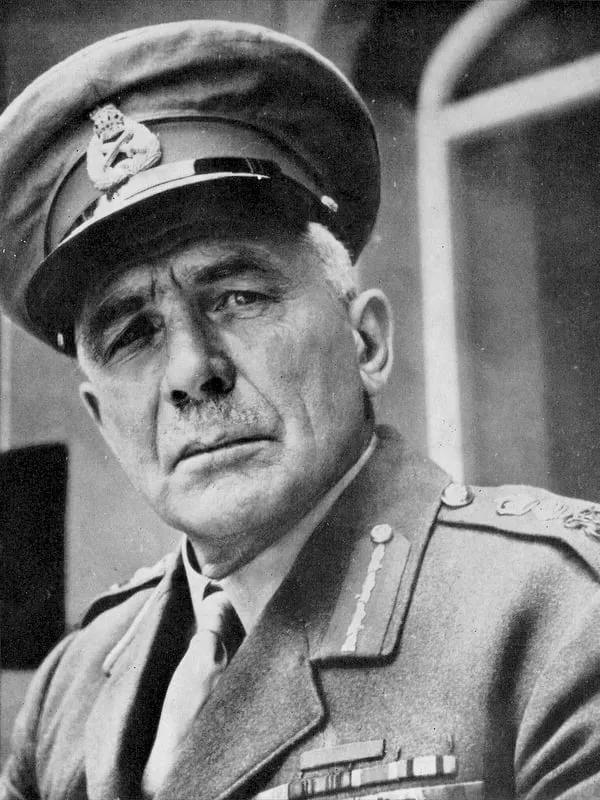
- Born:
- 6 May 1880, Edinburgh (Scotland)
- Died:
- 22 September 1959, London
- Author:
- Natalia
- Photo:
- War Office, domena publiczna, Wikimedia Commons

William Edmund Ironside, from 1941 the 1st Baron Ironside, was one of the most colourful British generals of the first half of the twentieth century. A giant of almost two metres, whom his fellow officers ironically called “Tiny”, he spoke more than a dozen languages, spied on the Germans in Africa as a young man, in 1919 commanded the Allied forces at Archangel and in Persia helped the future Shah to rise. In July 1939 he came to Warsaw for staff talks, and on 3 September he became Chief of the Imperial General Staff, the professional head of the British Army. For the first nine months of the war he was responsible for the British Army’s plans, and in the summer of 1940 he prepared the defence of the British Isles against a German invasion. His diaries are among the most important sources for the history of British military policy in 1937–1940.
Youth and the Boer War
He was born on 6 May 1880 in Edinburgh, the son of an army surgeon in the Royal Horse Artillery who died when the boy was not yet a year old. His mother, living on a modest widow’s pension, travelled with her son around the Continent, where life was cheaper. There Edmund began to learn languages. As an adult he was qualified as an official interpreter in seven and knew several others well, including Russian. He was educated at St Andrews and at Tonbridge School, and in 1898 entered the Royal Military Academy at Woolwich, where he made a name as a boxer and rugby player.
In June 1899 he was commissioned as a second lieutenant in the Royal Field Artillery and that same year left for South Africa. He fought in the field throughout the Second Boer War and was wounded several times. After the war he was part of the escort that brought the Boer commander Jan Smuts to the peace negotiations. Later, disguised as a Boer wagon driver, he gathered intelligence on the colonial troops in German South West Africa. Stories of this adventure led to his being regarded as the model for Richard Hannay, the hero of John Buchan’s spy novels. He spent the following years in India and South Africa, and in 1912 began the course at the Staff College, Camberley.
The First World War
The outbreak of war in August 1914 cut his studies short. Ironside went to France among the first staff officers of the original British Expeditionary Force, served at the bases at Boulogne and Saint-Nazaire and from the autumn on the staff of the 6th Division. In 1916 he became chief of staff of the newly formed 4th Canadian Division, which he trained and with which he fought on the Somme and, in April 1917, at the Battle of Vimy Ridge. During this fighting he several times effectively took over command of the division in place of its inexperienced commander. In the spring of 1918 he commanded the 99th Infantry Brigade on the Western Front.
Archangel, Hungary, Persia
In September 1918 Ironside was sent to North Russia, where since the summer Allied troops had held Archangel and Murmansk, officially to prevent the Germans from seizing war stores, in practice to support the opponents of the Bolsheviks. In November he took command of the whole multinational force on the Northern Dvina. It was his first independent command and one of the most exotic episodes of the Russian Civil War. For a year he travelled up and down the vast, frozen front, put down mutinies in White units and once narrowly escaped assassination. When London decided on evacuation, he handed over command to General Henry Rawlinson and returned home in the autumn of 1919. Promoted to major general, he was one of the youngest officers of that rank in the British Army. The barony he received twenty years later bore the title “of Archangel”.
In 1920 he headed a mission that supervised the withdrawal from Hungary of the Romanian troops remaining there after the Hungarian–Romanian War, and in the summer he was in Allied-occupied Turkey. In the autumn he took command of the British forces in northern Persia. Their task was to shield the country against the Bolsheviks and to prepare a withdrawal. Ironside brought about the removal of the Russian commander of the Cossack Brigade and entrusted command of the formation to Colonel Reza Khan, whom he regarded as a man capable of keeping order after the British left. In February 1921 Reza Khan carried out a coup and in 1925 became Shah as Reza Shah Pahlavi. How large Ironside’s part in this was is still debated by historians, but it is almost certain that he at least advised the plotters. In April 1921 the aircraft in which he was flying from Iraq to Persia crashed, and his long convalescence put an end to plans to give him a command in Iraq.
Between the wars
From 1922 to 1926 he was Commandant of the Staff College at Camberley. His friend J.F.C. Fuller, the theorist of armoured warfare, taught there, and Ironside also came to know Basil Liddell Hart. The two won him over to the idea of a small, mechanised professional army supported by air power. His subsequent career, however, was disappointing: he commanded a division at Aldershot and the Meerut District in India, served as Quartermaster-General in India and in 1936 took over Eastern Command in England. Everywhere he showed himself to be energetic but also brusque, which did not endear him to his superiors. In September 1937 he observed the great Wehrmacht manoeuvres and met Adolf Hitler. He returned convinced that war with Germany was coming and that the British Army was woefully unprepared for it.
In December 1937 the Secretary of State for War, Leslie Hore-Belisha, chose as Chief of the Imperial General Staff the younger Lord Gort, whom Ironside considered unsuited to the role. Ironside himself was judged too old. In November 1938 he became Governor of Gibraltar, traditionally a last post before retirement, and vigorously prepared the fortress for a siege. After only a few months, however, Hore-Belisha brought him back. From 1 July 1939 Ironside was Inspector-General of Overseas Forces, and it was widely assumed that in the event of war he would command the army sent to France.
The visit to Poland
In the second half of July 1939, roughly from 17 to 21 July, Ironside was in Warsaw. He held talks with Marshal Edward Rydz-Śmigły, Foreign Minister Józef Beck and the Chief of the General Staff, General Wacław Stachiewicz, watched exercises and was entertained in the General Staff officers’ mess. His warm, direct manner raised Polish spirits, and the very visit of so senior a general could give the impression that Britain was considering direct military assistance, which in reality was not planned. On his return Ironside gave assurances that the Polish government would not give Germany a pretext for war. According to some accounts he also warned that in the event of a German attack Poland would be quickly beaten and the eastern front would not hold for long, although in a conversation with Winston Churchill at the end of August he is said to have spoken very highly of the Polish Army. A few weeks later Poland and Britain signed their treaty of alliance.
Chief of staff in the Phoney War
On 3 September 1939, the day war was declared, Neville Chamberlain’s War Cabinet appointed Gort commander of the British Expeditionary Force and Ironside, contrary to his expectations, Chief of the Imperial General Staff. Ironside had already sent an officer to Aldershot to prepare his field headquarters. The decision was political: Hore-Belisha wanted Gort out of the War Office, and Churchill lobbied for Ironside. Ironside himself believed that by temperament he was unsuited to working in a staff and among politicians, but he accepted the appointment.
In September 1939, while Poland fought alone, Ironside was occupied mainly with organising an army that was to grow to several dozen divisions. He also considered future aid to Poland through Romania, but strongly opposed French ideas for a Balkan front. On the Western Front the British Army was to stand on the defensive alongside the French, and Ironside wanted to regain the strategic initiative through operations on the periphery. In the winter of 1939/1940 he became, alongside Churchill, the chief advocate of an expedition to Scandinavia: a landing in northern Norway was to allow the seizure of the Swedish iron-ore mines at Kiruna and Gällivare, cutting Germany off from them and at the same time helping Finland, which was fighting the Winter War. Norway and Sweden refused to let the troops pass, and on 12 March 1940 Finland made peace with the USSR, so the plan collapsed.
In April 1940 the Germans forestalled the Allies and occupied Denmark and Norway. During the Norwegian campaign Ironside struggled through endless meetings of the Cabinet and the Chiefs of Staff and with the shifting ideas of Churchill, who as First Lord of the Admiralty meddled in every detail of the operations. His most important decision was to push through the evacuation of troops from central Norway at the end of April. After 10 May he went to France, where at Lens he clashed with the French generals Gaston Billotte and Georges Blanchard, whom he judged to be resigned to defeat, and persuaded Gort and the French to mount a counter-attack, which on 21 May led to the Battle of Arras. The local success changed nothing, and Ironside finally conceded that Gort was right that evacuation was the only way out.
Home defence and retirement
On 27 May 1940 Ironside handed over the post of chief of staff to his deputy, General John Dill, and became Commander-in-Chief Home Forces, responsible for defending Britain against invasion. He had at his disposal a dozen or so poorly trained Territorial divisions, one armoured division with a handful of light tanks and the volunteers of the newly formed Home Guard. With such forces he opted for a static defence: a thin screen on the coast, roadblocks, lines of fortifications cutting London and the Midlands off from the sea, and a small reserve. The plan, approved by the Cabinet on 25 June, was soon criticised as too passive, and the RAF pointed out that many airfields would lie in front of the main line of defence. On 19 July Churchill, by now Prime Minister, replaced Ironside with General Alan Brooke. Ironside accepted his dismissal calmly.
In the summer of 1940 he received his field marshal’s baton, and in 1941 the title of Baron Ironside of Archangel. He never held another post. He settled in Norfolk, where he wrote, lectured and farmed his estate. Throughout his life he kept a diary running to nearly a million words. A selection from the years 1937–1940 was published in 1962 as The Ironside Diaries, after his death. He died on 22 September 1959 in London, in a military hospital to which he had been taken after a fall at home. He was buried with military honours at Hingham in Norfolk.
Assessment
Ironside was not one of the great commanders of the Second World War, and his tenure in 1939–1940 is associated with the defeats in Norway and France. He was, however, a man of rare courage, intelligence and experience, who had known war in Africa, France, Russia and the Middle East and understood the importance of mechanisation before others did. In the 1930s his close ties with Fuller, who went over to the British fascists, and his attendance at meetings of Anglo-German societies aroused the suspicion of the security services. The far right even mentioned his name in its fantasies about seizing power, although there is nothing to suggest that Ironside knew of this or had anything to do with it. For Poland he remained the general of July 1939, whose visit raised hopes of help that Britain was neither able nor willing to give in 1939.
Sources
Mentioned in battles
(01)Often appears with
People who appear in the same events.