Germany
Walter Schellenberg
Head of counter-intelligence in the Gestapo (1939–1941), head of SD foreign intelligence – Office VI of the RSHA (1941–1945), SS-Brigadeführer (1944)
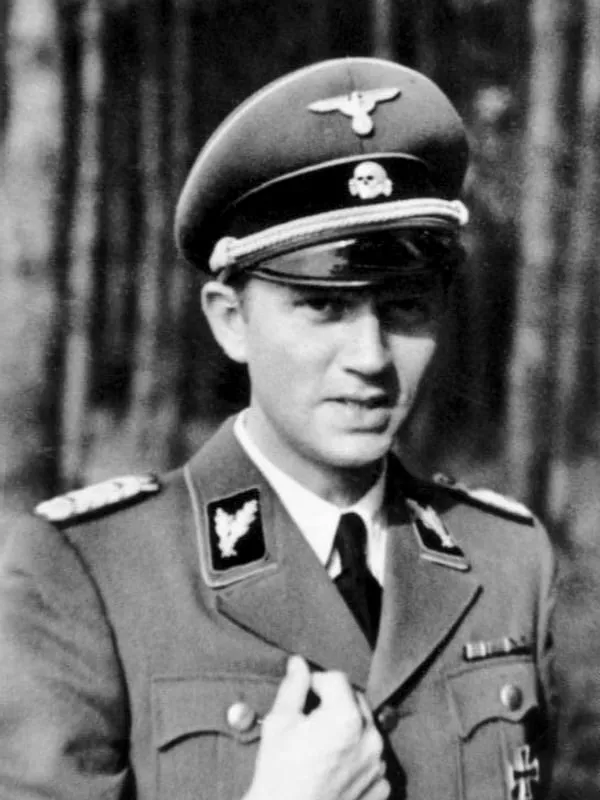
- Born:
- 16 January 1910, Saarbrücken (German Empire)
- Died:
- 31 March 1952, Turin (Italy)
- Author:
- Łukasz
- Photo:
- Alber, Kurt, CC BY-SA 3.0 DE, Wikimedia Commons

Walter Schellenberg was the youngest of the senior officials of the SS security apparatus and one of the most influential. A trained lawyer, elegant and fluent in French and English, he was quite unlike the brawlers of the Nazi movement’s early years, but he served the same system. As a subordinate of Reinhard Heydrich he helped to build the Reich Security Main Office; in November 1939 he organised the kidnapping of two British intelligence officers at Venlo; and from 1941 he ran SS foreign intelligence, which in 1944 absorbed what was left of the military Abwehr. He signed orders connected with the preparation of the Holocaust and was responsible for operations in which Soviet prisoners of war lost their lives. In the last months of the war, convinced that defeat was certain, he urged Heinrich Himmler to negotiate with the Western Allies and helped to secure the release of some of the camp prisoners. Tried at Nuremberg, he came away with a sentence of six years’ imprisonment, and his self-serving memoirs shaped the image of Third Reich intelligence for decades.
Early life
He was born on 16 January 1910 in Saarbrücken, the youngest of the seven children of Guido Schellenberg, a piano maker and dealer. After the First World War, when the Saar basin came under League of Nations administration and French economic control (the Territory of the Saar Basin) and his father’s business declined, the family moved to Luxembourg. Schellenberg returned to Germany to study: in 1929 he began medicine at the University of Marburg, but soon switched to law at the University of Bonn. Like many young men of his generation who later ended up in the SS security service, he carried from childhood the sense of insecurity bred by the post-war crisis and the collapse of the family business.
Soon after the Nazis came to power, on 1 May 1933, he joined the NSDAP and the SS. Years later he explained that he chose the SS because it attracted “a better class of people”, and also because membership made a career in the civil service easier. While still a student he began supplying information to the Sicherheitsdienst (SD), the SS party intelligence service; by his own account he was recruited by two of his lecturers who were themselves informants of the service. After graduating, in the mid-1930s, he moved to SD headquarters in Berlin.
In Heydrich’s service
Heydrich quickly recognised the young lawyer’s abilities. Schellenberg worked in SD counter-intelligence and dealt with foreign matters from his very first assignments: in the mid-1930s he travelled to France, and in 1937 to Italy, where he helped to prepare security arrangements for a visit. In March 1938 he accompanied Himmler and Heydrich to Vienna during the Anschluss, when the SD was seizing the files of the Austrian police and intelligence services. According to his memoirs, on the aircraft he saved Himmler from falling out through a badly closed door, which earned him the gratitude of the Reichsführer-SS. In March 1939 he was in Prague during the occupation of Bohemia and Moravia. In the same year he was promoted to SS-Sturmbannführer.
Schellenberg belonged to the group of lawyers and organisers who helped Heydrich merge the state police with the party security service. In February 1939 he drew up a memorandum on the further centralisation of the police apparatus, and when the Reich Security Main Office (RSHA) was created on 27 September 1939, he took charge of its group IV E – counter-intelligence within the Gestapo office headed by Heinrich Müller. He was also responsible for the security of the leadership on their travels, including Hitler’s visit to conquered Warsaw at the beginning of October 1939. His private life was troubled: his first marriage, to the seamstress Käthe Kortekamp in 1938, quickly broke down, and in 1940 he married Irene Grosse-Schönepauk, with whom he had five children.
Venlo
In the autumn of 1939 Schellenberg led the operation that made his name. Under the alias “Hauptmann Schämmel” he posed, before two officers of the British Secret Intelligence Service in the Netherlands, Major Richard Stevens and Captain Sigismund Payne Best, as the representative of a group of Wehrmacht officers who wanted to overthrow Hitler and make peace. When on the evening of 8 November Georg Elser’s bomb exploded in the Munich beer hall that Hitler had left some fifteen minutes earlier, Hitler ordered the game to be ended. On 9 November at Venlo, on the Dutch–German border, SS men from Alfred Naujocks’s squad seized both Britons, and the Dutch officer accompanying them, Dirk Klop, was mortally wounded. German propaganda then presented the kidnapped men as the instigators of the assassination attempt, and the presence of a Dutch officer as proof that the Netherlands was violating its neutrality. Hitler awarded Schellenberg the Iron Cross, First and Second Class. The operation strengthened the SD’s position against the Abwehr and made Schellenberg the man entrusted with foreign affairs.
SS foreign intelligence
In 1940, ahead of the planned invasion of Britain (Operation Sea Lion), Schellenberg oversaw the preparation of a handbook on British institutions for the occupation authorities. Attached to it was a list of people to be arrested immediately, containing more than 2,000 names, from Winston Churchill to writers and émigrés from Germany. Some of the information came from the interrogations of Stevens and Best. The extent of Schellenberg’s personal part in compiling these materials is a matter of dispute. In July 1940, at the request of Foreign Minister Joachim von Ribbentrop, he flew to Lisbon to persuade the Duke of Windsor, the former King Edward VIII, to remain in Europe, and if necessary even to abduct him. The plan failed: on 1 August the Duke sailed for the Bahamas, where he took up the post of governor.
In 1941 Schellenberg took part in the preparations for war with the Soviet Union. By his own account he conducted talks on Heydrich’s behalf with the army high command about the rules under which the Einsatzgruppen would operate behind the front, ending in an agreement that gave these units a free hand to murder the civilian population. On 20 May 1941 he signed an RSHA circular banning the emigration of Jews from France and Belgium “in view of the undoubtedly approaching final solution of the Jewish question”, which shows that he knew where the regime’s policy was heading. In mid-1941, after the discredited Heinz Jost was removed from office, he took over Office VI of the RSHA, the SD’s foreign intelligence service, initially in an acting capacity and formally in 1942. In 1944 he became an SS-Brigadeführer and Generalmajor of Police, one of the youngest generals in the SS.
His Office VI ran operations on every continent, generally with meagre results. In 1942 Schellenberg launched the “Zeppelin” undertaking: Soviet prisoners of war were recruited, trained and dropped behind Red Army lines as saboteurs and spies. Most of them were killed or went over to the Soviet side, and many prisoners judged unsuitable or unreliable were handed over to camps, where they were murdered. He was also in charge of Operation Bernhard, in which prisoners at Sachsenhausen forged British banknotes on a massive scale. Together with the Gestapo he broke up the Soviet intelligence network known as the Red Orchestra, which is sometimes considered his greatest success. He maintained contacts with the head of Swiss intelligence, Roger Masson (PL), which both sides used for their own ends. Legend also links him with Salon Kitty, a Berlin brothel bugged by the SS, but the story, popularised after the war by a novel and a film, is not borne out by the sources.
Schellenberg’s ambition, like Heydrich’s, was to bring all of the Reich’s intelligence under the SS. He had a social relationship with the head of the Abwehr, Admiral Wilhelm Canaris, including rides together in Berlin’s Grunewald, and at the same time a rivalry. In February 1944 Hitler abolished the Abwehr as an independent institution, and after the attempt on Hitler’s life on 20 July 1944 Schellenberg personally arrested Canaris. Military intelligence, as the “Mil” Office, came under his direction. Schellenberg thus became in practice the head of the Third Reich’s entire foreign intelligence, although within the RSHA he was hampered by the hostility of his superior, Ernst Kaltenbrunner, Heydrich’s successor.
Talks with the West
According to his own memoirs, Schellenberg had concluded as early as 1942 that Germany could not win the war, and began urging Himmler to seek peace with the Western Allies, if necessary without Hitler or against him. He sounded out various channels: in December 1943 in Stockholm, through Himmler’s masseur Felix Kersten, he met the American businessman Abram Hewitt, who had links with American intelligence. Himmler, however, wavered and made no decision.
In the last months of the war these soundings took the form of bargaining over the lives of prisoners. Himmler and Schellenberg treated the Jews in the camps as a bargaining chip with the West. Through the former President of Switzerland Jean-Marie Musy, they arranged for a train carrying some 1,200 Jews from the Theresienstadt ghetto to leave for Switzerland in February 1945. When Hitler learned of it, he forbade any further transports. At the same time Schellenberg was holding talks with the vice-president of the Swedish Red Cross, Count Folke Bernadotte, whom he brought to Himmler. The result was the White Buses operation, in which more than ten thousand camp prisoners were taken to Sweden in the spring of 1945, most of them Scandinavians, but also thousands of women from Ravensbrück, many of them Polish. On the night of 23–24 April 1945 in Lübeck, Himmler asked Bernadotte to pass on to the Western Allies an offer of surrender in the west. The Allies rejected it, demanding surrender to all of them, and Hitler, on learning of it from the radio on 28 April, stripped Himmler of all his posts. Schellenberg’s part in saving prisoners was real, but his motives – to save the Reich from the Red Army and himself from accountability – were already viewed with great caution at Nuremberg.
Trial and death
Schellenberg spent the last days of the war in Denmark and Sweden, trying to negotiate the surrender of the German forces in Scandinavia. In June 1945 he fell into British hands; the British took him to London and interrogated him for many months at a special intelligence centre, regarding him as one of the most valuable sources of knowledge about the German services. He testified before the International Military Tribunal at Nuremberg as a prosecution witness, incriminating the SS apparatus and his former colleagues.
He himself stood trial before an American military tribunal at Nuremberg in the so-called Ministries (Wilhelmstrasse) Trial, in which diplomats, ministers and senior officials of the Reich were tried. In April 1949 he was sentenced to six years’ imprisonment, counted from June 1945, for membership of criminal organisations and for complicity in the killing of Soviet prisoners of war used in the “Zeppelin” undertaking. The court took into account in his favour that he had helped the regime’s victims at the end of the war, although it doubted the purity of his intentions. He was released early from prison in Landsberg because of a serious liver disease (at the end of 1950 according to most sources, in 1951 according to some). He went to Switzerland and then settled at Pallanza on Lake Maggiore in Italy, where he worked on his memoirs. He died in Turin on 31 March 1952, at the age of 42.
Significance and memory
Schellenberg’s memoirs, published posthumously in English in 1956 as The Labyrinth and later in many languages, including Polish, became one of the most popular sources on Third Reich intelligence. Historians treat them with reserve: the author presents himself as a skilful professional, sceptical of ideology, an almost unwilling participant in the system and an advocate of peace, while omitting or playing down his own part in the crimes. Research based on the archives, including the records of his post-war interrogations, shows a man deeply involved in building the apparatus of terror, who knew perfectly well what the Einsatzgruppen were doing and where the policy towards the Jews was leading.
In popular culture it is rather the image from his memoirs that has stuck. In the Soviet Union and in Poland the 1973 television series Seventeen Moments of Spring won enormous popularity; in it Schellenberg, an intelligent and ironic interlocutor of the Soviet agent Stirlitz, was played by Oleg Tabakov. For the history of the war, Venlo remains more important: an operation that for years undermined London’s trust in the German opposition and gave Hitler yet another pretext for attacking a neutral country – together with the bureaucratic career of a young lawyer who rose without scruple in an organisation responsible for genocide.
Sources
Often appears with
People who appear in the same events.