United Kingdom
Edward VIII
Prince of Wales (1910–1936), King of the United Kingdom and the Dominions, Emperor of India (1936), Duke of Windsor (from 1937), Governor of the Bahamas (1940–1945)
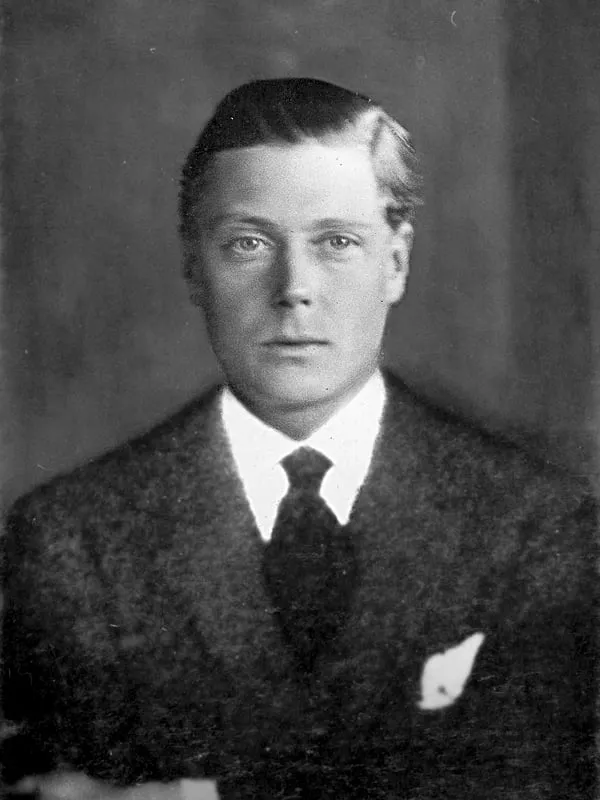
- Born:
- 23 June 1894, Richmond (United Kingdom)
- Died:
- 28 May 1972, Paris (France)
- Author:
- Natalia
- Photo:
- Lafayette, domena publiczna, Wikimedia Commons

Edward VIII was the most popular heir to the throne in British history and one of its shortest-reigning kings. In the 1920s, as a charming and modern Prince of Wales, he was the most photographed man in the world. He spent a mere 326 days on the throne, from 20 January to 11 December 1936, before he abdicated in order to marry the twice-divorced American Wallis Simpson. He matters to the history of the period not only because of the crisis he caused but also because of his political sympathies. Edward admired the new Germany; in 1937, as Duke of Windsor, he visited Hitler, and in 1940 he became the object of intrigues by German intelligence. Historians still argue over how far his sympathy for Nazism went, but no one disputes that it was better for Britain that his brother sat on the throne during the war.
Childhood and youth
Edward Albert Christian George Andrew Patrick David, known in the family as David, was born on 23 June 1894 at White Lodge in Richmond, near London, the eldest son of the Duke of York, the future King George V, and Mary of Teck. His last four names honoured the patron saints of England, Scotland, Ireland and Wales. He was brought up by nannies and strict tutors, and he never found common ground with his father, who demanded military discipline from his sons. He was educated at the naval colleges at Osborne and Dartmouth. In May 1910 his father became king, and on 23 June, his sixteenth birthday, Edward was created Prince of Wales. A ceremonial investiture was staged in 1911 at Caernarfon Castle at the initiative of the Welsh politician David Lloyd George, who taught him a few sentences of Welsh. The prince then spent two years at Oxford without taking a degree.
War and travels
In June 1914 he joined the Grenadier Guards. He wanted to fight at the front, but the Secretary of State for War, Lord Kitchener, would not allow it, since the capture of the heir to the throne would have been a disaster. Edward served on staffs in France, Italy and Egypt, but often visited the front-line trenches, for which he was awarded the Military Cross in 1916. The war, in which many of his friends were killed, shaped his views: he later said that the memory of “endless scenes of horror” had made him a supporter of peace at any price.
Between 1919 and 1935 he made sixteen tours of the Empire and the world. He visited Canada, the United States, Australia, India, Japan, Africa and South America. Everywhere crowds greeted him, and men all over the world copied the way he dressed. At the same time, in his letters from these tours, he expressed racist convictions that were typical of men of his class but which he voiced with exceptional crudeness. He also visited the industrial districts of England and Wales hit by unemployment, which made him popular among working people.
The prince and politics
His father was worried by his son’s way of life. Edward did not want to marry, and his successive partners were married women, above all Freda Dudley Ward and Thelma Furness. In 1930 he moved into Fort Belvedere in Windsor Great Park, and in January 1931 Thelma Furness introduced him to her friend Wallis Simpson, the wife of Ernest Simpson. From 1934 they were, it is generally believed, lovers, and Wallis gained an influence over the prince that worried the court, the government and the police, who kept them under discreet watch.
His views were worrying too. The prince believed that Britain should come to an understanding with Germany, and he regarded communism as a greater danger than fascism. In June 1935, at a conference of the British Legion, he called on the veterans to hold out a hand to their former German enemies, for which his father rebuked him for meddling in foreign policy. In Berlin his words were received with delight. Hitler saw the prince as a future ally, and German relatives and diplomats, among them his cousin Charles Edward, Duke of Saxe-Coburg and Gotha, encouraged him in this belief.
King
On 20 January 1936 George V died and Edward became king. From the start he broke with custom: he watched the proclamation of his accession from a window of St James’s Palace together with Wallis Simpson, and he flew to London by aeroplane, the first monarch in history to do so. It soon became clear that he had no patience for the daily work of a king. State papers piled up at Fort Belvedere and came back stained, and ministers suspected that guests were reading them. Edward made no secret of his dislike of the sanctions imposed on Italy over the war in Ethiopia and, according to some biographers, did not want to receive the exiled Emperor Haile Selassie.
In March 1936 Hitler sent troops into the Rhineland. According to the post-war memoirs of Fritz Hesse, an official of the German embassy in London, the King is supposed to have told Ambassador Leopold von Hoesch at the time that he had summoned the Prime Minister and threatened to abdicate if the government started a war. Historians have found no confirmation of this account in British documents and treat it as unverified. In any case, Stanley Baldwin’s government had no intention of opposing Germany by force of arms.
In the summer of 1936 the King went on a Mediterranean cruise with Wallis Simpson aboard the yacht Nahlin. On 27 October a court in Ipswich granted the Simpsons a decree nisi. On 16 November Edward told Baldwin that he intended to marry her. The government, the Church of England and the prime ministers of the Dominions decided that a divorcee with two living former husbands could not become queen, and they also rejected the idea of a morganatic marriage. In those same weeks the King visited unemployed miners in South Wales and uttered his famous “Something must be done”, which politicians took as yet another intrusion into their sphere. At the beginning of December the affair became public. Edward, whom Baldwin would not allow to appeal to the nation by radio, chose abdication. On 10 December he signed the instrument of abdication, and on 11 December he gave assent to the Abdication Act. That evening, in a radio broadcast, he said that he could not discharge the duties of king “without the help and support of the woman I love”. His brother succeeded him as George VI.
Duke of Windsor
The new King gave his brother the title of Duke of Windsor. Edward went to Austria, and on 3 June 1937 he married Wallis in France, at the Château de Candé. The royal family did not attend the wedding, and George VI refused the Duchess the style of Her Royal Highness. Disputes over money, titles and the right to return home poisoned relations between the brothers for years.
In October 1937, against the government’s advice, the Duke and Duchess toured Germany at the invitation of the head of the German Labour Front, Robert Ley. The tour was arranged by the French industrialist Charles Bedaux. They visited factories, including plants working for rearmament, and workers’ housing estates; the Duke inspected troops; they were guests of Hermann Göring at Carinhall and dined with Rudolf Hess, and they met Joseph Goebbels and Joachim von Ribbentrop. On 22 October the Duke talked with Adolf Hitler at the Berghof. The notes of this conversation were lost during the war. German propaganda showed photographs of the Duke returning Nazi salutes. In 1966 Edward himself wrote that Hitler had argued to him then that it was in the interest of England and Europe for Germany to be directed eastwards to deal with communism, while the rest could look on from the sidelines. A trip to the United States planned after the German visit was cancelled following protests by American trade unions.
The Windsors settled in Paris. In May 1939 the Duke broadcast an appeal for peace from the battlefield of Verdun, which was taken as support for the policy of appeasement. The BBC refused to carry it.
The war
After war broke out in September 1939 the Duke returned briefly to England and was then attached as a major general to the British military mission with the French Army. When the Germans attacked France in May 1940, the Windsors fled south and from there to Franco’s Spain and to Portugal. The Germans tried to exploit this. According to historians’ findings, based on German Foreign Ministry documents, Ribbentrop instructed Walter Schellenberg to carry out an operation codenamed “Willi”, which was to persuade the Duke to remain on the Iberian Peninsula and, if necessary, to abduct him. German diplomats assured Berlin in their reports that the Duke was ready to play a part in concluding peace. Winston Churchill threatened Edward with a court martial if he did not return to British territory and appointed him Governor of the Bahamas. On 1 August 1940 the Windsors sailed from Lisbon.
Edward governed the Bahamas until March 1945. The islanders remembered his efforts to combat poverty, but also his racist and antisemitic remarks and the bungled investigation into the murder of the millionaire Harry Oakes in 1943. In an interview with an American magazine in 1941 he is said to have called Hitler “the right and logical leader of the German people”, which he later denied. The German Foreign Ministry files captured by the Americans in 1945 – the so-called Marburg Files – containing reports of conversations with the Duke in 1940, were kept secret by the British government for more than a decade. They were published only at the end of the 1950s.
Last years
After the war the Windsors returned to France and led the life of wealthy society figures in Paris and New York. Edward was never again given an official role. In 1951 he published his memoirs, A King’s Story, in which he admitted that he had admired the Germans but denied that he had been a Nazi, and described Hitler as a “somewhat ridiculous” figure. In private, however, according to acquaintances, he could say that Hitler “was not such a bad chap after all”. He was only partly reconciled with his family. In 1952 he came to his brother’s funeral, but not to the coronation of his niece, Elizabeth II. In 1971 he received in Paris Emperor Hirohito, whom he had met half a century earlier. He died of throat cancer on 28 May 1972 at his home in Paris, ten days after a visit from the Queen. He was buried at Windsor, in the Royal Burial Ground at Frogmore. Wallis died in 1986 and was laid to rest beside him.
Significance
Edward VIII has gone down in history above all as the hero of a romance that cost him his crown. Historians stress, however, that the abdication was not solely a matter of morality. A king who disregarded his ministers, meddled in politics and made no secret of his sympathy for Germany was a problem for the government even before the marriage crisis. There is no evidence that he wanted to betray his country, and theories of a conspiracy to remove him from the throne for political reasons are speculation. What is certain is that the Nazis pinned hopes on him and in 1940 tried to make use of him. Thanks to the abdication, the symbol of British resistance in the war years was not he but his brother, George VI.
Sources
Often appears with
People who appear in the same events.