Germany
Franz Halder
Chief of the Army General Staff (1938–1942), Colonel General
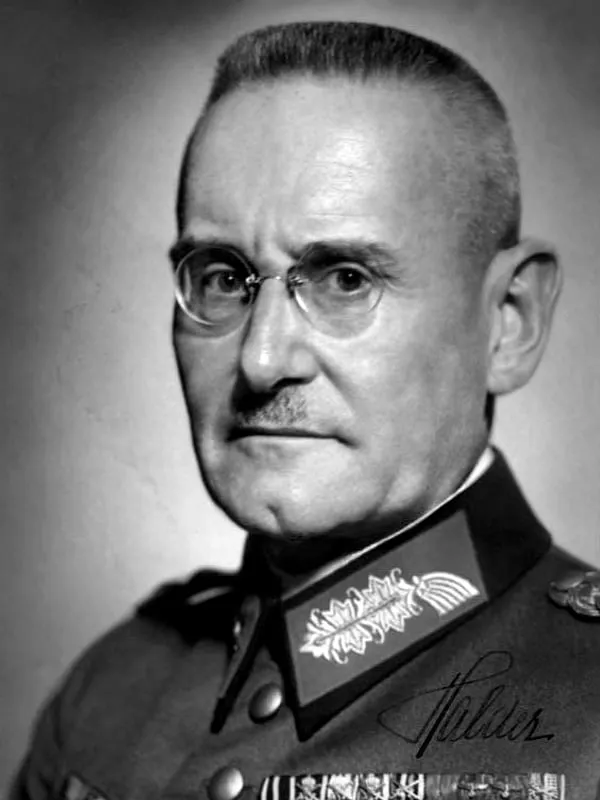
- Born:
- 30 June 1884, Würzburg (Kingdom of Bavaria, German Empire)
- Died:
- 2 April 1972, Aschau im Chiemgau (West Germany)
- Author:
- Natalia
- Photo:
- autor nieznany, CC BY-SA 3.0 DE, Wikimedia Commons

From September 1938 to September 1942 Franz Halder was Chief of the General Staff of the German Army, and thus the chief planner of the campaigns by which Hitler conquered most of Europe: in Poland, France and the Balkans, and the war against the Soviet Union. A pedantic Bavarian officer who looked more like a professor than a general, he belonged to a conspiracy against Hitler in 1938 and in the autumn of 1939 again contemplated a coup. Each time he drew back. His staff prepared the orders that turned the war in the east into a war of annihilation. Hitler dismissed him in 1942, and after the 20 July plot of 1944 Halder was sent to a concentration camp. After the war, as head of the German group in the US Army’s historical division, he spent well over a decade shaping a picture of the war in which Hitler alone was to blame, while the generals and their soldiers had fought honourably. His diary for 1939–1942 remains one of the most important sources for the history of the war.
A Bavarian staff officer
Franz Halder was born on 30 June 1884 in Würzburg into a family that had been bound up with the Bavarian army for three hundred years. His father, Maximilian, rose to the rank of Generalmajor. After finishing secondary school in Munich, Halder joined the 3rd Bavarian Field Artillery Regiment, commanded by his father, as an officer cadet in July 1902, and in 1904 he was commissioned as a second lieutenant. In 1907 he married Gertrud Erl, who also came from a military family; they had three daughters. From 1911 to 1914 he studied at the Bavarian War Academy, graduating top of his year.
During the First World War he served as a staff officer on the Western Front – with the Bavarian III Corps in Lorraine, the 6th Bavarian Division, the staff of the 2nd Army and the 5th Division, briefly in the east, and from 1917 with the army group of Crown Prince Rupprecht of Bavaria. He ended the war as a captain, holding the Iron Cross First Class and several Bavarian decorations.
In the Reichswehr and at Hitler’s side
Halder stayed on in the Reichswehr. He worked in the ministry as a specialist in tactics and training, among other places in the department headed by Walther von Brauchitsch, served in a Bavarian artillery regiment and on the staff of the 7th Division, and from 1929 was chief of staff of the 6th Division in Münster with the rank of colonel. Like many officers, he at first kept the Nazis at arm’s length. But the army was growing, and his career with it: in 1934 he became a Generalmajor, in October 1935 commander of the 7th Infantry Division in Munich, and in 1936 a Generalleutnant. He headed the staff directing the Wehrmacht’s manoeuvres, and at the 1937 manoeuvres he caught Hitler’s eye. From the autumn of 1937 he worked in the General Staff in Berlin, and on 1 February 1938 he was promoted to General of Artillery.
On 18 August 1938 the Chief of the General Staff, Ludwig Beck, resigned in protest against the plans for war with Czechoslovakia. On 1 September Halder, who shared Beck’s misgivings, took over the post. He made contact with officers and officials who were preparing to arrest Hitler the moment he gave the order to attack, with Brauchitsch to take the lead in the coup. It never happened, because the Munich Agreement handed Hitler the Sudetenland without a war. Halder was reportedly close to a breakdown. “What more can we do? He succeeds at everything,” he is said to have remarked. From then on he worked on the war plans without reservation. The new regulations for staff service issued in August 1939 abolished the traditional right of a staff officer to put on record in writing his dissent from a commander’s decision.
The plan for war with Poland
Halder was the principal author of the military part of Case White. His staff drew up the deployment directive issued by Brauchitsch on 15 June 1939: two army groups were to strike from East Prussia, Pomerania, Silesia and Slovakia and trap the main Polish forces in an encirclement west of the Vistula and the Narew. In an address to General Staff officers in the spring of 1939, whose text was found in the archives and published in the 1990s, Halder predicted that Poland would be swiftly crushed. On 14 August he began keeping a diary in which he recorded conversations and decisions day by day. On 23 May and 22 August he heard Hitler’s speeches announcing war and the “complete destruction of Poland”, and on 25 August at 3.02 p.m. he noted the order to attack, which was called off a few hours later.
During the September Campaign Halder directed the work of the OKH, the Army High Command, which redeployed troops when the Poles struck on the Bzura and decided on the encirclement of Warsaw. He knew what was happening behind the front. The campaign plans provided for “security” tasks in the armies’ rear areas to be carried out by the operational groups of the Security Police and the SD. Under the date of 19 September 1939 Halder recorded in his diary the account given by the Quartermaster General, Eduard Wagner, of a conversation with Reinhard Heydrich about the planned “housecleaning” of Jews, the intelligentsia, the clergy and the nobility. He did not protest, and when army officers reported crimes committed by the SS and police in the course of Operation Tannenberg, the OKH did not back them. On 27 October 1939 Halder received the Knight’s Cross of the Iron Cross.
From conspiracy to Barbarossa
In the autumn of 1939 Hitler wanted to attack France as early as November. Halder believed the army was not ready and once more talked with the conspirators, among them Colonel Hans Oster and Carl Goerdeler. When on 5 November Hitler berated Brauchitsch and threatened the “spirit of Zossen”, Halder panicked, ordered some of the documents destroyed and broke off the preparations. He later explained that his oath and the war forbade rebellion in the face of the enemy. Together with Brauchitsch he rejected the plan for a thrust through the Ardennes put forward by Erich von Manstein, but once Hitler adopted it, the OKH worked it out in detail. After the victory over France Halder was promoted to Colonel General on 19 July 1940. He also received secret payments from Hitler that doubled his salary.
As early as June and July 1940, before Hitler issued a formal order, Halder had his staff study the possibility of attacking the USSR. His plans went into Directive No. 21, “Barbarossa”, of 18 December 1940. On 30 March 1941 he noted Hitler’s words about a “war of annihilation” in which a communist was no comrade-in-arms. The OKH, with Halder’s involvement, prepared the decree restricting military jurisdiction over the Soviet population and the Commissar Order. On 3 July 1941 Halder wrote that the campaign against Russia had been won within fourteen days; on 11 August he admitted that he had underestimated the “Russian colossus”. After the defeat before Moscow and Brauchitsch’s dismissal he worked directly with Hitler, who had taken over command of the army himself. In the summer of 1942 they quarrelled over the summer offensive towards the Caucasus and Stalingrad. On 24 September 1942 Hitler dismissed Halder and replaced him with General Kurt Zeitzler.
Prisoner and historian
After the 20 July plot of 1944 the Gestapo established that Halder had taken part in the conspiracies of 1938–1939. Arrested on 23 July, he was held as a special prisoner in the Flossenbürg and Dachau camps. His wife shared his imprisonment. On 31 January 1945 he was formally expelled from the army. At the end of April SS men took a group of special prisoners, among them Léon Blum and Kurt Schuschnigg, to South Tyrol. There, at the beginning of May, they were taken over by Wehrmacht soldiers and then by the Americans. Halder spent several months in American captivity.
At Nuremberg he was a witness, not a defendant. Together with Brauchitsch, Manstein and others he wrote a memorandum on the German army in 1920–1945 that portrayed the military as apolitical and free of guilt. In 1948 a German denazification tribunal classified him as “exonerated”. A Bavarian prosecutor appealed when Halder’s diary showed that he had taken part in preparing the criminal orders, but the Americans would not allow him to be questioned again, and in 1950 the case was dropped.
From 1946 to 1961 Halder headed the German section of the US Army’s historical division, in which several hundred former Wehrmacht officers wrote more than 2,500 studies of the war. Halder controlled their content and insisted that they show the soldiers’ efforts, incriminate no one and refrain from criticising the decisions of the high command. In 1949 he published the book Hitler als Feldherr (“Hitler as Warlord”), in which the entire blame for the war in the east, for its defeats and its crimes, fell on Hitler. In 1961 the US Army awarded him a decoration for meritorious civilian service. His war diary was published in 1962–1964. He died on 2 April 1972 in Aschau im Chiemgau in Bavaria.
Assessment
Halder was a superb technician of war but a weak strategist, who underrated logistics and overrated the power of a swift blow. Twice he came close to rebellion and twice he drew back; the historian Christian Hartmann, his biographer, writes that for Halder resistance to Hitler was about the pace and risk of the war, not its aims. The plans he prepared opened the way to crimes in Poland and in the USSR, and he himself took note of them without objection. After the war, exploiting the trust the Americans placed in him during the Cold War, he created an influential version of history in which the generals were professionals deceived by a dictator. Scholars such as Bernd Wegner and Wolfram Wette regard him as one of the chief architects of the myth of the clean Wehrmacht.
Sources
Mentioned in battles
(16)- Invasion of Poland
- Battle of Dunkirk
- Rommel’s first offensive
- Siege of Tobruk
- Battle of Białystok–Minsk
- Operation Barbarossa
- Continuation War
- Battle of Kiev (1941)
- Battle of Smolensk (1941)
- Siege of Leningrad
- Battle of Moscow
- Battle of Rostov (1941)
- Rzhev–Vyazma offensive (1942)
- Second Battle of Kharkov
- Case Blue
- Operation Uranus
Often appears with
People who appear in the same events.
On the timeline
(62)The 40 most important of 62 events. All tagged “Franz Halder” (3) →
1938
1939
April
June
August
September
- 01
- Key eventGermany invades PolandAt dawn on 1 September 1939 the Wehrmacht attacked Poland from the north, west and south without declaring war. The Slovak army struck alongside the Germans.
- The bombing of WieluńOn the morning of 1 September 1939 Luftwaffe dive-bombers destroyed central Wieluń, a town with no troops or air defences. The first bombs hit its hospital.
- Operation TannenbergOn 1 September 1939 Security Police and SD Einsatzgruppen followed the Wehrmacht into Poland, carrying lists of names to “neutralise” Poland’s leading strata.