- Category:
- Crimes and repression
- Front:
- Scandinavia
- Date:
- 30 September 1943
- Author:
- Łukasz
- Tags:
- Denmark, Holocaust, Sweden, resistance
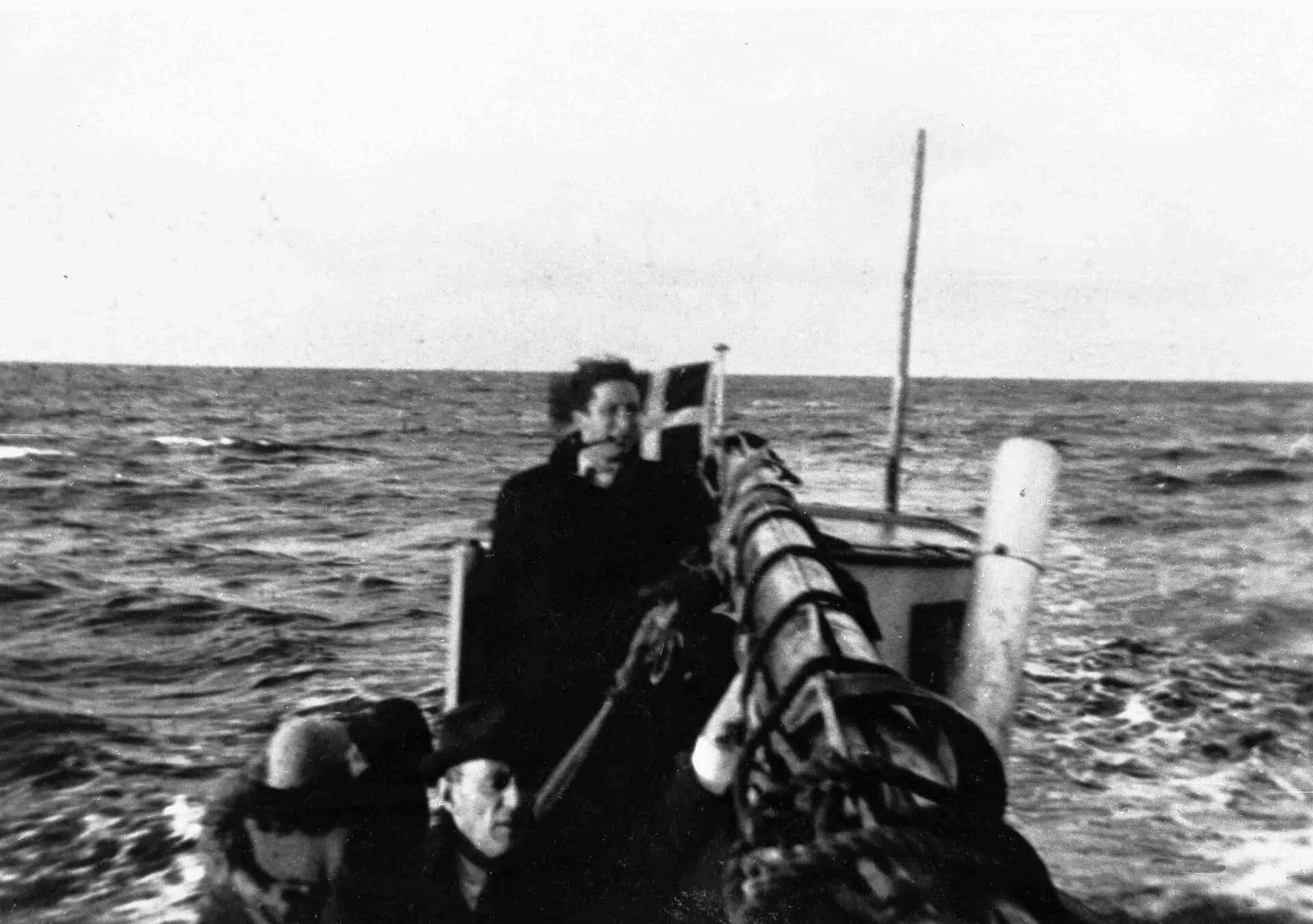
On 30 September 1943, in Copenhagen and across Denmark, a quiet operation unlike anything occupied Europe had yet seen was under way. Since the previous day Denmark’s Jews had known that the German police were preparing a round-up and that within days they were to be deported. They left their homes and hid with neighbours and friends, in hospitals, in vicarages and in summer houses on the coast, and the first fishing boats were carrying them by night across the Øresund (the Sound) to neutral Sweden. That same day Danish institutions began to protest openly, and in Stockholm Niels Bohr, who had escaped across the Sound the day before, was pressing Swedish politicians for a public assurance that Sweden would take in all the refugees.
Popular war chronologies record under this date that the Gestapo “begins rounding up Danish Jews” and that “some Danes” ferried them to Sweden. Both phrases need qualifying. The German round-up began only on the evening of 1 October, and 30 September was a day of flight and of hiding from it. And the rescue was carried out not by a handful of initiates but by thousands of ordinary people – from fishermen and doctors to police officers and civil servants – and soon by the organised resistance as well. Within a few weeks some 7,200 Jews and nearly 700 of their non-Jewish relatives reached Sweden. About 470 people fell into German hands.
An exception in occupied Europe
Denmark, occupied by the Germans on 9 April 1940, kept its own government, parliament, police and courts for three years. The Germans, anxious for calm in a country that supplied the Reich with food, did not press for the introduction of racial laws, and the Danish government consistently refused any discrimination against citizens of Jewish origin. Some 7,800 Jews then lived in the country, most of them in Copenhagen – both descendants of families settled there since the 17th century and newcomers from Eastern Europe, as well as refugees from Germany and Austria from the 1930s. They did not have to wear the star and lost neither their property nor their jobs. Danish politicians made it clear that any attempt to impose such regulations would mean the end of cooperation with the occupier.
Everything changed on 29 August 1943, when the Germans imposed a state of emergency, disarmed the Danish army, and Erik Scavenius’s government ceased to function. With that, the Danish Jews lost their most important shield: a state the occupier had to reckon with.
Best’s telegram
On 8 September 1943 the Reich plenipotentiary in Denmark, Werner Best, sent a telegram to Berlin proposing that the state of emergency be used to “solve the Jewish question” in Denmark. The motives of Best – an experienced SS official and once a close associate of Reinhard Heydrich – are still disputed by historians. According to one interpretation (put forward, among others, by his biographer Ulrich Herbert), Best wanted to strengthen his position vis-à-vis Berlin while ridding Denmark of its Jews without a major upheaval; according to others, he expected that the deportation would never take place, or was deliberately playing a double game. What is certain is that his telegram set the machinery in motion.
The decision was taken at the highest level. The matter was handled by the Foreign Minister, Joachim von Ribbentrop, and by Heinrich Himmler, and according to German research Hitler finally ordered the operation on 23 September, despite reservations voiced in Copenhagen. Police were brought into Denmark: from 13 September Ordnungspolizei units arrived from Norway, on 15 September about 120 Security Police officers arrived, and on 19 September Rudolf Mildner became head of the Sipo and SD in Denmark. On 17 September the Gestapo searched the office of the Jewish community in Copenhagen and took its card index with the names and addresses of its members. From Adolf Eichmann’s staff came his deputy, Rolf Günther, to direct the deportation. A ship was to put in at Copenhagen harbour to take away those arrested.
Interestingly, both Mildner and the Wehrmacht commander in Denmark, General Hermann von Hanneken, objected to the operation to their superiors, fearing that it would alienate the Danes completely. The Wehrmacht eventually lent military police, but its units guarding the coast for the most part did not take part in hunting down the fugitives.
Duckwitz’s warning
The plan did not remain a secret. Georg Ferdinand Duckwitz, the shipping attaché at the German legation and for years a trusted associate of Best, first tried to block the operation. On 22 September he was in Stockholm, trying to persuade the Prime Minister, Per Albin Hansson, to have Sweden officially intercede on behalf of the Danish Jews; the Swedes replied that they would take them in if the Germans agreed – and Berlin did not reply. When Duckwitz learned from Best the date of the round-up, set for the night of 1–2 October, he passed the news on 28 September to the Social Democratic politician Hans Hedtoft. Hedtoft informed the chairman of the Jewish community, C. B. Henriques – who at first refused to believe it – as well as people in the resistance and Swedish diplomats.
On the morning of 29 September, the eve of Rosh Hashanah, the Jewish New Year, the acting chief rabbi, Marcus Melchior, interrupted the service in the synagogue on Krystalgade and told the congregation that the Germans would come for them on the night of the festival. He urged them to leave their homes immediately, warn relatives and friends, and go into hiding until they could find a way to Sweden. That same afternoon the Swedish envoy assured the chairman of the community that Sweden would take in all the refugees. The news spread through the city by word of mouth: teachers sent pupils home, Social Democrats drove around Copenhagen at night delivering warnings, and doctors and nurses admitted “patients” under false names.
30 September
30 September was the day of flight. Most of Denmark’s nearly 8,000 Jews were already in hiding. People who had never before had anything to do with clandestine work handed strangers the keys to their flats and summer cottages; students, doctors, pastors and taxi drivers guided the fugitives to the coast of Zealand, especially around Helsingør, where the Sound is only a few kilometres wide. At first the crossings were organised chaotically, on individual initiative: fishermen demanded high sums for a passage, often a thousand kroner per person or more, and the fugitives waited for days in barns and attics.
That same day open protest began. Letter after letter reached Best and the Danish authorities – from business organisations, trade unions, universities and political parties. The bishops of the Lutheran Church prepared a pastoral letter, read out in all churches on Sunday 3 October: in it they called the persecution of the Jews contrary to the Christian commandment to love one’s neighbour, and declared that the Church would defend the right of its Jewish brothers and sisters to the same freedom that Christians valued more highly than life.
In Stockholm Niels Bohr, the Nobel Prize-winning physicist, whose mother came from a Jewish family, had crossed to Sweden on 29 September. According to his own account, repeated by the historian Richard Rhodes, on 30 September he obtained an audience with King Gustaf V and urged that Sweden publicly announce its readiness to take in the refugees; the Americans and British, who were waiting to fly him out to work on the Manhattan Project, had to be patient. Some historians, however, believe that the Swedish government had already made up its mind and was acting on a policy adopted in 1942 towards the Norwegian Jews. On 2 October Swedish radio announced that Sweden would take in all the Jews from Denmark – which emboldened thousands who had been hesitating.
The round-up that failed
At 8.30 p.m. on 1 October Best informed the Danish Foreign Ministry that an operation against “elements hostile to the Reich” had begun, and the Danish police were instructed not to interfere with the German action. During the night of 1–2 October German police went from door to door using the seized card index. Most of the flats were empty. According to German figures, 232 people were detained in Copenhagen and another 82 in the rest of the country – including many elderly people from the Jewish old people’s home. About 30 people classed as “half-Jews” were released the next day. The ship that was to have taken away thousands of deportees sailed on 2 October with the Jews detained that night and – to fill the empty places – 150 Danish communists previously interned in the Horserød camp. The communists were sent to the Stutthof concentration camp, the Jews to the Theresienstadt ghetto in the Protectorate of Bohemia and Moravia.
The flight continued throughout October. On the initiative of students, doctors and members of the Danish resistance, the chaotic crossings quickly turned into organised routes: money was collected to pay the fishermen so that escape would not depend on the fugitive’s wealth, and Bispebjerg Hospital in Copenhagen became one of the main assembly points. Most crossings were made at night, in fishing boats and rowing boats, from Zealand to Scania; the passage usually took less than an hour, but on rough autumn seas and under the threat of German patrols. Not everyone made it. During the night of 6–7 October in Gilleleje, acting on a tip-off, the Germans seized 85 fugitives hidden in the loft of the church. Several dozen people drowned, were killed while fleeing or took their own lives. After 2 October another 200–250 or so people fell into German hands.
In the end some 7,200 Jews and nearly 700 members of their non-Jewish families reached Sweden. About 470 people were deported (sources give between 464 and 481).
Theresienstadt
The fate of those deported to Theresienstadt differed from that of Jews from most European countries. The Danish authorities never stopped interceding on their behalf. On 2 November 1943 Eichmann agreed that the Jews from Denmark would not be sent on from Theresienstadt to the extermination camps; the Danes sent them parcels of food and clothing, and on 23 June 1944 representatives of the Danish authorities and the International Red Cross visited the ghetto – a visit that the Germans carefully stage-managed and exploited for propaganda. About 50 Danish Jews, mostly elderly, died in the ghetto of exhaustion and disease. In April 1945 the 425 survivors were taken from Theresienstadt to Sweden in the White Buses operation, run by Folke Bernadotte on behalf of the Swedish Red Cross.
Why it succeeded
Historians point to several reasons. The Danish Jews were few in number and lived mainly in Copenhagen, a few kilometres from neutral Sweden, which – after ending German transit – was increasingly open in taking in refugees. They had been rooted in Danish society for centuries, and that society regarded an attack on them as an attack on Denmark. The Germans, for their part, did not act with full determination: Best, who had set the operation in motion, did little to stop the fugitives once the information had leaked, the Wehrmacht on the coast mostly looked the other way, and German patrol boats on the Sound often did not intervene. After the operation ended, Best reported to Berlin that Denmark was “free of Jews”, since no Jew could any longer live or work there legally – and from that point of view he could regard his task as accomplished.
None of these circumstances, however, diminishes the decisions taken by thousands of people who put themselves at risk by hiding neighbours and strangers. In accordance with the wishes of the rescuers themselves, Yad Vashem honoured the Danish resistance collectively; a tree was planted in its honour in the Garden of the Righteous, and a fishing boat from Gilleleje stands in the museum. Some Danes were also individually recognised as Righteous Among the Nations, as was Georg Ferdinand Duckwitz.
Place in the war
The rescue of the Danish Jews was one of the few defeats suffered by the machinery of the Holocaust in occupied Europe. More than 99 per cent of Denmark’s Jews survived the war – in a country that a year and a half earlier had been listed in the minutes of the Wannsee Conference as part of the “Final Solution”. By comparison, in neighbouring Norway in the autumn of 1942 the Germans and Norwegian collaborators had managed to deport more than 700 Jews to Auschwitz, of whom a few dozen survived. The Danish case showed how much the attitude of those around the victims mattered: where the victims had the backing of state and society, and escape was physically possible, the Germans failed to destroy them.
The events of the autumn of 1943 also changed Denmark itself. The rescue, carried out largely by people with no previous connection to the underground, built networks for smuggling people, for communications and for finance that the resistance – led from mid-September by the Danish Freedom Council – drew on in the following years. From then on the routes across the Sound were used to smuggle people, mail and weapons. King Christian X, who from 29 August regarded himself as the occupier’s prisoner and refused all cooperation, became the symbol of this attitude – although the popular legend of the king pinning a yellow star to his uniform has no basis in fact, since Danes were never made to wear it.
Post-war Denmark looked back on October 1943 with pride, and in time historians added uncomfortable details to the story: the high fees charged by some of the boatmen, the informers who betrayed fugitives, and Best’s ambiguous role. Sentenced to death in Denmark after the war, a sentence commuted on appeal to imprisonment, Best was released in 1951. After the war Duckwitz joined the West German diplomatic service and served as the Federal Republic’s ambassador in Copenhagen.
Sources
Meanwhile
(04)Elsewhere, within a week.
- 1 October 1943 · MediterraneanThe Allies in NaplesOn 1 October 1943 Allied troops entered Naples, abandoned by the Germans after a four-day uprising. They found a city without water, power or a port.
- 27 September 1943 · Crimes and repressionThe execution of Mao ZeminLate on 27 September 1943 in Ürümqi, on Sheng Shicai's orders, Mao Zemin, Mao Zedong's brother, and the communists Chen Tanqiu and Lin Jilu were killed.
- 27 September 1943 · BalkansThe Germans take CorfuAfter two weeks of resistance the Italian garrison on Corfu gave in. On 27 September 1943 the Germans shot its commander, Colonel Lusignani, and many officers.
- 3 October 1943 · MilitaryMountbatten takes command in South-East AsiaIn early October 1943 Louis Mountbatten, appointed at Quebec in August, flew to India to take over the Allied South East Asia Command.
Related events
(04)The same battle, people or subject.
- 29 August 1943 · ScandinaviaThe state of emergency in DenmarkOn 29 August 1943 Germany imposed a state of emergency in Denmark and disarmed its army. The navy scuttled most of its ships; the government ceased to act.
- 14 October 1943 · PolandThe Sobibór uprisingOn 14 October 1943 prisoners of the Sobibór death camp killed a dozen or so SS men and guards. About 300 escaped to the forest; a few dozen survived the war.
- 19 March 1944 · Central and Eastern EuropeThe Germans occupy HungaryOn 19 March 1944 the Wehrmacht occupied Hungary in Operation Margarethe. Horthy remained regent, but real power passed to Veesenmayer and the SS.
- 19 April 1943 · PolandThe Warsaw Ghetto Uprising beginsOn 19 April 1943, the eve of Passover, ŻOB and ŻZW fighters drove back the Germans entering the Warsaw Ghetto. They soon returned under Jürgen Stroop.