- Category:
- Military operations
- Front:
- Pacific
- Date:
- 8 May 1942
- Author:
- Natalia
- Battle:
- Battle of the Coral Sea
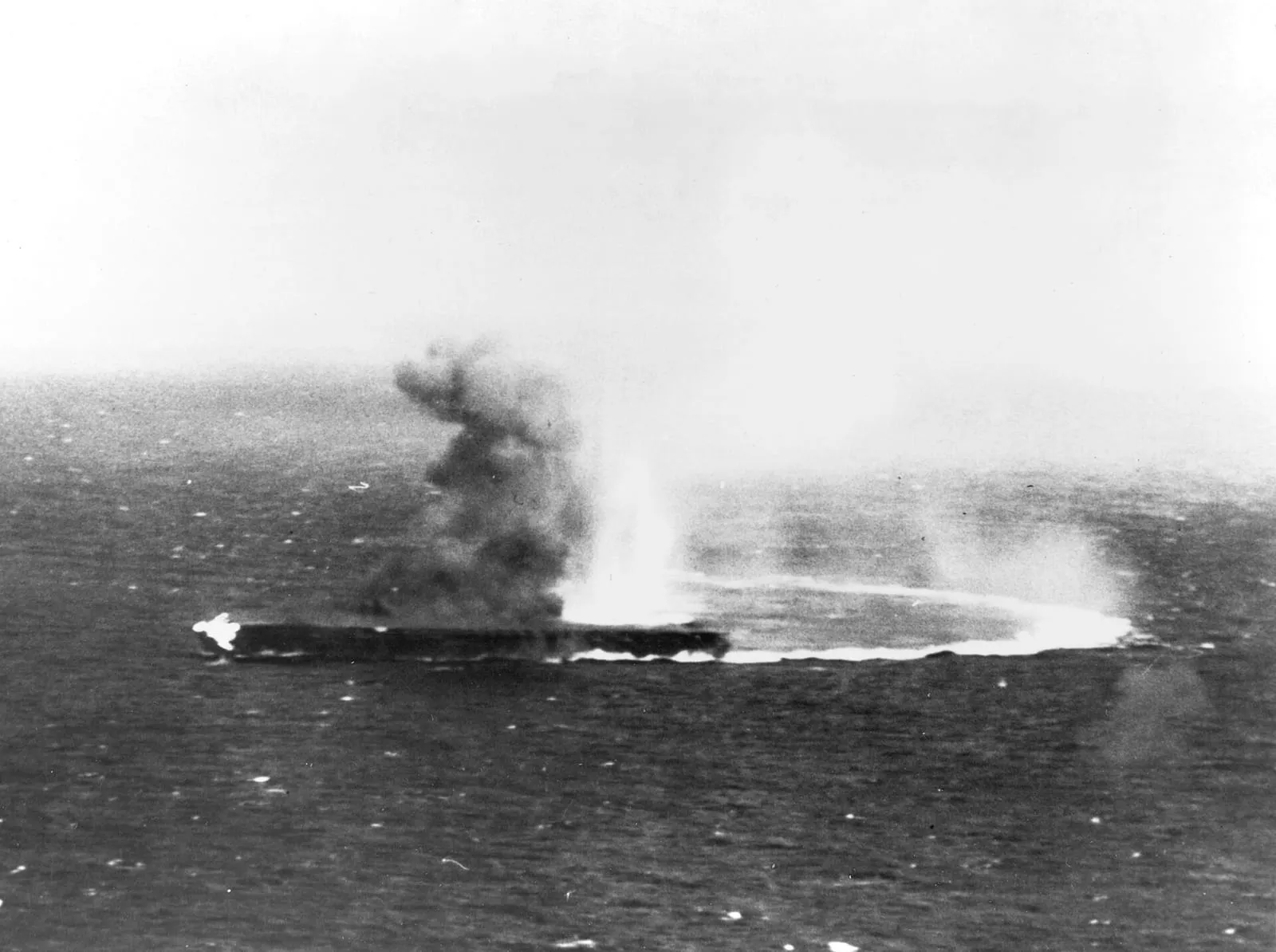
On the morning of 8 May 1942 in the Coral Sea, between New Guinea, the Solomon Islands and the north-east coast of Australia, two carrier forces at last found each other. On the American side were Lexington and Yorktown under the overall command of Rear Admiral Frank Jack Fletcher; on the Japanese side Shōkaku and Zuikaku of Rear Admiral Chūichi Hara’s 5th Carrier Division, screened by the cruisers of Vice Admiral Takeo Takagi. For less than two hours the aircraft of both sides attacked the enemy’s ships, whose crews never saw each other. By evening Lexington, one of the largest carriers in the world, lay on the bottom, Shōkaku was heading for Japan with her bow smashed, and the commander of the whole operation, Vice Admiral Shigeyoshi Inoue, had called off the landing at Port Moresby. It was the last and decisive clash of the four-day Battle of the Coral Sea.
Two days of blind blows
The Japanese Operation MO, which was to give the Imperial Navy a base at Port Moresby on the south coast of New Guinea and extend its air power over the Coral Sea, began on 3 May with the occupation of Tulagi in the Solomon Islands. The Americans knew its outline because cryptologists at Pearl Harbor and in Melbourne were reading Japanese signals, and so Admiral Chester Nimitz, commander of the Pacific Fleet, sent two carrier forces to the Coral Sea. On 4 May aircraft from Yorktown attacked Japanese ships off Tulagi, betraying the presence of American carriers. For the next two days the two forces searched for each other in vain, although on the evening of 6 May, according to post-war historians’ reconstructions, they were only about 70 nautical miles apart.
On 7 May both sides struck, but neither hit what it was looking for. Japanese airmen took the oiler Neosho and the destroyer Sims for a carrier and a cruiser and threw the entire striking power of both carriers at them: Sims sank and Neosho became a drifting wreck. The Americans, for their part, following an erroneous report of “two carriers”, came upon the light covering carrier Shōhō and sank her in a matter of minutes. The Japanese evening attack on Fletcher’s force ended in disaster for the attackers: many airmen were killed fighting the fighters, several even tried in the dark to land on Yorktown, mistaking her for their own ship, and others crashed returning at night to Shōkaku and Zuikaku. Both sides now knew that the enemy was close, and both prepared for a decision the next morning.
The morning of 8 May: each side spots the other almost simultaneously
The weather changed sides. The belt of low cloud and rain that had shielded the Americans on 7 May had shifted north and east overnight and now covered the Japanese; over the American carriers the sky was almost clear. At 6.15 a.m. (local time) Hara sent out seven torpedo bombers to search, supported by Kawanishi H6K flying boats from Tulagi and bombers from Rabaul. Twenty minutes later 18 Douglas SBD Dauntless dive bombers took off to search all round the American force. Fletcher had handed tactical control of air operations to Rear Admiral Aubrey Fitch, who was in Lexington and was the only American admiral on the spot with aviation experience.
At 8.20 a.m. Lieutenant Joseph G. Smith of Lexington spotted the Japanese carriers through a gap in the clouds. Two minutes later a reconnaissance aircraft from Shōkaku, commanded by Kenzō Kanno, sighted Fletcher’s force. The opponents were about 210 nautical miles (nearly 400 km) apart, and both immediately launched their aircraft. The Japanese took off at 9.15 a.m. in a single combined strike: 18 Mitsubishi A6M Zero fighters, 33 Aichi D3A dive bombers and 18 Nakajima B5N torpedo bombers under Lieutenant Commander Kakuichi Takahashi. The American carriers launched separate groups: from Yorktown 6 fighters, 24 dive bombers and 9 Douglas TBD Devastator torpedo bombers, from Lexington 9 fighters, 15 dive bombers and 12 torpedo bombers. Both fleets then steamed towards each other at full speed to shorten the return flight of their own airmen.
The attack on the Japanese carriers
Yorktown’s dive bombers under Lieutenant Commander William O. Burch reached the target at about 10.30 a.m. and waited for the slower torpedo bombers so as to strike simultaneously. Shōkaku and Zuikaku were then sailing a few kilometres apart, and Zuikaku had disappeared into a squall under low-hanging cloud. The whole attack therefore fell on Shōkaku. At 10.57 a.m. two 1,000-pound (about 450 kg) bombs hit the violently manoeuvring ship, tearing open her bow and the forward part of the flight deck and starting fires in the hangar. Yorktown’s torpedo bombers all missed.
Most of Lexington’s group lost its way in the clouds. It reached the Japanese ships only at about 11.30 a.m. and could attack with only part of its strength. Two dive bombers hit Shōkaku with a third bomb, this time on the deck abaft the island; two others missed while aiming at Zuikaku, and the eleven torpedoes dropped by the Devastators all missed. The Japanese covering fighters shot down several American aircraft in this phase. The American Mark 13 torpedoes, dropped from slow and obsolete aircraft, proved in the Coral Sea, as they soon would at Midway, an almost useless weapon.
Shōkaku did not sink, but she ceased to be a carrier. According to the account accepted in the literature, aviation fuel tanks exploded inside her, the engine workshop was destroyed, and 223 members of her crew were killed or wounded (108 killed, according to Japanese tallies). Her flight deck, torn and buckled at the forward end, made it impossible to launch aircraft, though the ship could still recover them. At 12.10 p.m. Captain Takatsugu Jōjima, with the consent of Takagi and Hara, took the damaged carrier out of the battle escorted by two destroyers. Her aircraft, which were attacking the Americans at the time, had to land on Zuikaku.
The attack on Lexington and Yorktown
At 10.55 a.m. Lexington’s radar detected the incoming Japanese strike at a range of 68 nautical miles. The American fighter cover, however, was weak and badly positioned: some of the Wildcats were waiting too low, expecting torpedo bombers at low altitude, and the Japanese flew over them. After the losses of the previous evening the Japanese torpedo bombers could no longer attack both carriers in full strength. Lieutenant Commander Shigekazu Shimazaki sent fourteen of them against Lexington and only four against Yorktown.
The attack began at 11.13 a.m. The four torpedoes aimed at Yorktown missed. Lexington, converted in the 1920s from a battlecruiser hull, was a huge ship and hard to manoeuvre; the Japanese attacked her from both sides at once, and at 11.20 a.m. two torpedoes struck her port side. The first damaged the aviation fuel tanks, the second ruptured a water main, so that some of the boilers had to be shut down. Immediately afterwards the dive bombers arrived: nineteen aircraft from Shōkaku led by Takahashi hit Lexington with two bombs and many near misses, while fourteen from Zuikaku attacked Yorktown. At 11.27 a.m. a 250 kg semi-armour-piercing bomb struck Yorktown in the middle of the flight deck, pierced four decks and exploded deep inside the hull, killing or badly wounding 66 men. A dozen or so near misses strained her plating below the waterline. The ship nevertheless kept her place in formation and could still recover aircraft.
On the way back both strikes clashed once more with enemy fighters and bombers. Among those killed were Kanno, who instead of returning straight to his carrier had guided the Japanese aircraft to the target, and Takahashi. By about noon the sky over the ships was empty. The Japanese airmen reported sinking two American carriers; the Americans were convinced that one Japanese carrier had gone to the bottom.
The death of Lexington
For the first hour after the attack it seemed that Lexington would come out of the battle with serious but manageable damage. The fires were put out, the list was corrected by pumping fuel, and the ship was making more than 20 knots and recovering returning aircraft. Petrol vapour from the ruptured tanks, however, was spreading unnoticed through the hull. At 12.47 p.m. a spark from an electric motor left running unattended set off a massive explosion near central station; 25 men were killed and a fire broke out. At about 2.42 p.m. came a second explosion, at 3.25 p.m. a third, and after 3.30 p.m. the ship’s captain, Captain Frederick C. Sherman, reported that the fires could not be controlled.
At 5.07 p.m. the crew began to abandon ship. The evacuation went with surprising order: the sailors slid down ropes into the water, from where they were picked up by cruisers and destroyers. Among the last to leave the deck were Fitch and Sherman. At 7.15 p.m. the destroyer Phelps fired five torpedoes into the burning wreck, and at 7.52 p.m. Lexington sank. According to American figures 216 of her more than 2,900 crew were killed; 36 aircraft went down with her. The loss of “Lady Lex”, as the sailors called her, was painful for the US Navy also because she then represented roughly a quarter of American carrier strength in the Pacific.
Both sides withdraw
In the afternoon Fletcher assessed the situation. Both his carriers were damaged, fighter losses were heavy, and with the loss of Neosho fuel was short. At 2.22 p.m. Fitch passed him reports according to which the Japanese had two undamaged carriers, which radio intercepts seemed to confirm. Convinced that he faced superior forces, Fletcher decided to withdraw his force from the Coral Sea. He passed the position of the Japanese carriers to General Douglas MacArthur so that bombers from Australia could attack them. On 9 May Task Force 17 turned east, and Nimitz ordered Yorktown sent back to Pearl Harbor as quickly as possible. Rear Admiral John Crace’s Australian-American cruiser force, detached as early as 7 May to bar the convoy’s route to Port Moresby and unaware of Fletcher’s withdrawal, went on patrolling the western part of the sea until the night of 9/10 May.
The Japanese were in a scarcely better position. At about 2.30 p.m. Hara reported to Takagi that of all the aircraft of both carriers only 24 fighters, 8 dive bombers and 4 torpedo bombers were still fit to fly. Of the returning strike, 46 of 69 aircraft landed on Zuikaku, and a dozen or so of them were so badly damaged that they were pushed straight over the side. Takagi’s cruisers were running short of fuel. At 3 p.m. Takagi reported to Inoue that two American carriers had been sunk, but that because of aircraft losses he could no longer cover the landing. Inoue, who was directing operations from Rabaul and whose reconnaissance aircraft had seen Crace’s cruisers at sea, turned the invasion convoy back and postponed Operation MO to 3 July.
In the evening an order arrived from Japan from Isoroku Yamamoto, commander of the Combined Fleet, to turn round, destroy the remnants of the Allied forces and complete the capture of Port Moresby. Inoue, however, did not cancel the convoy’s return, and Takagi, who after refuelling set off to search on 10 May, found no one. Shōkaku reached Kure on 17 May, almost capsizing on the way in heavy seas because water was pouring in through her shattered bow; Zuikaku arrived there on 21 May.
Losses and balance
Many war chronologies state that after the battle Shōkaku had “a buckled flight deck requiring two months of repairs”. This is broadly true but needs refining: the ship received three bomb hits (two from Yorktown, one from Lexington); the repair in dock at Kure itself, begun on 16 June, lasted according to surviving records only about ten days, but with the waiting time and the rebuilding of the air groups Shōkaku and Zuikaku rejoined the Combined Fleet only on 14 July, that is, after roughly two months. In May the Japanese Naval General Staff estimated that this would take two to three months.
The losses of both sides in the whole battle, counted from 4 to 8 May, are given variously. The Americans lost Lexington, Sims and Neosho and about 66–69 aircraft; the number killed is put by different tallies at between about 650 and more than 700, most of them from the crews of Lexington and Sims. The Japanese lost Shōhō, a destroyer and several small vessels off Tulagi and, depending on how they are counted, between 69 and nearly 100 aircraft; tallies based on the work of Mark Peattie and Anthony Tully speak of 966 killed, including more than 600 from Shōhō. In terms of tonnage sunk (according to frequently cited calculations about 42,000 tons American against about 19,000 tons Japanese) and the only large carrier sunk, it was a tactical victory for Japan. The Japanese airmen, seasoned veterans of Pearl Harbor and the Indian Ocean, operated more efficiently and coordinated their attacks better. But they also suffered losses that the Imperial Navy could not quickly make good: according to historians’ calculations some 90 Japanese carrier aircrew were killed, against 35 American.
Both sides proclaimed victory and both exaggerated. Tokyo announced the sinking of two American carriers, Yorktown and supposedly Saratoga, and other ships. American communiqués spoke of a dozen or more, and according to some press versions even several dozen, Japanese ships sunk or damaged, and the loss of Lexington was revealed only in June, after Midway.
A new kind of naval war
The clash of 8 May ended the first naval battle in history in which the ships of the opposing sides never once saw each other or exchanged fire. Aircraft took over the role of the guns, and the distances over which the fighting took place reached several hundred kilometres. Commanders on both sides had to make decisions on the basis of uncertain, late and often wrong reports from airmen who mistook an oiler for a carrier and a cruiser for a battleship. Fletcher, moreover, was on the spot with his ships, whereas Inoue directed the operation from distant Rabaul and could not react as events unfolded. The US Navy put the experience of the Coral Sea, from the organisation of fighter cover and its coordination with radar to methods of fighting the petrol fires that killed Lexington, to use in the battles that followed.
Significance
Although the battlefield was left in Japanese hands and their losses in ships were smaller, the objective of the operation was not achieved. For the first time since the start of the Pacific war a Japanese landing force turned back without reaching its objective. Port Moresby, the key Allied base in New Guinea and the forefield of northern Australia, was not attacked from the sea. For the Australians and the Americans in Australia the result of the battle was at first a disappointment, since it was feared that the Japanese would return, but strategically it was the first clear check to the Japanese offensive after half a year of uninterrupted victories from Pearl Harbor to the Indian Ocean. A little later, on 15 May, the follow-up operation against Nauru and Ocean Island (Banaba) was also called off when Japanese aircraft spotted, east of the Solomons, the force of Enterprise and Hornet, sent south soon after the Doolittle Raid.
The most important consequences of the battle, however, emerged a month later. Yamamoto was preparing a great operation against Midway Atoll, by which he wanted to draw the rest of the American fleet into a decisive battle. Shōkaku and Zuikaku did not make it to Midway: the first because of her damage, the second because of her losses in aircraft and airmen, which no one tried to make good quickly. Japan therefore went to Midway with only the four carriers of Vice Admiral Chūichi Nagumo’s force. The Americans did the opposite. The damaged Yorktown, whose repair had initially been estimated at several months, was made ready for battle by the Pearl Harbor dockyard workers in about three days, and her depleted squadrons were made up with aircraft and crews from Saratoga, then under repair. At Midway aircraft from Yorktown sank Sōryū and helped destroy Hiryū; the ship herself was sunk on 7 June. In June 1942 Japan lost four carriers there, and with them the initiative in the Pacific.
Some historians, among them H. P. Willmott, Jonathan Parshall and Anthony Tully, consider that Yamamoto made a mistake in sending two modern carriers to the secondary Operation MO just before the decisive battle: he thereby weakened himself both in the Coral Sea and at Midway. The closing of the sea route to Port Moresby in turn led the Japanese, in the summer of 1942, to try to reach it overland across the Owen Stanley Range, which led to the fighting on the Kokoda Track. In August the Americans landed on Tulagi and Guadalcanal, opening the first great Allied offensive in the Pacific. The Coral Sea was its first harbinger: it showed that Japanese expansion had reached its limit and that the war on the ocean would henceforth be a war of carriers.
Sources
Meanwhile
(04)Elsewhere, within a week.
- 9 May 1942 · MediterraneanOperation BoweryOn 9 May 1942, 64 Spitfires flew off Wasp and Eagle for Malta. This time they went straight into action and the defenders began to win back the skies.
- 10 May 1942 · MediterraneanChurchill's ultimatum to AuchinleckOn 10 May 1942 Churchill, for the War Cabinet, ordered Auchinleck to fight in Libya no later than the time of the June convoy to Malta.
- 5 May 1942 · AfricaThe landing on MadagascarOn 5 May 1942 the British landed on Vichy Madagascar. After two days of fighting and a dash by the destroyer Anthony, Diego Suarez fell on 7 May.
- 4 May 1942 · Western FrontThe second raid on ExeterOn the night of 3/4 May 1942 the Luftwaffe returned to Exeter and burned the city centre. About 160 people died and a bomb destroyed a cathedral chapel.
Related events
(04)The same battle, people or subject.
- 25 May 1942 · PacificPreparations for MidwayAt the end of May 1942 Japanese forces sailed for the Aleutians and Midway, while the Americans, knowing their plan, repaired the Yorktown in three days.
- 3 June 1942 · PacificThe Battle of Midway beginsOn 3 June 1942 a Catalina sighted Japanese transports heading for Midway. B-17s hit no ship, and Nagumo's carriers were still hidden in the fog.
- 4 June 1942 · PacificThe sinking of Nagumo's carriersOn 4 June 1942 at Midway American dive-bombers set Akagi, Kaga and Sōryū ablaze, and Hiryū that evening. The Japanese managed to hit Yorktown first.
- 7 June 1942 · PacificThe end of the Battle of MidwayOn 5–7 June 1942 Yamamoto called off the Midway attack, US planes sank the cruiser Mikuma, and a Japanese submarine finished off Yorktown, which sank on 7 June.