United Kingdom
John Tovey
Commander-in-Chief, Home Fleet (1940–1943), Commander-in-Chief, The Nore (1943–1946), Admiral of the Fleet
- Born:
- 7 March 1885, Rochester (England)
- Died:
- 12 January 1971, Funchal (Madeira)
- Author:
- Natalia
- Photo:
- Royal Navy official photographer, domena publiczna, Wikimedia Commons

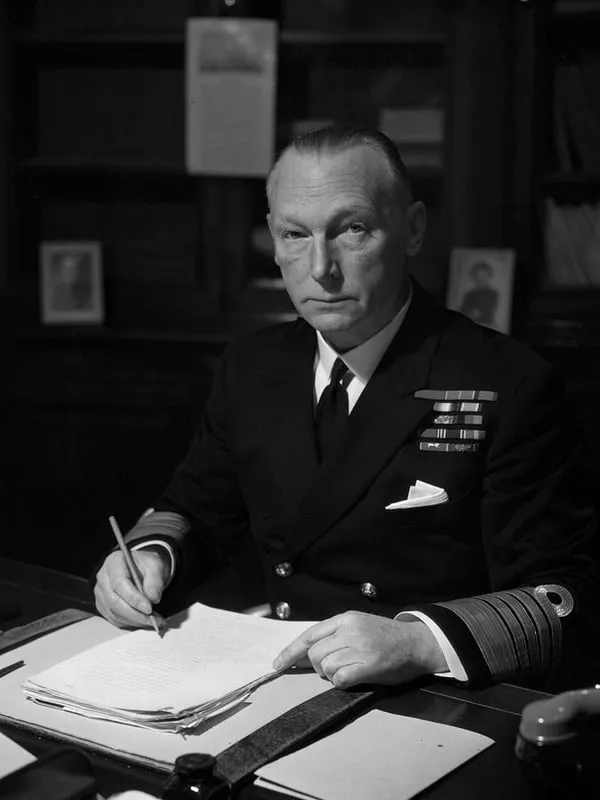
Sir John Cronyn Tovey, from 1946 Baron Tovey, was one of the most important British naval commanders of the Second World War. A career destroyer officer, decorated for a daring torpedo attack at the Battle of Jutland, in 1939–1940 he commanded the light forces of the Mediterranean Fleet in the first clashes with Italy. From December 1940 to May 1943 he was Commander-in-Chief of the Home Fleet at Scapa Flow. In May 1941, from the battleship King George V, he directed the pursuit of the German battleship Bismarck, which had sunk the Hood and was then sunk herself. Later he was responsible for covering the Arctic convoys to the Soviet Union and repeatedly clashed over them with the Prime Minister, Winston Churchill, and the First Sea Lord, Dudley Pound. He was a stubborn, independent commander, popular with his sailors, who was not afraid to tell his superiors uncomfortable truths.
Youth and early service
He was born on 7 March 1885 at Borley Hill in Rochester, Kent, the youngest of eleven children of Lieutenant Colonel Hamilton Tovey of the Royal Engineers and Maria Elizabeth, née Goodhue, who came from Canada. His parents were often abroad, so the boy spent several years at Durnford preparatory school in Langton Matravers, Dorset. He remembered it so fondly that half a century later he took the name of the village for his peerage. He was a gifted sportsman who played cricket and football, and later golf for the navy.
In January 1900, not yet fifteen, he joined the training ship Britannia at Dartmouth as a cadet, and in May 1901 he went as a midshipman to the battleship Majestic, flagship of Admiral Arthur Wilson’s Channel Squadron. He then served in the cruiser Ariadne on the North America and West Indies Station, became a sub-lieutenant in 1904 and a lieutenant in 1906. His superiors praised him as “zealous” and “meticulous”, although one early report criticised his “poor manner with men”. Even then his character was in evidence. According to an anecdote repeated by his biographers, when a senior officer began giving orders to the boats that young Tovey was in charge of, Tovey took off his white gloves, unbuckled his sword belt, handed them to his astonished superior and went below.
The First World War
When war broke out he was first lieutenant of the light cruiser Amphion, which struck a German mine on 6 August 1914 and sank, the first British warship lost in the war. In January 1915 Tovey received his first independent command, the destroyer Jackal, in which he took part in the Battle of Dogger Bank. In May 1916 he took over the destroyer Onslow. At the Battle of Jutland on 31 May 1916 Onslow attacked first the German battlecruisers, then the damaged cruiser Wiesbaden, and finally the line of battleships. Tovey had his badly hit ship pressed home to the attack and fire her last torpedoes, after which Onslow was towed to Aberdeen by the equally damaged destroyer Defender. For this “persistent and determined” attack Tovey was promoted to commander and in 1919 received the Distinguished Service Order (DSO). He later commanded the destroyer Ursa at the Second Battle of Heligoland Bight in November 1917, and the destroyer Wolfhound. He was also awarded the French Croix de Guerre. In 1916 he married Aida Rowe. The marriage remained childless.
Between the wars
After the war Tovey took the senior officers’ course at the Royal Naval College, Greenwich, and spent two years in the Operations Division of the Admiralty Naval Staff. In 1923 he was promoted to captain, and in the mid-1920s he commanded a succession of destroyer flotillas. He completed the Imperial Defence College, headed the navy’s tactical school, and in 1930–1932 was naval assistant to the Second Sea Lord, who was responsible for the fleet’s personnel.
In April 1932 he took command of the battleship Rodney. It was a difficult assignment: in September 1931 Rodney’s crew had been among the most restive participants in the Invergordon Mutiny, when sailors of the Atlantic Fleet refused to put to sea on learning of a cut in their pay. Tovey, regarded as a “safe pair of hands”, soon restored the ship’s efficiency and good name. In doing so he often clashed with the fleet commander, Admiral John Kelly, and later liked to quote a sentence from Kelly’s confidential report on him: “Captain Tovey shares one characteristic with me. In myself I call it tenacity of purpose; in Captain Tovey I can only describe it as sheer bloody obstinacy.” He left Rodney, which nine years later he would lead into battle against the Bismarck, in 1934.
In 1935 he became Commodore of the Royal Naval Barracks at Chatham, an important training centre at a time of rapid naval expansion, and in August that year he was promoted to rear admiral. In 1938 he became Rear Admiral (Destroyers) of the Mediterranean Fleet in Malta. His ships patrolled Spanish waters during the Civil War and supported the British authorities in Palestine, where the Arab revolt was under way. On 3 May 1939 he was promoted to vice admiral.
In the Mediterranean
The first months of the war in the Mediterranean were quiet, since Italy remained neutral and many ships had been sent to other theatres. When Italy entered the war in June 1940, Tovey was second-in-command of the Mediterranean Fleet under Admiral Andrew Cunningham and commanded its light forces, the cruisers and destroyers, flying his flag in the cruiser Orion. On 28 June his cruisers intercepted three Italian destroyers off Crete carrying supplies to Libya and sank the Espero. So much ammunition was expended that Cunningham had to postpone planned convoys from Malta, prompting a caustic remark from him about the enormous expenditure of shells on a single thousand-ton destroyer. On 9 July Tovey led the cruisers at the Battle of Calabria (Punta Stilo), the first clash between the British and Italian fleets, and earned praise in Cunningham’s report. In the autumn of 1940 he briefly commanded the 1st Battle Squadron.
Commander-in-Chief, Home Fleet
On 2 December 1940, on Cunningham’s recommendation, Tovey succeeded Admiral Charles Forbes as Commander-in-Chief of the Home Fleet, with the acting rank of admiral. On 1 January 1941 he was knighted as a Knight Commander of the Order of the Bath. The fleet at Scapa Flow had above all to prevent German surface ships from breaking out into the Atlantic, to cover convoys and to support operations on the Norwegian coast, such as the Lofoten raid in March 1941. Despite pressure from London, Tovey believed that a fleet commander should go to sea with his fleet and share its dangers with his sailors, even though this took him away from the centres of command.
His greatest test came in May 1941. When the battleship Bismarck and the heavy cruiser Prinz Eugen broke out into the Atlantic in Operation Rheinübung, Tovey sent cruisers and Vice Admiral Lancelot Holland’s squadron with the Hood and Prince of Wales to intercept them, and himself sailed in King George V with the aircraft carrier Victorious. After the Hood was sunk on 24 May and contact with the Germans was lost during the night of 24–25 May, an error in plotting radio bearings aboard his flagship sent the fleet in the wrong direction for several hours. On the evening of 26 May, however, aircraft from the carrier Ark Royal of James Somerville’s Force H jammed the Bismarck’s rudders. Contrary to the expectations of some of his staff, Tovey did not attack as darkness fell. He let Philip Vian’s destroyers harry the enemy throughout the night and struck on the morning of 27 May, from up-wind and with the light behind him, with King George V and Rodney. In less than two hours the Bismarck was a burning wreck; she sank, and only just over a hundred of her crew survived. In his report Tovey paid tribute to an enemy that had put up “a most gallant fight against impossible odds” and gone down with her colours flying. In October 1941 he was made a Knight Commander of the Order of the British Empire for this victory.
The pursuit had a bitter epilogue. The Admiralty wanted to court-martial Rear Admiral Frederic Wake-Walker and the captain of Prince of Wales, John Leach, for failing to renew the action against the Bismarck after the Hood was sunk. Tovey held that they had acted correctly and threatened to resign and to appear at the court martial as the defendants’ friend. The matter was dropped. Nor did he forget a signal sent by the Admiralty in the final phase of the pursuit, ordering him to sink the Bismarck at all costs, even if King George V – a ship almost out of fuel, in waters full of submarines – then had to be towed home. He later called it “the stupidest and most ill-considered signal ever sent” and let it be understood that he would not have obeyed it.
The Arctic convoys
From August 1941, after the German attack on the Soviet Union, the Home Fleet covered the supply convoys sailing round the North Cape to Murmansk and Archangel. From the outset Tovey warned that in the summer months, with continuous daylight, without air cover and within range of German aircraft, U-boats and the battleship Tirpitz stationed in Norway, the convoys were courting disaster. Churchill, under pressure from Stalin and Roosevelt, insisted that they continue. Tovey’s fears were borne out by convoy PQ 17 in July 1942: on the orders of Pound, who feared an attack by the Tirpitz, the escort withdrew, and the merchant ships scattered and were mostly sunk. The convoys were suspended until September, when they could be given the cover of an escort carrier. Churchill regarded Tovey as an “obstructionist” and tried to remove him, but the admiral served out his full two-and-a-half-year term. In October 1942 he was confirmed in the rank of admiral. In 1944 the Soviet authorities awarded him the Order of Suvorov 1st Class for covering the convoys, but Tovey never wore it.
The Nore and the end of the war
In May 1943 Tovey handed over the Home Fleet to Admiral Bruce Fraser, and in the summer he became Commander-in-Chief, The Nore, a command based at Chatham and responsible for the Thames Estuary and the east coast of England. He directed the protection of coastal convoys in the North Sea, harried by German E-boats and aircraft, and minesweeping, and his command took part in preparing the naval side of the invasion of Sicily and the Normandy landings. On 22 October 1943 he was promoted to the highest rank, Admiral of the Fleet. In 1945 he became First and Principal Naval Aide-de-Camp to the King.
Last years
At the beginning of 1946 Tovey retired from active service, although as an Admiral of the Fleet he formally remained on the active list until his death. On 15 February 1946 he was created Baron Tovey, of Langton Matravers, a hereditary peerage, and took his seat in the House of Lords. In retirement he was, among other things, a Church Commissioner for England and president of charities for seafarers. He was a deeply religious man and in the 1940s published two pamphlets on faith. In time he gave up most of his posts to care for his wife, who was gravely ill with arthritis. Aida Tovey died in June 1970, and he himself on 12 January 1971 in Funchal on Madeira. Both were buried in a cemetery near Swanage, Dorset. As they had no children, the barony became extinct on his death.
Significance
Tovey’s career spanned the Royal Navy’s journey from the late Victorian era to the war of aircraft carriers, radar and codebreaking, and his greatest victory illustrates that change well. The Bismarck was found by a flying boat and stopped by biplane torpedo bombers, and only then finished off by battleships. As a commander Tovey was able to combine these means into a single operation, to wait patiently for the right moment and to accept the risk that delay entailed. For the British the sinking of the Bismarck was the most celebrated naval victory of 1941 and an answer to the loss of the Hood; for the Germans it marked the end of battleship sorties into the Atlantic, which Grand Admiral Erich Raeder had made the second pillar of the Battle of the Atlantic. Tovey’s opponent in that operation, Admiral Günther Lütjens, went down with his ship.
Equally important, if less spectacular, was his stance towards his superiors. In the disputes over the fate of the officers after the Battle of the Denmark Strait and over the summer Arctic convoys, he defended the judgement of the professional at sea against pressure from politicians and the Admiralty, regardless of his own career. Historians of the Royal Navy rank him among the outstanding admirals of the Second World War, alongside Cunningham and Somerville, and the fate of convoy PQ 17 proved him right in the most tragic way.
Sources
Commanded in battles
(01)Often appears with
People who appear in the same events.