United States
J. Robert Oppenheimer
Professor of physics at Berkeley and Caltech (1929–1943), director of the Los Alamos laboratory (1942–1945), chairman of the AEC General Advisory Committee (1947–1952), director of the Institute for Advanced Study (1947–1966)
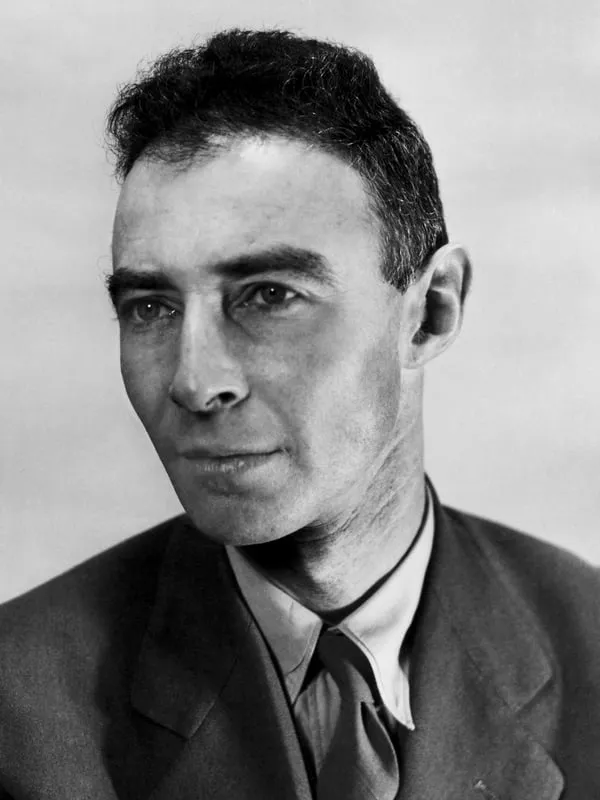
- Born:
- 22 April 1904, New York (USA)
- Died:
- 18 February 1967, Princeton (New Jersey, USA)
- Author:
- Łukasz
- Photo:
- autor nieznany, domena publiczna, Wikimedia Commons

J. Robert Oppenheimer was an American theoretical physicist who from 1942 to 1945 headed the Manhattan Project’s weapons design laboratory at Los Alamos, New Mexico. Under his direction several thousand scientists, engineers and technicians designed and built the first atomic bombs in less than three years: the device tested in the desert near Alamogordo on 16 July 1945 and the bombs dropped on Hiroshima and Nagasaki in August 1945. Called the “father of the atomic bomb” after the war, he was one of the most influential advisers to the United States government on nuclear energy, and at the same time an opponent of a crash programme to build the hydrogen bomb. In 1954, amid the tensions of the Cold War, he was stripped of his security clearance. The decision was not overturned until 2022.
New York and Harvard (1904–1925)
He was born on 22 April 1904 in New York into a wealthy Jewish family. His father, Julius, from Hanau in Germany, had arrived in the United States in 1888 as a teenager with no money and no English, and made a fortune importing textiles. His mother, Ella Friedman, was a painter. His brother Frank, eight years younger, also became a physicist. The initial “J.” that Robert placed before his name stood, in his own words, for nothing.
From 1911 he attended the Ethical Culture School in New York, founded by Felix Adler, which laid great stress on moral education. After finishing school in 1921 he contracted dysentery while travelling in Europe, which delayed his studies by a year. He entered Harvard University in 1922 and graduated summa cum laude in chemistry in 1925, after only three years.
Cambridge and Göttingen (1925–1929)
In the autumn of 1925 he went to England, to the Cavendish Laboratory of the University of Cambridge, headed by Ernest Rutherford. Experimental work did not suit him, and his time in Cambridge was a period of severe psychological crisis. According to his friends’ accounts, he is supposed to have left a poisoned apple on the desk of his tutor, Patrick Blackett; the story, however, is unconfirmed and there are no documents to support it.
In 1926 he moved to the University of Göttingen, then one of the main centres of the emerging quantum mechanics. Under Max Born he gained his doctorate in March 1927. Together with Born he published a paper formulating the Born–Oppenheimer approximation, which separates the motion of atomic nuclei from that of electrons in the description of molecules – to this day one of the basic tools of quantum chemistry. In Göttingen he met many physicists who later played important roles, among them Enrico Fermi and Edward Teller.
On returning to the United States he spent the academic year 1927–1928 as a fellow at Harvard and at the California Institute of Technology. In 1928–1929 he was in Europe again: in Leiden with Paul Ehrenfest and in Zurich with Wolfgang Pauli.
Berkeley and Caltech (1929–1941)
In 1929 he took up posts both at the University of California, Berkeley and at the California Institute of Technology in Pasadena, dividing the year between the two. At Berkeley he created the first significant school of theoretical physics in the United States; until then American theorists had had to train in Europe. A group of doctoral students and young researchers gathered around him, many of whom later worked on the Manhattan Project. He worked closely with Ernest Lawrence, the inventor of the cyclotron.
His work in the 1930s concerned quantum electrodynamics, cosmic rays and the theory of the atomic nucleus. In 1930 he pointed out that the positively charged particles predicted by Paul Dirac could not be protons, which anticipated the discovery of the positron in 1932. In 1939, with George Volkoff, he showed that there is an upper limit to the mass of a neutron star (the Tolman–Oppenheimer–Volkoff limit), and with Hartland Snyder he described the gravitational collapse of a massive star, predicting the objects later called black holes. When news of the fission of the uranium nucleus reached America in early 1939, he quickly understood that the release of neutrons could make a chain reaction possible, and therefore a bomb – experiments confirming this were soon carried out at Columbia University.
He was also interested in literature, poetry and philosophy; he learned Sanskrit and read the Bhagavad Gita in the original, later naming it among the books that had most shaped his outlook.
Left-wing connections
Until the mid-1930s Oppenheimer, as he himself admitted, took no interest in politics. That changed with the Great Depression, the fate of the German Jews, including his own relatives, and the Spanish Civil War. He gave money to the cause of the Spanish Republic, to university teachers’ unions and to left-wing organisations. Many of the people close to him belonged to or were associated with the Communist Party of the United States: his brother Frank and Frank’s wife; the medical student Jean Tatlock, with whom he had a relationship from 1936; and some of his doctoral students. Oppenheimer himself always denied being a party member; whether in 1937–1942 he took part in a closed party cell at the university, as some of its alleged members later claimed, remains disputed among historians.
On 1 November 1940 he married the biologist Katherine (“Kitty”) Puening, widow of the Communist Joe Dallet, who had been killed in Spain in 1937 fighting in the International Brigades. They had two children: a son, Peter (born 1941), and a daughter, Katherine (“Toni”, born 1944 at Los Alamos). These connections meant that from 1941 he attracted the interest of the FBI and later of army counter-intelligence.
Los Alamos (1942–1945)
In 1941 Oppenheimer began advising the American uranium programme, overseen by the Office of Scientific Research and Development. In 1942 he was put in charge of coordinating the calculations on “fast neutron reaction”, and that summer he organised a seminar of theorists at Berkeley who estimated how much fissile material a bomb would require and also discussed, for the first time, the possibility of a thermonuclear bomb. When the army took over the programme and the Manhattan Project began, its head, General Leslie Groves, met Oppenheimer in October 1942 and decided to entrust him with running a new, secret weapons design laboratory. It was not an obvious choice: Oppenheimer had no Nobel Prize and no management experience, and counter-intelligence had reservations because of his left-wing associations. Groves nevertheless pushed through his security clearance.
As the site of the laboratory Oppenheimer proposed the Los Alamos mesa in New Mexico, which he knew from trips to his ranch in those mountains. The laboratory – later the Los Alamos National Laboratory – opened in the spring of 1943. Oppenheimer managed to draw leading physicists to the isolated mountain settlement, among them Hans Bethe, Teller and, from 1944, Fermi; Niels Bohr also served as a consultant. At its peak, in 1945, several thousand people lived at Los Alamos.
The most serious crisis came in 1944. It turned out that plutonium from the Hanford reactors contained the isotope plutonium-240, which fissions spontaneously too often for it to be used in a simple “gun-type” bomb, in which one piece of material is fired into another. In July 1944 Oppenheimer abandoned the plutonium gun design, and in August he reorganised the laboratory to concentrate on the far more difficult implosion method, in which a sphere of plutonium was to be compressed by precisely shaped explosive charges. The simpler gun-type design was kept for the uranium bomb, which fell on Hiroshima as Little Boy. The final design of the implosion device was approved in Oppenheimer’s office on 28 February 1945.
In August 1943 he himself reported to the security services that an engineer, George Eltenton, had been seeking ways of passing information to the Soviet Union; for several months, however, he gave inconsistent versions of the affair and shielded his friend Haakon Chevalier, who had acted as the go-between. This so-called Chevalier affair came back to haunt him in 1954.
Trinity, Hiroshima and Nagasaki
In the spring of 1945 Oppenheimer joined Fermi, Lawrence and Arthur Compton on the scientific panel of the Interim Committee, which advised the Secretary of War, Henry Stimson, on the use of the bomb. In its report of June 1945 the panel stated that it could propose no technical demonstration likely to end the war and saw no acceptable alternative to direct military use. In July, according to Teller’s account, Oppenheimer discouraged him from circulating at Los Alamos the petition of Leó Szilárd urging the president not to use the bomb without warning Japan.
On 16 July 1945 Oppenheimer watched the Trinity test – the explosion of the implosion device at the test site near Alamogordo – from a bunker. He chose the name of the test himself; he later said that he had been inspired by the Holy Sonnets of John Donne. According to his brother, his first words were: “I guess it worked.” The most famous words associated with that moment – the line from the Bhagavad Gita, “Now I am become Death, the destroyer of worlds” – come from his recollections recorded only in the 1960s. News of the successful test reached President Harry Truman at Potsdam and prompted him to hint to Stalin about the new weapon.
After the atomic bombings of Hiroshima and Nagasaki on 6 and 9 August 1945, Oppenheimer became a household name in America. His attitude to those events is judged in different ways. He never publicly condemned the decision to drop the bombs and defended the scientists’ part in building them, yet – according to Truman himself and to witnesses – at a meeting with the president in October 1945 he said that he felt he had “blood on my hands”, which angered Truman. In a lecture in 1947 he said that the physicists had “known sin”. On 16 October 1945 he handed over the direction of Los Alamos to Norris Bradbury; in 1946 Truman awarded him the Medal for Merit.
Adviser in the atomic age (1945–1952)
After the war Oppenheimer pressed for international control of atomic energy. His ideas decisively shaped the Acheson–Lilienthal Report of 1946, which proposed entrusting uranium mining and the production of fissile materials to an international authority; the plan, presented to the UN in altered form, foundered on Soviet opposition. In 1947 he became chairman of the General Advisory Committee of the newly created civilian Atomic Energy Commission (AEC) and director of the Institute for Advanced Study in Princeton, where Albert Einstein, among others, worked.
After the first Soviet atomic test (RDS-1) in August 1949, a dispute flared up in Washington over building the hydrogen bomb. In October 1949 the committee under Oppenheimer’s chairmanship unanimously advised against a crash programme, citing both technical doubts and the fact that a weapon of unlimited power would serve chiefly to destroy civilian populations. In January 1950, however, Truman decided to build the bomb, and Oppenheimer made enemies of the weapon’s supporters, above all Teller, the AEC commissioner Lewis Strauss and part of the air force leadership. In August 1952 his term on the committee expired and he was not reappointed.
The 1954 hearing
In November 1953 William Borden, former executive director of the congressional Joint Committee on Atomic Energy, wrote to the FBI that Oppenheimer was “more probably than not” a Soviet agent. In December President Dwight Eisenhower ordered that a “blank wall” be placed between Oppenheimer and state secrets, and the AEC chairman, Strauss, suspended his security clearance. Oppenheimer refused to resign and demanded a hearing. From April to May 1954 his case was examined by a three-man board chaired by Gordon Gray. Among those who testified against him was Teller, who declared that he would prefer to see the country’s vital interests in “hands which I understand better”; Groves defended his wartime decision but admitted that under the new criteria he would not have granted him clearance. The board found Oppenheimer to be a loyal citizen but, by two votes to one, recommended against restoring his clearance, citing among other things his stance on the hydrogen bomb and the Chevalier affair. On 29 June 1954 the AEC upheld that decision by four votes to one, pointing to “defects of character” and his former Communist associations. The hearing took place in the McCarthy era, and many scientists saw it as punishment for his opinions.
Last years
Oppenheimer remained director of the Institute for Advanced Study until 1966, lecturing and writing about the place of science in society; in 1953 he gave the Reith Lectures on the BBC. President John F. Kennedy decided to award him the Enrico Fermi Award, but it was presented to him in December 1963, after the assassination in Dallas, by Kennedy’s successor, Lyndon B. Johnson. His security clearance was never restored. A heavy smoker for many years, he developed throat cancer at the end of 1965. He died in Princeton on 18 February 1967; his wife sank the urn containing his ashes in the sea off the island of Saint John in the US Virgin Islands, where he had a house.
Significance
Oppenheimer was one of the founders of American theoretical physics, but he went down in history above all as the scientific director of the building of the weapon that ended the war in the Pacific and opened the nuclear age. In 1945 the Los Alamos laboratory under his direction delivered both the Trinity device and the bombs, the components of which for Hiroshima were carried to Tinian by the cruiser Indianapolis. After the war he became a symbol of the dilemmas facing scientists confronted with weapons of mass destruction, and his fall in 1954 one of the most notorious cases of the McCarthy era. On 16 December 2022 the Secretary of Energy, Jennifer Granholm, vacated the AEC’s 1954 decision, finding that the proceedings had been flawed and had violated the commission’s own regulations. His life has been the subject of numerous biographies and of Christopher Nolan’s 2023 film Oppenheimer.
Sources
Often appears with
People who appear in the same events.