- Category:
- Crimes and repression
- Front:
- Mediterranean
- Date:
- 24 March 1944
- Author:
- Łukasz
- Tags:
- Italy, resistance, Holocaust, Albert Kesselring
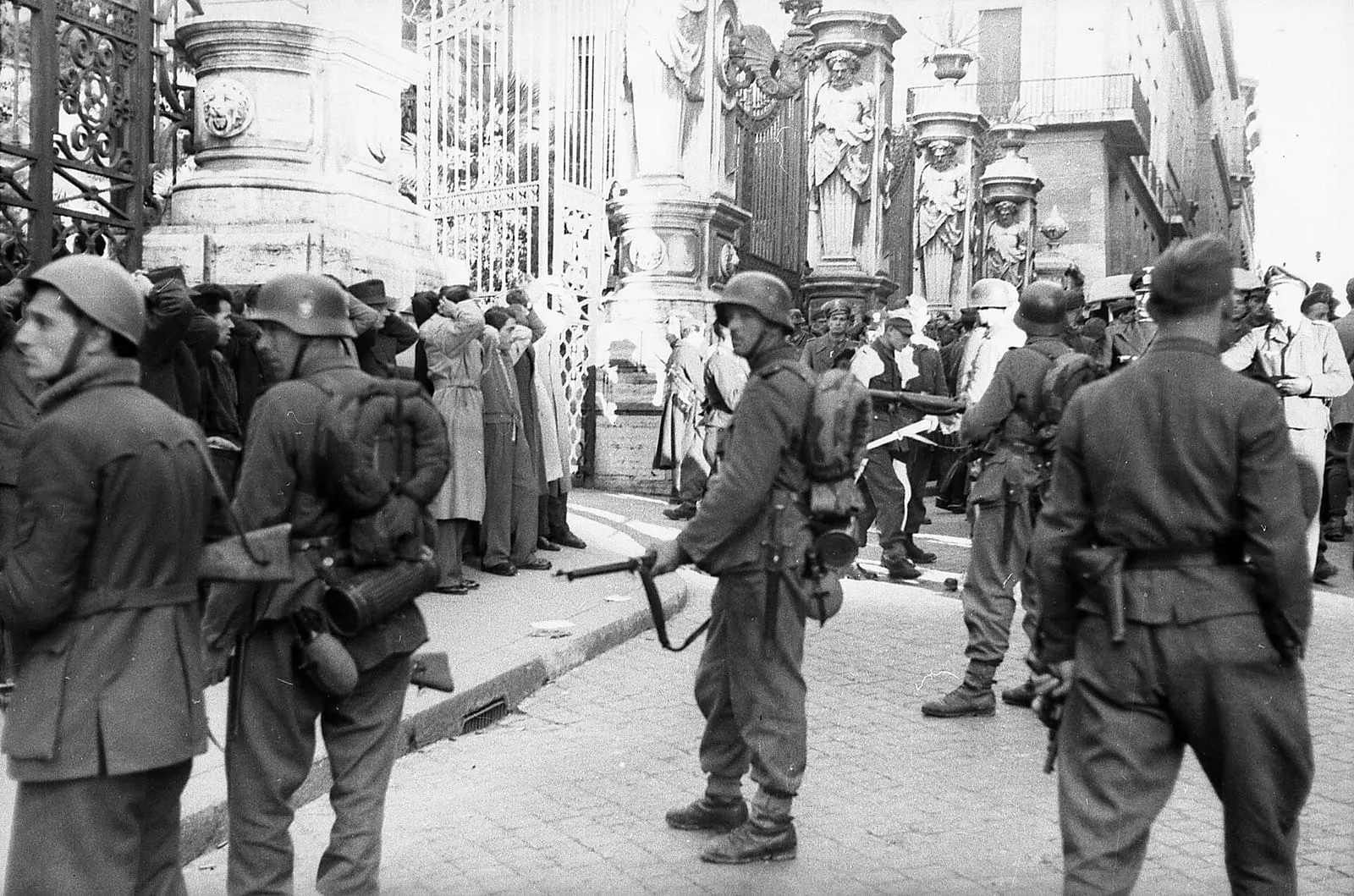
On 24 March 1944, in disused quarries on the Via Ardeatina on the southern outskirts of Rome, the German Security Police shot 335 men and boys. It was the response to an attack by communist partisans who, the day before, had blown up a column of German police in the Via Rasella, killing 33 policemen. The occupiers adopted the rule that ten Italians would die for every German killed, and chose the victims from the prisons – from among members of the resistance, political prisoners, Jews held pending deportation and people detained by chance. The execution lasted several hours, and the Germans blew up the entrances to the tunnels to hide the bodies. The Ardeatine Caves massacre (Italian Eccidio delle Fosse Ardeatine) is the greatest crime committed in Rome itself during the war and remains to this day a symbol of the German occupation in Italy.
The entry in chronologies of the war – “335 Italians, including 75 Jews, killed in reprisal for a bomb attack in which German soldiers died” – agrees with the findings of historians. It needs only to be made more precise in two respects. Those killed in the Via Rasella were not Wehrmacht soldiers but men of the German Order Police from the Bozen Regiment, recruited in South Tyrol (PL). And there were also a few foreigners among those shot, so it would be more accurate to speak of 335 victims, the overwhelming majority of them Italians.
Rome under occupation
The Germans occupied Rome in September 1943, after the announcement of the Italian armistice with the Allies. The Italians had declared it an open city back in August, which the Allies did not recognise, and in practice it was governed by the German city command of General Kurt Mälzer of the Luftwaffe, while from 10 September the Security Police and the SD there were headed by SS-Obersturmbannführer Herbert Kappler. It was his men who on 16 October 1943 carried out the round-up of Jews in the Roman Ghetto and across the city; more than a thousand of those detained were deported to Auschwitz, from which a mere handful returned. In a building on the Via Tasso a prison and interrogation centre was set up, where members of the resistance were tortured.
After the Allied landing at Anzio on 22 January 1944 the front lay a few dozen kilometres from the city. The Romans expected early liberation, and when the beachhead stalled – at the beginning of March the Germans went over to the defensive at Anzio – the occupation grew harsher. The Germans and the fascist police of the Italian Social Republic broke up much of the military underground and the political resistance groups, and hundreds of people were held in the prisons on the Via Tasso and at Regina Coeli.
Small communist combat groups, the GAP (Gruppi di Azione Patriottica), were active in the city, similar to those that had already begun attacks in Milan and other northern cities in the autumn. Their political leadership – above all Giorgio Amendola – held that Rome must not wait passively for the Allies and that the population had to be roused to fight. From the autumn of 1943 the gappisti attacked German soldiers, fascist militiamen and their premises in the city.
The Via Rasella attack
The target chosen was the 11th Company of the III Battalion of the Bozen Police Regiment. The battalion had been formed in the autumn of 1943 from inhabitants of South Tyrol, many of whom had opted for German citizenship in 1939; many of them had previously served in the Italian army. In Rome the company marched in formation through the centre every afternoon, along the narrow Via Rasella near the Palazzo Barberini. The attack was planned for 23 March, the 25th anniversary of the founding of the first fascist Fasci di combattimento by Mussolini.
Over a dozen gappisti took part in the action, among them Rosario Bentivegna, Carla Capponi, Franco Calamandrei and Carlo Salinari. Bentivegna, disguised as a street sweeper, pushed a rubbish cart in which a bomb of a dozen or so kilograms of TNT in a metal casing had been hidden. At around 3.50 p.m., as the column approached the cart, he lit the fuse and walked away. The explosion shook the street; the other gappisti threw mortar bombs at the survivors and opened fire on them, and then all of them managed to escape. Twenty-eight policemen died on the spot, others died during the night and the next day – 33 in all, according to the count accepted in the historiography (some sources give higher figures, which include those who died later). The blast also killed two Italian civilians, among them the teenage Piero Zuccheretti.
The Germans and the Italian police immediately cordoned off the block. The policemen fired at the windows of the houses, convinced that the bombs had been thrown from above; more than a hundred residents of the surrounding buildings, chosen at random, were led out and detained. A furious General Mälzer arrived on the scene threatening to blow up the whole district, followed at once by Kappler and German diplomats, who tried to calm him down.
The decision to retaliate
The news reached Hitler’s headquarters in East Prussia that same afternoon. According to witnesses, Adolf Hitler demanded a reprisal “that would make the world tremble” and reportedly spoke of shooting thirty to fifty Italians for every German killed; no written order from Hitler setting this ratio has survived. The ratio was fixed on the spot. Mälzer and Kappler spoke by telephone with the commander of the Fourteenth Army, General Eberhard von Mackensen, to whom Rome was subordinate as the rear area of the Anzio front. Mackensen decided that ten for one would suffice and ordered that the so-called Todeskandidaten be shot – prisoners already sentenced to death or charged with offences punishable by death.
Field Marshal Albert Kesselring, commander-in-chief of the German forces in Italy, was at the Anzio beachhead that day. In the evening, after returning to his headquarters, he spoke with the chief of the Wehrmacht operations staff, General Alfred Jodl: he proposed the ratio of ten to one and was given a free hand. From Kesselring’s headquarters the order went down the chain to shoot ten Italians for every policeman killed, to be carried out within 24 hours. Who was to do the shooting was decided only at noon on 24 March. Mälzer assigned the task to the commander of the battalion of the Bozen Regiment that had been attacked, Major Hellmuth Dobbrick, but he refused, citing among other things the religious scruples of his men. The chief of staff of the Fourteenth Army, Colonel Wolf Rüdiger Hauser, also refused, arguing that the reprisal was a matter for the police who had been attacked. Mälzer therefore entrusted the execution to Kappler and his officers, and ordered Kappler himself to “set an example” and shoot in person.
No one demanded that the perpetrators give themselves up, and no public warning or appeal was issued. The post-war legend that the gappisti could have saved the hostages by surrendering to the Germans finds no confirmation in the documents – Kesselring himself testified in 1946 that no such appeal had been made.
The death lists
Kappler began to draw up the list on the evening of 23 March, together with his deputy, SS-Hauptsturmführer Erich Priebke. It soon emerged that the German prisons held only a few people sentenced to death and a dozen or so charged with offences carrying that penalty. When the number of dead policemen rose to 32 during the night, 320 names were needed. Kappler’s superior, the commander of the Security Police in Italy, General Wilhelm Harster, is said to have advised him to fall back on Jews if necessary. Kappler put on the list 75 Jews detained in Rome and awaiting deportation – some of them arrested after denunciations in the preceding weeks – and then added further groups: prisoners from the Via Tasso accused of underground activity, people detained in the Via Rasella, people being tried by a German military court and people who had already received light sentences. Fifty names were to be supplied by the head of the fascist police in Rome (the questore), Pietro Caruso, who selected them from Regina Coeli prison.
On the morning of 24 March the 33rd policeman died. On his own initiative, without orders from above, Kappler added ten more people. The list, moreover, was neither finished nor checked: the officials were working in haste, names from Caruso kept arriving until the last moment, and some entries were incomplete. Among those on the list were distinguished men: Colonel Giuseppe Cordero Lanza di Montezemolo, who led the clandestine Military Front (Fronte Militare Clandestino) loyal to the king and to the government of Pietro Badoglio and had been tortured on the Via Tasso since January; General Simone Simoni; three Carabinieri officers; the priest Pietro Pappagallo, who had helped people in hiding; and the former fascist politician of Jewish origin Aldo Finzi, who had been expelled from the party in 1942 and had made contact with the resistance.
The execution
The place chosen for the execution was a set of disused underground tuff quarries on the Via Ardeatina, near the catacombs on the Via Appia. On the afternoon of 24 March lorries brought the prisoners from the Via Tasso, and at around 3.30 p.m. from Regina Coeli as well. Their hands were tied. They were led into the depths of the tunnels in groups of five, by torchlight. At the entrance Priebke read out the names and ticked them off on the list. Inside, the victims had to kneel, and each of the executioners fired at close range into the back of the head – one bullet per person was supposed to be enough. Kappler, as ordered, fired in person, with the second group; afterwards he forced those officers who hesitated to shoot as well. Kappler had cognac brought to the quarries to bolster the executioners’ courage.
The execution went on until evening; according to Italian findings it was carried out in 67 rounds. The bodies piled up so quickly that later victims had to kneel on the corpses of those before them, and many did not die from the first shot. During the execution it turned out that five more people had been brought than the list provided for. It was decided to kill them too, so that no one would leave the quarries alive and give away the place. Thus 335 people died instead of 330. In the evening engineers blew up the entrances to the tunnels, and the heaps of bodies remained under the rubble until the city was liberated.
The victims
The dead came from every social stratum of Rome: officers and workers, lawyers, doctors, students, shopkeepers, craftsmen, artists. The youngest was 15. According to the findings of the Italian commission that identified the bodies after the war, about 39 of the victims belonged to the military underground, about 52 to groups of the Action Party (Partito d’Azione) and the Giustizia e Libertà movement, and about 55 to Bandiera Rossa, a communist organisation independent of the mainstream resistance, which was the most heavily represented. Among the dead were 75 Jews, chosen solely because of their origin – such as the young boxer Lazzaro Anticoli, betrayed to the Germans by a woman informer from the ghetto. The rest were socialists, common criminals, people arrested for petty offences and passers-by detained by chance. None of them had taken part in the Via Rasella attack.
Nothing was announced to the families. For weeks many of them kept bringing parcels to the prisons, not knowing that the addressees were dead; some received terse notifications after a while, others nothing at all. After the liberation of Rome in June 1944 the tunnels were opened and the exhumation began, conducted by a team of forensic doctors led by Professor Attilio Ascarelli. Despite his efforts, a few victims have still not been identified; the last names were established by DNA testing only in the 21st century.
The communiqué and the silence
On the evening of 24 March the German command issued a communiqué through the Italian Stefani agency, which the Roman newspapers printed the next day. It called the attack an ambush by “Badoglian communists” and said of the reprisal only that ten of them had been shot for every German killed and that “the order has already been carried out”. Neither names nor the place were given.
Immediately afterwards the Vatican’s L’Osservatore Romano published a comment deploring “thirty-two victims on the one side” and “three hundred and twenty persons sacrificed for the guilty parties who escaped arrest” on the other, and calling on the Romans to remain calm. Pope Pius XII made no public protest. His defenders stress that the Holy See learned of the planned reprisal only a few hours beforehand, without details, and that a loud protest could have endangered thousands of people hidden in Roman religious houses; his critics, notably the American historian Robert Katz, believe that the Pope could and should have done more. The dispute continues to this day, as do the disputes over the bombing of the Vatican and the Pope’s whole policy in occupied Rome.
In Italian memory the attack itself was also long disputed. The right and part of Catholic opinion accused the gappisti of bringing the reprisal down on the city; the Italian courts, which after the war heard applications and lawsuits against them, ruled the Via Rasella attack to be an act of war against the occupier, not an ordinary crime.
The reckoning
Pietro Caruso was the first to answer for the crime. After the liberation of Rome he was tried by an Italian court and shot in September 1944. General Mackensen and General Mälzer were tried by a British military court in Rome; in November 1946 both were sentenced to death, but their sentences were commuted to imprisonment. Mälzer died in prison in 1952, and Mackensen was released the same year. Kesselring was tried in 1947 at Mestre near Venice for the Ardeatine Caves and for his orders against the partisans; his death sentence was likewise commuted to life imprisonment, and in 1952 he was released.
Kappler, handed over to the Italians by the British, was tried in 1948 by an Italian military tribunal in Rome. On 20 July 1948 it sentenced him to life imprisonment. The court did find that a reprisal on such a scale and in such a form was unlawful, but it accepted that in the case of 320 victims Kappler had been carrying out his superiors’ orders – and convicted him of killing the remaining fifteen, added on his own responsibility, and separately of extorting gold from the Jews of Rome. Kappler’s subordinates were acquitted. In 1977 Kappler managed to escape from a military hospital in Rome to West Germany, where he died the following year.
The case of Priebke lasted longest; he fled to Argentina after the war and lived there under his own name for half a century. Tracked down in 1994 and extradited to Italy, he was tried several times; in 1998 a military appeal court sentenced him, together with another SD officer, Karl Hass, to life imprisonment. Both served their sentences under house arrest, and Priebke died in 2013.
A mausoleum was built at the scene of the crime and opened on the fifth anniversary, 24 March 1949. The 335 victims lie there in identical graves beneath a common concrete slab, Christians beside Jews. Every year on 24 March a state ceremony is held there, attended by the President of Italy.
Place in the war
The Ardeatine Caves massacre did not change the situation at the front. The battle for the Anzio beachhead and the third battle of Monte Cassino went on, and Rome was liberated only on 4 June 1944, when General Mark Clark’s US Fifth Army entered the city. The Roman underground survived, though it lost many people, and the GAP carried out no more actions on that scale in the city before the liberation. The crime did, however, foreshadow how the Germans would respond to partisan activity throughout occupied Italy.
In June and July 1944, as the partisan movement grew in the mountains, Kesselring issued orders on the fight against the “bands” that provided for reprisals against the civilian population and assured commanders of impunity. In their shadow Wehrmacht and SS units carried out the worst massacres of civilians in Italy over the following months, among them those at Sant’Anna di Stazzema and Marzabotto. The Ardeatine Caves case came up again in the trials of German war criminals in Italy and remains to this day a point of reference for Italian memory of the occupation and the resistance – including memory of how few of the perpetrators were punished.
Sources
Meanwhile
(04)Elsewhere, within a week.
- 22 March 1944 · PacificThe Japanese cross into IndiaIn late March 1944 Japanese divisions entered Manipur. At Sangshak a parachute brigade held them for a week, and the 17th Division fought its way to Imphal.
- 26 March 1944 · Eastern FrontStrachwitz's counter-attack at NarvaOn 26 March 1944 Hyazinth Strachwitz's battle group struck the Soviet bridgehead at Krivasoo, south of Narva, and destroyed its western part.
- 21 March 1944 · ScandinaviaFinland rejects the Soviet termsOn 21 March 1944 Moscow announced that Finland had not accepted its peace terms. That same day Helsinki agreed to send a delegation to Moscow.
- 20 March 1944 · Eastern FrontThe Red Army at the Romanian borderOn 17–20 March 1944 Konev's troops crossed the Dniester into Bessarabia and Zhukov's took Vinnytsia. The German front in Ukraine was falling apart.
Related events
(04)The same battle, people or subject.
- 4 June 1944 · MediterraneanThe Allies in RomeOn 4 June 1944 the US Fifth Army entered Rome, which the Germans had left without fighting in the city – the first Axis capital taken by the Allies.
- 1 March 1944 · MediterraneanThe second bombing of the VaticanOn 1 March 1944 six small bombs fell just outside the Vatican wall, killing a workman and damaging the Holy Office. The British privately admitted a mistake.
- 1 March 1944 · MediterraneanThe strikes in northern ItalyOn 1 March 1944 a general strike began in Turin, Milan, Genoa and other cities of occupied Italy. The Germans and the Salò Fascists replied with deportations.
- 12 September 1943 · MediterraneanThe rescue of MussoliniOn 12 September 1943 German paratroopers freed Mussolini from a hotel on the Gran Sasso. Skorzeny took the glory; Hitler made Mussolini head of the Salò state.