United States
Mark W. Clark
Commander of the Fifth Army (1943–1944), of 15th Army Group (1944–1945) and of UN forces in Korea (1952–1953), general (1945)
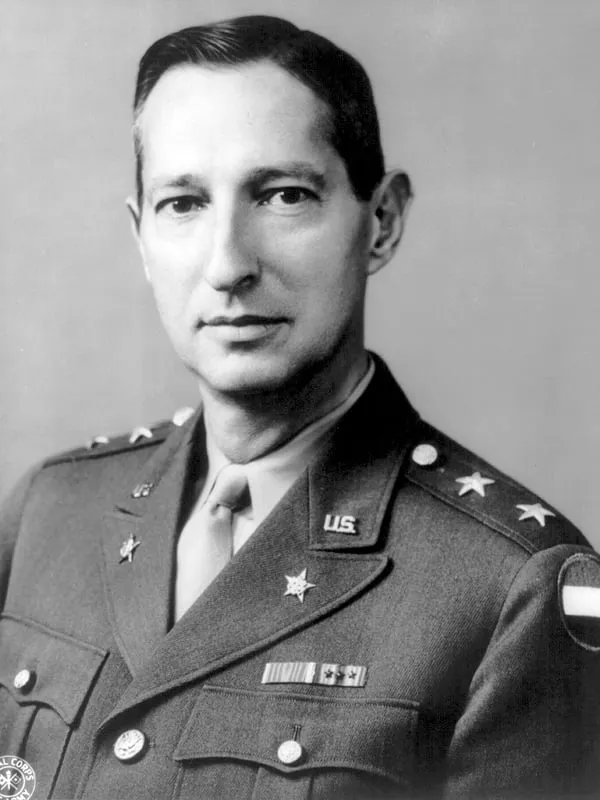
- Born:
- 1 May 1896, Madison Barracks, Sackets Harbor (New York, United States)
- Died:
- 17 April 1984, Charleston (South Carolina, United States)
- Author:
- Natalia
- Photo:
- Photo by U.S. Army Signal Corps, domena publiczna, Wikimedia Commons

Mark Wayne Clark was the youngest American three-star, and later four-star, general of the Second World War and one of its most controversial commanders. A friend of Dwight Eisenhower and an outstanding staff officer, he helped to plan the landings in North Africa and then for almost two years led the US Fifth Army in Italy – from Salerno, by way of Monte Cassino and Anzio, to Rome. Ambitious, careful of his own image and distrustful of the British, he won fame as the conqueror of the Eternal City, but also sharp criticism for the bloody crossing of the Rapido and for his turn towards Rome in May 1944. He ended the war in command of all Allied forces in Italy, and nine years later he signed the armistice that ended the fighting in Korea.
An officer’s son
He was born on 1 May 1896 at Madison Barracks in Sackets Harbor, New York, the son of a regular infantry officer, Charles Carr Clark. His mother, Rebecca Ezekiels, came from a family of Romanian Jews. He spent much of his childhood in Highland Park near Chicago, where his father was stationed. In 1913, at the age of seventeen, he entered the Military Academy at West Point. There he met Eisenhower, two classes ahead of him, and the two became lasting friends. Frequent illness kept him at the academy longer than planned; he graduated on 20 April 1917, two weeks after the United States entered the war, near the bottom of his class – a class that produced many future generals, among them Matthew Ridgway and J. Lawton Collins.
The First World War and the interwar years
He arrived in France as a captain in the 11th Infantry Regiment on 1 May 1918, his 22nd birthday. In June, in the Vosges, while his division was relieving French troops, he was badly wounded in the shoulder and back by shell splinters. Once he had recovered he was judged unfit for front-line duty and transferred to the supply service of the First Army, where he was responsible for feeding the troops until the end of the war. After the armistice he served with the occupation forces in Germany.
The interwar years brought him the slow career typical of the army of the time. He was an aide in the War Department, a staff officer in San Francisco and an instructor with the Indiana National Guard; he was not promoted to major until 1933, more than fifteen years after becoming a captain. He passed through the Command and General Staff School and the Army War College. In 1940 he caught the eye of the Army Chief of Staff, General George Marshall, who brought him to the War College as an instructor. Together with General Lesley McNair, Clark prepared the great Louisiana Manoeuvres of 1941, the test of the rapidly expanding army. In August 1941 he skipped the rank of colonel altogether and was promoted straight to brigadier general.
London, Algiers and Torch
After the United States entered the war Clark became Chief of Staff of Army Ground Forces and in April 1942 the youngest major general in the US Army. In June he went to England with Eisenhower as commander of II Corps and soon of all US ground forces in the European theatre. Winston Churchill, delighted by the tall, energetic general, called him “the American Eagle”. When the idea of invading France that year was dropped in the summer of 1942, Clark became Eisenhower’s deputy and the chief organiser of the planning of Operation Torch.
On the night of 21–22 October 1942 he landed from a submarine near Cherchell to arrange help for the landings with French officers – an adventure from which he returned without his trousers, lost in the surf, but with a good deal of publicity. After the landings in North Africa it was he who negotiated in Algiers with Admiral François Darlan the ceasefire and agreement that ended the fighting with the Vichy forces but caused a storm in the British and American press. On 11 November 1942, at the age of 46, he became the youngest lieutenant general in the US Army.
The Fifth Army and Salerno
On 5 January 1943 Clark took command of the newly created Fifth Army – the first American field army formed outside the United States. For six months it took no part in the fighting in Tunisia or Sicily, training in Morocco and keeping watch on Spanish Morocco. Clark’s rapid promotion aroused the jealousy of older generals; George Patton regarded him as a careerist who was “too damned slick”. Clark himself admitted that he found it hard to command men who had recently been his superiors, and he was reluctant to remove incompetent subordinates.
On 9 September 1943 the Fifth Army, made up of the US VI Corps and the British X Corps, landed in the Gulf of Salerno. The plan, drawn up in haste, had serious weaknesses: a wide front, corps separated from each other, and no preliminary naval bombardment in the American sector. On 12–14 September a German counter-attack nearly split the beachhead, and Clark’s staff drew up plans for a partial evacuation (the crisis at Salerno). Clark, however, kept his head. He drove up to the front line, personally directed the defence of threatened sectors, and for his conduct on 14 September received the Distinguished Service Cross. Historians still judge Salerno in two ways: as proof of his courage and as the result of flaws in a plan for which he was responsible. After the battle he removed the commander of VI Corps, General Ernest Dawley, and on 1 October his troops entered Naples.
Cassino, the Rapido and Anzio
In the autumn of 1943 the Fifth Army’s advance stalled in the mountains against one German defensive line after another. In January 1944 Clark sent the 36th Division across the Rapido (properly the Gari) below Monte Cassino to pin down the Germans before the landing at Anzio. The attack on the night of 20–21 January, made despite the misgivings of the divisional commander, ended in disaster: the division lost about 1,700 men. After the war the 36th Division veterans’ association demanded that Congress investigate the “incompetent and inexperienced” commander who had “needlessly sacrificed” its soldiers. The House of Representatives cleared Clark, and he himself never commented on the affair in public. Some historians defend him, pointing out that the crossing was part of a wider plan dictated by the aims of the Anzio operation.
The landing at Anzio (Operation Shingle), carried out on 22 January 1944 by General John Lucas’s VI Corps, stalled in its beachhead for four months; in the end Clark replaced Lucas with General Lucian Truscott. In February, on the direct order of General Harold Alexander, commander of the Allied armies in Italy, he gave the order to bomb the abbey on Monte Cassino, although he himself – like his chief of staff – was not convinced that it was a military necessity. Three times in those months he came close to death: under fire from his own ships on the way to Anzio, when bombs dropped in error fell a few dozen metres from his trailer, and when his aircraft caught the cable of a barrage balloon.
Rome
In May 1944 the Allies broke through the Gustav Line – in the fourth assault on Monte Cassino the monastery hill was taken by General Władysław Anders’s Polish II Corps, part of the British Eighth Army – and the troops in the Anzio beachhead went over to the offensive. Alexander wanted them to strike towards Valmontone and cut the line of retreat of the German Tenth Army. On 25 May Clark, without consulting his superior, turned Truscott’s main force north-west towards Rome. On 4 June 1944 the Americans entered the Italian capital, and the next day Clark drove into the city in triumph. His glory was short-lived – on 6 June the Allies landed in Normandy – and the Tenth Army escaped to the north. Truscott later wrote that had Clark kept to Alexander’s orders, the aims of the Anzio operation would have been fully achieved, and the American historian Carlo D’Este called the decision as militarily stupid as it was insubordinate. Other scholars, such as James Holland, argue that the attack on the line held by the German Fourteenth Army achieved more than the critics suggest. The dispute over the “race for Rome” is one of the liveliest in the historiography of the Italian campaign.
The Gothic Line and victory in Italy
In the summer of 1944 the Fifth Army gave up VI Corps and the French Expeditionary Corps for the landings in southern France, which Clark had opposed from the start. Weakened, it fought that autumn on the Gothic Line, where its advance again bogged down in rain and mud. Alongside Americans and British troops its ranks then included Brazilian soldiers and Japanese Americans of the 100th Battalion and the 442nd Regiment. In December 1944 Clark succeeded Alexander as commander of 15th Army Group – that is, of all Allied ground forces in Italy – and Truscott took over the Fifth Army. On 10 March 1945, at the age of 48, Clark became the youngest four-star general in the US Army. In the spring he led the final offensive in Italy, in which the Polish II Corps took Bologna, and at the beginning of May he accepted the surrender of the German forces in Italy.
Austria and Korea
After the war Clark was High Commissioner and commander of US forces in occupied Austria. There he negotiated with Soviet representatives for the first time and became convinced that one could talk to communists only from a position of strength. In 1947 he took part in the talks of the Council of Foreign Ministers on the Austrian treaty, and he then commanded the Sixth Army in San Francisco and Army Field Forces. In 1951 President Harry Truman nominated him as envoy to the Holy See, but after protests from Protestant groups and senators Clark withdrew in January 1952.
In May 1952 he succeeded his West Point contemporary Ridgway as commander of UN forces in the Korean War and of US forces in the Far East. He favoured stronger pressure on China and North Korea, but Washington was intent on ending the war. On 27 July 1953 he signed the armistice agreement at Panmunjom. In his memoirs he wrote that he had gained the “unenviable distinction” of being the first US Army commander to sign an armistice without victory. He retired at the end of October 1953.
Later years
From 1954 to 1965 Clark was president of The Citadel, the military college in Charleston. He also headed a government task force that examined the work of American intelligence and coined the term “intelligence community”. He published two volumes of memoirs: Calculated Risk (1950) and From the Danube to the Yalu (1954). With his first wife, Maurine Doran, whom he married in 1924, he had a son and a daughter; after her death in 1966 he married again. His views provoked opposition: he linked “un-Americanism” and communism with unassimilated immigrants, and during the war he said that soldiers had to kill Germans “like rattlesnakes”. He died on 17 April 1984 in Charleston, the last surviving American general to have worn four stars during the Second World War. He was buried in the grounds of The Citadel.
Significance
Clark is one of the commanders about whom historians have argued longest. He was an outstanding organiser and staff officer, brave on the battlefield and skilful in commanding a multinational army in which French, Brazilians, New Zealanders, Indians and Poles fought alongside Americans and British. At the same time his ambition, his concern for publicity and his distrust of the British led to decisions that cost his soldiers their lives or let the enemy escape. Salerno, the Rapido and Rome remain the three points around which the argument over his place in the history of the Italian campaign – the longest campaign of the Western Allies in Europe – still turns.
Sources
Commanded in battles
(04)Mentioned in battles
(01)Often appears with
People who appear in the same events.
On the timeline
(49)The 40 most important of 49 events. All tagged “Mark W. Clark” (12) →
1942
February
June
August
October
November
- 08
- Key eventThe landings in North AfricaOn 8 November 1942 more than 70,000 American and British troops landed in Morocco and Algeria. The Vichy French resisted at Casablanca and Oran.
- The Algiers putschOn the night of 7/8 November 1942 some 400 underground volunteers seized Algiers for several hours and detained General Juin and Admiral Darlan.