- Category:
- Military operations
- Front:
- Mediterranean
- Date:
- 22 January 1944
- Author:
- Łukasz
- Battle:
- Battle of Anzio
- Tags:
- Italy, United States, United Kingdom, Wehrmacht
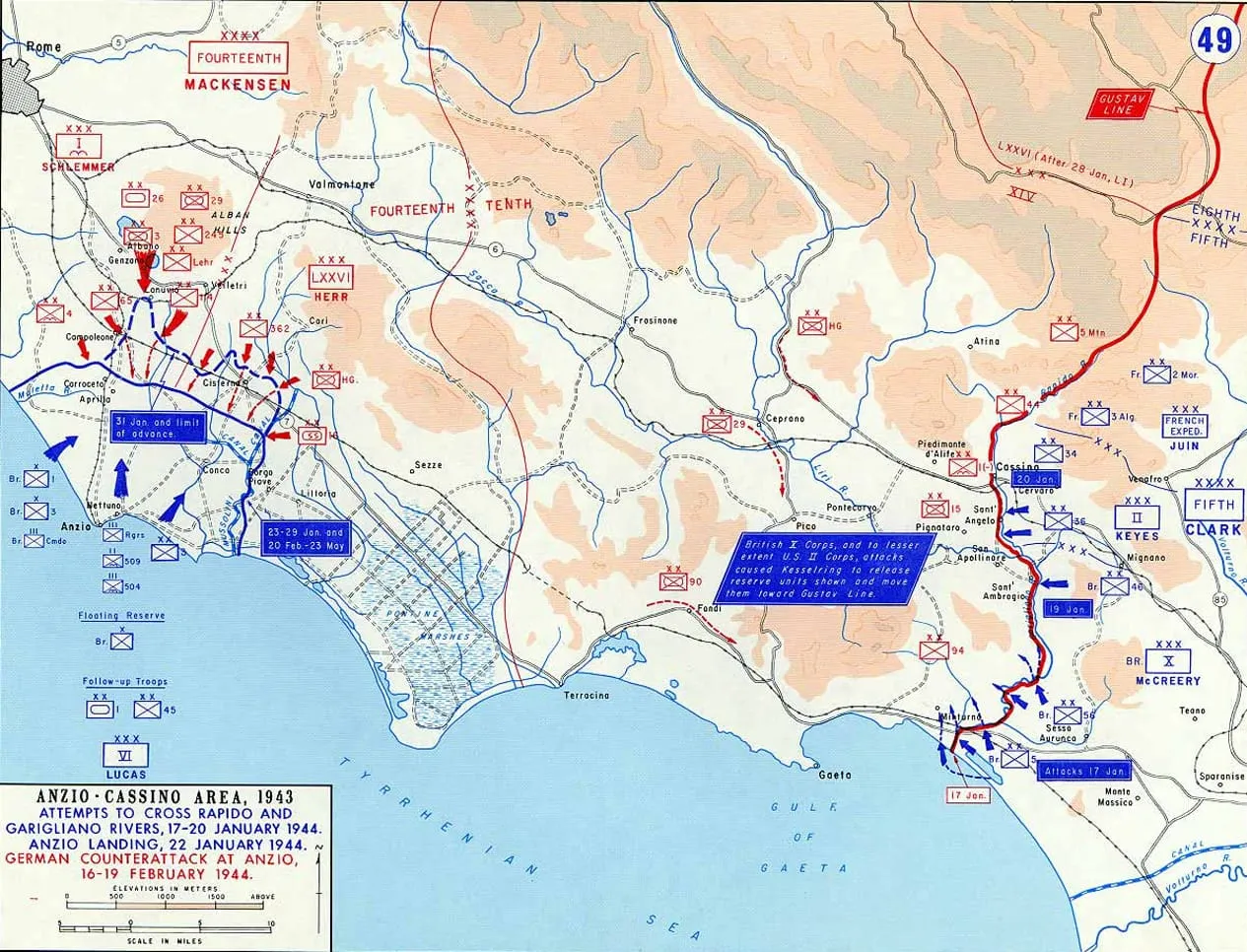
At two in the morning on 22 January 1944 soldiers of Major General John Lucas’s US VI Corps began coming ashore on the beaches at Anzio and Nettuno, less than 60 kilometres south of Rome. The Allies expected a repeat of Salerno – fire from the dunes and a tank counter-attack. Instead there was almost nobody on the coast. By midnight about 36,000 soldiers and more than 3,000 vehicles had been landed; thirteen men had been killed, and some two hundred Germans had been taken prisoner. Operation Shingle achieved one of the most complete surprises of the whole war.
That surprise, however, could not be turned into victory. Instead of striking inland at once, Lucas consolidated and built up his beachhead, while Field Marshal Albert Kesselring within a few days brought troops to Anzio from all over Italy and from France, Yugoslavia and Germany. A landing that was meant to open the road to Rome and break the Gustav Line turned into a four-month siege of a crowded strip of coast. The troops in the beachhead broke out only in the second half of May.
Churchill’s idea
In the autumn of 1943 the Allied advance in Italy stalled. After the landing at Salerno and the capture of Naples, General Mark Clark’s Anglo-American Fifth Army and the British Eighth Army were grinding their way through successive German defensive lines in the mountains, in rain and mud, paying for every kilometre. Rome, which after its occupation by the Germans in September 1943 had become the symbolic goal of the campaign, remained far off. The main bolt of the German defences was the Gustav Line, with the Monte Cassino massif guarding the Liri valley – the only convenient road to Rome.
The idea of outflanking this line from the sea had been circulating since October at the headquarters of General Harold Alexander, who commanded the Allied forces in Italy. A landing at Anzio was planned and then, on 18 December 1943, cancelled, because the Fifth Army had not managed to get close enough to link up quickly with troops put ashore on the beach. It was then that Winston Churchill took the matter up again. The prime minister, who had fallen ill with pneumonia after the Tehran Conference and was recovering in Tunis and Marrakesh, decided that the Italian campaign was bogging down and that one bold stroke could decide the fate of Rome. In his vision two divisions put ashore behind the Germans would threaten their communications, force them to abandon the Gustav Line and open the road to the Eternal City. At a conference at Carthage near Tunis on Christmas Day 1943 he pushed through the revival of the operation. He himself later expressed his hopes in the image of a “wildcat” that, flung ashore, would sink its claws into the German rear – and it was with this image that he bitterly compared what the landing actually produced.
The greatest obstacle was the shortage of landing ships. The tank landing ships (LSTs) were soon due to sail for Britain, where the invasion of France was being prepared. Churchill personally obtained President Roosevelt’s agreement to keep them in the Mediterranean until the beginning of February, and later also to increase their number so that there would be enough for two divisions. For the Americans, who were determined that nothing should delay the invasion of Normandy, it was a concession made reluctantly.
The plan and the doubts
The task went to Lucas’s VI Corps, which had been taken out of the line at Cassino in December. Allotted to the landing were the US 3rd Infantry Division under Major General Lucian Truscott, the British 1st Infantry Division under Major General Ronald Penney, three battalions of American Rangers under Colonel William Darby, two British commando units, the 509th Parachute Infantry Battalion and the 504th Parachute Infantry Regiment, as well as tanks, artillery and support units – some 40,000 men in all in the first wave. The invasion fleet, Task Force 81, was led by the American Rear Admiral Frank Lowry; the British part of the fleet off Peter Beach by Rear Admiral Thomas Troubridge.
The plan was linked to the offensive on the Gustav Line. On 17 January British X Corps attacked on the Garigliano, and during the night of 20–21 January the US 36th Division attempted to cross the Rapido and suffered a bloody defeat. These attacks were meant to draw the German reserves south – and in that they succeeded: the commander of the German Tenth Army, General Heinrich von Vietinghoff, obtained from Kesselring two panzergrenadier divisions that had been stationed near Rome. The Anzio area was left almost without defenders.
Lucas’s orders, however, were more cautious than Churchill’s conception. Alexander wanted the landing to cut the German supply lines and threaten the rear of General Fridolin von Senger und Etterlin’s XIV Panzer Corps. In his final order Clark instructed Lucas to seize and secure a beachhead and then to “advance on” the Alban Hills – the heights commanding the roads running south from Rome. He did not specify when this was to happen. According to Lucas’s account, before he sailed Clark told him: “Don’t stick your neck out, Johnny. I did at Salerno and got into trouble.”
Lucas, a 54-year-old gunner, did not believe in the operation. He wrote in his diary that he would be put ashore with insufficient forces and landed in serious trouble, that the whole affair had “a strong odor of Gallipoli”, and that “the same amateur” was still on the coach’s bench – an allusion to Churchill, the author of the failed Gallipoli landing of 1915. The gloomy mood was deepened by the dress rehearsal near Salerno on 18–19 January: badly handled, it ended with the loss of many DUKW amphibians and guns. There was no time left to put things right.
The landing
The convoys left Naples on 21 January and, by a roundabout route intended to mislead German reconnaissance, reached Anzio during the night. The preliminary bombardment was brief: just before the landing rocket ships drenched the beaches with salvoes, and then silence fell. The British 1st Division and the commandos went ashore on Peter Beach, about 9 kilometres north-west of Anzio. The US 3rd Division landed on X-Ray Beach east of Nettuno. Darby’s Rangers struck straight at the harbour of Anzio and took it almost without a fight, and the paratroopers of the 509th Battalion took Nettuno.
Resistance came only from a few scattered outposts and weak units resting behind the front. Throughout the day the Luftwaffe attacked the beaches and ships with single aircraft. By midnight the British had pushed about 3 kilometres inland and the Americans about 5; the port of Anzio, almost undamaged, was receiving the first landing ships. VI Corps’ losses that day were 13 killed and 97 wounded.
The fleet suffered most. The waters off Anzio were thickly mined, and the minesweepers cleared them under fire. On 22 January the American minesweeper USS Portent – an Auk-class vessel in service since April 1943 – struck a mine and sank; survivors were picked up by nearby vessels. At dusk the next day German bombers fell on the covering force. On 23 January the British destroyer HMS Janus was sunk; a veteran of the Battle of Cape Matapan, she had supported the troops ashore with her guns during the first two days of the landing. The cause of her sinking is disputed: some sources speak of an aerial torpedo dropped by a Heinkel He 111, others of a Henschel Hs 293 guided glide bomb, which the Germans were then using against ships off Anzio. Janus went down in about twenty minutes; according to British figures 158 men were killed, including her captain, Lieutenant Commander William Morrison, and about 80 survived. That same evening a glide bomb blew off the bow of her sister ship HMS Jervis, which nevertheless managed to return to Naples.
These were only the first casualties. In the following weeks German aircraft, submarines, long-range artillery and mines sank or damaged dozens of vessels off Anzio, including the British cruisers Spartan and Penelope and the hospital ship St David.
Kesselring’s response
Kesselring learned of the landing at about 3 a.m. The surprise was complete – according to German officers’ accounts, only the day before the head of the Abwehr, Admiral Wilhelm Canaris, had assured Kesselring’s staff that no landing was to be expected for the time being – but it did not find him unprepared. He had plans ready, under code names, for a landing at each of the likely points on the coast; for the Rome area it was Case Richard (Fall Richard). Every division in Italy had to keep a motorised battle group at readiness, able to move within a few hours to wherever the enemy landed.
At 5 a.m. Kesselring set Case Richard in motion. Battle groups of the 4th Parachute Division and the Hermann Göring Panzer Division occupied the roads leading from Anzio through Campoleone and Cisterna into the Alban Hills. The Wehrmacht High Command, with Hitler’s approval, sent to Italy the equivalent of more than three divisions from France, Yugoslavia and Germany and placed three more divisions already in Italy at Kesselring’s disposal. Vietinghoff, despite the fighting on the Garigliano and the Rapido, had to give up some of his forces from Cassino, and the headquarters of General Eberhard von Mackensen’s Fourteenth Army set off from northern Italy. On the evening of 22 January the staff of General Alfred Schlemm’s I Parachute Corps arrived at Anzio and began bringing order to the medley of battalions streaming in from all directions.
On the morning of 22 January Kesselring feared that if the Allies struck at once, within a day or two, he would not be able to stop them. By the evening, seeing that the troops in the beachhead were not moving inland, he concluded that a defence could be built. By 24 January more than 40,000 Germans already surrounded the beachhead, and on 25 January Mackensen’s Fourteenth Army took over the whole defence. By the end of the month elements of eight German divisions were fighting around Anzio, and more were on the way. Hitler demanded not merely that the landing be contained but that it be destroyed – the beachhead was to become an example that would deter the Allies from invading France.
A whale on the beach
Lucas decided that his first task was to hold the beachhead. Over the following days he landed men, equipment and ammunition, built up his defences and waited for reinforcements: the US 45th Infantry Division and part of the 1st Armored Division. Patrols pushed inland reported empty roads, but VI Corps advanced slowly. The British reached Aprilia, a settlement built in the 1930s on the drained Pontine Marshes, which the soldiers called “the Factory”. On 25–27 January the Americans tried in vain to take Cisterna. By 29 January 69,000 men, 508 guns and 208 tanks had been assembled in the beachhead – but by then there were more than 70,000 Germans around it.
Churchill was furious. “I had hoped that we were hurling a wildcat on to the shore, but all we got was a stranded whale,” he said. Alexander, visiting the beachhead, pressed for an attack, and Clark, although he himself had earlier counselled caution, grew impatient. Only on 30 January did VI Corps launch its attack on Campoleone and Cisterna – too late.
Lucas’s decision still divides historians. His critics, following Churchill and Alexander, argue that he wasted the only chance: on 22 and 23 January the roads to the Alban Hills and to Rome lay open, and a bold thrust could have cut Highways 6 and 7, the main supply lines of the German Tenth Army. The British historian John Keegan judged that Lucas had achieved “the worst of both worlds”: he had exposed his own troops without endangering the enemy. Lucas’s defenders – among them the American historian Martin Blumenson and some of the participants in the battle, including Truscott – reply that two divisions could not simultaneously hold the beach and the hills more than 30 kilometres away. Forward columns would have been cut off and destroyed by the rapidly arriving German reinforcements, and the beachhead would have lost its defenders. Lucas was also keeping to the letter of Clark’s order, which did not require him to march on the hills. Most historians reach an intermediate conclusion: the inadequate forces and vague objective were the fault of the planners, but a more energetic commander could at least have taken Cisterna and Campoleone before the Germans did.
Place in the war
The landing at Anzio was the last major Allied landing in the Mediterranean before the invasion of Normandy and one of the most controversial undertakings of the whole Italian campaign. It began with complete surprise and ended as one of the longest and bloodiest battles in western Europe. On 30 January the attack on Cisterna and Campoleone collapsed, and two Ranger battalions were almost entirely destroyed. In February the Germans went over to counter-attacks; during Operation Fischfang on 16–20 February the beachhead came close to being broken, and the defence was saved only by massed fire from artillery, warships and aircraft. On 22 February Clark relieved Lucas and handed VI Corps to Truscott.
Then came months of positional warfare reminiscent of the Western Front of 1914–1918: trenches, night patrols, shelling by heavy railway guns that the soldiers called “Anzio Annie”, and incessant air raids on a crowded patch of ground where there was no safe place even in the field hospitals. Only on 23 May, as part of the great offensive that broke the Gustav Line and brought the capture of Monte Cassino by the Polish II Corps, did the troops in the beachhead go over to the attack. On 25 May they linked up with units coming up from the south. Clark then sent his main forces not across the line of retreat of the German Tenth Army but towards Rome, which the Americans entered on 4 June 1944 – two days before the Normandy landings.
The price was high: according to the most frequently cited figures, American battle casualties at Anzio amounted to about 24,000 men and British to about 10,000, on top of which came tens of thousands of sick and evacuated from the front. The Germans lost, by various estimates, between about 30,000 and 40,000 men. The landing did not bring a swift victory, but it tied down at Anzio several German divisions that Hitler could otherwise have sent to France or to the Eastern Front. The argument over whether it was a misconceived idea from the start or a good plan squandered by cautious execution continues to this day.
Sources
Meanwhile
(04)Elsewhere, within a week.
- 20 January 1944 · Western FrontThe raid on Berlin of 20 JanuaryOn the night of 20–21 January 1944 the RAF sent 769 bombers to Berlin. They reportedly dropped about 2,300 tons of bombs; 35 aircraft were lost.
- 24 January 1944 · PolandBurdenko CommissionOn 24 January 1944 the Burdenko Commission signed a communiqué blaming the Katyn massacre on the Germans. It rested on evidence forged by the NKVD.
- 19 January 1944 · ScandinaviaOperation Outward in SwedenOn the night of 19–20 January 1944 two trains collided at Laholm in Sweden. A British balloon from Operation Outward contributed to the accident.
- 19 January 1944 · Eastern FrontThe Leningrad–Novgorod offensiveOn 19 January 1944 the Red Army took Ropsha and Krasnoye Selo near Leningrad, and Novgorod the next day. The German 18th Army began retreating west.
Related events
(04)The same battle, people or subject.
- 16 February 1944 · MediterraneanOperation FischfangOn 16 February 1944 the German Fourteenth Army struck down the Albano road at the Anzio beachhead. After five days the Allies held and the attack collapsed.
- 17 January 1944 · MediterraneanThe Battle of Monte Cassino beginsOn 17 January 1944 British X Corps crossed the lower Garigliano at the western end of the Gustav Line. The first Battle of Monte Cassino had begun.
- 3 March 1944 · MediterraneanThe Germans go on the defensive at AnzioOn 3 March 1944 the Germans gave up further attacks on the Anzio beachhead. After the failed assault at Cisterna the front froze into static warfare until May.
- 22 February 1944 · MediterraneanTruscott replaces LucasOn 22 February 1944 General Clark relieved John Lucas of command of VI Corps at Anzio. Command passed to Major General Lucian Truscott of the 3rd Division.