1943–1945: The Italian campaign
Battle of Anzio
- Dates:
- 22 January – 5 June 1944
- Front:
- Mediterranean
- Location:
- The coast of Lazio (Italy), about 50 km south of Rome: the beaches and ports of Anzio and Nettuno, the reclaimed Pontine Marshes with Aprilia, Carroceto, Campoleone and Cisterna, and the approaches to the Alban Hills with Velletri and ValmontoneOn the battle map →
- Sides:
- United States and United KingdomHarold Alexander, Mark Clark, John Lucas, Lucian Truscott, Ronald PenneyNazi GermanyAlbert Kesselring, Eberhard von Mackensen
- Result:
- Ultimately an Allied victory, bought at a high price. The landing on 22 January surprised the Germans, but VI Corps failed to exploit the surprise and for four months defended a cramped beachhead against counter-offensives by the Fourteenth Army. On 23 May it broke out of the encirclement, on 25 May it linked up with the forces advancing from the Gustav Line, and on 4–5 June the Allies entered Rome. The turn towards Rome, however, allowed the German Tenth Army to escape northwards.
- Author:
- Natalia
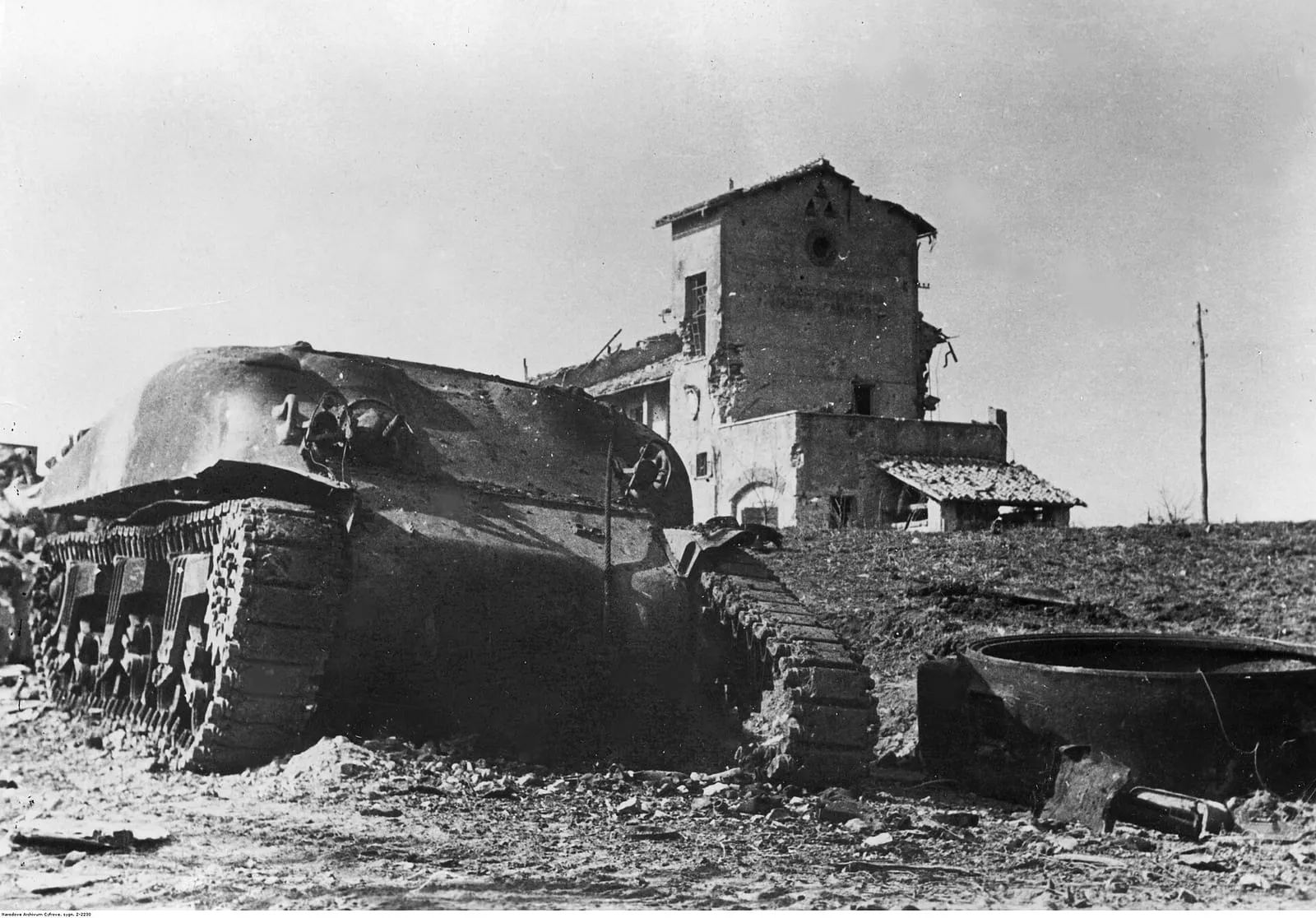
The Battle of Anzio – the fighting for the beachhead at Anzio and Nettuno on the coast of Lazio, waged from 22 January to the beginning of June 1944 – was the most controversial episode of the entire Italian campaign. It began with a landing codenamed Shingle, which was meant to outflank the German Gustav Line from the sea, cut the supply lines of the troops holding it and open the road to Rome for the Allies. The landing by General John Lucas’s Anglo-American VI Corps took the Germans completely by surprise and on the first day cost barely a dozen or so lives. Instead of a swift advance inland, however, there followed four months of fighting for survival: within a few days Field Marshal Albert Kesselring had ringed the beachhead with divisions, and in February his Fourteenth Army came close to driving the Allies into the sea.
Winston Churchill, the operation’s chief advocate, summed it up bitterly: he had hoped to hurl a wildcat on to the shore, and had got a stranded whale instead. The beachhead, shelled day and night from the hills, became for the soldiers of both sides a byword for grinding positional warfare. Only in May 1944, when the Allies broke the Gustav Line at Monte Cassino, did the troops at Anzio break out of the encirclement – and General Mark Clark’s decision to turn towards Rome instead of cutting off the German retreat still divides historians.
Name and dates
The codename Shingle (the pebbles of a beach) covered only the landing at Anzio and Nettuno; in Polish and English-language writing the whole struggle for the beachhead is called the Battle of Anzio or the Battle of Anzio–Nettuno. It is taken to begin at dawn on 22 January 1944, when the first units came ashore. The end date is a matter of convention. The troops from the beachhead linked up with the US II Corps advancing from the south on 25 May, and on 4 June the Americans entered Rome, which the Germans abandoned without fighting for the city itself; most sources, English-language ones included, end the battle on that day. The end date can also be taken as 5 June – the day on which the Allies secured the whole city together with the bridges over the Tiber and Clark made his ceremonial entry into Rome – so as to cover everything from the landing to the fall of Rome.
The Battle of Anzio was inextricably bound up with the simultaneous Battle of Monte Cassino: the attack on the Gustav Line was meant to draw German reserves south before the landing, and the landing to threaten the rear of the troops defending Cassino. Neither operation achieved its aim without the other.
Background
In the autumn of 1943 the Allied advance up the Italian peninsula became bogged down. After taking Naples and crossing the Volturno, Clark’s US Fifth Army and the British Eighth Army spent the whole autumn chewing their way through one German delaying position after another in the mountains, in rain and mud, losing men at a rate more reminiscent of the First World War than the Second. In December, in the attack on the Winter Line, the mountain bastions of Monte Camino and Monte Lungo were taken, but in January 1944 the front came up against the strongest of the German lines – the Gustav Line, anchored on the Garigliano and Rapido rivers and on the Monte Cassino massif, which closed the Liri valley and with it the road to Rome.
The idea of outflanking this barrier from the sea had been under consideration at the headquarters of General Harold Alexander’s 15th Army Group since October. Above all, however, there was a shortage of tank landing ships (LSTs), which were soon to sail for Britain for the invasion of France. When the Fifth Army’s attack stalled in December far short of Cassino, the plan for a one-division landing was judged too risky and on 18 December 1943 it was formally cancelled.
Churchill revived it. Returning from the Tehran Conference and suffering from pneumonia, the Prime Minister argued to the commanders in Tunis on Christmas Day, and then in Marrakesh, that a two-division strike behind the German lines would deliver Rome and might bring about the collapse of Kesselring’s entire defence. With the consent of President Franklin Delano Roosevelt he secured the retention of several dozen LSTs in the Mediterranean until the beginning of February. Dwight Eisenhower, about to leave for London, left the decision to the British; command in the Mediterranean passed to General Henry Maitland Wilson.
The Americans were sceptical. Clark saw the landing chiefly as a diversion to draw the Germans away from Cassino, and did not believe that two divisions could hold out on their own. His order to Lucas was cautious: to seize and secure a beachhead and then to “advance on” the Alban Hills – with no timetable and no obligation to capture them. Lucas himself, an experienced but disillusioned corps commander who had taken over VI Corps in September 1943 on the very beachhead at Salerno, wrote in his diary that the whole affair had “a strong odor of Gallipoli” and that “the same amateur” was still on the coach’s bench – an allusion to Churchill and to the Gallipoli campaign of 1915. Both Americans’ thinking was weighed down by the experience of the Battle of Salerno, where in September 1943 a German counter-attack had all but destroyed the Fifth Army’s beachhead.
The plan was for the Fifth Army to attack the Gustav Line a few days before the landing. On 17 January the British X Corps crossed the lower Garigliano, and on 20 January the US 36th Infantry Division tried – with disastrous results – to cross the Rapido. Kesselring did indeed send his reserves from the Rome area south, the 29th and 90th Panzergrenadier Divisions, stripping the coast of Lazio. When the Allied convoys sailed from Naples, there were only a few small units between Anzio and Rome.
The opposing forces
The landing was carried out by Rear Admiral Frank Lowry’s Task Force 81, divided into the American X-Ray Force and the British Peter Force under Rear Admiral Thomas Troubridge. The first wave of VI Corps consisted of Major General Ronald Penney’s British 1st Infantry Division with two Commando units, Major General Lucian Truscott’s 3rd Infantry Division, Colonel William Darby’s three Ranger battalions, the 509th Parachute Infantry Battalion and the 504th Parachute Infantry Regiment. According to various tallies the first wave numbered some 36,000–40,000 men and over 3,000 vehicles. In the following weeks the US 45th Infantry Division, part of the 1st Armored Division, Major General Gerald Templer’s British 56th Infantry Division and the American-Canadian 1st Special Service Force were sent in, and in the spring the US 34th and 36th Divisions and the British 5th Division as well. By the end of May there were some 150,000 Allied troops in the beachhead.
On the German side there was almost no one between Rome and the sea at the moment of the landing. Kesselring, however, had a ready-made plan, Richard, for a landing on the coast of Lazio: every division in Italy earmarked mobile battle groups which, on the alarm, would set off for a designated place. They were drawn from the Gustav Line and from northern Italy and, on the orders of the Wehrmacht High Command (OKW), also from France, Yugoslavia and Germany. The ring round the beachhead was successively formed by the 4th Parachute Division, the Hermann Göring Parachute Panzer Division, the 3rd and 29th Panzergrenadier Divisions, the 26th Panzer Division, the 65th, 71st, 362nd and 715th Infantry Divisions and the elite Infantry Lehr Regiment. From 25 January the whole was commanded by General Eberhard von Mackensen’s Fourteenth Army, with General Alfred Schlemm’s I Parachute Corps and General Traugott Herr’s LXXVI Panzer Corps. At the beginning of February the army numbered about 100,000 men. From the spring a few units of the Italian Social Republic also fought alongside it, among them paratroopers of the Nembo battalion and marines of the Barbarigo battalion of the Decima Flottiglia MAS.
The landing and the lost weeks (22–29 January)
The convoys left Naples in the afternoon of 21 January and, after a feint voyage southwards, anchored off Anzio during the night. At around 2 a.m. on 22 January, after a short rocket bombardment from the ships, the first units went ashore: the British about 8 km north of Anzio, the Americans east of Nettuno. The Rangers took the port of Anzio on the move, and paratroopers of the 509th Battalion took Nettuno. Resistance was negligible: by midnight some 36,000 men and 3,200 vehicles had been landed at a cost of 13 killed, 97 wounded and 44 missing; about 200 Germans were taken prisoner. By noon all the first day’s objectives had been reached, and according to some accounts an American jeep patrol drove that night as far as the outskirts of Rome.
The heaviest losses of the first days were suffered by the navy. On 22 January itself the US minesweeper USS Portent sank after striking a mine. On the evening of 23 January German bombers attacked the ships in the anchorage with guided bombs and aerial torpedoes. The British destroyer HMS Janus – hit, depending on the source, by a torpedo or a guided bomb – sank within a quarter of an hour or so; only about 80 of her crew survived. Her sister ship HMS Jervis lost her bow but stayed afloat. On 24 January aircraft sank the clearly marked hospital ship St David, and at dusk on 29 January a Henschel Hs 293 glide bomb struck the anti-aircraft cruiser HMS Spartan at anchor; she capsized and sank in the Anzio roads.
On land Lucas acted in accordance with the letter of his orders and his own convictions. Instead of sending light forces towards the Alban Hills, some 30 km away, he spent a week landing men, equipment and supplies, fortifying a beachhead a dozen or so kilometres deep and waiting for reinforcements. Patrols advanced cautiously: on 27 January the 3rd Division got to within a few kilometres of Cisterna, and the British, after heavy fighting, took “the Factory” – the new Fascist model town of Aprilia – and Carroceto station on the Anzio–Albano road. Kesselring, who on 22 January itself had feared that he would be unable to stop a determined advance, concluded by the evening of that day that a defence was possible. By 24 January more than 40,000 Germans surrounded the beachhead, and by 29 January – according to Allied tallies – some 71,000, against about 69,000 Allied troops with 508 guns and 208 tanks.
Lucas’s caution is the most debated question of the whole battle. Churchill, Alexander and a number of British historians believed that a swift dash to the Alban Hills would have cut the Tenth Army’s supply routes and forced the Germans to withdraw from Cassino. Others – including Kesselring himself after the war and many American historians – point out that two divisions without enough tanks, strung out over several dozen kilometres, would have been cut off and smashed by the reserves pouring in from every direction. John Keegan wrote that a raid on Rome on the first day would probably have succeeded, but that its spearheads would soon have been crushed; at the same time he judged that Lucas had combined the worst of both options – exposing his own troops without endangering the enemy.
Cisterna and Campoleone (30 January – 2 February)
On 30 January, when the leading units of the 45th Division and the 1st Armored Division had arrived in the beachhead, Lucas struck in two directions. On the left the British 1st Division, supported by American tanks, attacked along the Anzio–Albano road towards Campoleone (PL) station; on the right Truscott’s 3rd Division was to take Cisterna, cut the Via Appia (Route 7) and push on to Velletri.
The attack on Cisterna was preceded by a night march by the Rangers. The 1st and 3rd Ranger Battalions – 767 men in all – set off before dawn along a drainage ditch to surprise the Germans in the town; the 4th Battalion was to clear the road behind them. Intelligence did not know that fresh units of the Hermann Göring Division, preparing for an attack of their own, had just taken up positions in and around Cisterna. At dawn both battalions were ambushed in open fields a few hundred metres short of the town. A fight lasting several hours against tanks and self-propelled guns ended in surrender; six men made it back to their own lines, and the rest were killed or captured. The 4th Ranger Battalion and the 3rd Division, which tried to break through to their aid, suffered heavy losses and were stopped a few kilometres short of Cisterna. Soon afterwards the Germans paraded the captured Rangers through the streets of Rome in a propaganda march filmed for the newsreels. The use of lightly armed Rangers as the spearhead of the attack was sharply criticised; their remnants were disbanded, and several hundred survivors were transferred to the 1st Special Service Force. Darby was soon sent to the most threatened sector of the front.
At Campoleone the British drove a wedge into the German lines but failed to take the station, and on 31 January they came to a halt in a long, narrow salient along the road. On 2 February Alexander and Clark agreed that the offensive had run its course and ordered Lucas to go over to the defensive. From then on the initiative lay with the Germans.
The German counter-offensives (3–20 February)
Adolf Hitler saw the beachhead as the chance of a victory that would show the Allies and his own people that any landing in Europe would be thrown back into the sea. In a directive of 28 January he called Anzio an “abscess” south of Rome that had to be cut out, and demanded of his troops a “fanatical will” to win. On the night of 3–4 February the Fourteenth Army struck at the British salient at Campoleone. The Germans infiltrated along the gullies at its base and cut off three battalions of the 3rd Brigade, which were saved only by a counter-attack by the newly landed 168th Brigade of the 56th Division. From 7 February night battles raged for Aprilia and Carroceto, in which British Guards battalions dwindled to a few companies. On 10 February the Germans retook the Factory, and an attack by Lucas to recover it collapsed the next day.
At dawn on 16 February, after a half-hour bombardment, Operation Fischfang (“Fish Catch”) began – Mackensen’s main thrust along the Anzio–Albano road, with Tiger tanks and the Infantry Lehr Regiment, which Hitler had designated as the spearhead. The blow fell on the US 45th Division and the British 56th Division. By 17 February the Germans had driven a wedge several kilometres deep into the beachhead and had come up against the so-called final beachhead line, anchored on the bridge carrying the Anzio–Albano road over the lateral road across the former marshes, known to the Allies as the “Flyover”. This was the most dangerous moment of the battle: the Germans were little more than ten kilometres from the sea, and the defenders had nowhere left to fall back to. On 18 February the commander of the British 1st Division, Penney, was seriously wounded, and on the same day a German submarine sank the cruiser HMS Penelope off the coast as she was returning to Anzio; 417 sailors were killed.
The beachhead did not fall because the Allies had overwhelming superiority in firepower. The corps artillery, the ships offshore and the air forces – on 17 February Allied aircraft flew several hundred sorties over the beachhead – broke up German columns before they reached the line; by some estimates the Allied artillery fired about ten shells for every German one. On 19 February a counter-attack by VI Corps reserves – tanks of the 1st Armored Division and infantry of the 3rd Division – struck the flank of the wedge, and on 20 February Fischfang petered out. In the days from 16 to 20 February alone the Germans lost about 5,400 men and the Allies about 3,500; since the start of the battle the losses of each side were approaching 20,000.
A change of command and the last German offensive (22 February – 4 March)
The crisis sealed Lucas’s fate. Churchill had long been pressing Alexander, and after visiting the beachhead on 14 February Alexander wrote to the Chief of the Imperial General Staff, Alan Brooke, that the command of VI Corps was “negative” and lacking in drive. On 15 February Lucas noted in his diary that those at the top were disappointed that he had not driven the Germans out of Italy, though there had been no military reason why he should have succeeded. Clark, who valued and had defended him, gave way: on 17 February he appointed Truscott deputy corps commander, and on 22 February he informed Lucas that he would hand over command the next day. Lucas formally became deputy commander of the Fifth Army, and in March he was sent back to the United States. Truscott was succeeded at the head of the 3rd Division by Brigadier General John O’Daniel.
Although his troops were exhausted, Hitler demanded another attempt. On 29 February the LXXVI Panzer Corps attacked from the direction of Cisterna in the 3rd Division’s sector, but the offensive, lacking surprise and in appalling weather, collapsed within a few days at a cost of about 2,500 men to the Fourteenth Army. At the beginning of March Kesselring sent his chief of staff, General Siegfried Westphal, to Hitler’s headquarters, where he convinced the Führer that further attacks were pointless. Both sides went over to the defensive.
The besieged beachhead (March – May)
For the next two and a half months the beachhead resembled the Western Front of 1915–1917. At its deepest it reached only about 11 kilometres inland, and every point within it – the beaches, the port, the field hospitals, the depots – lay within range of German artillery, which watched everything from the slopes of the Alban Hills. The troops lived in dugouts and cellars, movement took place at night, and the shelling never stopped. Particularly notorious were two German 280 mm K5 railway guns, hidden in tunnels by day and known to the Allies as “Anzio Annie” or the “Anzio Express”; their shells fell on the port and on the ships offshore. One of them, “Leopold”, was captured by the Americans at Civitavecchia in June 1944.
The civilian population suffered severely. The Germans stopped the drainage pumps and flooded part of the Pontine Marshes, which had been reclaimed in the 1930s, and malaria, against which there was no quinine, struck – according to Italian estimates – tens of thousands of the region’s inhabitants in the months that followed. The towns founded by Mussolini on the reclaimed land, Aprilia and Cisterna among them, lay in ruins; in the spring Truscott evacuated some 22,000 civilians from the beachhead. In February SS units shot a dozen or so inhabitants of Cisterna in reprisal for the killing of a German soldier.
During this period both sides rotated their exhausted divisions. The British Guards Brigade, which in less than two months had lost almost 2,000 of its roughly 2,500 men, and the bled-white 56th Division were withdrawn from the beachhead; in their place came the British 5th Division and the US 34th Division, and in May the 36th Division as well. Kesselring, lacking the strength for another offensive, ordered the construction behind the beachhead, and further on south of Rome, of the Caesar Line, to which the Fourteenth and Tenth Armies were to fall back if necessary.
The breakout and the road to Rome (23 May – 5 June)
Alexander planned the spring offensive as a single operation along the whole front. On the evening of 11 May the attack on the Gustav Line began, in the course of which soldiers of General Władysław Anders’s Polish II Corps took the monastery on Monte Cassino on 18 May and the French Expeditionary Corps broke through the front in the Aurunci mountains. Once the Tenth Army began to retreat, VI Corps was to go into action. Alexander chose Operation Buffalo: a thrust through Cisterna to Valmontone to cut Route 6 – the Tenth Army’s main line of retreat – and trap it in an encirclement. Clark, determined that his own army should take Rome, had Truscott also prepare Operation Turtle, an advance on Rome west of the Alban Hills.
At 5.45 a.m. on 23 May some 1,500 guns opened fire, after which VI Corps went on to the attack. The first day was very bloody – the 1st Armored Division lost about a hundred tanks and the 3rd Division more than 900 men – but the German front cracked. On 25 May the 3rd Division took the ruins of Cisterna in house-to-house fighting, and on the morning of the same day, near Borgo Grappa, patrols from the beachhead met units of the US II Corps advancing along the coast from the Gustav Line. After four months the beachhead was no longer an island.
On the evening of 25 May, when the spearheads of the 1st Armored Division were a few kilometres from Valmontone, Truscott received orders from Clark to swing his main forces 90 degrees to the north-west, towards Rome. From then on only the 3rd Division and the 1st Special Service Force pushed on towards Valmontone, and Alexander learned of the change only the following day, when it was already a fait accompli. Truscott later wrote that he was “dumbfounded” and that, had Clark kept to Alexander’s orders, the strategic objectives of the Anzio operation would have been fully achieved. The Germans held the Velletri gap and Route 6 until 30 May, and seven divisions of the Tenth Army withdrew northwards.
The new line of advance soon stalled on the Caesar Line. The breakthrough came only with the 36th Division, which on the night of 30–31 May climbed the undefended Monte Artemisio massif and came out behind the German positions at Velletri; Mackensen then offered his resignation, which Kesselring accepted. On 2 June the Caesar Line collapsed, and Hitler forbade the defence of Rome so as to prevent fighting in the city. On 4 June the first American units entered the Italian capital, and on 5 June, when the Allies had secured the whole city and the bridges over the Tiber, Clark drove into Rome and called a press conference on the Capitol.
Losses
Casualty figures vary depending on whether they cover only the fighting for the beachhead (22 January – 22 May) or also the breakout and the advance on Rome, and whether they include the sick. According to the tally of the US Army Center of Military History, cited in most studies, VI Corps lost about 29,200 men in battle during the campaign – some 4,400 killed, 18,000 wounded and 6,800 captured or missing – and a further 37,000 or so to sickness, frostbite, injuries and combat exhaustion. Two-thirds of the battle casualties fell in the period from the landing to the end of the German counter-offensives at the beginning of March. Other tallies give a total of some 24,000 American and 10,000 British casualties. German losses, suffered almost entirely by the Fourteenth Army, are estimated at about 27,500 men: some 5,500 killed, 17,500 wounded and 4,500 captured or missing. At sea, according to the operation’s naval tally, the Allies lost two light cruisers, three destroyers, two minesweepers and a hospital ship off Anzio, as well as a number of landing craft and transports. There are no reliable overall figures for civilian deaths.
Significance
The Battle of Anzio did not fulfil the hopes with which it had been launched. The landing neither forced the Germans to abandon the Gustav Line nor brought the swift capture of Rome; instead it tied down several Allied divisions for four months in a cramped, shell-swept beachhead that had to be supplied by sea at the expense of ships needed for the invasion of France. Most commentators consider the plan flawed at its root – two divisions without strong armoured support could not both cut the Tenth Army’s supply routes and beat off the inevitable counter-attack. After the war Kesselring called it a “half-measure”, while Churchill in his memoirs laid the blame on Lucas’s caution. The debate over whether a bolder commander would have taken the Alban Hills or merely led his corps to destruction all the sooner continues to this day.
At the same time the battle brought the Allies benefits to which its defenders, led by Alexander and Churchill, pointed. To eliminate the beachhead the Germans brought divisions to Italy from France, Yugoslavia and Germany, and gave up transferring several of Kesselring’s best divisions to Western Europe, where they were to repel the invasion. Hitler also lost a battle that he himself had made a test case: his promise that every landing would be thrown back into the sea proved hollow – a lesson the German command had to bear in mind as it prepared to defend the coasts of France. The Allies, for their part, learned how important it was to land large forces quickly and to give a beachhead strong cover from the sea and the air.
The longest shadow over the battle was cast by Clark’s decision of 25 May. The entry into Rome on 4 June was a great propaganda success, but only two days later the world could think of nothing but the Normandy landings, while the German Tenth Army, which had not been cut off, withdrew in good order to successive defensive lines, as far as the Gothic Line in the Apennines. As a result the Italian campaign dragged on for almost another year, until the surrender of the German forces in Italy on 2 May 1945. Lucas, sent home, never again held a field command and died in 1949; Truscott, who led the breakout, commanded VI Corps in the landings in Provence in August 1944 and, from December, the Fifth Army in Italy. The war cemeteries at Nettuno and Anzio, where several thousand American and British soldiers lie, remain the most enduring testimony to the battle.