- Category:
- Military operations
- Front:
- Mediterranean
- Date:
- 4 June 1944
- Author:
- Natalia
- Battle:
- Battle of Anzio
- Tags:
- Italy, United States, Mark W. Clark, Albert Kesselring
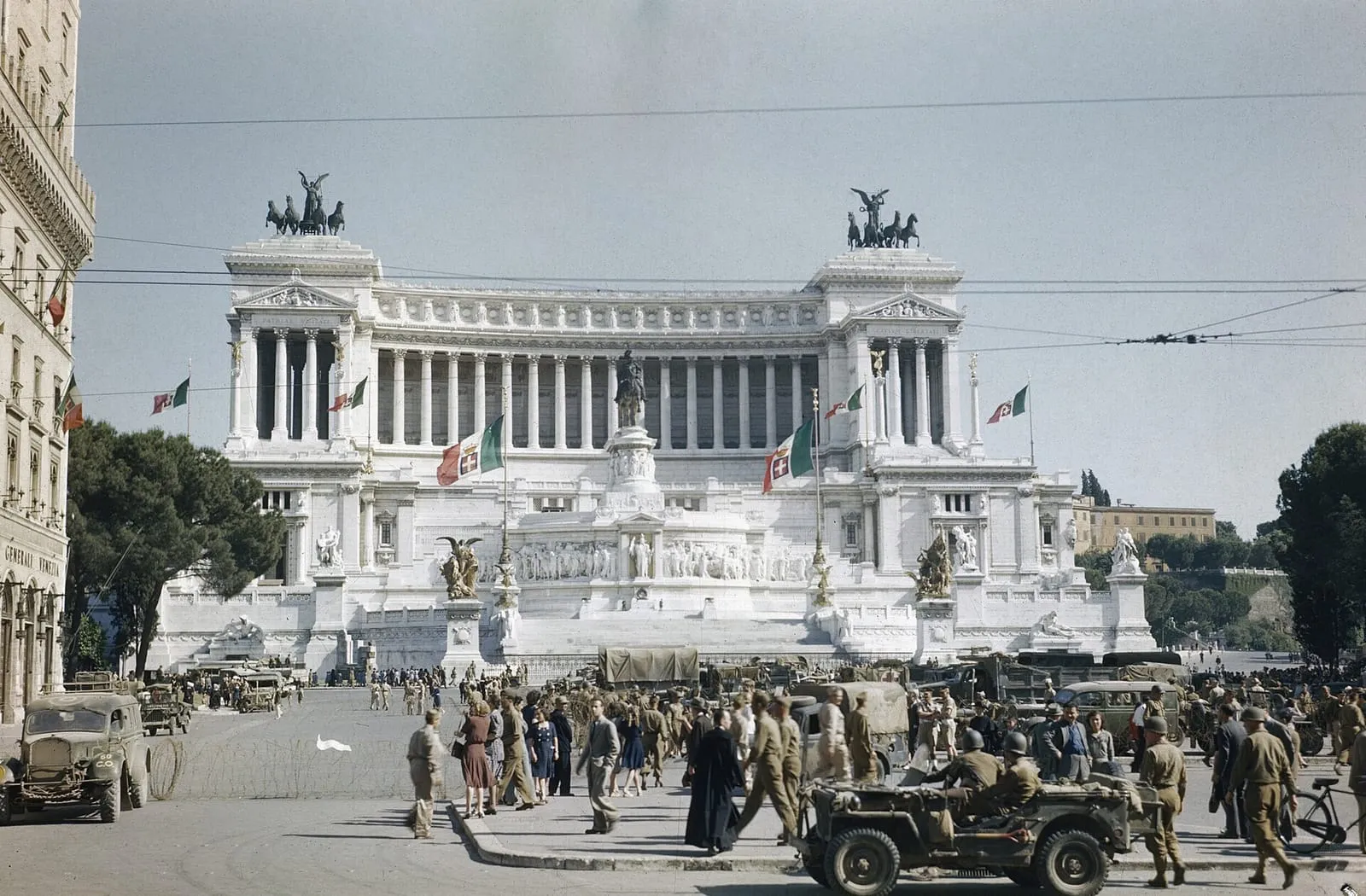
On the evening of 4 June 1944 the first units of General Mark Clark’s US Fifth Army reached the bridges over the Tiber in the very heart of Rome. The city, occupied by the Germans in September 1943, passed into Allied hands with almost no fighting within its limits: Albert Kesselring, with Hitler’s consent, had withdrawn his troops, and only German rearguards clashed with the American spearheads in the suburbs. Rome was the first Axis capital to be taken by the Allies. The triumph was short-lived, however – two days later the world could think of nothing but the landings in Normandy – and both German armies that had been defending the approaches to the city escaped to the north.
Breaking the Caesar Line
After the breakout from the Anzio beachhead and the link-up with the rest of the Fifth Army on 25 May, Clark turned the main body of General Lucian Truscott’s VI Corps towards Rome instead of – as General Harold Alexander wanted – cutting Highway 6 near Valmontone and trapping the retreating Tenth Army. The attack stalled on the Caesar Line, the last German position before the city, running through the Alban Hills. A gap in it was found by patrols of General Fred Walker’s 36th Division: the Monte Artemisio massif above Velletri lay on the boundary between two German corps and was almost unoccupied. On the night of 30/31 May two of the division’s regiments silently climbed the ridge, and on 1 June the 36th Division took Velletri and began descending into the rear of the German defences.
At the same time General Geoffrey Keyes’s II Corps, which had come out of the Aurunci Mountains and joined the forces from the beachhead, was advancing along Highway 6. On the morning of 2 June a patrol of the 3rd Division entered Valmontone, which the Germans had abandoned during the night, and by evening both American corps had broken through the Caesar Line. Kesselring then concluded that Rome could not be held. On the night of 2/3 June General Heinrich von Vietinghoff’s Tenth Army began disengaging from the British Eighth Army and withdrawing through the mountains towards the River Aniene east of the city, while General Eberhard von Mackensen’s Fourteenth Army was given permission to pull its whole front back from the Alban Hills behind the Tiber.
Was Rome an “open city”?
It is often written that the Allies entered Rome “the day after the Germans declared it an open city”. The reality was more complicated. The government of Marshal Pietro Badoglio had already declared Rome an open city in August 1943, but the Allies did not recognise this, because headquarters operated in Rome and the railways and roads supplying the front ran through it; the Germans, who occupied the city in September, used them throughout the occupation. From the autumn of 1943 the German High Command (OKW) had debated whether to defend the city or give it up if the front drew near. It agreed only to spare monuments and hospitals and to respect the neutrality of the Vatican; Hitler personally stipulated that the bridges over the Tiber within the city must not be blown.
According to the American official history (Ernest F. Fisher, Cassino to the Alps), it was only on 3 June, with the American spearheads already in sight of Rome, that the OKW authorised Kesselring to approach the Allies through the Vatican with a proposal that both sides recognise Rome as an open city: no troops or troop movements in the city, no destruction, and the power stations and waterworks to be preserved. Allied Armies in Italy headquarters left these soundings unanswered, and Allied radio called on the people of Rome to rise against the Germans. Clark ordered his commanders to protect public and private property in the city and not to fire on it unless the Germans put up a defence – in which case battalion and higher commanders were to act without delay.
On the afternoon of 3 June the OKW instructed Kesselring to hold the front south and south-east of Rome only as long as was necessary for the Fourteenth Army to cross the Tiber, and then to withdraw it north of the city. Hitler decreed that Rome, “because of its significance as a place of culture”, must not become a battleground. Kesselring unilaterally declared Rome an open city, and during the night his staff issued the evacuation orders. Fisher compares this declaration to the declaration of Brussels and Paris as open cities in 1940 and calls it a “pre-emptive surrender” of the city: it was a decision by one side, not an agreement, and the Allies never formally accepted it.
The race for the bridges
Clark did not know that the Germans had orders to spare the bridges, and he regarded seizing them intact as his main task, so that the army could pass through Rome without stopping. There was also an open race between his corps to be first into the city. In II Corps the lead was taken by improvised groups: General Robert Frederick’s 1st Special Service Force (an American-Canadian special operations brigade), reinforced by tanks of Colonel Hamilton Howze’s task force from the 1st Armored Division, and the spearheads of the 88th and 85th Divisions. On the morning of 4 June Frederick’s column crossed the municipal boundary of Rome in the suburb of Tor Pignattara and almost at once lost two tanks to a concealed anti-tank gun. In the eastern suburbs, around Centocelle, German rearguards with tanks and self-propelled guns held out until the afternoon. That morning Clark and Keyes also reached the city limits; according to an oft-repeated anecdote, Clark had himself photographed beneath a sign reading “Roma” while shooting was still going on nearby.
Small patrols, often guided by local partisans through courtyards, monasteries and shops, infiltrated the city throughout the day. Several units – the 88th Division, the 1st Special Service Force and a group from the 85th Division that had reached the city early in the morning – later claimed to have been first, and the official history does not settle the dispute. Howze’s main column set off for the centre after 3.30 p.m. and in the evening reached the central station (Termini); one of its companies turned into Piazza Venezia, where it caught up with German stragglers. By 11 p.m. all the bridges in II Corps’ sector, as far as the historic Milvian Bridge, were in American hands. In the darkness on one of the bridges a detachment of the 88th Division mistook Frederick’s men for Germans; in a brief exchange of fire one man was killed and several, including Frederick himself, were wounded.
Truscott’s VI Corps, worn out by the fighting on the Caesar Line, advanced more slowly and methodically. At around 6 p.m. the spearhead of General Ernest Harmon’s 1st Armored Division entered the inner city along the Via Appia Nuova through Porta San Giovanni, and a battalion of armoured infantry seized the Ponte Palatino. Before midnight the 36th Division marched through the blacked-out streets. “As we walked through the dark streets,” Walker recalled, “we could hear people clapping their hands at all the windows of the tall buildings.” By the morning of 5 June the Fifth Army stood on the Tiber along a front of about 30 kilometres, from the river’s mouth to its confluence with the Aniene; the British 1st and 5th Divisions held the left wing, and General Alphonse Juin’s French Expeditionary Corps covered the right, east of the city. According to Fisher, on 4 June the Fifth Army numbered 369,000 men – the most in its entire history – including 231,000 Americans, 95,000 French (mostly Algerians and Moroccans) and 43,000 British.
The Romans, the Pope and the last victims of the occupation
Rome’s Committee of National Liberation did not call an uprising. Italian historians explain this in various ways: the mediation of the Vatican, which according to some accounts passed on signals that the Germans would leave the city if they were not attacked; the fear of moderate groups and monarchists of strengthening the communists; the reluctance of the Allies, who wanted power handed to General Roberto Bencivenga as the representative of the Badoglio government; and, finally, the losses the resistance had suffered in the arrests of spring 1944 and in the Ardeatine Caves massacre. Partisans did, however, fight in the suburbs and the surrounding area: they captured German stragglers, fired on columns on the roads out of the city and tried to save bridges and installations from destruction. On 5 June, at the bridge over the Aniene on the Via Salaria, thirteen-year-old Ugo Forno was killed after he and his friends had prevented it from being blown up.
The departing occupiers went on killing to the end. On 4 June, in a copse at the 14th kilometre of the Via Cassia near La Storta, the Germans shot fourteen prisoners taken from the Security Police prison in Via Tasso, among them the trade unionist Bruno Buozzi, one of the leaders of the pre-war labour movement.
On the morning of 5 June, as Allied columns were still driving through the streets, the Romans poured out of their homes in crowds. The soldiers who had actually taken the city had passed through it at night and almost in silence; the ovations and flowers familiar from the newsreels went to those who followed them. That day Clark drove into the centre, summoned his corps commanders to the town hall on the Capitoline Hill and met war correspondents there. As Fisher observes, the capture of Rome was a victory for the whole coalition, but only the Americans tasted the triumphal entry – even though the Eighth Army, with the Polish II Corps, and the French had contributed decisively to the May breakthrough. On the same day a crowd gathered in the square before St Peter’s Basilica, and Pius XII said from the balcony that in recent days he had trembled for the fate of the city, but that now Rome had been spared the horrors of war “thanks to the goodwill of both sides”.
The liberation of the capital also opened an Italian political crisis. On 5 June King Victor Emmanuel III, in accordance with an earlier agreement, handed his prerogatives to his son Umberto as Lieutenant General of the Realm, without himself abdicating. Badoglio resigned, and in June a new government based on the anti-fascist parties was formed by Ivanoe Bonomi, who had been prime minister before the Fascists came to power.
Retreat to the north
Some accounts add that the German forces withdrew to a line on Lake Trasimeno. This is a shorthand: on 4 June the Tenth and Fourteenth Armies were only just breaking contact with the Allies – the Fourteenth behind the Tiber, the Tenth through the Simbruini Mountains and the crossings of the Aniene between Rome and Tivoli. The Germans manned the Trasimene Line (also known as the Albert Line), running from the Tyrrhenian coast past Lake Trasimeno towards the Adriatic, only after two weeks of delaying actions, and heavy fighting for it lasted roughly from 20 to 30 June. Its sole purpose was to gain time for completing the fortifications of the Gothic Line in the Apennines.
The pursuit brought no decision. The British Eighth Army, advancing from the Liri valley through the mountains with two armoured divisions and their long columns, reached the Aniene east of Rome only two days later, and German rearguards, mines and demolitions repeatedly held up its spearheads. Kesselring managed to gather both armies and withdraw them in good order, even though a dangerous gap at times opened between them. On 4 June Alexander reported to Winston Churchill that the success was beyond doubt, but he later admitted that had Clark carried out his plan at Valmontone the German defeat would have been far greater, adding: “I can only assume that the immediate lure of Rome for its publicity value persuaded Mark Clark to switch the direction of his advance.” Clark maintained that destroying the German armies south of Rome had been unrealistic – and, as Fisher notes, the fact that the Tenth Army escaped without using Highway 6 does to some extent support him.
The price of the spring offensive was high. According to figures cited by Fisher, between 11 May and 4 June the Americans lost 3,145 killed, 13,704 wounded and 1,082 missing; the French Expeditionary Corps lost more than 10,600 men from 1 April; and the Polish II Corps lost 629 killed, 2,044 wounded and 93 missing during the offensive. Losses of all the Allies came to about 40,000. In roughly the same period the two German armies lost some 38,000 men according to the OKW war diary (another German tally gives just under 32,000); the Allies claimed to have taken more than 15,000 prisoners.
Its place in the war
Rome was the first Axis capital to fall into Allied hands, and the only one taken before the landings in France. On 5 June Franklin Delano Roosevelt declared in a radio “fireside chat”: “The first of the Axis capitals is now in our hands. One up and two to go!” – while warning that the road to victory over Germany would still be long and costly. But the very next day the Normandy landings pushed events in Italy into the background, in the newspapers and in staff planning alike.
For the people of Rome, 4 June ended nine months of occupation that had brought hostage executions, round-ups, the deportation of Rome’s Jews in October 1943 and hunger – and, before that, the Allied bombing of working-class districts. Unlike many other Italian cities, Rome came through the war almost untouched, with its bridges, waterworks and power stations intact – the result both of decisions by the two sides and of pressure from the Vatican. The liberation of the capital also hastened the revival of Italian political life: the Bonomi government, based on the anti-fascist parties, soon moved to Rome.
Strategically, the capture of Rome closed the chapter that had opened in January with the landing at Anzio and the battles for Monte Cassino. Alexander hoped he could now follow up his blow into northern Italy and towards the Alps, but the Americans insisted on a landing in Provence: in the summer three American and four French divisions, and with them Truscott and Juin, were taken from the Italian front for Operation Dragoon. Alexander’s weakened armies reached the Gothic Line in August, where the front came to a halt for the winter. The controversy over Clark’s decision at Valmontone, and over whether the prestige of taking Rome was worth letting the German Tenth Army escape, continues among historians to this day; the Italian campaign ended only with the surrender of the German forces in Italy on 2 May 1945.
Sources
Meanwhile
(04)Elsewhere, within a week.
- 4 June 1944 · AtlanticThe capture of U-505On 4 June 1944 a US carrier group led by USS Guadalcanal forced U-505 to surface off Africa. A boarding party seized the boat, its Enigma and codes.
- 5 June 1944 · Western FrontThe night before the invasionOn the night of 5/6 June 1944 over 1,000 RAF bombers struck batteries on the Bay of the Seine and three airborne divisions dropped into Normandy.
- 6 June 1944 · Western FrontD-Day: the Normandy landingsOn 6 June 1944 some 156,000 Allied troops landed in Normandy by sea and air. Five beachheads were taken, but Caen remained in German hands.
- 2 June 1944 · Central and Eastern EuropeOperation FranticOn 2 June 1944 American bombers from Italy struck Debrecen and landed in Ukraine, beginning shuttle-bombing missions through bases in the USSR.
Related events
(04)The same battle, people or subject.
- 22 January 1944 · MediterraneanThe landing at AnzioOn 22 January 1944 General Lucas's VI Corps landed at Anzio and Nettuno, close to Rome. Surprise was complete, but the Germans soon ringed the beachhead.
- 3 March 1944 · MediterraneanThe Germans go on the defensive at AnzioOn 3 March 1944 the Germans gave up further attacks on the Anzio beachhead. After the failed assault at Cisterna the front froze into static warfare until May.
- 16 February 1944 · MediterraneanOperation FischfangOn 16 February 1944 the German Fourteenth Army struck down the Albano road at the Anzio beachhead. After five days the Allies held and the attack collapsed.
- 25 May 1944 · MediterraneanThe link-up with the Anzio beachheadOn 25 May 1944 the Anzio beachhead linked up with the Fifth Army from the south, and Clark turned VI Corps on Rome instead of trapping the Tenth Army.