Germany
Ewald von Kleist
Commander of XXII Corps (1939), Panzer Group Kleist (1940), 1st Panzer Group and 1st Panzer Army (1941–1942), Army Group A (1942–1944), field marshal (1943)
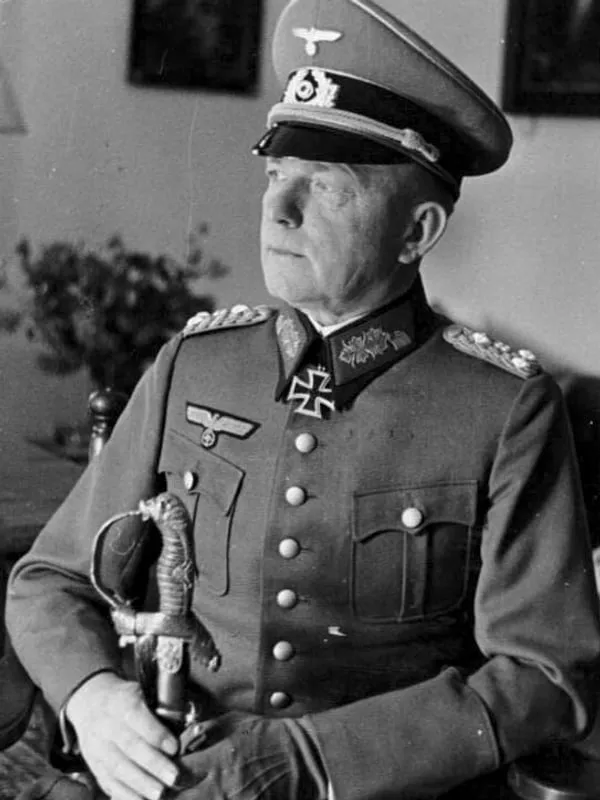
- Born:
- 8 August 1881, Braunfels an der Lahn (Prussia, German Empire)
- Died:
- 13 November 1954, Vladimir (USSR)
- Author:
- Łukasz
- Photo:
- Hartmann, Fritz, CC BY-SA 3.0 DE, Wikimedia Commons

Ewald von Kleist was a German cavalry general who, at the age of almost sixty, was placed at the head of the first grouping of several panzer corps in history. In May 1940 his panzer group crossed the Ardennes, forced the Meuse at Sedan and within a week reached the English Channel, cutting off the Allies’ best armies in Belgium. In 1941 his tanks conquered Ukraine, in 1942 they reached the Caucasus, and after the defeat at Stalingrad Kleist led his troops out of there and was made a field marshal. An aristocrat and monarchist who made no secret of his distance from the Nazis, he nevertheless served Hitler faithfully until Hitler dismissed him. After the war he was convicted as a war criminal in Yugoslavia and in the Soviet Union, and he was the only Wehrmacht field marshal to die in a Soviet prison.
Origins and the First World War
Paul Ludwig Ewald von Kleist was born on 8 August 1881 in Braunfels on the Lahn. He came from an old Pomeranian noble family that had given Prussia two field marshals and many generals. His father, Hugo von Kleist, was a civilian, however – a grammar-school headmaster and senior education official. In March 1900 Ewald joined the 3rd Field Artillery Regiment as an officer cadet, and in August 1901 he was commissioned as a second lieutenant. He completed the cavalry school in Hanover and the War Academy in Berlin. In March 1914, by then a Rittmeister (cavalry captain), he transferred to the 1st Life Hussars Regiment, one of the elite units of the Prussian cavalry.
In August 1914 he commanded a squadron at the Battle of Tannenberg in East Prussia. From 1915 until the end of the war he was a staff officer, mainly on the Western Front, including on the staff of the Guards Cavalry Division. For his service in that war he received the Iron Cross, both classes.
The Reichswehr and retirement
After the war Kleist served in the volunteer units of the Freikorps (PL), and in 1920 he was accepted into the 100,000-man Reichswehr. For several years he taught tactics at the cavalry school in Hanover, and from 1928 he was chief of staff of the 2nd Cavalry Division in Breslau (Wrocław) and then of the 3rd Division in Berlin. In 1931, as a colonel, he took over the 9th Infantry Regiment in Potsdam, in which an exceptional number of aristocrats served, and in 1932 the 2nd Cavalry Division. In October 1932 he became a Generalmajor.
Kleist was a monarchist and made no secret of wishing for the return of the Hohenzollerns. After Adolf Hitler came to power, however, his career continued. In December 1933 he became a Generalleutnant, in 1935 commander of VIII Corps and VIII Military District in Silesia, and in August 1936 General of Cavalry. In February 1938, during the Blomberg–Fritsch affair, when Hitler got rid of many generals considered unsympathetic to the regime, Kleist was sent into retirement. He later claimed that he had been harmed by speaking up too loudly for Christianity and the Church. He settled on his estate near Breslau.
The September Campaign
In the summer of 1939, during the preparations for the attack on Poland, Kleist was recalled to service and given XXII Army Corps (motorised) in the 14th Army of General Wilhelm List, on the southern wing of Gerd von Rundstedt’s Army Group South. His chief of staff was Colonel Kurt Zeitzler, later Chief of the Army General Staff. The corps, with the 2nd Panzer Division, the 4th Light Division (PL) and a mountain division, attacked from Slovakia on 1 September. In the first days of the war it was held up at Jordanów by the motorised 10th Cavalry Brigade of Colonel Stanisław Maczek, which fell back step by step without allowing itself to be encircled. The corps then advanced through Lesser Poland, forced the San and turned north towards the Bug, where, according to some sources, around 17 September its spearheads met Guderian’s troops advancing from East Prussia, closing the ring in the rear of the Polish armies.
The September Campaign was Kleist’s first experience of commanding fast mobile troops. After the war he said that he had successfully applied to motorised units the principles he had learned in the cavalry. The Soviet soldiers he met at the end of the campaign, who had entered Poland on 17 September, made a good impression on him: he noted their surprising degree of motorisation and their discipline.
A panzer group in the west
When the Manstein plan, which envisaged the main thrust through the Ardennes, was adopted in the winter of 1940, the panzer and motorised divisions of Army Group A were combined in March into a single grouping, named after its commander: Panzer Group Kleist. According to many historians, the choice of an experienced cavalryman rather than one of the creators of the armoured arm was meant to ensure that the risky advance would be led by a cautious man obedient to his superiors. The group comprised Heinz Guderian’s XIX Corps, Georg-Hans Reinhardt’s XLI Corps and XIV Motorised Corps – five panzer divisions and several motorised divisions in all.
On 10 May 1940 Kleist’s columns set off through Luxembourg and the Belgian Ardennes. On the evening of 12 May they reached the Meuse, and on 13 May Guderian’s infantry crossed the river at Sedan and Reinhardt’s at Monthermé. Kleist and Guderian quarrelled throughout. Kleist wanted to attack somewhat further west, at Flize, and preferred a short, concentrated air strike before the assault to day-long air attacks, but on both points Guderian’s view prevailed. On 15 May Kleist received the Knight’s Cross of the Iron Cross. That same evening, as the French defence west of the Meuse was collapsing, he ordered the advance halted, fearing a blow against his exposed southern flank. On the morning of 17 May he relieved the insubordinate Guderian of his command, but after General List mediated, Guderian returned to his corps and pressed on. On 20 May the tanks of Kleist’s group reached the English Channel near Abbeville.
Kleist also had a part in one of the most controversial decisions of the campaign. On 23 May he reported that after two weeks of marching and fighting his group had lost, counting destroyed and damaged vehicles, about half its tanks. This report was among the arguments that persuaded Rundstedt, and on 24 May Hitler, to halt the armoured advance at Dunkirk. After the war Kleist said that he had considered the halt order a mistake. In June, in the second part of the campaign, his group attacked from the bridgeheads on the Somme and, after heavy fighting against French delaying positions, was shifted east and advanced through Burgundy as far as Lyon. On 19 July 1940 he was promoted to Colonel General.
The Balkans and Ukraine
In April 1941 Kleist’s group, renamed 1st Panzer Group, attacked Yugoslavia from Bulgarian territory, took Niš, and on 12 and 13 April its spearheads reached Belgrade. In June, in Operation Barbarossa, it again fought in Rundstedt’s Army Group South. At the end of June, in Volhynia, it shattered the Soviet mechanised corps in a great tank battle; in August, together with the infantry, it closed the pocket at Uman; and in September, driving north to meet Guderian’s group, it encircled the troops of the Southwestern Front east of Kiev. The Battle of Kiev brought the Germans more than half a million prisoners. In October the group was renamed 1st Panzer Army. At Melitopol it destroyed two Soviet armies, and on 21 November it took Rostov-on-Don, but had to give it up within a week. This was the Wehrmacht’s first serious retreat of the war, and it cost Rundstedt his post.
After the war Kleist spoke of the Red Army with respect. He said that its soldiers had been first-class fighters from the start and that the T-34 was the best tank in the world. In February 1942 he received the Oak Leaves to the Knight’s Cross, and in May his army, together with General Friedrich Paulus’s 6th Army, encircled at Kharkiv the Soviet forces that were themselves on the offensive, taking more than 200,000 prisoners. That same year Hitler gave him an endowment in the form of land worth 567,000 Reichsmarks. His Silesian estate was enlarged with land previously confiscated from Jewish owners. Such lavish gifts were meant to secure the loyalty of the most senior commanders to the regime.
The Caucasus and dismissal
In the summer of 1942, in Case Blue, Kleist’s 1st Panzer Army was the spearhead of Army Group A, which was to seize the oilfields of the Caucasus. In August it took Maykop, but it never reached Grozny, let alone Baku. On 22 November 1942, in the days when the Red Army was closing the ring around the 6th Army at Stalingrad, Kleist took command of Army Group A, which Hitler had been leading personally since September. When the Soviet offensive threatened to cut off his troops, he withdrew them from the Caucasus in January 1943: the 1st Panzer Army passed through Rostov, and the 17th Army fell back to the Kuban bridgehead. On 1 February 1943, in the days of the 6th Army’s capitulation at Stalingrad, he was made a field marshal.
In the occupied Caucasus, on the advice of General Ernst Köstring, the former military attaché in Moscow, Kleist tried to win over the local population. He recruited volunteers from among the Cossacks and the Caucasian peoples and, according to some historians, opposed the forced deportation of workers to the Reich, which led to disputes with the Plenipotentiary for Labour Deployment, Fritz Sauckel. This picture of a “humane” occupier, drawn by his defenders, has deep flaws, however. In the area under his troops’ control, units of Einsatzgruppe D murdered Jews, prisoners of war and the sick, among other places in Krasnodar, where gas vans were used. In Nalchik, between 600 and 1,000 Jews were murdered in November and December 1942, although the local Mountain Jews were spared after representations by local leaders, in which, according to some historians, Kleist helped them. After the war he insisted that he had heard only rumours of the mass killings.
In 1943 Army Group A held the Kuban bridgehead and then fought in southern Ukraine, where a Soviet advance cut off the Crimea. Kleist clashed with Hitler several times over withdrawals. In March 1944, as the front in right-bank Ukraine was collapsing, he announced that he would pull his troops back to Bessarabia even against Hitler’s wishes. On 30 March 1944 Hitler summoned him, together with Erich von Manstein, to his headquarters at Obersalzberg, presented both with the Swords to the Knight’s Cross, and dismissed them both. Kleist received no further posting. After the 20 July plot of 1944 the Gestapo briefly detained him. His relative Ewald von Kleist-Schmenzin, for years involved in the conspiracy against Hitler, was executed on 9 April 1945. The field marshal himself, although he maintained contacts with some of the conspirators, did not join them.
Captivity and death
At the end of April 1945 Kleist was taken prisoner by American soldiers in Mitterfels in Bavaria. In 1946 he testified as a witness at Nuremberg. In September 1946 the British handed him over to Yugoslavia, where in 1948 a court sentenced him to 15 years’ imprisonment for war crimes committed during the 1941 invasion. Kleist then testified that the bombing of Belgrade on 6 April 1941 had been an act of terror and Hitler’s personal revenge. Some historians, however, consider that his personal guilt was not proven and that the trial was largely political.
In March 1949 Yugoslavia handed him over to the Soviet Union. Kleist did not plead guilty. On 21 February 1952 the Military Collegium of the Supreme Court of the USSR sentenced him to 25 years’ imprisonment, among other things for the crimes of German troops in Krasnodar Krai, where, according to the Soviet indictment, more than 61,000 civilians had died. Classed as a particularly dangerous criminal, he was sent to the prison in Vladimir. He died there of heart failure on 13 November 1954 (some sources give 16 November), less than a year before the last German prisoners were released following Chancellor Konrad Adenauer’s visit to Moscow. He was the highest-ranking German soldier to die in Soviet captivity. He was buried in the prison cemetery.
Assessment
Kleist was neither a theorist nor an enthusiast of armoured warfare, and that is precisely why in 1940 he was given command of the Wehrmacht’s most important grouping. His caution and his quarrels with Guderian meant that popular memory credited the victory over France rather to the subordinates who defied his orders. Historians point out, however, that in 1941–1942 he himself proved an able commander of large armoured formations, and that in January 1943 he saved the whole of Army Group A from encirclement. His life is also typical of the Prussian military aristocracy: a conservative and monarchist who despised the Nazis, he accepted promotions and estates from Hitler and fought his war, including in areas where the troops and police of the Third Reich committed mass crimes. He paid for that war with his life in a Soviet prison, the only one of Hitler’s field marshals to do so.
Sources
Commanded in battles
(08)- 10 May – 25 June 1940Battle of FranceWestern Front
- 12–15 May 1940Battle of Sedan (1940)Western Front
- 6–17 April 1941Invasion of YugoslaviaBalkans
- 7 July – 26 September 1941Battle of Kiev (1941)Eastern Front
- 17 November – 2 December 1941Battle of Rostov (1941)Eastern Front
- 12–28 May 1942Second Battle of KharkovEastern Front
- 28 June – 18 November 1942Case BlueEastern Front
- 26 August – 23 December 1943Battle of the DnieperEastern Front
Mentioned in battles
(05)Often appears with
People who appear in the same events.