- Category:
- Crimes and repression
- Date:
- 31 July 1941
- Author:
- Natalia
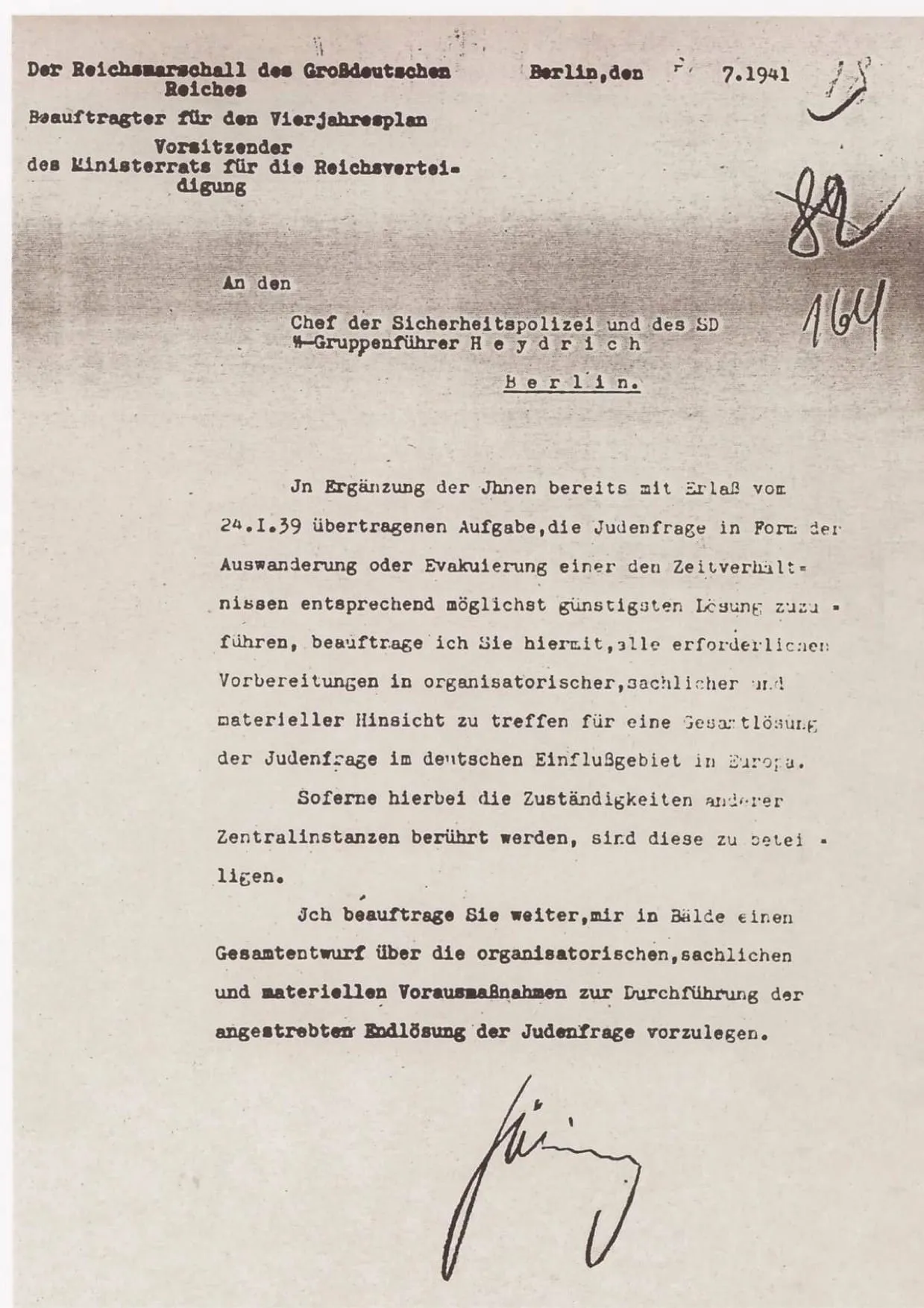
On 31 July 1941 Hermann Göring – Reich Marshal, Plenipotentiary for the Four-Year Plan and chairman of the Ministerial Council for the Defence of the Reich – signed a short letter to the Chief of the Security Police and SD, SS-Gruppenführer Reinhard Heydrich. It fitted on a single page and consisted of three sentences:
“In addition to the task already assigned to you by the decree of 24 January 1939, of bringing the Jewish question, in the form of emigration or evacuation, to the most favourable solution possible under present conditions, I hereby instruct you to make all the necessary preparations, in organisational, practical and material respects, for a total solution (Gesamtlösung) of the Jewish question in the German sphere of influence in Europe. Insofar as the competences of other central authorities are affected, they are to be brought in to co-operate. I further instruct you to submit to me shortly an overall draft of the organisational, practical and material preliminary measures for carrying out the intended final solution (Endlösung) of the Jewish question.”
The document, which after the war entered the record of the Nuremberg trials, is one of the most frequently cited sources for the history of the Holocaust. It contains the official term “final solution of the Jewish question”, and it authorised Heydrich, in the name of the second man in the state, to co-ordinate the actions of all Reich institutions towards the Jews across the whole continent. The letter was written at a time when SS and police units in the occupied Soviet territories had been shooting Jews for five weeks, but it did not yet speak openly of killing. What exactly it meant in July 1941 has been a matter of dispute among historians for decades.
Many chronologies state that Göring, “on Adolf Hitler’s orders”, instructed Heydrich to submit a “general plan of the administrative, material and financial measures” needed for the final solution. Three elements of this description need qualifying. The letter was not an order issued on Göring’s initiative but an authorisation that Heydrich himself had prepared and brought to him for signature. The text does not mention Adolf Hitler, and no written order from Hitler on the matter has survived; historians agree that Göring would not have issued such a document against Hitler’s will, but whether and when Hitler gave a specific instruction remains unknown. Finally, the quoted wording comes from the English translation prepared for the Nuremberg tribunal. The original speaks of “organisational, practical and material” measures (organisatorisch, sachlich und materiell), not “administrative, material and financial” ones.
From emigration to a “territorial solution”
Göring had been dealing with the “Jewish question” on Hitler’s instructions since the autumn of 1938. On 12 November 1938, two days after Kristallnacht, he convened a conference at the Air Ministry at which a “contribution” of a billion marks was imposed on the Jews of Germany and it was decided to drive them out of economic life. On 24 January 1939 he put Heydrich in charge of Jewish emigration through the new Reich Central Office for Jewish Emigration. It was to this very decree that the letter of 31 July 1941 referred. The aim of the Third Reich’s policy at that time was to drive the Jews out of Germany, Austria and the Protectorate, even at the price of robbing them.
The war changed the scale of the problem as the Nazis saw it. The conquest of Poland brought almost two million Jews under German rule, and the victory over France several hundred thousand more in Western Europe. Emigration was no longer enough, and SS planners began to talk of a “territorial solution”, that is, the deportation of the Jews to a remote “reservation”. In the autumn of 1939 this was to be the borderland around Lublin, to which Adolf Eichmann sent the first transports under the Nisko Plan. In June 1940 Heydrich wrote to the Foreign Minister, Joachim von Ribbentrop, that the problem of more than three million Jews under German rule could no longer be solved by emigration and that a “territorial final solution” was needed. In the summer of 1940 the place of exile was to be Madagascar, a plan that was unrealistic without peace with Britain and command of the seas. Each of these schemes assumed that many of the deportees would die, but none yet envisaged systematic murder.
When, at the turn of 1940 and 1941, Hitler decided to attack the Soviet Union, the boundless territories of the east took the place of Madagascar. According to a note of 21 January 1941 by Eichmann’s associate Theodor Dannecker, the Jewish question in the German-controlled part of Europe was, “in accordance with the Führer’s will”, to be brought to a “final solution” after the war, and Heydrich had already been given the task, through Heinrich Himmler or Göring, of submitting a draft plan. On 26 March 1941, as a note by Heydrich himself discovered by the historian Götz Aly shows, he presented Göring with a draft document on the Jewish question. Göring approved it with one amendment, concerning the competences of Alfred Rosenberg, the future Minister for the Occupied Eastern Territories, and told him to resubmit it. The letter of 31 July was thus the fruit of preparations that had been under way since the spring, not a sudden improvisation.
The summer of 1941
When Göring signed the letter, the war in the east had been going on for five weeks. Behind the armies attacking the Soviet Union came the four Einsatzgruppen of the Security Police and SD, subordinate to Heydrich, as well as Order Police battalions and SS brigades under Himmler. In the first weeks they killed mainly Jewish men of military age, communists and Soviet officials, often together with local collaborators or by inciting pogroms. In Kaunas, in Lwów (Lviv), in Białystok, at Ponary (Paneriai) near Wilno and in Riga, tens of thousands of people had been killed by the end of July, according to historians’ estimates. From the second half of July, after Himmler’s talks with the SS and police commanders in the east, both the number of units and the number of victims rose markedly, and in August women and children too began to be shot en masse.
At the same time, in the Reich and in occupied Poland, there was a growing conviction that the existing “solutions” were not working. On 16 July 1941 the head of the SD office in Poznań, Rolf-Heinz Höppner, wrote to Eichmann about the overcrowded Łódź ghetto and asked whether, before the winter, when the Jews could no longer be fed, the “most humane solution” might not be to finish off those unfit for work “by some quick-acting means”. On the same day, at a conference at headquarters, Hitler declared that Germany would never give up the territories it had conquered in the east. The next day he entrusted Himmler with the “police security” of the occupied Soviet territories, and on 20 July Himmler, in Lublin, was issuing instructions intended to prepare the ground for German settlement in the east. Many historians believe that in the euphoria of mid-July, when victory over the USSR seemed near, the last restraints within the leadership of the Third Reich gave way.
According to the testimony Eichmann gave before the court in Jerusalem in 1961, the draft of the letter of 31 July was prepared in his section on Heydrich’s instructions, and Heydrich took it to Göring for signature. The text built on the March document but went further: it now covered not just the Reich but the entire “German sphere of influence in Europe”, and thus allied and occupied countries as well. Above all, it gave Heydrich a mandate to co-ordinate the work of other institutions, ministries and occupation authorities, which until then had each pursued their own policy towards the Jews, often getting in one another’s way.
What the document meant
From the outset the letter of 31 July has been read in two ways. The prosecutors at Nuremberg regarded it as proof that Göring had ordered the murder of the Jews. Under cross-examination by the American prosecutor Robert Jackson in March 1946, Göring objected to the translation of the word Gesamtlösung as “final solution” and claimed that it referred to the emigration and deportation of the Jews, and that he had known nothing of the killings. The tribunal did not believe him.
Among historians the dispute concerns whether the decision to murder all the Jews of Europe had already been taken by July 1941. For some scholars, known as intentionalists, such as Lucy Dawidowicz, the letter was a direct translation into official language of an intention Hitler had been nurturing for years, and the “final solution” had meant extermination from the start. Raul Hilberg, author of the fundamental work on the Holocaust, saw it as the moment at which the murder of the Jews in the east began to turn into a plan embracing the whole continent.
Historians who emphasise the gradual, “cumulative” nature of the radicalisation read the document differently. Christopher Browning believes that in mid-July, in a mood of imminent victory, Hitler encouraged Himmler and Heydrich to prepare a plan for the extermination of the remaining Jews of Europe, and that Göring’s letter commissioned a kind of “feasibility study”. In his view the actual decision was taken in the autumn, between September and October 1941, when Hitler agreed to the deportation of the Jews from the Reich and the SS began building the first extermination centres. Peter Longerich holds that in July 1941 what was still envisaged was a plan to deport the Jews after the war to the conquered Soviet territories, where they would perish from labour, hunger and cold, and that the transition to immediate murder in all countries came in stages, up to the spring and summer of 1942. The German historian Christian Gerlach identified December 1941, after the United States entered the war, as the moment of Hitler’s fundamental decision. Many scholars today believe that there was no single order, but rather a sequence of decisions taken between the summer of 1941 and the spring of 1942.
For all their differences, historians agree on several points. The letter of 31 July was not an order to begin the killing, since that was already under way in the east and needed no signature from Göring. What it did was give Heydrich and his office, the Reich Security Main Office, formal authority over the whole of the Reich’s anti-Jewish policy in Europe. The language of the document, with its “evacuation”, “total solution” and “preliminary measures”, became the model for the bureaucratic euphemisms in which genocide was later described.
Place in the war
Heydrich used the authorisation in accordance with its letter. In the autumn of 1941 his office organised the first deportations of Jews from Germany, Austria and the Protectorate to the ghettos of Łódź, Kaunas, Riga and Minsk, and in October Jews were forbidden to emigrate from the Reich. At the end of November Heydrich sent out invitations to a meeting of state secretaries and SS representatives on the “final solution”; he enclosed with them a copy of Göring’s letter of 31 July, so that no one would be in any doubt as to who had the right to direct it. The meeting, postponed from December, took place on 20 January 1942 in a villa on the Wannsee near Berlin and went down in history as the Wannsee Conference. Heydrich spoke there of eleven million Jews who were to be covered by the “final solution”, and the minutes were taken by Eichmann.
By the time the officials gathered at Wannsee, the killing was already under way on a vast scale. In December 1941 at Chełmno nad Nerem people began to be killed with exhaust fumes in gas vans, and from the spring of 1942 the extermination camps at Bełżec, Sobibór and Treblinka and the gas chambers at Auschwitz-Birkenau were in operation. By the end of the war the Germans and their helpers had murdered some six million European Jews, about half of them Polish Jews.
Heydrich did not live to see the completion of what he had planned: he died on 4 June 1942 after an assassination attempt carried out in Prague by Czechoslovak parachutists sent from London, and the operation to murder the Jews of the General Government, directed by Odilo Globocnik, was named after him. Göring, sentenced to death in 1946 by the International Military Tribunal at Nuremberg, among other things for crimes against humanity, took his own life on the night before his execution. Eichmann, abducted from Argentina by Israeli intelligence in 1960, was tried in Jerusalem and hanged in 1962. The letter of 31 July 1941 remains one of the few documents in which the leaders of the Third Reich, in writing, albeit in the language of official euphemism, entrusted someone with the “final solution of the Jewish question”.
Sources
Meanwhile
(02)Elsewhere, within a week.
- 5 August 1941 · Eastern FrontThe end of the Smolensk pocketOn 5 August 1941 Bock declared the Smolensk pocket battle over, claiming over 300,000 prisoners. Days later the Germans also closed the Uman pocket.
- 7 August 1941 · Eastern FrontThe Germans reach the Gulf of FinlandOn 7 August 1941 the Germans reached the Gulf of Finland at Kunda and split the Soviet 8th Army. Tallinn was cut off, and Narva fell on 17 August.
Related events
(04)The same battle, people or subject.
- 1 September 1941 · Crimes and repressionThe Star of David in the ReichOn 1 September 1941 Heydrich signed a decree requiring Jews aged six and over in the Reich and the Protectorate to wear a yellow “Jude” star from 19 September.
- 28 September 1941 · Crimes and repressionBabi YarOn 28 September 1941 the Germans summoned Kiev’s Jews to assemble. On 29–30 September Sonderkommando 4a and German police shot 33,771 people at Babi Yar.
- 20 January 1942 · Crimes and repressionThe Wannsee ConferenceOn 20 January 1942 Heydrich gathered fifteen SS, Party and ministry officials by the Wannsee to co-ordinate the murder of Europe's Jews, already under way.
- 18 August 1941 · Crimes and repressionAktion T4 haltedIn August 1941 Hitler ordered a halt to the gassing of the sick under Aktion T4. More than 70,000 people had died, and the killing went on in secret.