- Category:
- Military operations
- Front:
- Eastern Front
- Date:
- 2 October 1941
- Author:
- Łukasz
- Battle:
- Battle of Moscow
- Tags:
- Wehrmacht, Red Army, Fedor von Bock, Georgy Zhukov
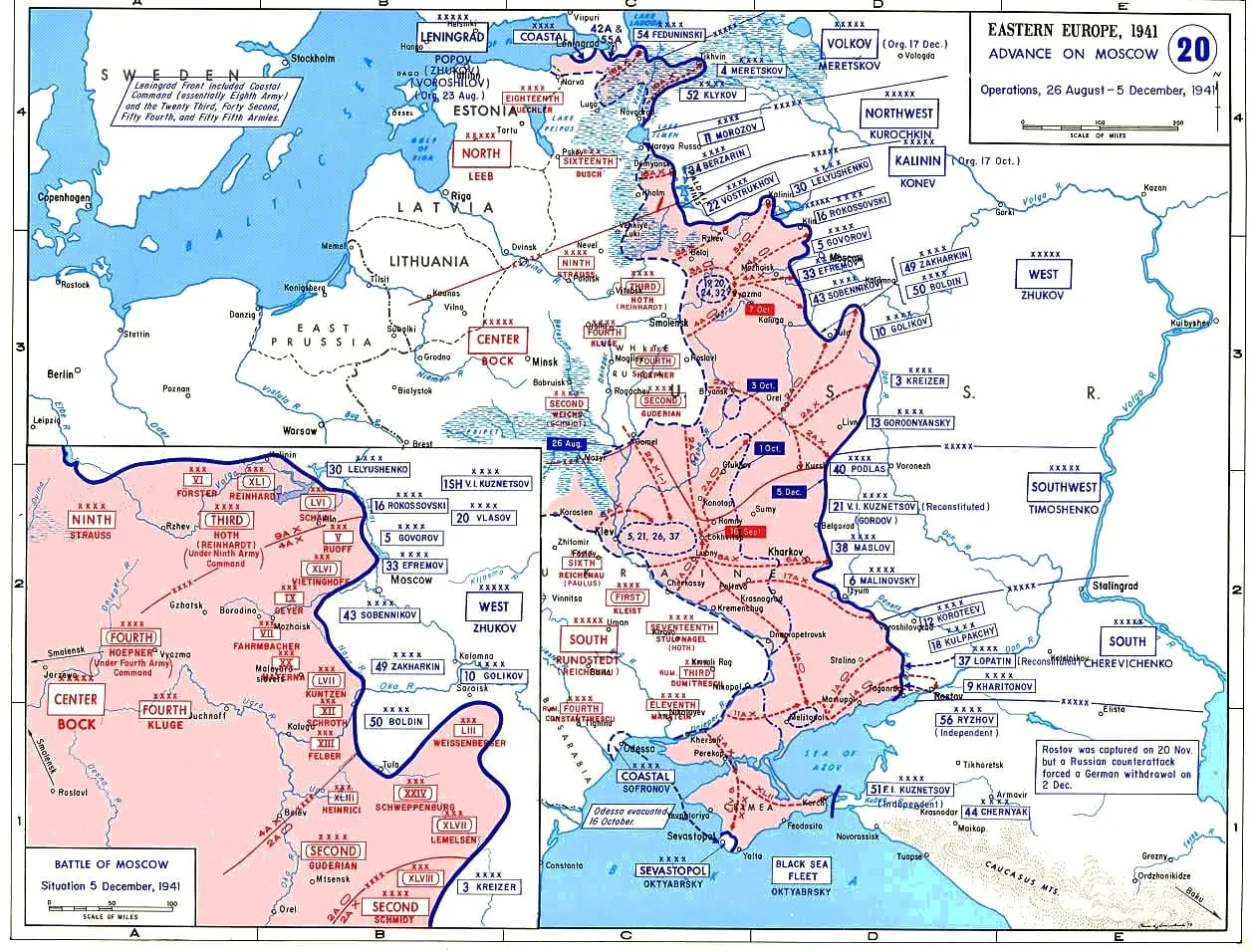
At dawn on Thursday 2 October 1941, at 5.30 a.m., after a short artillery preparation and Luftwaffe air raids, the main forces of Field Marshal Fedor von Bock’s German Army Group Centre struck the Soviet troops barring the road to Moscow. Two panzer groups set off, one from the area of Dukhovshchina, north of the Smolensk–Moscow highway, and one from the area of Roslavl, south of it, followed by the infantry of three armies. Two days earlier, on 30 September, Colonel General Heinz Guderian’s panzer group had already attacked on the southern wing. Operation Typhoon (Unternehmen Taifun) had begun – the Wehrmacht’s last great offensive of 1941, intended to smash the Soviet armies in front of Moscow and then take the Soviet capital before winter. The weather was still fine, dry and sunny, and within the first few hours the Soviet front had cracked in several places.
Some chronologies state under 2 October that the defence of the capital was directed by General Georgy Zhukov, “already a Hero of the Soviet Union for his command in the fighting against the Japanese in the Russian Far East and at Leningrad”. This needs correcting. On the day Typhoon began, Zhukov was in Leningrad, where since mid-September he had commanded the Leningrad Front. Stalin summoned him to Moscow only once the front at Vyazma had already collapsed: according to Zhukov’s memoirs he telephoned him on 5 October, and the general flew to the capital on 7 October. On 8 October he took over the Reserve Front, and on 10 October command of the Western Front, with which it was merged. At that time he held a single Gold Star of a Hero of the Soviet Union, awarded on 29 August 1939 for the victory over the Japanese at the Battle of Khalkhin Gol in Mongolia – not in the Russian Far East, and not for Leningrad. He received the other three in 1944, 1945 and 1956.
Back to Moscow
The offensive against Moscow was more than a month late. At the end of July Army Group Centre stood at Smolensk, where a pocket had been closed, and the army high command – Field Marshal Walther von Brauchitsch and his chief of staff, General Franz Halder – as well as Bock and Guderian wanted to press on straight for the capital. Adolf Hitler thought otherwise: the grain and industry of Ukraine, and Leningrad, mattered more to him. On 21 August he settled the dispute and turned Guderian’s panzer group south, into the rear of the South-Western Front. The great victory at Kiev, where the Germans entered the city on 19 September and, by their own figures, took 665,000 prisoners in the pocket, seemed to prove him right. On the Moscow sector, meanwhile, the front stood still, and Bock’s troops had to fend off Soviet attacks, the largest of which, at Yelnya, forced them at the beginning of September to abandon an exposed salient.
Even before the Kiev pocket was closed, Hitler decided to return to the Moscow axis. Directive No. 35 of 6 September 1941 ordered the destruction of the Soviet forces east of Smolensk in a double encirclement aimed in the general direction of Vyazma, and only then a pursuit towards Moscow, with the right wing resting on the Oka and the left on the upper Volga. Hitler wanted the attack to begin within a dozen or so days; Halder considered this impossible. The army high command’s guidelines of 10 September enlarged the plan: from the south, from the area of Glukhov, Guderian’s group, returning from Kiev, was to strike towards Oryol and Bryansk. The operation received the code name Typhoon on 19 September. The final conference of the army and panzer group commanders with Bock and Halder was held in Smolensk on 24 September, and orders were issued to the armies on 26 September.
Army Group Centre was reinforced at the expense of both its neighbours. From Leningrad, where the blockade had closed on 8 September, came Colonel General Erich Hoepner’s 4th Panzer Group with five panzer divisions; Guderian’s group returned from Ukraine; and two fresh panzer divisions arrived from the Reich. Bock now had three field armies and three panzer groups: in the north Colonel General Adolf Strauss’s 9th Army with Colonel General Hermann Hoth’s 3rd Panzer Group; in the centre Field Marshal Günther von Kluge’s 4th Army with Hoepner’s group; and in the south Colonel General Maximilian von Weichs’s 2nd Army and Guderian’s group. Air support came from Field Marshal Albert Kesselring’s Luftflotte 2. According to German returns cited by historians, on 2 October the army group numbered about 1.9 million men in 78 divisions, including 14 panzer and 8 motorised divisions. The number of tanks is disputed: Soviet historiography wrote of 1,700, while the German historian Klaus Reinhardt counted about 1,200, not all of them serviceable. For aircraft the discrepancies are even greater, since they depend on whether serviceable aircraft or all aircraft are counted.
It was the largest force the Wehrmacht had so far concentrated on a single axis, but it was no longer the army of 22 June. The infantry divisions had suffered serious losses that had not been made good. According to German figures, Guderian’s group had about half its establishment of tanks at the start of the operation and Hoth’s 70–80 per cent; only Hoepner’s group was nearly at full strength. Lorries and tractors were in short supply, and the railways, being converted to the narrower European gauge, struggled to bring up ammunition and fuel. Hitler was holding back new tanks in the Reich for units he intended to form after the expected collapse of the USSR. Even so, the German staffs were convinced that one great blow before winter would decide the war in the east.
On the other side of the front
Three Soviet fronts stood in the way to Moscow. In the north, from Lake Seliger to Yelnya, was the Western Front of Colonel General Ivan Konev, who had replaced Marshal Semyon Timoshenko in September, with six armies: the 22nd, 29th, 30th, 19th, 16th and 20th. Behind it and on its left wing was Marshal Semyon Budyonny’s Reserve Front: two armies, the 24th and 43rd, in the front line on the Desna, and four more in the second echelon near Vyazma. In the south was the Bryansk Front of Colonel General Andrei Yeremenko, with the 50th, 3rd and 13th Armies and General Arkady Yermakov’s operational group. Russian studies based on the archives, among them that of Grigori Krivosheev’s team, give the three fronts some 1.25 million men, nearly a thousand tanks and some 7,600 guns and mortars; older Soviet publications gave much lower figures. According to the same sources this was about 40 per cent of the men and artillery of the entire Soviet armed forces.
The figures, however, did not reflect the weakness of these troops. After the summer battles many divisions had been filled up with freshly mobilised reservists, or were militia divisions formed in the summer from Moscow volunteers, poorly armed and almost untrained. There was a shortage of radio sets, experienced staff officers and anti-tank guns. Of Konev’s nearly 480 tanks, according to some studies, only a few dozen were modern. The armies were defending sectors several dozen kilometres wide, with one division in reserve. Behind them, since July, two belts of fortifications had been under construction, the Rzhev–Vyazma line and the Mozhaisk Line, on which tens of thousands of people from Moscow and its surroundings, mostly women, were working; by October they had been only partly completed.
The Soviet command was expecting an attack. On 26 September Konev reported German preparations to the Stavka and predicted an attack on 1 October, but he expected it in the centre, along the highway, and placed his strongest armies there. On 27 September the Stavka ordered a switch to the defensive and the strengthening of positions; the Bryansk Front was warned only on 28 September. The Germans, meanwhile, struck at the junctions between armies and where the defence was weakest.
Guderian moves first
Guderian insisted that his group should set off two days before the rest. In his sector of advance there were almost no metalled roads, and he wanted to reach the highway at Oryol as quickly as possible, before the autumn rains began. On the morning of 30 September his two motorised corps struck from around Glukhov and Shostka at Yermakov’s group and the left wing of the 13th Army, broke through the defences and drove north-east towards Sevsk and Karachev. Counter-attacks by Soviet tank brigades, ordered during the night by Stalin and the Chief of the General Staff, Marshal Boris Shaposhnikov, failed to stop the German columns.
On 3 October the forward units of the 4th Panzer Division drove into Oryol, some 200 kilometres from where they had set off three days earlier. The city, an important railway junction and the headquarters of a military district, was not prepared for defence. Guderian noted in his memoirs that trams were still running in the streets, and that crates of factory machinery ready for evacuation stood by the roads. The capture of Oryol gave the Germans a metalled highway to Tula and Moscow and a route into the rear of the Bryansk Front. A few days later, however, Guderian’s group, renamed the 2nd Panzer Army, ran into a hastily assembled corps under Major General Dmitry Lelyushenko and Colonel Mikhail Katukov’s tank brigade, equipped with T-34 tanks, near Mtsensk.
The breakthrough of 2 October
The main blow fell on the fronts of Konev and Budyonny. During the night before the attack the troops were read Hitler’s proclamation to the “soldiers of the Eastern Front”, announcing that “the last great decisive battle of this year” was beginning that day. In the north Hoth’s group broke through at the junction of the Soviet 30th and 19th Armies and on 3 October seized a bridgehead on the Dnieper. Konev threw his front reserve against it, the operational group of Lieutenant General Ivan Boldin; the fighting near Kholm-Zhirkovsky lasted two days, after which Boldin had to withdraw, and only a shortage of fuel briefly halted the Germans. South of the highway Hoepner’s group smashed the Reserve Front’s 43rd Army on the Desna and drove deep into the Soviet rear. On 4 October its divisions took Spas-Demensk, Kirov and Mosalsk, and on 5 October Yukhnov, less than 200 kilometres from Moscow. At the same time Weichs’s 2nd Army was attacking the 50th and 3rd Armies of the Bryansk Front.
In Moscow, which the Luftwaffe had been bombing since the night of 21–22 July, for several days no one understood what was happening at the front. Communications between front headquarters and the armies were cut by air raids and by German tanks in the rear. According to Russian studies, when on 5 October reconnaissance airmen reported a German armoured column on the road to Yukhnov, they were not believed, and the report was checked three times; the People’s Commissar for Internal Affairs, Lavrentiy Beria, reportedly accused the commander of the Moscow Military District’s air force of spreading panic. Budyonny reported that day that he lacked the forces to close the gap on his front’s left wing. Only on 5 October did the Stavka allow Konev and Budyonny to fall back to the Rzhev–Vyazma line, but by then the German pincers were already behind them. The same day, according to Zhukov’s memoirs, Joseph Stalin telephoned him in Leningrad.
“This enemy is already broken”
The offensive began in the days when a conference of the three powers was meeting in Moscow. The British Minister of Supply, Lord Beaverbrook (Max Aitken), and President Roosevelt’s envoy W. Averell Harriman had been negotiating with Stalin and Vyacheslav Molotov since 29 September on deliveries of arms and raw materials, and on 1 October they signed a protocol in which Britain and the United States undertook to supply them for nine months. As the delegations were leaving, Army Group Centre was already on the attack, and Western observers were wondering whether Moscow would hold out until winter.
Hitler had no doubts. On the evening of 3 October, in his first public speech since the outbreak of war with the USSR, he opened the annual Winter Relief collection at the Berlin Sportpalast. He announced that a new “operation of gigantic proportions” had been under way for 48 hours, and that he was saying so only now because he could say that this enemy was already broken and would never rise again. He claimed that some 2.5 million Soviet soldiers had already been taken prisoner, and that more than 18,000 tanks and 22,000 guns had been captured or destroyed. These words would soon turn against him. A week later, after the pockets at Vyazma and Bryansk had been closed, the Reich Press Chief, Otto Dietrich, told foreign journalists that the campaign in the east had been decided, and the German press wrote of the last days of the Red Army.
The German staffs shared this optimism. On 4 October Halder wrote in his diary that Operation Typhoon was proceeding “in a positively classic manner”, and at Bock’s headquarters the question was no longer whether the encirclements could be closed but how many panzer divisions could be sent straight on towards Moscow. In its first week Typhoon looked like a repeat of June: a breakthrough within hours, armoured wedges several dozen kilometres behind the front, Soviet headquarters without communications and with no picture of the situation.
Place in the war
The opening of Operation Typhoon was one of the most dangerous moments of the war for the Soviet Union. On 7 October the spearheads of Hoepner’s and Hoth’s panzer groups met in the Vyazma area, and shortly afterwards further encirclements closed at Bryansk. Most of the troops of the three fronts defending Moscow were caught in the pockets; the Germans later announced that they had taken more than 670,000 prisoners in the two battles, and historians, while accepting lower figures, agree that it was one of the greatest defeats of the Red Army. For several days there were few troops left between Vyazma and Moscow. Zhukov, who took over the Western Front on 10 October, had to rebuild the defence on the Mozhaisk Line from the remnants of shattered armies, cadets of military schools and divisions brought in from other sectors, including the Far East. In mid-October panic broke out in Moscow, part of the government left for Kuibyshev, and from 20 October, under a decree of the previous day, the city was under a state of siege.
The encircled armies, however, fought on for almost two weeks and tied down several dozen German divisions that were then missing from the pursuit. During the night of 6–7 October the first snow fell, and in mid-month the rasputitsa set in, the autumn thaw that turned the roads into a quagmire. At the end of October the German advance bogged down a few dozen kilometres from the capital. When the ground froze in November Bock moved again, and in the first days of December his spearheads reached the approaches to Moscow, but they no longer had the strength to take it. On 5 and 6 December the Red Army went over to a counter-offensive that threw the Germans back from the capital.
The operation that began on 2 October was the last attempt to decide the war in the east in a single campaign, as the Barbarossa plan had assumed. It brought the Germans their greatest encirclement victories of 1941 and, at the same time, their first great defeat. Hitler’s words about an enemy who would “never rise again” became one of the best-known examples of premature triumph in the history of the war. For Zhukov, summoned from Leningrad just as the front at Vyazma was falling apart, the defence of Moscow was the beginning of the fame that would make him the most celebrated commander of the Red Army.
Sources
Meanwhile
(04)Elsewhere, within a week.
- 1 October 1941 · Crimes and repressionThe camp at MajdanekFrom 1 October 1941 the SS was to build a camp near Lublin for 50,000 Soviet prisoners of war. So began Majdanek, where nearly 80,000 people died.
- 28 September 1941 · Crimes and repressionBabi YarOn 28 September 1941 the Germans summoned Kiev’s Jews to assemble. On 29–30 September Sonderkommando 4a and German police shot 33,771 people at Babi Yar.
- 28 September 1941 · BalkansThe Drama uprisingOn the night of 28–29 September 1941 Greeks around Drama rose against Bulgarian occupation. The Bulgarians crushed the revolt and shot thousands of civilians.
- 27 September 1941 · PoliticsThe founding of EAMOn 27 September 1941 in Athens the communists and three small left-wing parties founded the National Liberation Front (EAM), the core of the Greek resistance.
Related events
(04)The same battle, people or subject.
- 10 October 1941 · Eastern FrontThe Vyazma and Bryansk pocketsIn early October 1941 the Germans encircled the main forces of three fronts defending Moscow at Vyazma and Bryansk. On 9 October Berlin proclaimed victory.
- 6 November 1941 · PoliticsStalin’s speech of 6 NovemberOn 6 November 1941 Stalin spoke in Mayakovskaya metro station, and on 7 November he took the parade on Red Square, from which troops marched to the front.
- 5 December 1941 · Eastern FrontThe counter-offensive at MoscowOn 5 December 1941 the Kalinin Front, and on 6 December the Western Front, struck an exhausted Army Group Centre. The Germans fell back along the whole front.
- 28 June 1941 · Eastern FrontThe Białystok–Minsk pocketOn 28 June 1941 the Germans took Minsk, closing the ring around the Western Front. In the Białystok and Minsk pockets they took some 300,000 prisoners.