Battle of Kock
- Dates:
- 2–5 October 1939
- Front:
- Poland
- Location:
- Around Kock, Serokomla, Wola Gułowska, Adamów and Krzywda in the northern Lublin region, between the Wieprz, the Tyśmienica and the Łuków–Dęblin railwayOn the battle map →
- Sides:
- PolandFranciszek KleebergNazi GermanyGustav von Wietersheim
- Result:
- Polish tactical victory, German strategic victory. Independent Operational Group Polesie defeated the 13th Motorised Division, but with its ammunition exhausted it capitulated on 6 October. Some 17,000 soldiers went into captivity.
- Author:
- Natalia
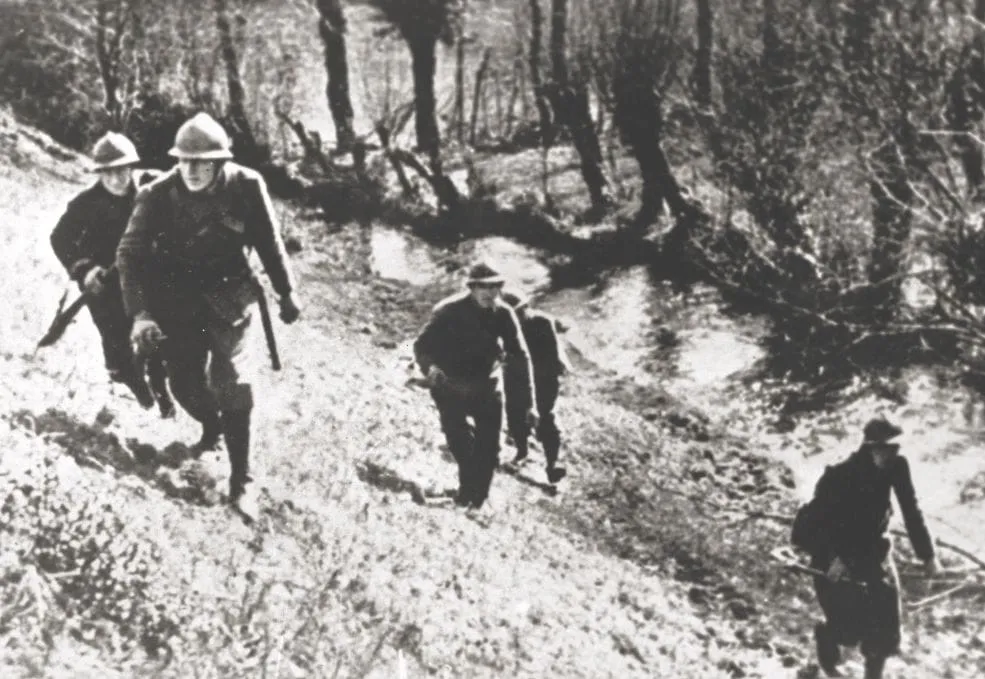
The Battle of Kock was the last battle fought by the regular Polish Army in the September Campaign. It was fought by Independent Operational Group Polesie under Brigadier General Franciszek Kleeberg, a force made up of improvised infantry divisions and cavalry which since mid-September had been fighting its way westwards from Polesie. By the end of September, when Warsaw had already capitulated and Hel was holding out with the last of its strength, some 17,000–18,000 of Kleeberg’s soldiers were still in the field between the Bug and the Vistula. From 2 to 5 October, in the woods and villages between Kock, Serokomla, Wola Gułowska and Krzywda, they fought two German motorised divisions of the XIV Corps (PL) under General of Infantry Gustav von Wietersheim. On 5 October the Poles forced the German 13th Motorised Infantry Division to retreat, but that same evening they ran out of ammunition. On 6 October Operational Group Polesie laid down its arms. Kleeberg was the last Polish general to capitulate in 1939, and the only commander of so large a force who did not lose a single battle.
Name and dates
Polish historiography has settled on the name “Battle of Kock”, although the little town itself lay only on the north-western edge of the battlefield. The heaviest fighting took place a dozen or so kilometres further on, at Serokomla, Wola Gułowska, Adamów and Krzywda, which is why some authors speak of the Battle of Kock and Wola Gułowska. In Germany the battle is known as the Schlacht bei Kock.
The battle can be dated 2–5 October 1939. On the morning of 2 October the German 13th Motorised Infantry Division ran into Polish outposts at Kock and Serokomla, and on the evening of 5 October the last attacks died away and Kleeberg decided to capitulate. The same dates, “KOCK 2–5 X 1939”, are commemorated by a plaque on the Tomb of the Unknown Soldier in Warsaw. Many accounts extend the battle to 6 October, since firing continued during the night of 5–6 October and the act of capitulation was signed and arms laid down on the morning of 6 October.
Background
The defence of Polesie
In 1939 Kleeberg commanded Corps District No. IX (PL) in Brest. The district had no combat role in the war plans: its divisions, the 20th and 30th Infantry Divisions, had gone west in August, leaving in the barracks only depot units, reservists, surplus equipment and, at Pińsk, the Navy’s River Flotilla. When, after the German invasion, the front in the north collapsed and General Heinz Guderian’s XIX Panzer Corps broke through the defences on the Narew and set off southwards, Polesie suddenly found itself in the front line. On 9 September the Commander-in-Chief’s staff instructed Kleeberg to organise a defence along the Mukhavets and the Pripyat, from Brest to the eastern border, and on 11 September Independent Operational Group Polesie was created by order of the Commander-in-Chief. Its task was to screen from the north and east the troops falling back into the Lublin region and towards the Romanian bridgehead.
From the depot units Kleeberg formed several groupings. The strongest, “Kobryń”, under Colonel Adam Epler of the General Staff, had seven infantry battalions and artillery. The “Brześć” grouping of Brigadier General Konstanty Plisowski defended the Brest fortress against Guderian’s corps from 14 to 17 September, while the “Kobryń” grouping fought the Battle of Kobryń against the German 2nd Motorised Infantry Division on 16–18 September and withdrew in good order. The soldiers were mostly older reservists, short of heavy weapons, signals equipment and transport, but they proved tenacious from their very first engagements.
Between the Germans and the Red Army
On 17 September the Red Army invaded from the east. The Commander-in-Chief, Marshal Edward Rydz-Śmigły, ordered his troops to avoid fighting the Soviets and to withdraw to Romania and Hungary, and during the night of 17–18 September he crossed the Romanian border together with the President and the government. Kleeberg at first carried out this order and directed his units towards Kowel. That same day he was joined by the Podlasie Cavalry Brigade of Brigadier General Ludwik Kmicic-Skrzyński, which had slipped away from the Germans through the Białowieża Forest. When the Red Army took Kowel and closed the road south, and contact with higher command was lost, Kleeberg changed his plan around 22 September. He decided to go to the relief of besieged Warsaw.
Marching west, he gathered along the way stragglers from scattered units, escapees from captivity and volunteers. On 26 September he joined forces with the grouping of Colonel Ottokar Brzoza-Brzezina, formed in the Małoryta area, and on 27 September the main body crossed the Bug near Włodawa. In Włodawa Kleeberg set up a Polish civil administration. On 27 and 28 September he reorganised his forces: the “Kobryń” grouping became Colonel Epler’s 60th Infantry Division, and Colonel Brzoza-Brzezina’s grouping, merged with the remnants of the “Drohiczyn” grouping, became the 50th Infantry Division (PL). On 28 September he took under his command the Zaza Cavalry Division of Brigadier General Zygmunt Podhorski, formed on 18 September in the Białowieża Forest from cavalry regiments that had broken out of encirclement in northern Mazovia. From then on the force officially bore the name Independent Operational Group Polesie. Kleeberg was also joined by Brigadier General Czesław Młot-Fijałkowski, former commander of Independent Operational Group Narew, whose troops had been destroyed.
On the march the group clashed several times with the Red Army. On 28–30 September, in the Battle of Jabłoń (PL) and at Milanów, Polish units beat off attacks by the Soviet 143rd Rifle Division, destroying several tanks and taking prisoners. On 1 October at Wytyczno, several dozen kilometres to the south, the Soviets destroyed the Border Protection Corps (KOP) grouping of Brigadier General Wilhelm Orlik-Rückemann, which had been trying to link up with Kleeberg. Some of its soldiers, among them the “Bereźne” battalion, nevertheless reached Operational Group Polesie.
Objective: Dęblin
Between 28 and 30 September news of the capitulation of Warsaw reached Kleeberg’s headquarters. The objective of the march no longer existed. Kleeberg gathered his commanders, set out the situation and resolved to fight on. The group was to make for Dęblin, seize the large military arms depots at Stawy, replenish its ammunition, which was already desperately short, and move into the Holy Cross Mountains to carry on the fight from the forests. Some historians, among them Apoloniusz Zawilski, believe that Kleeberg also wanted to preserve a cohesive, disciplined force as the nucleus of further armed struggle against the occupier. In his last order the general himself wrote that he had first wanted to go south and, when that became impossible, to the aid of Warsaw.
On 29 September the group set out from the Włodawa area through Parczew towards Kock. On 30 September its units took up positions between the Tyśmienica and the Wieprz, and the Zaza Division occupied Kock, driving out a German reconnaissance detachment. On 1 October Kleeberg moved his headquarters to Serokomla. Meanwhile the German command, which after the fall of Warsaw was regrouping its forces on the new demarcation line laid down by the Boundary and Friendship Treaty, had spotted a large Polish force between the Bug and the Vistula. On 30 September the commander of the German Tenth Army, General Walter von Reichenau, ordered the XIV Motorised Corps to destroy it. The 13th Motorised Infantry Division set out eastwards from Dęblin on 29 September and on the evening of 1 October reached the area of Przytoczno, Stoczek and Charlejów. The two sides were marching straight at each other.
Forces and commanders
By various calculations Operational Group Polesie numbered from about 17,000 to about 20,000 men. It consisted of:
- the 60th Infantry Division “Kobryń” under Colonel Adam Epler (the 182nd, 183rd and 184th Regiments and an independent battalion of the 179th Regiment), the strongest and most experienced unit of the group;
- the 50th Infantry Division “Brzoza” under Colonel Ottokar Brzoza-Brzezina (the 178th, 179th and 180th Regiments);
- the Zaza Cavalry Division under Brigadier General Zygmunt Podhorski, made up of the “Plis” cavalry brigade of Colonel Kazimierz Plisowski (PL) and the “Edward” brigade of Colonel Edward Milewski (PL), together with the “Wilk” and “Olek” infantry battalions;
- the Podlasie Cavalry Brigade under Brigadier General Ludwik Kmicic-Skrzyński;
- the 13th Observation Squadron and the remnants of other sub-units.
The chief of staff was Colonel Mikołaj Łapicki of the General Staff. Every unit was under strength. There was a shortage of artillery, especially heavy artillery, of anti-tank weapons, motor transport and dressings, and above all of ammunition. The soldiers, however, had successful fights against both the Germans and the Soviets behind them, and their morale, especially in the 60th Division and the cavalry, was high by all accounts.
On the German side fought the XIV Motorised Corps of General of Infantry Gustav von Wietersheim, part of Reichenau’s Tenth Army. Two of its divisions went into action: the 13th Motorised Infantry Division of Lieutenant General Paul Otto and, from 4 October, the 29th Motorised Infantry Division of Lieutenant General Joachim Lemelsen. On 8 September soldiers of the latter’s 15th Infantry Regiment had committed the Ciepielów massacre, murdering, according to various findings, between 250 and 300 Polish prisoners of war. Each motorised division had an establishment strength of over 16,000 men, several thousand vehicles, strong artillery and armoured cars. Polish studies put the German forces at Kock at about 30,000 men. The Germans had a clear superiority in artillery and an overwhelming one in motorisation and supply, but they were fighting on wooded, marshy ground where their vehicles often lost their advantage.
The course of the battle: 2 October
The commander of the 13th Motorised Infantry Division, General Otto, believed he was facing demoralised remnants that would surrender at the first contact, and sent against them a single battalion of the motorised 93rd Infantry Regiment with a battery of artillery. The battalion split into two groups, which headed for Kock and for Serokomla.
On the morning of 2 October a column of German personnel carriers and lorries drove into the fire of an outpost of the “Wilk” battalion on the edge of Kock. After an exchange of fire lasting several hours the Germans withdrew. The 179th Infantry Regiment of the 50th Division came up to defend the town, and a German attack at around 11 a.m. broke down despite artillery support. In the evening German motorcyclists got as far as the church in Kock but were driven off by fire.
At Serokomla and Hordzież the “Plis” cavalry brigade took up positions. Its artillery beat off a German armoured reconnaissance towards the village of Poznań, and when at around 10 a.m. the Germans attacked along the road from Kock to Serokomla, a squadron group of the 5th Uhlan Regiment under Major Korpalski counter-attacked. In their next attack the Germans entered Serokomla, but a counter-attack by the 2nd Uhlan Regiment, supported by the 5th and 10th Uhlans, threw them out of the village. The Poles took more than 200 prisoners, several officers among them. The “Brzoza” division fought at Kock and Talczyn and towards the end of the day moved to the Adamów area. In the north, from the direction of Żelechów, the vanguard of the 29th Motorised Division was already approaching the railway station at Krzywda.
German reconnaissance had assumed a defenceless enemy. The first day ended with German losses of several hundred killed, wounded and captured. According to German accounts General von Wietersheim, who knew that the Poles were in the woods north-west of Kock, supposed that Kleeberg was unaware of Warsaw’s capitulation.
The course of the battle: 3 October
General Otto committed his whole division. The 33rd Motorised Regiment was to destroy the 50th Division at Talczyn and Annopol, the 93rd Regiment was to take Serokomla and Hordzież and smash the Zaza cavalry, and the 66th Regiment entered the fighting in the afternoon. Kleeberg rightly judged that the main blow would fall on the cavalry at Serokomla. General Podhorski obtained his consent for a counter-stroke: the 178th and 180th Infantry Regiments under Lieutenant Colonel Kazimierz Gorzkowski were to attack from Serokomla and Talczyn towards Charlejów and the village of Poznań, while the “Edward” cavalry brigade struck at the German rear from Józefów. The 179th Infantry Regiment attacked from Kock towards Poizdów.
The infantry attack began in the morning and at first went well, then stalled under German artillery fire. Around noon the “Edward” brigade went into the attack. The 1st Uhlan Regiment and the 3rd Light Horse Regiment advanced on foot across a marshy valley, the 3rd Mounted Rifles Regiment on horseback after crossing near the village of Czarna. The cavalrymen overran the crews of the German artillery in the village of Poznań, but with ammunition lacking and the frontal infantry attack having broken down, the action was called off. The Germans meanwhile attacked the “Wilk” battalion and the 50th Division and inflicted heavy losses on them. By evening, however, they had not managed to break the Polish defence.
Kleeberg gave up further attacks and regrouped. The 50th Division moved overnight to the Adamów and Burzec area, the 60th Division to the woods south of Hordzieżka, the “Plis” and “Edward” brigades screened the group from the south, and the Podlasie Cavalry Brigade from the north and west, near Radoryż.
The course of the battle: 4 October
In view of the 13th Division’s failures, General von Wietersheim brought into action Lemelsen’s 29th Motorised Division, which moved to the Żelechów area and prepared an attack from the north. The two German formations were to destroy Operational Group Polesie in the triangle Wola Gułowska – Adamów – Krzywda.
In the morning the 13th Division attacked the Zaza cavalry and the 50th Division. Its 66th Regiment took Zakępie and advanced on Adamów, where it was stopped by the 1st Battalion of the 180th Infantry Regiment. Under artillery fire the “Wilk” and “Olek” battalions had to abandon Czarna, and the uhlans of the 5th Regiment Wola Gułowska. The Germans occupied the cemetery at Wola Gułowska and turned it into a strongpoint. Squadrons of the 2nd and 10th Uhlans tried several times to retake it; ground changed hands at the cemetery in Turzystwo and by the church, but by nightfall the Germans had not been dislodged. An attack on the Polish right wing was beaten off by Lieutenant Colonel Targowski’s 182nd Infantry Regiment. In the afternoon, near Wola Okrzejska, the cavalry of the 60th Division threw back a German armoured patrol, which Lieutenant Colonel Małysiak’s 3rd Mounted Rifles finally destroyed.
In the evening Kleeberg called a briefing of his commanders at the railway station at Krzywda, where his headquarters was located. The plan for the next day was bold: pin the 13th Division frontally at Adamów and Wola Gułowska, and then, with the 60th Division’s reserve – the 183rd Regiment and Major Michał Bartula’s independent battalion of the 179th Regiment, reinforced by the “Edward” brigade, under the overall command of Lieutenant Colonel Tadeusz Śmigielski of the General Staff – strike through Niedźwiedź and Charlejów at its left wing and rear and drive it onto the 50th Division. Once the 13th Division was destroyed, the whole group was to turn against the 29th Division.
The course of the battle: 5 October
On 5 October, the day on which Adolf Hitler took the victory parade in Warsaw, the 13th Motorised Division launched an attack at around 8 a.m. on the sector from Adamów to Konorzatka. At the same time, as planned, the 60th Division struck. Its 182nd Regiment, supported by a battery of howitzers, quickly drove the Germans out of Helenów. Major Józef Żeleski’s 184th Regiment attacked the cemetery at Wola Gułowska, but only a second attack, together with Major Bartula’s battalion, took the village and the cemetery, along with prisoners and equipment. Bartula’s battalion, which went into the attack with its officers at the head of the companies and platoons, suffered the heaviest losses: the battalion commander, two company commanders and a platoon commander were killed.
On other sectors the Germans had success. The 66th Motorised Regiment took Adamów and, after heavy fighting, Gułów, and the 33rd Regiment took Wojcieszków and Glinne. The “Brzoza” division was pushed out of Adamów towards Burzec and the woods near Krzywda, and its 178th and 180th Regiments suffered heavy losses in unsuccessful counter-attacks. The “Plis” brigade, however, recaptured the Adamów woods, and the 182nd Regiment held Helenów.
The battle was decided at around 4 p.m. The last German attack from Adamów struck the 10th Uhlans and the 182nd and 184th Infantry Regiments. The 184th, which had run out of artillery ammunition, had to fall back. At that point the 2nd Battalion of the 183rd Regiment, supported by artillery, made a bayonet charge in the woods near Gułów against the Germans who were attacking the southern wing of the “Plis” brigade. The Germans began to fall back, pursued by infantry and cavalry. At the same time the “Edward” brigade advanced through Niedźwiedź and Budziska into the rear of the 13th Division. A squadron group made up of the squadrons of Captain Łaski and Second Lieutenant Burlingis captured the village of Poznań together with a German battery, which had to be destroyed when the uhlans were forced to withdraw under fire from another battery. General Otto ordered his division to retreat. In the north the Podlasie Cavalry Brigade was still fighting the 29th Division, which had also attacked the rear of the “Brzoza” division. Both Polish formations withdrew south of Krzywda.
This was the greatest success of Operational Group Polesie: the 13th Motorised Division had been beaten and was retreating. The success was cancelled out, however, by a report from the quartermaster, Lieutenant Colonel Kazimierz Stawiarski of the General Staff. According to him, the whole group had about 20 artillery shells left, and no rifle ammunition or dressings. Supplies could not be obtained, and the depot at Stawy, towards which the group had been heading, lay on the other side of the German lines. The next day the group, surrounded by two motorised divisions, would have had nothing to fight with.
Capitulation
On the afternoon of 5 October General Kleeberg, General Młot-Fijałkowski and Colonel Epler met in a cottage in the village of Hordzieżka. Kleeberg decided to capitulate. In the evening two envoys, Lieutenant Colonel Kazimierz Gorzkowski and Lieutenant Colonel Tadeusz Śmigielski, set out for the headquarters of the 13th Division. A ceasefire was agreed until the morning of 6 October, by which time the capitulation was to be concluded. In some places, however, firing continued until 1 a.m. General Podhorski at first refused to lay down his arms and wanted to break through to the south, but in the morning he changed his mind. During the night the soldiers destroyed and buried their weapons and equipment.
At around 2 a.m. the Polish envoys handed the Germans the agreed text of the act of capitulation. According to some studies, because the envoys’ powers were limited, the act had to be signed by Kleeberg in person at General Otto’s headquarters. According to other accounts, the formal handover and signing took place before noon on 6 October in the Jabłonowski Palace in Kock, in the presence of General von Wietersheim. In the morning Kleeberg took the last parade of his soldiers. At 10 a.m., in the village of Czarna and at other assembly points, his farewell order of the previous day was read out to them, and the laying down of arms began.
In the order Kleeberg recalled the group’s path from Polesie, the failed march south and on Warsaw, and the fighting against the Soviets and the Germans. He stated that the group was surrounded and that ammunition and food were exhausted. “It is a commander’s privilege to take responsibility upon himself. Today I take it in this hardest of moments – ordering an end to further pointless fighting, so as not to shed soldiers’ blood in vain,” he wrote. The order ended with the words: “Poland is not yet lost. Nor shall it be.”
In the afternoon the disarmed columns set off for the assembly points. Some soldiers changed into civilian clothes and did not go into captivity; others escaped later, among other places from the transit camp in Radom. Those who refused to lay down their arms and stayed in the forests were hunted down by the Germans.
Losses
Figures for losses are incomplete and inconsistent. According to Polish studies, some 250–300 soldiers of Operational Group Polesie were killed in the fighting against the Germans between 2 and 5 October, and several hundred were wounded. Polish authors estimate German losses at between about 300 and 500 killed, though some of them give these figures including the wounded. The fighting of 2 October alone cost the 13th Division, by various calculations, 300–400 killed, wounded and captured. The Germans also lost a dozen or more vehicles.
According to figures cited in Polish literature, 16,860 soldiers went into captivity, including 1,255 officers and four generals: Kleeberg, Podhorski, Kmicic-Skrzyński and Młot-Fijałkowski. The Germans captured about 10,000 rifles, over 200 heavy machine guns, 20 guns and around 5,000 horses.
Significance
The Battle of Kock could not change the outcome of the campaign. By the time it began, Warsaw, Modlin and Hel had already capitulated, and the eastern half of the country had been occupied by the Red Army. Militarily, then, it ended as it had to: with the capitulation of a force without supplies, surrounded by an army that had behind it all the resources of a victorious state. Tactically, however, it was a Polish victory. Improvised divisions of reservists and cavalry that had marched hundreds of kilometres defeated a German motorised division at full strength. Kleeberg capitulated not because he had lost but because he had nothing left to fire, and he stressed this in his last order.
The capitulation of Operational Group Polesie brought to an end the organised resistance of regular Polish forces in the 1939 campaign. Only small groups fought on. The most famous of their commanders, Major Henryk Dobrzański, known as “Hubal”, never laid down his arms and, at the head of the Separate Unit of the Polish Army, fought in the Kielce region until the spring of 1940. Many soldiers who avoided captivity or escaped from it joined the underground – the Service for Poland’s Victory and later the Home Army.
Kleeberg was sent to Oflag IV-B in the fortress of Königstein in Saxony. Suffering from a serious heart condition, he died on 5 April 1941 in a military hospital in Dresden. The government-in-exile posthumously promoted him to Major General. In 1969 his ashes were transferred to the war cemetery in Kock, where he was laid to rest among his soldiers. General von Wietersheim later commanded the XIV Corps in France, Yugoslavia and the USSR, and in September 1942 Hitler removed him from command at Stalingrad after he had proposed withdrawing from the city.
In Polish memory Kock became a symbol of soldierly endurance and honour: the last battle of September 1939, in which the Polish Army was not defeated. It is commemorated by the plaque on the Tomb of the Unknown Soldier in Warsaw, by a museum in Wola Gułowska opened on the 50th anniversary of the battle, and by a monument to Kleeberg in Kock. The general’s last order, with its faith that “Poland is not yet lost. Nor shall it be”, closed the first campaign of the Second World War. Poland’s war, however, went on – in the underground at home and in the army being rebuilt in France.
Places·Polesia