Poland
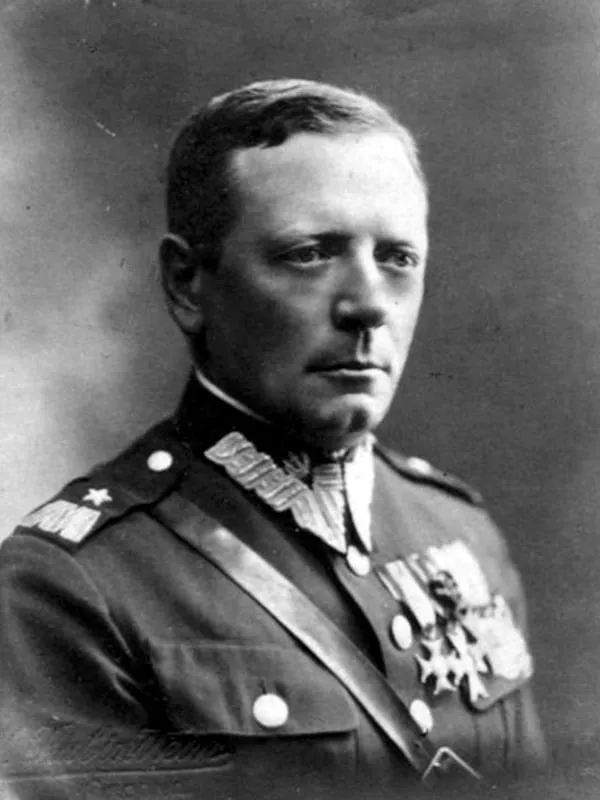
Franciszek Kleeberg
Commander of Corps District No. IX in Brest (1938–1939), commander of Independent Operational Group Polesie (1939), Brigadier General, posthumously Major General
- Born:
- 1 February 1888, Tarnopol (Austria-Hungary)
- Died:
- 5 April 1941, Dresden
- Author:
- Natalia
- Photo:
- autor nieznany, domena publiczna, Wikimedia Commons

Franciszek Kleeberg was a professional officer who spent most of his career in staff posts and regional commands, well away from the front rank of the Polish generals. A graduate of an Austro-Hungarian military academy, an officer of the Polish Legions, a chief of staff in the wars over Poland’s borders and, in the 1930s, commander of the corps districts in Grodno and Brest, he had no combat role at all in the war plans of September 1939. Yet out of depot units, reservists and stragglers he created Independent Operational Group Polesie, which fought both the Germans and the Red Army and fought the last battle of the September Campaign at Kock. He laid down his arms on 6 October 1939 as the last Polish general commanding in the field – not because he had been beaten, but because he had run out of ammunition. He died in German captivity in 1941.
An officer of the imperial and royal army
He was born on 1 February 1888 in Tarnopol (Ternopil) in eastern Galicia. His father, Emilian, had fought in the January Uprising and later served for many years as an officer of the Austrian 11th Dragoon Regiment, rising to the rank of lieutenant colonel. According to family tradition, the Kleebergs were descended from a Swedish soldier who was taken prisoner by the Poles in the 17th century and settled in the Polish–Lithuanian Commonwealth. Franciszek’s younger brother, Juliusz, also became a brigadier general in the Polish Army.
Franciszek attended a technical secondary school (Realschule) in Hranice in Moravia, passed his school-leaving examinations in Vienna in 1905 and entered the Technical Military Academy at Mödling near Vienna, which trained artillery and engineer officers. On 1 September 1908 he was commissioned as a second lieutenant of artillery and began his service with the 2nd Field Howitzer Regiment in Vienna. In 1911 he completed the artillery gunnery school at Hajmáskér in Hungary; in 1913 he was promoted to lieutenant and admitted to the Kriegsschule (War School) in Vienna, the training ground of Austro-Hungarian general staff officers. He never finished the course, because war broke out in 1914.
In the Polish Legions
He spent the first months of the war on Austro-Hungarian staffs on the Serbian front and in the Carpathians. In May 1915 he was posted to the Polish Legions. He was briefly chief of staff of the II Brigade, then deputy chief of staff and, for a time, chief of staff of the Legions Command. On 1 November 1915 he was promoted to captain, and in June 1916 he became chief of staff of the III Brigade. During the war he received Austro-Hungarian military decorations as well as the Prussian Iron Cross, Second Class.
From February to July 1917, when the Legions were placed under German training in the Kingdom of Poland as the nucleus of a future army, he was deputy commander of the 1st Artillery Regiment at Góra Kalwaria and commandant of the combined artillery schools. In July 1917 he was promoted to major. After the oath crisis he worked in the Training Inspectorate of the Polish Armed Forces (Polnische Wehrmacht), and until April 1918 he ran an artillery course at Garwolin. In 1918 he applied to exchange his Austrian citizenship for Polish. In response, the Austro-Hungarian authorities transferred him to the Italian front in June 1918 as a punishment, as a staff officer of the 54th Infantry Brigade. On 16 April 1918 he married Wanda Paszkowska; their son Zbigniew was born in 1920.
The border wars
In November 1918, summoned by General Tadeusz Rozwadowski, he returned home and on 18 November became chief of staff of the Army “East” (PL), which directed the fighting against the Ukrainians in Eastern Galicia. For his part in the fighting for Lwów (Lviv) he received the Silver Cross of the Virtuti Militari. In 1919 he was deputy chief of staff of the Kraków General District Command and later headed the organisation section of the Ministry of Military Affairs. Formally admitted to the Polish Army as a lieutenant colonel, he was promoted to colonel in 1920.
During the Polish–Soviet War, in July 1920, he became chief of staff of the 1st Army, and on 15 August chief of staff of the operational group of General Kazimierz Raszewski, whose task was to shield Pomerania and Greater Poland from a Soviet cavalry corps advancing along the East Prussian border towards the lower Vistula.
A general of the Second Polish Republic
From October 1920 he was chief of staff of the Poznań General District Command, later reorganised as the Command of Corps District No. VII. From January 1923 to May 1924 he commanded the 14th Greater Poland Infantry Division in Poznań. He then spent more than a year studying in France – at the École Supérieure de Guerre in Paris, the infantry training centre at Versailles and the artillery training centre at Metz. On his return he became second director of studies at the Higher Military School (the staff college) in Warsaw.
During the May Coup of 1926 he sided with the lawful authorities against Marshal Józef Piłsudski. This did not, however, end his career. In March 1927 he took command of the 29th Infantry Division in Grodno, and on 1 January 1928 President Ignacy Mościcki promoted him to brigadier general. Kleeberg was a friend of General Władysław Sikorski, who after 1926 found himself in opposition to the Piłsudski camp. In August 1936 he became commander of Corps District No. III (PL) in Grodno, and in 1938 of Corps District No. IX (PL) in Brest-on-the-Bug, which covered Polesie and Podlasie.
September 1939: Independent Operational Group Polesie
Under the mobilisation plans, the divisions of the Brest district left in August 1939 to join the field armies in the west. The district commander was left with depot units, reservists and auxiliary formations. After the German invasion of Poland the northern front quickly collapsed, and General Heinz Guderian’s XIX Panzer Corps drove through Podlasie towards Brest. On 9 September the Commander-in-Chief’s staff ordered Kleeberg to organise the defence of Polesie along the line of the Mukhavets and the Pripyat. From the depot units he formed several groupings, named after the towns where they had been assembled. The Brest grouping under Brigadier General Konstanty Plisowski defended the Brest fortress against Guderian from 14 to 17 September, while the Kobryń grouping under Colonel Adam Epler fought at Kobryń.
After the Red Army invaded on 17 September, Kleeberg began to carry out the order of the Commander-in-Chief, Marshal Edward Rydz-Śmigły, to withdraw to Romania and Hungary, and directed his troops towards Kowel. When the Soviets closed the road south and contact with higher command was lost, around 22 September he decided to march to the relief of besieged Warsaw. On the way he gathered stragglers, volunteers and entire units that had slipped out of encirclement. On 27 September he crossed the Bug at Włodawa and set up a Polish civil administration there, and on 28 September he took the Zaza Cavalry Division of Brigadier General Zygmunt Podhorski under his command. From then on the force was called Independent Operational Group Polesie and numbered 17,000–18,000 men in two improvised infantry divisions and the cavalry. At the end of September it beat off Soviet attacks at Jabłoń (PL) and Milanów.
The news of the capitulation of Warsaw did not persuade Kleeberg to lay down his arms. He decided to march on Dęblin, seize ammunition from the depots at Stawy and move into the Świętokrzyskie Mountains to fight on. Historians, among them Apoloniusz Zawilski, suggest that he also wanted to preserve a cohesive, disciplined force as the nucleus of continued resistance against the occupier. From 2 to 5 October, in the Battle of Kock, Independent Operational Group Polesie fought General Gustav von Wietersheim’s German XIV Motorised Corps. On 5 October, at Wola Gułowska, his troops forced the 13th Motorised Infantry Division to retreat. That same day it emerged that the group had about 20 artillery shells left and no rifle ammunition. In the afternoon Kleeberg decided to surrender. In his last order he wrote: “It is the privilege of a commander to take responsibility upon himself. Today I take it at this hardest moment – by ordering an end to further pointless fighting, so as not to shed soldiers’ blood in vain.” The order ended with the words: “Poland is not yet lost. Nor will it be.” On 6 October his soldiers laid down their arms. Nearly 17,000 men went into captivity.
Captivity and death
Kleeberg was held in Oflag IV-B in Königstein Fortress on the Elbe, a camp for senior officers and generals. He spent a year and a half there. He developed a serious heart condition and died on 5 April 1941 in the military hospital in the Weißer Hirsch district of Dresden, aged 53. He was buried in a cemetery in Dresden’s Neustadt.
The Polish authorities in exile posthumously promoted him to major general with seniority from 1 January 1943. After the war, in 1947 and 1970, the Polish government-in-exile awarded him the Knight’s Cross and the Commander’s Cross of the Virtuti Militari. In 1969, on the 30th anniversary of the battle, the authorities of the Polish People’s Republic brought his ashes back to Poland. On 30 September the urn was handed over to a Polish delegation in Dresden, and on 6 October 1969 it was laid to rest in the war cemetery at Kock, among the fallen soldiers of Independent Operational Group Polesie. He has a symbolic grave in Powązki Cemetery in Warsaw.
Significance
Kleeberg was neither a great strategist nor a household name in interwar Poland. His place in history rests on five weeks in 1939. With no plan, no orders from above and no rear services, he built from nothing a force that fought longer than any other regular Polish formation, and led it into the last battle in good order and in high spirits. He was one of the few commanders of the September Campaign who lost no battle. He also took upon himself the hardest decision a commander can face, and justified it by concern for the lives of soldiers who “may yet be of use”. Many of them did indeed return to the fight, in the underground at home or in the army being rebuilt in France and the Middle East.
In the Polish People’s Republic his memory was awkward, because his soldiers had also fought the Red Army, and his last order was printed with those passages removed. Even so, Kock became a symbol of the Polish September, and Kleeberg himself “the last general of the Polish September”. Streets and schools in many towns bear his name; in 1989 the Polish Post issued a stamp with his portrait, and Wola Gułowska has a museum devoted to the combat record of Kleeberg’s soldiers. In 2009 he was posthumously awarded the Grand Cross of the Order of Polonia Restituta, and in 2019 his name was given to the 19th Mechanised Brigade in Lublin, which also took over the traditions of Independent Operational Group Polesie.
Sources
Commanded in battles
(01)Mentioned in battles
(02)Often appears with
People who appear in the same events.
On the timeline
(05)1939
September
October
- 06
- The surrender at KockOn 6 October 1939 General Kleeberg’s Polesie group laid down its arms near Kock – the last regular Polish Army formation still fighting in the 1939 campaign.
- Hitler offers peaceOn 6 October 1939 Hitler proposed a peace conference in the Reichstag if the West accepted the conquest of Poland, whose fate was for Germany and the USSR.