1938–1939: The Soviet–Japanese border conflicts
The Battle of Lake Khasan
- Dates:
- 29 July – 11 August 1938
- Front:
- Far East
- Location:
- Zaozyornaya (Changkufeng) and Bezymyannaya (Shachaofeng) hills west of Lake Khasan, between the lake and the lower Tumen River, where the borders of the USSR (Primorsky Krai), Manchukuo and Korea met, about 130 km south-west of VladivostokOn the battle map →
- Sides:
- Soviet UnionVasily Blyukher, Grigory ShternJapan (and Manchukuo)Kamezō Suetaka, Kōtoku Satō
- Result:
- Japan halted the fighting and withdrew from the disputed hills after the truce of 11 August 1938. A political success for the USSR, bought with losses several times higher than Japan's.
- Author:
- Łukasz
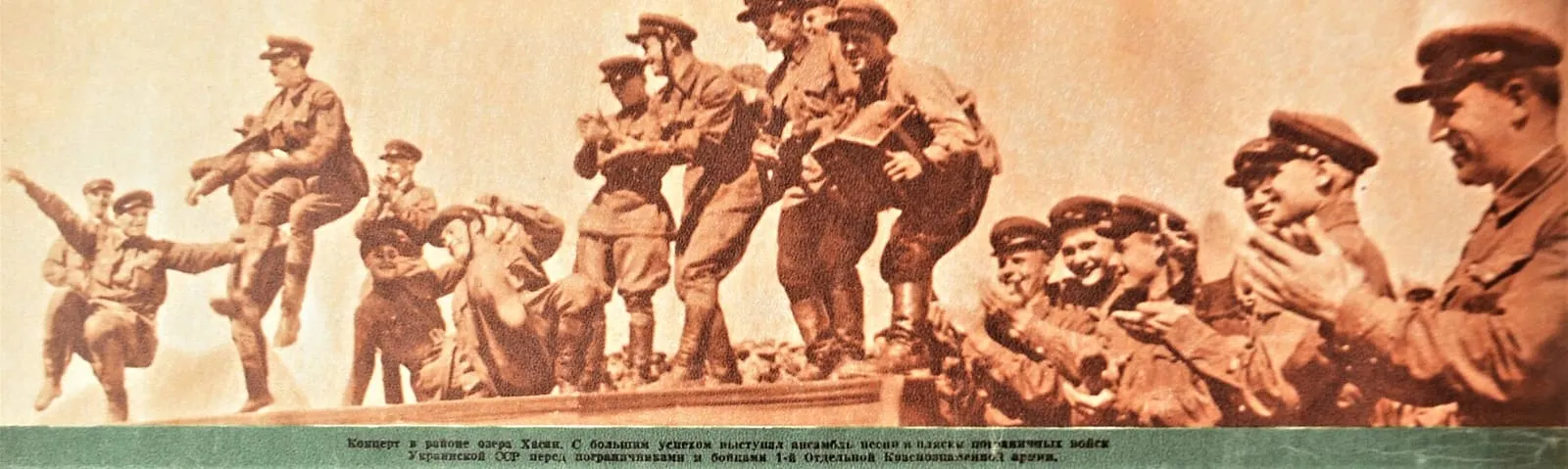
The Battle of Lake Khasan was the first real battle between the Red Army and the Japanese army since the intervention in Siberia. It was fought from 29 July to 11 August 1938 over two low hills in the farthest, southern corner of the Soviet Primorsky Krai, where the borders of the USSR, Manchukuo and Korea met. A dispute over a few hundred metres of ridge turned into a clash in which two rifle divisions, a mechanised brigade and several hundred aircraft fought on the Soviet side, and a single reinforced division of the Korea Army on the Japanese side. The Japanese seized the hills and held them for more than a week under heavy fire, after which their government asked for a truce and agreed to withdraw. The USSR achieved its political aim, but at such a cost that the outcome of the battle sealed the downfall of Marshal Vasily Blyukher. A year later the two armies clashed again, on a far larger scale, at Khalkhin Gol.
Name and dates
In Russia the fighting is called the Khasan battles (Khasanskiye boi) or the Lake Khasan conflict. In Japan it is known as the Changkufeng incident (Chōkohō jiken), after the Chinese name of the higher of the two hills, which the Russians call Zaozyornaya (“Beyond the Lake”). The second hill is Bezymyannaya (“Nameless”), in Chinese and Japanese Shachaofeng. English-language literature uses both names: Lake Khasan and the Changkufeng Incident.
The fighting is dated from 29 July 1938, the day of the first armed clash over Bezymyannaya. Tension, however, had been building since the first half of July, when Soviet border guards occupied the summit of Zaozyornaya, and the first shots were fired on the border in the middle of the month. It is taken to have ended on 11 August, the day the truce came into force; it had been agreed in Moscow on 10 August, while arrangements concerning the troops’ lines and the exchange of the bodies of the fallen continued on 12 and 13 August.
Background
The border between Russia and China in this area had been set by the Convention of Beijing of 1860, and the boundary markers were placed on the basis of the Hunchun Protocol of 1886. The map attached to these documents was inaccurate, and over half a century most of the markers had disappeared. The Soviet side held that the border ran along the ridge of the hills west of Lake Khasan, across the summit of Zaozyornaya; the Japanese and Manchukuo side, that the ridge right down to the lakeshore belonged to Manchukuo. The disputed strip was a few hundred metres wide, but from the summit of Zaozyornaya one could see, on one side, the Soviet rear as far as Posyet Bay, and on the other the valley of the Tumen, the Korean railway line into Manchuria and the approaches to the port of Rajin (today Rasŏn).
After the Mukden incident and the conquest of Manchuria, Japan and the USSR shared a border several thousand kilometres long. By the mid-1930s there were hundreds of incidents on it every year, and in June 1937, in a clash over islands in the Amur, Japanese artillery sank a Soviet gunboat. From November 1936 Japan was a party, with Germany, to the Anti-Comintern Pact. After the Marco Polo Bridge incident the Sino-Japanese War broke out, and in August 1937 the USSR signed a non-aggression pact with China and began supplying it with arms and aircraft, also sending volunteer airmen. The Japanese command feared a Soviet attack on Manchukuo while the main body of the army was fighting in China, but it also knew how badly the Great Purge had weakened the Red Army. In the Far East the arrests intensified in the spring and summer of 1938. On 13 June (14 June according to some sources) the head of the NKVD in the Far East, Genrikh Lyushkov, defected to Manchukuo and handed the Japanese ciphers and details of troop dispositions.
On 1 July 1938 the Special Red Banner Far Eastern Army was transformed into the Far Eastern Front under Marshal Blyukher. At the beginning of July, as later research in the Soviet archives showed, the deputy head of the NKVD, Mikhail Frinovsky, gave a verbal order to occupy the summit of Zaozyornaya, which had until then been no man’s land. Border guards of the 59th Posyet Border Detachment took it around 8–12 July, dug trenches and put up wire entanglements, partly beyond the line recognised by the Soviet side itself. Manchukuo protested on 14 July, Japan on 15 July. The People’s Commissar for Foreign Affairs, Maxim Litvinov, showed the Japanese ambassador Mamoru Shigemitsu the 1886 map and refused to withdraw the troops. In mid-July a Japanese gendarme was killed by a Soviet bullet on the border.
In Tokyo, the operations section of the General Staff, under Colonel Masazumi Inada, wanted to use the dispute for a limited “reconnaissance in force”, which was to show whether the USSR was prepared to fight in defence of China before the army moved on Wuhan. The 19th Division was moved up to the border from Nanam (Japanese: Ranan) in northern Korea. On 20 July the War Minister, Seishirō Itagaki, and the Chief of the General Staff, Prince Kotohito Kan’in, asked Emperor Hirohito for permission to use force. The Emperor refused and sharply rebuked Itagaki, who had assured him of the support of the other ministers. According to the diary of Kumao Harada, secretary to the genrō Kinmochi Saionji, he declared that from then on the army was not to move a single soldier without his order. Some Soviet and Russian publications state that Hirohito approved the plan of attack on 22 July, but Japanese sources do not confirm this. The troops remained on standby, with a ban on using aircraft and on widening the dispute. On the other side, Blyukher, seeking to avoid war, sent a commission to Zaozyornaya on 24 July, which found that the border guards had crossed the border by a few metres in several places, and he ordered the wire to be moved. Moscow later treated this as one of the proofs of his “defeatism”.
Forces
On the Japanese side fought the Korea Army’s 19th Division under Lieutenant General Kamezō Suetaka – above all Colonel Kōtoku Satō’s 75th Infantry Regiment and Colonel Isamu Chō’s 74th Regiment – supported by a mountain artillery regiment and heavy artillery units attached later, as well as by a few Manchukuo detachments and an armoured train. According to the American historian Alvin D. Coox, author of the standard monograph on the fighting, there were no fewer than 10,000 Japanese in the battle zone, of whom some 7,000–7,300 were in the division’s combat units. Soviet sources gave a figure of more than 20,000. The Japanese used neither aircraft nor tanks.
The Red Army committed the 39th Rifle Corps, with the 32nd and 40th Rifle Divisions and the 2nd Mechanised Brigade, supported by corps artillery, border guards and the aircraft of the front and of the Pacific Fleet. According to Russian figures, some 15,000 soldiers and border guards took part in the fighting, while the corps sent to the area as a whole numbered almost 23,000 men. It had more than 230 guns, about 285 tanks (mainly T-26s and BTs) and the support of between 250 and more than 350 aircraft. The front’s chief of staff, and from 3 August the de facto commander of the operation, was Komkor Grigory Shtern. The Deputy People’s Commissar for Defence, Lev Mekhlis, also arrived at headquarters; he kept watch over the commanders’ political “vigilance” and sent denunciations of Blyukher to Moscow.
Course of the battle: 29–31 July
On the morning of 29 July, in fog, a Japanese detachment attacked a Soviet patrol on Bezymyannaya. According to the Soviet version, some 150 soldiers and gendarmes attacked eleven border guards under Aleksei Makhalin; according to the Japanese version, a local unit attacked on its own initiative Soviet troops who had just crossed the border and begun to dig in. The border guards held out for several hours; many of them, including Makhalin, were killed, and the Japanese took the hill. In the afternoon a reserve of border guards and a company of the 40th Division arrived and drove them back beyond the ridge.
General Suetaka judged this to be a situation in which he was entitled to “counter-attack resolutely”. On the evening of 30 July Japanese artillery shelled the hills. During the night of 30–31 July Satō’s 75th Regiment made a night assault: according to Japanese figures, just over a thousand men attacked Zaozyornaya and fewer than four hundred Bezymyannaya. Some 300 Soviet soldiers on each hill were routed or pushed back, and the Japanese claimed to have destroyed a dozen or so tanks. The attack cost them, by their own figures, 45 killed and more than 130 wounded. The night assault was later held up in the Japanese army as a model of such tactics. By the morning of 31 July both hills were in Japanese hands. Work immediately began on digging full-depth trenches and putting up wire. Tokyo accepted the fait accompli, but forbade any advance beyond the ridge and refused to send reinforcements, fearing that Suetaka would use them to widen the fighting.
On 31 July the People’s Commissar for Defence, Kliment Voroshilov, placed the 1st Coastal Army and the Pacific Fleet on alert. A hasty Soviet counter-attack by two battalions the same day achieved nothing.
Course of the battle: the attack of 2 August
On 1 August Joseph Stalin, Vyacheslav Molotov and Voroshilov spoke to Blyukher by telegraph. According to a later order by Voroshilov, Stalin asked the marshal outright whether he “really had any desire to fight the Japanese” and ordered him to go to the scene at once. Blyukher arrived at Posyet on 2 August and threw into the attack the regiments of the 40th Rifle Division, which were only just reaching the lake along the single dirt road. Crossing the border was forbidden, so the attack had to go through the narrow defiles between the lake and the hills, straight at the Japanese trenches. The artillery was not ready, communications were not working, almost no reconnaissance had been carried out, and the tanks bogged down on the marshy shores. Partly because of fog, the air force gave the attack only limited support. The soldiers reached the foot of the hills but did not take the summits, and in the evening they were ordered to break off the attacks. On 3 August Mekhlis reported that Blyukher was unfit to command, and Shtern took over the direction of the operation.
Course of the battle: the attack of 6–9 August
By 4 August the 32nd Rifle Division (commanded by Colonel Nikolai Berzarin, later the commandant of Berlin), the 2nd Mechanised Brigade and the corps artillery had reached the lake. Shtern gave the order to destroy the enemy between Zaozyornaya and the lake and restore the border. On 6 August at about 4 p.m., when the fog had lifted, more than two hundred aircraft, including four-engined TB-3 bombers, bombed the Japanese positions, and after three-quarters of an hour of artillery bombardment the infantry and tanks moved off at 5 p.m.: the 32nd Division from the north against Bezymyannaya, the 40th Division from the south-east against Zaozyornaya. According to one Japanese artilleryman, the Soviets fired more shells in a single day than the Japanese did in the whole two weeks.
The Japanese defended themselves stubbornly. Lacking aircraft and tanks, they had a few anti-tank guns, grenades and bottles of petrol, and their infantry counter-attacked at night. Tanks thrown into battle in small groups, without infantry cover, were lost in the marshes and on the slopes. According to Soviet figures, the Japanese made more than a dozen counter-attacks on 7 August. Soviet sources state that a red banner was planted on the summit of Zaozyornaya on the evening of 6 August and that by 8 August the hill was in the hands of the 40th Division and the 118th Rifle Regiment. On 9 August the 32nd Division is said to have taken Bezymyannaya, although according to some Russian publications the hill was fully occupied only after the truce. Japanese sources claim that their soldiers held part of the summit of Zaozyornaya until the end of the fighting. Japanese artillery fired from islets in the Tumen and from the Korean bank, and Soviet aircraft also bombed nearby villages in Korea. On 9 August the Japanese made several diversionary attacks on other sectors of the border to draw Soviet forces away.
The truce
On 10 August the headquarters of the 19th Division reported that the division was close to exhaustion and asked for swift talks. The same day in Moscow Shigemitsu proposed to Litvinov that the fighting should stop. It was agreed that hostilities would cease at noon on 11 August, local (Primorye) time, with the troops remaining on the lines they had held at midnight on 10 August. The shooting finally died down at about 1.30 p.m. In the evening Colonel Chō met Shtern on Zaozyornaya, and on 12 and 13 August the positions of the troops were fixed and the bodies of the fallen exchanged. The Japanese units soon left the ridge, and Soviet border guards occupied the hills. The border remained where the Soviets had drawn it.
Losses
Casualty figures vary by source. According to Soviet data published in 1993, the Red Army lost 792 killed and missing and 3,279 wounded and sick. More recent Russian tallies give 960 killed, died of wounds and disease, and missing, as well as 2,752 wounded and 527 sick. Much lower figures were presented at the meeting of the Main Military Council on 31 August 1938. Soviet data speak of 72 tanks destroyed and damaged; the Japanese claimed to have destroyed or disabled 96. The Japanese General Staff counted 526 killed and missing and 913 wounded, while the Soviet side estimated Japanese losses at around 650 killed and 2,500 wounded. The Japanese Foreign Ministry, for its part, inflated Soviet losses to 1,200 killed and 5,500 wounded. The figures of both sides show that the Red Army lost several times as many men as its opponent, despite a several-fold numerical superiority and complete command of the air.
Significance
The USSR proclaimed victory. More than 6,500 participants in the fighting received decorations, 26 of them the title of Hero of the Soviet Union, and the 40th Rifle Division was awarded the Order of Lenin. In political terms Moscow had indeed got its way: Japan withdrew from the hills and gave up further fighting. In military terms, however, the picture was very unfavourable, and some historians, Polish ones among them, regard the clash as inconclusive or as a tactical success for the Japanese, who with one division and no air support held their positions for more than a week.
Moscow looked for scapegoats. On 31 August the Main Military Council found the Far Eastern Front to be poorly prepared for war; by an order of 4 September Blyukher was recalled and the front disbanded. On 22 October the marshal was arrested, and on 9 November 1938 he died in prison after brutal interrogations. The Red Army drew some lessons from Khasan that proved useful the following year. The Japanese army, by contrast, concluded that the USSR did not intend to fight for Manchukuo, since it had contented itself with recovering two hills – which made it easier to decide on the offensive against Wuhan. The Kwantung Army, for its part, attributed the defeat to the weakness of the Korea Army and did not change its methods.
In May 1939, on the Khalkhin Gol river on the border between Manchukuo and Mongolia, another, much larger clash broke out, ending in the defeat of the Japanese 6th Army. That defeat, coinciding with the Molotov–Ribbentrop Pact, convinced Tokyo that the road north was closed. In April 1941 Japan signed a neutrality pact with the USSR and turned south, towards the European colonies and war with the United States, while the USSR was able in 1941 to transfer some of its Far Eastern troops to the Moscow area. After the war the fighting at Khasan was included in the indictment before the International Military Tribunal for the Far East, which found it to be part of Japan’s war of aggression.