Japan
Mamoru Shigemitsu
Minister to China (1931–1932), ambassador to the USSR (1936–1938), Britain (1938–1941) and Nanjing (1941–1943), foreign minister (1943–1945, 1945, 1954–1956)
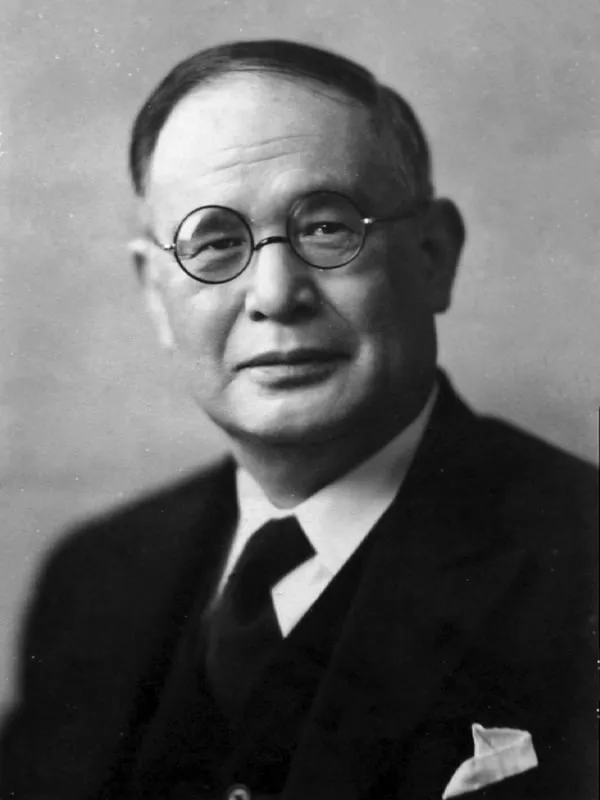
- Born:
- 29 July 1887, Mie, Ōita Prefecture (now Bungo-Ōno, Japan)
- Died:
- 26 January 1957, Yugawara (Kanagawa Prefecture, Japan)
- Author:
- Łukasz
- Photo:
- autor nieznany, domena publiczna, Wikimedia Commons

Mamoru Shigemitsu was a Japanese career diplomat and politician who served three times as foreign minister. Throughout the interwar years he worked at the posts where the crises leading to the Pacific War were played out: Shanghai and Beijing, Moscow and London. In April 1932 he lost a leg in a bomb attack in Shanghai, and for the rest of his life he walked with an artificial leg and a cane. He was regarded as an opponent of the military’s adventurist policies and of the pact with Germany, and yet in 1943–1945 he directed Japan’s diplomacy during a war it was losing. It was he who, on 2 September 1945, aboard the battleship Missouri, was the first to sign the instrument of surrender. Later sentenced by the Tokyo tribunal to the lightest punishment handed down to any of the defendants, he returned to politics and in 1956 brought Japan into the United Nations.
Youth and first postings (1887–1919)
He was born on 29 July 1887 in the village of Mie in Ōno District, Ōita Prefecture, on the island of Kyushu (today part of the city of Bungo-Ōno). He was the second son of a descendant of samurai of the former Kitsuki domain who after the Meiji Restoration became a district official. He graduated from the law faculty of Tokyo Imperial University. In September 1911, after passing the diplomatic examination, he joined the Foreign Ministry, two years after Hachirō Arita.
He spent his first years in Europe, as an attaché in Berlin and a secretary at the embassy in London, followed by a short consular posting on the west coast of the United States (sources give Portland or Seattle). In 1919 he was a member of the Japanese delegation to the Paris Peace Conference, which prepared the Treaty of Versailles.
China and the bomb in Hongkou Park (1920–1932)
In the 1920s Shigemitsu specialised in treaty affairs and China. He headed a section in the treaties bureau, was first secretary of the legation in Beijing and counsellor of the embassy in Berlin, and in 1929 he took over the consulate-general in Shanghai. As early as March that year, in confidential talks with Chinese diplomats, he finalised the agreement that closed the Jinan Incident. At the turn of 1930 and 1931 he became head of the Japanese legation in China. An advocate of accommodation with Chiang Kai-shek’s government, he saw the Mukden Incident of September 1931 as a blow to his policy. In his memoirs he later wrote that Japan’s international achievements since the Meiji era had been destroyed overnight.
When fighting broke out in Shanghai in January 1932, Shigemitsu conducted armistice negotiations with the Chinese, mediated by representatives of Britain, the United States, France and Italy. On 29 April, when the agreement was almost ready, he attended celebrations of the Emperor’s birthday in Hongkou Park. The Korean independence activist Yun Bong-gil threw a bomb onto the platform, killing the chairman of the Japanese residents’ association and mortally wounding General Yoshinori Shirakawa. Shigemitsu was badly wounded in the right leg. On 5 May, in hospital and just before his leg was amputated, he signed the armistice ending the Shanghai Incident. From then on he wore a heavy artificial leg and walked with a cane.
Vice-minister, Moscow and London (1933–1941)
After his recovery, in 1933 Shigemitsu became vice-minister for foreign affairs, first under Kōsai Uchida and then under Kōki Hirota. This was the time when Japan, after the League of Nations adopted the Lytton Report, left the League and pursued an increasingly unilateral policy towards China. In his notes he at the same time criticised the Western powers for holding on to colonies in Asia; he combined opposition to the army’s high-handedness with a belief in Japan’s special role on the continent.
In 1936 he went to Moscow as ambassador. The post proved difficult: Shigemitsu had to deal with a series of border clashes between the Red Army and Japanese and Manchukuo troops. In July 1938 the People’s Commissar for Foreign Affairs, Maxim Litvinov, showed him a map of 1886 and refused to withdraw troops from a disputed hill by Lake Khasan. After two weeks of fighting, on 10 August 1938, the two men agreed a ceasefire in Moscow that ended the fighting at Lake Khasan.
In the autumn of 1938 Shigemitsu took over the embassy in London. Anglo-Japanese relations were then deteriorating fast because of the war in China, and in the summer of 1939 the Japanese army’s blockade of the British concession in Tianjin brought the two countries to the brink of conflict (the Tientsin Incident). The ambassador tried to calm the disputes and sent sober reports on the situation in Europe to Tokyo. After the outbreak of war he repeatedly warned that Japan should not become involved in it. When the foreign minister, Yōsuke Matsuoka, concluded the Tripartite Pact with Germany and Italy on 27 September 1940, Shigemitsu regarded it as a mistake that would harden the United States’ attitude towards Japan.
In June 1941 he was recalled. On his way home he spent a fortnight or so in Washington, discussing with Ambassador Kichisaburō Nomura the possibility of a direct meeting between Prime Minister Fumimaro Konoe and President Franklin D. Roosevelt. No such meeting ever took place. After Japan rejected the Hull note and attacked Pearl Harbor, Shigemitsu, who was accused in Tokyo of being too conciliatory, was appointed in December 1941 ambassador to the government of Wang Jingwei in Nanjing.
Nanjing and the Foreign Ministry (1942–1945)
In Nanjing Shigemitsu argued that the “Greater East Asia Co-Prosperity Sphere” would win no support if Japan treated the Chinese and the other peoples of Asia as subordinates. He was one of the authors of the “new China policy”: in January 1943 the Nanjing government declared war on the United States and Britain, and in return Japan handed over to it its concessions in Chinese cities and gave up extraterritoriality. In practice Wang’s government remained wholly dependent on the Japanese army.
On 20 April 1943 Prime Minister Hideki Tōjō gave Shigemitsu the Foreign Ministry in place of Masayuki Tani. The new minister tried to give the idea of “Greater East Asia” the form of an alliance of formally equal states. In August 1943 Japan recognised the independence of Burma under Ba Maw, and in October the Republic of the Philippines. On 5–6 November 1943 the Greater East Asia Conference met in Tokyo, attended by the leaders or representatives of Manchukuo, Nanjing China, Thailand, Burma and the Philippines, with Subhas Chandra Bose as an observer. The joint declaration spoke of mutual respect for independence, equality and cooperation. Historians point out that the declaration served above all propaganda and the mobilisation of resources for the war, while the occupied countries remained under the control of the Japanese military.
After the fall of the Tōjō cabinet Shigemitsu kept his portfolio in the cabinet of Kuniaki Koiso, and from 22 July 1944 he also headed the Ministry of Greater East Asia, created in 1942 against the diplomats’ objections. When the Koiso cabinet resigned on 5 April 1945, the new prime minister, Kantarō Suzuki, entrusted foreign affairs to Shigenori Tōgō. Shigemitsu therefore took no part in the struggle over the Potsdam Declaration and the decision to surrender.
Plenipotentiary of defeated Japan (1945)
On 17 August 1945, two days after Emperor Hirohito’s broadcast, Shigemitsu returned as foreign minister in the government of Prince Naruhiko Higashikuni, formed to steer the country through the ceasefire and the beginning of the occupation. To him fell the hardest task of all: signing the instrument of surrender on behalf of the Emperor and the government. On behalf of Imperial General Headquarters it was to be signed by the Chief of the Army General Staff, General Yoshijirō Umezu.
On the morning of 2 September 1945 the two men, with a nine-member delegation, were taken out to the battleship USS Missouri, anchored in Tokyo Bay. Shigemitsu, in morning coat and top hat, struggled up onto the deck on his artificial leg. After a short speech by General Douglas MacArthur he was the first to sign the document, at around 9.04 a.m. according to most accounts. According to witnesses, he was momentarily unsure where to sign, and MacArthur told his chief of staff, General Richard Sutherland, to show him the right place. Umezu signed after him, followed by MacArthur and the representatives of the Allied nations. Thus was accomplished the surrender of Japan aboard the Missouri, which ended the Second World War. Shigemitsu himself noted that he regarded the day not as the culmination of disgrace but as a starting point for the country’s rebirth. In a poem written that day he expressed the hope that his homeland would flourish so that many would come to despise his name.
The next day, 3 September, Shigemitsu met MacArthur in Yokohama and, according to Japanese accounts, persuaded him to withdraw the proclamations that had been prepared to introduce direct military government and American occupation currency (MacArthur in Japan). As a result, the occupation took an indirect form: the American command governed through the Japanese government and administration. On 17 September 1945 Shigemitsu left the government, and was succeeded by Shigeru Yoshida.
The Tokyo tribunal (1946–1950)
The American prosecutors did not initially intend to indict Shigemitsu, who was regarded as a moderate diplomat. According to Japanese and American accounts, his name was added to the list of defendants at the insistence of the Soviet prosecutor Sergei Golunsky, who arrived in Tokyo in April 1946. Shigemitsu was arrested on 29 April 1946, the day the indictment was announced, and held in Sugamo Prison. Among those who testified in his defence was Joseph Grew, the former American ambassador in Tokyo.
On 12 November 1948 the International Military Tribunal for the Far East found him guilty of taking part in waging aggressive war as foreign minister in 1943–1945, and of failing, despite knowing of the ill-treatment of prisoners of war, to do enough to put an end to it. The tribunal took into account mitigating circumstances: his lack of involvement in planning the war, and his earlier warnings and protests. His sentence of seven years’ imprisonment was the lightest imposed on any of the defendants in the trial. Some observers – including, according to Japanese accounts, the chief prosecutor Joseph Keenan – regarded the conviction as a compromise with Soviet demands. On 21 November 1950 Shigemitsu was released on parole, and after the peace treaty came into force in 1952 the rest of his sentence was remitted. In Sugamo he wrote his memoirs, Shōwa no dōran (published 1952), later issued in English as Japan and Her Destiny.
Return to politics (1952–1956)
After Japan regained its sovereignty and the ban on his public activity was lifted, in June 1952 Shigemitsu became leader of the conservative Progressive Party (Kaishintō), and in October he was elected to the House of Representatives for a constituency in Ōita Prefecture. In November 1954 he co-founded the Japan Democratic Party with Ichirō Hatoyama, and in December, when Hatoyama became prime minister, he became deputy prime minister and, for the third time, foreign minister. In 1955 the two conservative parties merged to form the Liberal Democratic Party.
The main aims of his third tenure were Japan’s admission to the UN and the normalisation of relations with the USSR, which had not signed the San Francisco peace treaty. At the end of 1955 Japan’s admission to the UN was blocked by a Soviet veto.
In the summer of 1956 Shigemitsu conducted peace treaty negotiations in Moscow. They foundered on the question of the Kuril Islands, seized by the Red Army after the Soviet Union entered the war against Japan. According to Japanese sources, the minister, hitherto an advocate of a hard line towards Moscow, concluded that the Soviet offer, limited to the return of Habomai and Shikotan, should be accepted, but Hatoyama rejected this view. The prime minister went to Moscow himself and on 19 October 1956 signed the Soviet–Japanese Joint Declaration. It ended the state of war and restored diplomatic relations, deferred the territorial question to a peace treaty that has never been concluded, and committed the USSR to support Japan’s application to join the UN.
On 18 December 1956 the General Assembly unanimously admitted Japan as the 80th member of the organisation founded on the United Nations Charter. In a speech in New York Shigemitsu declared that Japan could become a bridge between East and West, and after the session he himself raised the Japanese flag in front of the UN headquarters. A few days later, with the resignation of the Hatoyama government, he ceased to be minister.
Death and significance
Mamoru Shigemitsu died suddenly of a heart attack on 26 January 1957 at his summer house in Yugawara, aged 69, barely a month after his success at the UN.
His life illustrates well the ambiguous position of Japanese career diplomats in 1931–1945. Shigemitsu judged soberly the consequences of the aggression in Manchuria, of the alliance with Germany and of war with the Western powers, and warned against them, yet he remained in the service of a state whose policy was shaped by the army, and as minister he represented it in the worst years of the war. His programme of equality among the nations of Asia served in practice to justify Japanese domination of the occupied countries. For the history of the Second World War, Shigemitsu remains above all the man who on 2 September 1945, aboard the Missouri, signed Japan’s unconditional surrender; for post-war history, the minister who a decade or so later brought his country back into the international community.
Sources
Mentioned in battles
(01)Often appears with
People who appear in the same events.