1944: The liberation of the Philippines
Battle of Leyte Gulf
- Dates:
- 23–26 October 1944
- Front:
- Pacific
- Location:
- The waters around the central Philippines – the Palawan Passage, the Sibuyan Sea, the Surigao Strait, the sea east of Samar and the ocean east of Cape Engaño at the northern tip of LuzonOn the battle map →
- Sides:
- United StatesWilliam Halsey, Thomas Kinkaid, Marc Mitscher, Jesse Oldendorf, Clifton SpragueJapanSoemu Toyoda, Takeo Kurita, Jisaburō Ozawa, Shōji Nishimura, Kiyohide Shima, Takijirō Ōnishi
- Result:
- Decisive American victory. According to Samuel E. Morison's tally, the Japanese lost 4 aircraft carriers, 3 battleships, 10 cruisers and 9 destroyers and – by various estimates – about 10,000–12,500 men. The Americans lost a light carrier, 2 escort carriers, 2 destroyers and a destroyer escort, and about 3,000 dead. The Leyte landings were saved, and the Japanese fleet ceased to exist as a force capable of independent operations.
- Author:
- Natalia
Name and dates
The Battle of Leyte Gulf is the name given to a series of naval and air engagements fought between 23 and 26 October 1944 in the waters of the central Philippines. In them the Japanese Combined Fleet threw almost every warship still fit for combat against Admiral William Halsey’s US Third Fleet and Vice Admiral Thomas Kinkaid’s Seventh Fleet, which were covering the landing on Leyte on 20 October. The Japanese called the whole operation Shō-Gō 1 (“Victory 1”); the Americans at first spoke of the “Second Battle of the Philippine Sea”, and the name taken from Leyte Gulf caught on only later.
Many historians regard it as the largest naval battle of the Second World War, and by some measures – the number of ships, their combined tonnage and the number of participants, estimated at more than 200,000 sailors and airmen – the largest naval battle in history. It was not, however, a single engagement but four main battles fought in waters several hundred kilometres apart: in the Sibuyan Sea (24 October), in the Surigao Strait (on the night of 24/25 October), off Samar and off Cape Engaño (both on 25 October). They were preceded on 23 October by an attack by American submarines in the Palawan Passage and followed on 26 October by the pursuit of the retreating Japanese ships.
The battle lasted from 23 to 26 October 1944. The fight for the island of Leyte itself, which began with Ranger landings on the islets at the entrance to the gulf on 17 October, went on ashore until the end of December and is treated as a separate Battle of Leyte.
Background: the Shō-Gō plan
After its defeat in the Philippine Sea in June 1944, the Japanese navy still had a strong surface fleet – including the two largest battleships in the world, Yamato and Musashi – but it had almost no trained carrier aircrew left. Over the summer the commander of the Combined Fleet, Admiral Soemu Toyoda, drew up four variants of the Shō (“Victory”) plan to meet an American attack on the Philippines (Shō-Gō 1), Formosa and the Ryukyu Islands (Shō-Gō 2), the Japanese home islands (Shō-Gō 3) or the Kurils and Hokkaido (Shō-Gō 4). The loss of the Philippines would cut Japan off from the oil, rubber and other raw materials of South-East Asia; as Toyoda explained after the war, a fleet based in Japan would then have had no fuel, and one remaining in the south no ammunition or supplies.
For lack of tankers the main surface forces were stationed at the Lingga anchorage near Singapore, close to the sources of oil, while the surviving carriers lay in Japan’s Inland Sea, where new air groups were being trained for them. The plan exploited this dispersal. Vice Admiral Jisaburō Ozawa’s carriers, with a handful of aircraft, were to come down from the north and draw off the main American striking force – Halsey’s fast carriers. Meanwhile two forces of battleships and cruisers were to pass through the inland waters of the Philippines and, in a pincer movement – from the north through the San Bernardino Strait and from the south through the Surigao Strait – break into Leyte Gulf to destroy the transports and the amphibious fleet. Had this succeeded, the troops put ashore on Leyte would have been cut off from their supplies.
The Japanese high command accepted that it might lose most of the fleet in the process. The plan was also largely the product of a false picture of the situation: between 12 and 16 October Japanese aviation, fighting off the American air raids on Formosa, had suffered heavy losses, yet its pilots reported sinking more than a dozen American carriers. Tokyo proclaimed a great victory, and although the navy soon began to doubt these reports, the army based its decision to reinforce Leyte on them. In reality not a single American ship had been sunk.
On 17 October, as American Rangers began landing on the islets of Suluan and Dinagat at the entrance to Leyte Gulf, Toyoda put his forces on alert, and on 18 October he set Shō-Gō 1 in motion. The attack on the gulf was finally fixed for dawn on 25 October. The battleships moved from Lingga to Brunei on Borneo to refuel there; on 20 October Ozawa’s carriers sailed from the Inland Sea. That same day the Americans landed on the east coast of Leyte, and General Douglas MacArthur waded ashore, fulfilling the promise he had made after his escape from the Philippines in 1942.
Forces
The strongest Japanese force was Vice Admiral Takeo Kurita’s Centre Force: five battleships (Yamato, Musashi, Nagato, Kongō and Haruna), ten heavy and two light cruisers and 15 destroyers. It left Brunei on the morning of 22 October and was to pass north of Palawan, through the Sibuyan Sea and the San Bernardino Strait, then south along the east coast of Samar to Leyte Gulf. A few hours after Kurita, Vice Admiral Shōji Nishimura’s force also sailed from Brunei – the two old battleships Yamashiro and Fusō, the heavy cruiser Mogami and four destroyers – which was to reach the Surigao Strait by way of the Sulu Sea and Mindanao. Behind it, independently and without any coordination of plans, came Vice Admiral Kiyohide Shima’s force from the direction of the Pescadores: the heavy cruisers Nachi and Ashigara, the light cruiser Abukuma and four destroyers. Nishimura was formally subordinate to Kurita, and Shima to the command of the South-West Area Fleet; on the spot neither had any authority over the other.
Ozawa’s Northern Force, the bait in the whole plan, consisted of the fleet carrier Zuikaku – the last of the six that had attacked Pearl Harbor – three light carriers (Zuihō, Chitose and Chiyoda), two battleships partly converted into carriers (Ise and Hyūga), three light cruisers and nine destroyers. The carriers, however, had only about 110 aircraft aboard, most of them flown by half-trained crews. Support from land was to come from the First Air Fleet, whose command in Manila Vice Admiral Takijirō Ōnishi took over in those days, and from Vice Admiral Shigeru Fukudome’s Second Air Fleet, transferred to Luzon from Formosa.
The Americans had a clear superiority. Halsey’s Third Fleet, answering to Admiral Chester Nimitz at Pearl Harbor, consisted above all of Vice Admiral Marc Mitscher’s fast carrier force (Task Force 38), divided into four groups, with Vice Admiral Willis Lee’s six modern battleships. Kinkaid’s Seventh Fleet, answering to MacArthur, had carried and was covering the landing force; it included, among others, Rear Admiral Jesse Oldendorf’s old battleships and cruisers, which were bombarding the coast, several dozen PT boats and Rear Admiral Thomas Sprague’s 16 escort carriers, divided into three units codenamed Taffy 1, Taffy 2 and Taffy 3. The third of these was commanded by Rear Admiral Clifton Sprague (no relation to Thomas).
According to the figures cited in the literature, the Americans had in all 8 fleet and 8 light carriers, 18 escort carriers, 12 battleships, 24 cruisers and about 140 destroyers and destroyer escorts, together with roughly 1,500 aircraft. The Japanese had 4 carriers, 9 battleships, 20 cruisers, more than 30 destroyers and – counting land-based aviation – about 300 aircraft. The American weaknesses were the divided command – Halsey and Kinkaid had no common superior on the spot – and a clause in Halsey’s orders stating that if an opportunity arose to destroy a major part of the enemy fleet, this would become his primary task.
23 October: the Palawan Passage
The first blow was struck by submarines. Kurita led his force through the narrow passage between the island of Palawan and the reefs of the South China Sea without putting out an anti-submarine screen. Just after midnight on 23 October the submarines Darter (Commander David McClintock) and Dace (Commander Bladen Claggett) picked it up on radar and sent a report that gave Halsey his first news that the Japanese fleet had put to sea.
Darter hit Kurita’s flagship, the cruiser Atago, with four torpedoes, sinking her in under 20 minutes, and damaged the heavy cruiser Takao with two more. A few minutes later Dace hit the cruiser Maya with four torpedoes; she blew up and sank within minutes. Kurita had to swim for his life; he was picked up by the destroyer Kishinami, and in the afternoon the admiral transferred his flag to Yamato. The damaged Takao turned back to Brunei with two destroyers, so that on the very first day Kurita lost five ships.
The submarines tried to finish off Takao, but during the night of 23/24 October Darter ran aground on Bombay Shoal. Her crew was taken off by Dace, and the wreck, which could not be scuttled, was destroyed later.
24 October: the Sibuyan Sea and Princeton
On the morning of 24 October Halsey’s reconnaissance aircraft found Kurita in the Sibuyan Sea, in the middle of the Philippine archipelago, and a little later Nishimura’s force in the Sulu Sea as well. Halsey had three carrier groups at hand; he recalled the fourth and strongest, Vice Admiral John McCain’s, which had been sent to Ulithi the day before to replenish. Before his aircraft could take off to attack, however, Japanese land-based aviation from Luzon – mainly machines of Fukudome’s Second Air Fleet – struck Rear Admiral Frederick Sherman’s group in three waves. Most of the attackers were shot down by fighters; Commander David McCampbell of the carrier Essex alone shot down nine aircraft in a single sortie. At 9.38 a.m., however, a lone Yokosuka D4Y dive bomber hit the light carrier Princeton with a bomb. The fire reached the torpedoes in the hangar; in the afternoon a huge explosion wrecked the carrier’s stern and showered with fragments the cruiser Birmingham, which was helping to fight the fire. On Princeton 108 men were killed, and on Birmingham, according to the tallies, more than 230 – more than on the carrier herself. In the evening the wreck was finished off by torpedoes from the cruiser Reno.
Meanwhile aircraft from five fleet carriers and one light carrier flew 259 combat sorties against the Centre Force. Kurita had no fighter cover, but the Americans concentrated most of their blows on a single ship. Musashi took, by various counts, 17–20 torpedo hits and more than a dozen bomb hits. In the evening, at about 7.35 p.m., she capsized and sank; more than a thousand of her crew of nearly 2,400 were killed, among them her captain, Rear Admiral Toshihira Inoguchi. The heavy cruiser Myōkō was torpedoed and turned back, and several other ships, including Yamato and Nagato, suffered lighter damage. The rest of the force, however, remained fit to fight.
At about 3.30 p.m. Kurita, lacking air support, turned west to get out of range of the aircraft and reported this to Toyoda. The American airmen, convinced that they had inflicted far greater damage than they actually had, reported that a shattered fleet was retreating. At about 5.15 p.m. Kurita turned east again, towards the San Bernardino Strait; soon afterwards he received Toyoda’s order that, trusting in divine guidance, the whole fleet should advance to the attack.
Ozawa, whose task after all was to be found, sent most of his aircraft against Sherman’s group on 24 October. The attack achieved nothing, and most of the surviving machines flew on to Luzon. The Japanese carriers were not spotted until 4.40 p.m., far to the north-east of Luzon.
Halsey’s decision
On the afternoon of 24 October, before Ozawa had even been found, Halsey’s staff drew up a plan for the event of Kurita heading for the San Bernardino Strait. At 3.12 p.m. Halsey sent out a signal stating that four battleships with cruisers and destroyers “will be formed” as Task Force 34 under Lee and would engage at long range. Kinkaid, Nimitz and Admiral Ernest King in Washington read it as an executive order: they assumed that the battleship force already existed and would guard the exit from the strait. An evening clarification that TF 34 would be formed only on Halsey’s order was passed only by short-range voice radio, so it never reached Kinkaid.
That evening Halsey had to choose. He judged the airmen’s reports of Kurita’s heavy losses to be reliable and concluded that the Centre Force – even if it got through the strait – could be dealt with by the Seventh Fleet. He regarded Ozawa’s carriers as the main threat and the most valuable target, not knowing that they had almost no aircraft. Nor did he want to split the fleet and leave battleships without air cover. At about 8.20 p.m. he reported to Kinkaid that he was going north “with three groups” to strike the carriers at dawn. He took all three carrier groups then present and all the fast battleships; not a single ship guarded the San Bernardino Strait – not even a destroyer was sent there on picket duty.
During the night a reconnaissance aircraft from the light carrier Independence reported that Kurita was again steaming east and that the navigation lights in the strait had been lit. Rear Admiral Gerald Bogan and Vice Admiral Lee passed on their doubts, but Halsey did not change his decision. Kinkaid, convinced that TF 34 was standing at the exit from the strait, focused his attention on the south, where he was preparing to receive Nishimura.
The night of 24/25 October: the Surigao Strait
In the south Kinkaid had time to prepare. At the northern end of the Surigao Strait Rear Admiral Oldendorf deployed six old battleships – five of them had been sunk or damaged at Pearl Harbor and later rebuilt – with American cruisers and the Australian Shropshire on their flanks. Further down the strait waited destroyers, and further south still 39 PT boats. The arrangement was a classic “crossing of the T”: the Japanese column, advancing up the narrow strait, would have to come under the fire of the whole line while able to reply only with its forward guns.
Nishimura, knowing that Kurita was behind schedule, waited neither for him nor for Shima and entered the strait at night. The PT boats attacked him without success but reported his movements. At about 3 a.m. on 25 October destroyers struck with torpedoes from both sides of the column. The battleship Fusō, probably hit by the destroyer Melvin, fell out of line, caught fire and sank; the traditional account has her breaking into two burning halves, though more recent surveys of the wreck cast doubt on this. The destroyer Yamagumo also went down, and Michishio and Asagumo were crippled. A second wave of destroyers, including the Australian Arunta, hit Yamashiro again.
At 3.51 a.m. the cruisers opened fire, and two minutes later the battleships. The ships with modern fire-control radar – West Virginia, California and Tennessee – did most of the shooting; Mississippi fired only a single salvo, regarded as the last salvo ever fired by a battleship at another battleship. Yamashiro, hit by heavy shells and torpedoes, sank at about 4.19 a.m.; Nishimura went down with her. The burning Mogami turned back. In the confusion the American destroyer Albert W. Grant came under fire from both sides and was badly damaged. Of Nishimura’s seven ships only the destroyer Shigure survived.
Shima entered the strait after Nishimura had already been destroyed. A PT boat hit his light cruiser Abukuma; Nachi collided with the burning Mogami. Shima judged it pointless to press on and turned back. In the morning Oldendorf’s ships and aircraft finished off Asagumo, while Mogami, bombed again, had to be scuttled with Japanese torpedoes. The Americans lost one PT boat and several dozen men killed. The Battle of the Surigao Strait was the last battle in history in which battleships fought battleships.
25 October: the battle off Samar
Kurita passed through the San Bernardino Strait just after midnight on 25 October without meeting a single ship and turned south along the east coast of Samar. At about 6.45 a.m. he ran into Clifton Sprague’s Taffy 3: six slow escort carriers, designed to support troops ashore and hunt submarines, three destroyers and four destroyer escorts. Bearing down on them were four battleships, Yamato among them, six heavy cruisers, two light cruisers and more than a dozen destroyers. Some minutes later Yamato opened fire on surface ships for the first time.
Sprague turned his carriers east, into the wind, to launch every aircraft, laid a smokescreen, took shelter in a rain squall and called for help in plain language. Aircraft from Taffy 3, and later from Taffy 2 and Taffy 1 as well, attacked the Japanese ships with bombs and torpedoes, and when they ran out of ammunition made dummy runs to draw fire and force the ships to take evasive action. Kurita, who took his opponents for fast fleet carriers, ordered a “general attack” instead of forming a battle line; his ships scattered and the pursuit lost its cohesion.
The first to charge the Japanese fleet, on his own initiative, was Commander Ernest Evans in the destroyer Johnston; one of his torpedoes blew the bow off the heavy cruiser Kumano. Sprague threw the remaining destroyers and destroyer escorts into the attack – Hoel, Heermann and Samuel B. Roberts. Turning away from their torpedoes, Yamato headed north and for some minutes lost touch with the battle. The small ships paid a high price: Hoel sank before 9 a.m., Samuel B. Roberts – later called “the destroyer escort that fought like a battleship” – at about 10.05 a.m., and Johnston a few minutes later; Evans was killed and posthumously awarded the Medal of Honor. At 9.07 a.m. fire from Japanese cruisers sank the escort carrier Gambier Bay, the only American carrier ever sunk by naval gunfire. The Japanese, however, lost three heavy cruisers – Chōkai, Chikuma and Suzuya – sunk or scuttled after air attacks.
At 9.11 a.m., with Japanese cruisers closing to within a few kilometres of the carriers, Kurita unexpectedly broke off the action and ordered his ships to reassemble to the north. After several hours of manoeuvring, at about 12.30 p.m., he finally gave up on entering Leyte Gulf and headed north, then back towards the San Bernardino Strait, which he passed through that evening. Survivors from the sunken ships of Taffy 3 waited in the water for about two days to be rescued, because a wrong position had been given; many died of exhaustion, wounds or shark attacks. According to American tallies, the escort carrier units lost more than 1,600 killed and missing in the battle.
The first kamikaze attacks
On 25 October the Japanese used suicide air attacks in an organised way for the first time. Vice Admiral Ōnishi, who on arriving in Manila had only a few dozen serviceable aircraft of the First Air Fleet at his disposal, concluded that only pilots deliberately crashing their bomb-laden machines into the decks of American carriers could put them out of action for a few days and cover the passage of Kurita’s fleet. On 19–20 October, at the Mabalacat base on Luzon, the first “special attack unit” (tokkōtai) was formed from volunteers of the 201st Air Group and named kamikaze (“divine wind”). Isolated suicide attacks had occurred before – on 21 October in Leyte Gulf a Japanese aircraft struck the superstructure of the Australian cruiser Australia, killing, among others, her captain, though it is not certain whether the attack was deliberate.
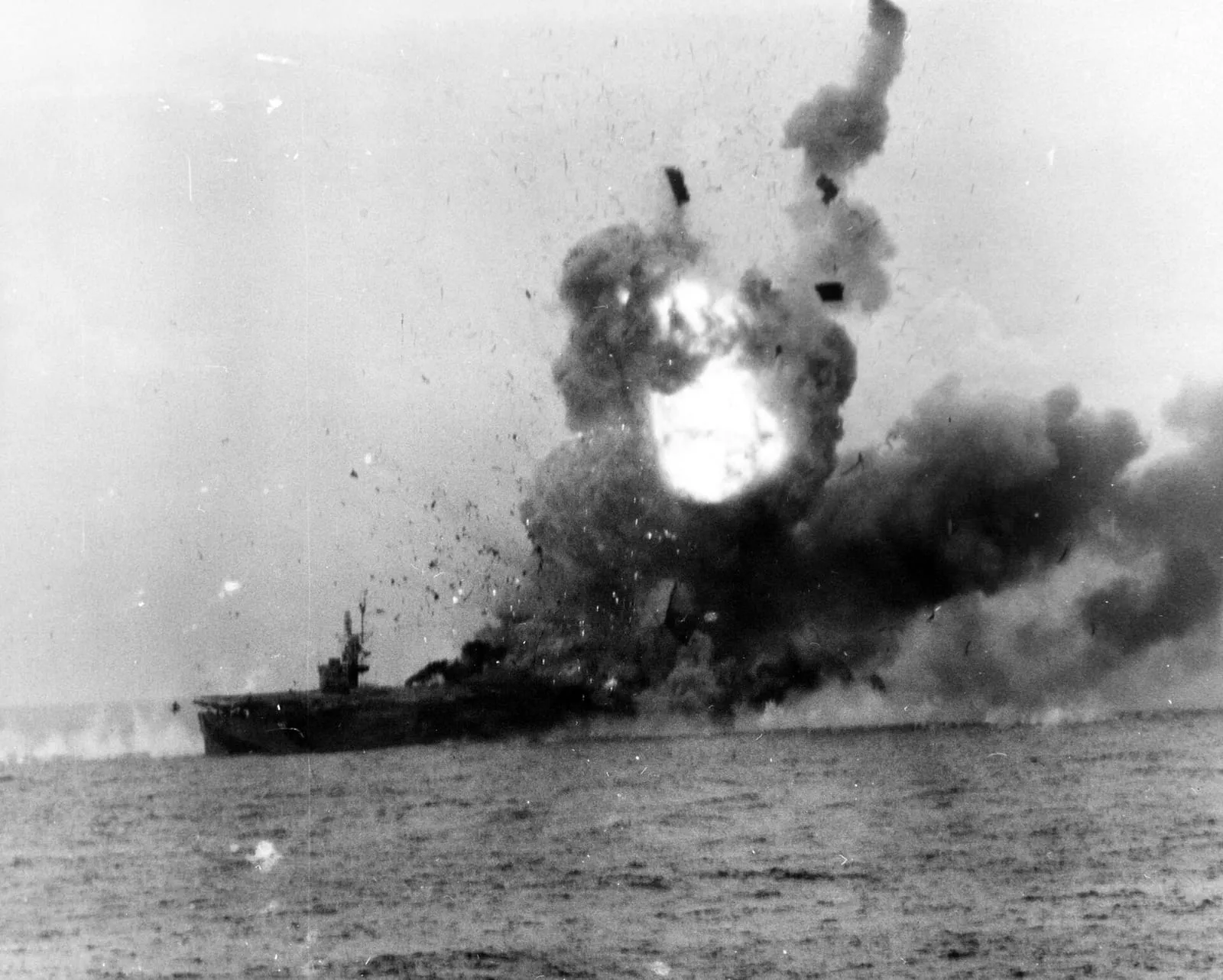
On the morning of 25 October aircraft from Davao on Mindanao attacked Taffy 1, hitting the escort carriers Santee and Suwannee. At about 10.50 a.m., just after the battle off Samar had ended, five bomb-carrying Zero fighters led by Lieutenant Yukio Seki appeared over Taffy 3. One of them crashed into the escort carrier St. Lo; the bomb started fires and explosions in the hangar, and the ship sank within half an hour – the first large warship sunk by a kamikaze attack. The carriers Kitkun Bay, Kalinin Bay and White Plains were also damaged. The effectiveness of these attacks, far greater than that of ordinary air raids, made them the principal method of combat of Japanese aviation in the months that followed.
25 October: Cape Engaño and “Where is Task Force 34?”
At dawn on 25 October Mitscher’s aircraft set off against Ozawa’s carriers east of Cape Engaño, the northern tip of Luzon. Over the course of the day they flew 527 sorties in six waves. The Japanese had barely a dozen or so fighters in the air. The light carrier Chitose sank in the morning, Zuikaku – hit by torpedoes and bombs – in the afternoon, and Zuihō soon after her. Ozawa transferred his flag to the light cruiser Ōyodo. The damaged Chiyoda was finished off in the evening by Rear Admiral Laurance DuBose’s cruisers, which also sank the destroyer Hatsuzuki. During the night the submarine Jallao sank the light cruiser Tama. The hybrid battleship-carriers Ise and Hyūga escaped.
Meanwhile, from 8 a.m. onwards, Halsey had been receiving increasingly desperate calls from Kinkaid, who had learned only at dawn that TF 34 was not guarding the San Bernardino Strait. Halsey replied that McCain’s group was coming to help, but it was hundreds of kilometres from Samar. At about 10 a.m. a signal from Nimitz reached him with the question: “Where is, repeat, where is Task Force 34?” The coders had, as was customary, added random padding words at the end – “the world wonders” – which were not removed. Halsey took the message as a public insult; according to his memoirs, he threw his cap to the deck and for a long time could not regain his composure. At 11.15 a.m., when Lee’s battleships were almost within gun range of Ozawa’s ships, he turned south with them. He arrived too late to cut off Kurita’s line of retreat.
26 October: the pursuit
During the night of 25/26 October Halsey’s force caught only the straggling destroyer Nowaki at the exit from the San Bernardino Strait. During the day aircraft of the Third and Seventh Fleets sank the light cruiser Noshiro from Kurita’s force, as well as the cruiser Kinu and the destroyer Uranami, which had been carrying reinforcements to the west coast of Leyte; American land-based bombers sank the damaged Abukuma. The escort carrier Suwannee was hit by a kamikaze once again. With this the Battle of Leyte Gulf came to an end.
Losses
Tallies of losses differ depending on which ships sunk shortly before and shortly after the battle are counted as part of it. According to the American naval historian Samuel E. Morison, the Japanese lost 26 warships: four carriers (Zuikaku, Zuihō, Chitose and Chiyoda), three battleships (Musashi, Yamashiro and Fusō), six heavy cruisers (Atago, Maya, Chōkai, Chikuma, Suzuya and Mogami), four light cruisers (Noshiro, Abukuma, Tama and Kinu) and nine destroyers – some 300,000 tons in all. By various estimates, between about 10,000 and more than 12,000 Japanese sailors and airmen were killed.
The Americans lost the light carrier Princeton, two escort carriers (Gambier Bay and St. Lo), two destroyers (Johnston and Hoel), the destroyer escort Samuel B. Roberts, the submarine Darter and a PT boat – about 37,000 tons in all – and around 200 aircraft. About 3,000 Americans were killed, most of them in the battle off Samar and aboard Princeton and Birmingham; the Australians also lost several dozen sailors.
Controversies: Halsey and Kurita
Two decisions taken on 24 and 25 October remain controversial to this day. Halsey was accused of having taken the bait, of taking all the battleships north and failing to tell Kinkaid clearly that the San Bernardino Strait had been left unguarded, and then of turning back too late to help the Seventh Fleet and too early for Lee’s battleships to finish off Ozawa. Clifton Sprague later wrote bitterly that he had had no reason to suppose that his northern flank was exposed. In his report and in his memoirs, published in 1947, Halsey himself argued in his defence that Kurita had already been weakened, that the Seventh Fleet had enough strength to stop him, and that destroying the carriers was in line with his orders; he admitted only that turning the battleships round at 11.15 a.m. had been a mistake.
An even greater puzzle is the decision of Kurita, who had the defenceless transports in Leyte Gulf in front of him and turned back. In post-war interrogations and his few public statements he pointed to a report of American carriers to the north, which he had wanted to engage, to the lack of news about the fate of Nishimura and Ozawa, to the incessant air attacks and to his belief that the transports had already left. Historians add his exhaustion after three days of fighting and his swim in the sea on 23 October, the confusion that followed the loss of his flagship, and his conviction that he had been fighting fast fleet carriers. According to many researchers, the report he spoke of has never been found in Japanese records.
Significance
The Battle of Leyte Gulf ended in a decisive American victory, although opportunities missed on both sides made it less complete than it might have been. The Japanese plan failed at every point: Ozawa’s decoy worked, but Kurita did not exploit the open road, and the southern forces were destroyed in the Surigao Strait. The American troops on Leyte kept their seaborne supplies, and the fighting ashore went on until the end of December 1944; in January 1945 the Americans landed on Luzon.
The Japanese navy suffered the heaviest losses in its history and ceased to exist as a force capable of conducting independent operations. The surviving ships, short of fuel and aircraft, returned to bases in Japan and Singapore; many of them were later sunk by aircraft and submarines. The fleet’s last major operation was Yamato’s suicide sortie towards Okinawa in April 1945. The loss of the Philippines, moreover, cut Japan off from the oil of the Dutch East Indies. The Battle of Leyte Gulf also marked the beginning of the kamikaze war, which in the last months of the war cost the US Navy several thousand dead and influenced American estimates of the cost of invading Japan.