1940–1943: The North African campaign
Battle of the Mareth Line
- Dates:
- 20–28 March 1943
- Front:
- Mediterranean
- Location:
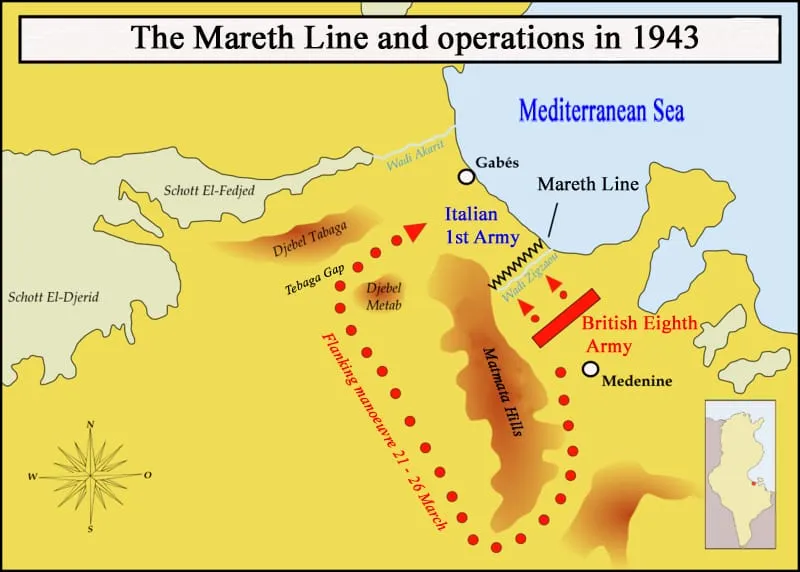
- Southern Tunisia (French protectorate): the Mareth Line fortifications along the Wadi Zigzaou, from the coast of the Gulf of Gabès to the Matmata Hills, and the Tebaga Gap between the Matmata Hills and Jebel Tebaga, with the road to El Hamma and GabèsOn the battle map →
- Sides:
- United Kingdom, New Zealand, British India and Free FranceBernard Law Montgomery, Oliver Leese, Bernard Freyberg, Brian HorrocksItaly and Nazi GermanyGiovanni Messe, Hans-Jürgen von Arnim
- Result:
- Allied victory. XXX Corps' frontal assault across the Wadi Zigzaou was repulsed, but the outflanking move through the Tebaga Gap (Operation Supercharge II) forced the Italian First Army to abandon the Mareth Line on 27–28 March. The Axis forces withdrew in good order to the Wadi Akarit, losing some 7,000 prisoners.
- Author:
- Łukasz
The Battle of the Mareth Line was the last great battle that the British Eighth Army fought in Africa to a carefully prepared plan. At the end of March 1943 Bernard Law Montgomery attacked the old French fortifications in southern Tunisia, behind which General Giovanni Messe’s Italian-German First Army stood on the defensive. It was Eighth Army’s first major attack since the Second Battle of El Alamein four and a half months earlier, and at the same time an important episode of the Tunisian campaign.
The battle did not go as planned. The frontal assault across the deep ravine of the Wadi Zigzaou, which was meant to shatter the Axis defence, stuck fast in the mud and was thrown back by a German armoured counter-attack. The decision came only with the outflanking of the line from the west: General Bernard Freyberg’s New Zealanders, reinforced by an armoured division and supported by air power on an unprecedented scale, broke through the Tebaga Gap on 26 March and threatened to cut off Messe’s entire army. Messe, however, managed to withdraw to a new position on the Wadi Akarit, so Montgomery won the battle but did not destroy his opponent.
Name and dates
The battle is known as the Battle of the Mareth Line or the Battle of Mareth; the British usually speak of the Battle of the Mareth Line, while the New Zealanders treat the fighting in the Tebaga Gap as a battle in its own right. It comprised two operations: the frontal Operation Pugilist against the fortifications on the Wadi Zigzaou, and the outflanking move through Tebaga, whose decisive stage was code-named Supercharge II – a reference to Operation Supercharge, which had decided the Battle of El Alamein in November 1942.
The battle’s time frame is defined in various ways. Preliminary attacks on the approaches to the line began on the night of 16–17 March, and the New Zealand corps had set out on its outflanking march several days earlier still. The main assault on the line began on the evening of 20 March. Some studies end the battle on 26 March, the day of the breakthrough at Tebaga, others on 31 March, when Montgomery formally closed Operation Supercharge II, and others again include the capture of Gabès on 29 March. The battle is usually framed as 20–28 March 1943: from the evening assault across the Wadi Zigzaou to the day on which Messe ordered the Mareth Line abandoned and his troops escaped the threat of encirclement. The rearguard actions at El Hamma and the march on Gabès belong to the pursuit, which led to the Battle of Wadi Akarit at the beginning of April.
Background
After the defeat at El Alamein, Erwin Rommel’s army retreated across the whole of Libya. Eighth Army took Tripoli on 23 January 1943, and in February Rommel took up position on the Mareth Line – a belt of French fortifications built in the 1930s against the Italians. The Mareth Line closed off the coastal plain between the Gulf of Gabès and the Matmata Hills and ran along the Wadi Zigzaou – a dry riverbed with steep banks, in places more than ten metres high, which formed a natural anti-tank ditch. The French judged the desert plateaux of the Jebel Dahar west of the hills impassable to vehicles and did not extend the fortifications there. At the northern end of the Matmata Hills, however, a route from the desert led through the Tebaga Gap, between the hills and the Jebel Tebaga range, towards El Hamma and Gabès – straight into the rear of the line.
The Axis had occupied Tunisia after the Allied landings in North Africa in November 1942. In the north it fought the Americans, British and French, and in February 1943 it inflicted a painful defeat on the Americans in the Battle of the Kasserine Pass. In the south, facing Eighth Army, stood Messe’s Italian First Army, formed from the troops that had retreated with Rommel across Libya. The line was manned by the Italian divisions “Giovani Fascisti”, “Trieste”, “Pistoia” and “La Spezia”, interspersed with the German 90th Light Division and 164th Light Division. The 15th Panzer Division stood in reserve, and the Tebaga Gap was guarded by the weak Italian Saharan Group. By British estimates Messe had some 85,000 men in all, more than half of them Germans, about 440 guns and fewer than 150 tanks. By the same estimates Eighth Army had more than 700 serviceable tanks and nearly 700 guns before the battle.
The Axis command in Tunisia underwent major changes in March. Rommel, commander of Army Group Africa since February, made one more attempt on 6 March to disrupt Montgomery’s preparations in the Battle of Medenine. Forewarned by signals intelligence, the British awaited him behind a dense screen of anti-tank guns, and the attack by three panzer divisions collapsed, costing the Germans, according to various sources, about 50 tanks. Three days later the sick and exhausted Rommel flew to Europe and never returned to Africa. Hans-Jürgen von Arnim took over the army group, and the defence of the Mareth Line was directed by Messe – a general who had previously commanded an Italian corps in the Soviet Union and had no illusions about the balance of forces.
Montgomery’s plan
From the outset Montgomery intended two blows. Lieutenant General Oliver Leese’s XXX Corps was to break through the line near the coast, in the Zarat area, where the 50th (Northumbrian) Division was to cross the Wadi Zigzaou and the sappers were to prepare crossings for the tanks. At the same time the 2nd New Zealand Division, reinforced by the British 8th Armoured Brigade, artillery and Free French units and renamed the New Zealand Corps, was to outflank the fortifications from the west across the desert and strike through the Tebaga Gap at El Hamma and Gabès. A route through the hills had already been found in January by patrols of the Long Range Desert Group; the pass it used was named Wilder’s Gap after the patrol commander. Montgomery could also draw on the advice of General Georges Catroux, who before the war had directed the construction and manning of the line and was now in Algiers.
The western flank was covered by General Philippe Leclerc’s Free French column, which after its march from Chad through the Fezzan had taken the name Force L. The Greek Sacred Band also served in its ranks. As early as 10 March, at Ksar Ghilane, the French beat off an attack by a German detachment from the 90th Light Division that had been sent to reconnoitre and remove the threat to the Axis western flank.
The Americans were also brought into the plan. II Corps, rebuilt after Kasserine and commanded since 6 March by George Patton, was to advance from central Tunisia through Gafsa and El Guettar towards the coast, threatening the communications of Messe’s army and drawing its reserves. The whole was overseen by Harold Alexander, commander since February of the 18th Army Group, to which both British armies and the Americans were subordinate.
Course of the battle
Preparations and preliminary attacks
The New Zealand Corps left the Medenine area on 11 March and within a few days had assembled, concealed, in the desert south of the line. On the night of 16–17 March the divisions of XXX Corps drove the Axis outposts off the approaches, although the British Guards suffered heavy losses in the minefields of the hills the British called the Horseshoe. On the night of 19–20 March the New Zealanders passed through Wilder’s Gap. They had intended to march only by night, but on 20 March, when their columns were spotted by Axis air reconnaissance, Freyberg was ordered to keep moving by day as well. Messe thus learned of the threat from the west and began to strengthen the Tebaga Gap.
Operation Pugilist – the assault across the Wadi Zigzaou (20–23 March)
XXX Corps’ main assault opened at 9.45 p.m. on 20 March with the fire of several hundred guns; the infantry went in before midnight. The infantry of the 151st Brigade of the 50th Division – battalions of the Durham Light Infantry – crossed the Wadi Zigzaou with scaling ladders and fascines and by dawn had taken several strongpoints, including Ouerzi and Ksiba Ouest, held by Italians of the “Giovani Fascisti” Division. The trouble began with getting the tanks across. The sappers were to blow down the steep side of the ravine, and the Valentine infantry tanks of the 50th Royal Tank Regiment were to drive down to the bottom, drop fascines into the water and climb out on the far bank. But the bed proved soft: the first tank bogged down and blocked the crossing, and the rest began to dig themselves in under artillery fire. By dawn only four tanks had reached the far bank.
Throughout 21 March the infantry in the bridgehead beat off counter-attacks by the Italians and the German 90th Light Division. The following night the British widened the breach and several dozen more tanks crossed the ravine, but the anti-tank guns and wheeled vehicles could not follow: the churned-up crossings turned to mud, and rain partly filled the wadi with water. The rain also grounded the air forces. On 22 March Messe threw the 15th Panzer Division into a counter-attack. Its tanks and anti-tank guns destroyed most of the Valentines in the bridgehead – British sources speak of about 35 – and the infantry was pushed back to the edge of the ravine, losing several hundred men, including about 200 prisoners.
On the night of 22–23 March the commander of the 50th Division, General John Nichols, concluded that the bridgehead would not survive another day. Leese woke Montgomery before dawn on 23 March and explained the situation. Montgomery agreed to a withdrawal, and on the night of 23–24 March the surviving men and tanks returned to the southern bank of the Wadi Zigzaou. The frontal assault on the Mareth Line had failed.
The left hook – the New Zealanders at Tebaga (21–25 March)
The New Zealand Corps reached the entrance to the Tebaga Gap on 21 March, later than planned, because the terrain proved more difficult than the scouts had judged. On the night of 21–22 March, with artillery support, New Zealand battalions took the Saharan Group’s positions by the old Roman wall that cut across the gap and captured several hundred Italian prisoners. For a moment the way opened for the tanks, but the headquarters of the 8th Armoured Brigade was unwilling to attack in the dark, and by morning the first German units had arrived at Tebaga. Messe had managed to move the 164th Light Division and the 21st Panzer Division there. Over the following days the New Zealanders held the entrance to the gap but could not break through the ever stronger defence.
The failure on the Wadi Zigzaou forced Montgomery to change his plan – and it was this decision that settled the outcome of the battle. On 23 March he decided to shift the weight of the attack to the western flank. The headquarters of Lieutenant General Brian Horrocks’s X Corps and the 1st Armoured Division, which had been waiting in reserve for the breakthrough, set off on the night of 23–24 March on a roundabout route across the desert to join the New Zealanders. Horrocks was to take charge of the fighting at Tebaga, which caused friction with Freyberg, his senior in rank and experience. On the Mareth front, meanwhile, XXX Corps was to keep up the pressure, and General Francis Tuker’s 4th Indian Division was to strike through the Matmata Hills at the western flank of the fortifications.
On the Axis side uncertainty reigned. As late as 24 March Arnim doubted that Eighth Army could muster a fresh attack, and was more worried about Maknassy, where Patton’s Americans were attacking, than about Tebaga. On 25 March, however, he concluded that the First Army could not hold the Mareth Line and ordered a withdrawal to the Wadi Akarit to begin, starting with the slow-moving Italian infantry divisions. Messe and the commander of the 164th Division, General Kurt von Liebenstein, would have preferred to counter-attack at Tebaga first, but the threat from the Americans and the New Zealand outflanking move left them no choice.
Operation Supercharge II – the breakthrough at Tebaga (26–28 March)
The new attack was prepared to surprise the defenders by its timing and its weight of fire. On the night of 25–26 March the New Zealand 21st Battalion took Point 184, which overlooked the approaches. British bombers attacked Axis transport and communications all night. The main blow was planned for the late afternoon of 26 March, when the sun would be in the defenders’ eyes and the wind would carry clouds of dust over their positions. For two and a half hours before the assault Eighth Army’s tactical air force (the Desert Air Force) flew continuous sorties: every quarter of an hour a fresh wave of fighter-bombers – Kittyhawks and Hurricanes armed with anti-tank cannon – arrived over the battlefield, strafing and bombing gun positions and tanks from low level under the cover of Spitfires. Targets were marked with coloured smoke, and forward air officers directed the pilots from the ground. The British had never before used such close cooperation between air and ground forces; the plan was pushed through by the commander of the Desert Air Force, Air Vice-Marshal Harry Broadhurst, against the doubts of some air commanders, among them Arthur Coningham, commander of the Allied tactical air forces in Tunisia, who disliked using fighters as “flying artillery”.
At 4 p.m. the artillery barrage of the New Zealand Corps and X Corps began. The attack was led by the Sherman, Grant and Crusader tanks of the 8th Armoured Brigade, followed by carriers and the New Zealand infantry of the 5th and 6th Brigades – as well as the 28th (Māori) Battalion. The defenders of the 164th Light Division and 21st Panzer Division had not expected an attack in broad daylight and were taken by surprise. By nightfall the attackers had driven some 6 kilometres into the defences; in the fighting for Point 209, Second Lieutenant Moana-Nui-a-Kiwa Ngarimu of the Māori Battalion captured one of its summits and held it all night against counter-attacks; he was killed on the morning of 27 March and posthumously awarded the Victoria Cross. After moonrise, at about 11 p.m., General Raymond Briggs’s 1st Armoured Division passed through the breach and drove on through the night towards El Hamma, some 30 kilometres further on, halfway to the coast.
On the morning of 27 March the 15th and 21st Panzer Divisions counter-attacked the New Zealanders’ right flank but had been beaten off by 9 a.m. The British tanks, however, were stopped short of El Hamma by a screen of German anti-tank guns, including 88 mm guns. Freyberg persuaded Horrocks that the New Zealanders should not follow the armoured division but should turn across difficult country directly towards Gabès. The dispute over the direction of the advance, sandstorms and minefields slowed the pursuit, however. Messe exploited the delay: on 27 and 28 March his troops abandoned the Mareth Line, while the German divisions, holding out at El Hamma, covered the retreat. By 28 March the First Army had slipped out of the encirclement that threatened it and was falling back to the position on the Wadi Akarit.
Losses
Figures for losses are incomplete and calculated in different ways, depending on how the battle is framed. According to British studies, from the preliminary attacks to the close of Operation Supercharge II on 31 March Eighth Army lost about 4,000 killed, wounded and missing, a large part of them from the 50th Division, which had bled itself white on the Wadi Zigzaou, as well as several dozen tanks. According to New Zealand sources the New Zealand Corps alone lost 945 men and 51 tanks.
Axis losses in killed and wounded are not known precisely. By 28–29 March the Allies had taken about 7,000 prisoners; according to some sources about 2,500 of them were Germans, according to others the majority. The hardest hit were the 164th Light Division, which lost most of its weapons and vehicles at Tebaga, the 15th Panzer Division and the Italian divisions “La Spezia”, which lost nearly half its strength, and “Pistoia”, which was almost destroyed. After the battle several Italian divisions had to be merged. The German 90th Light Division came out of the fighting relatively intact.
Significance
The Battle of the Mareth Line ended in an Allied victory, but not the kind Montgomery had wanted. His plan had been to destroy the First Army on the Mareth Line and march on Sfax; instead Messe’s army, though seriously weakened, withdrew in good order, and on 29 March, as the New Zealanders entered Gabès, it was already occupying the position on the Wadi Akarit – the last natural barrier between the salt lakes (chotts) and the sea. Eighth Army had to storm it at the beginning of April, and then again at Enfidaville.
For the British the battle was nonetheless an important lesson. Montgomery, often accused of rigidity, showed that after a setback he could quickly shift the weight of his attack to where the defence was weaker. The breakthrough at Tebaga became a model of cooperation between ground forces and tactical air power: the methods worked out in Tunisia – standing patrols of fighter-bombers over the battlefield, marking targets with smoke, air force officers attached to ground units – were later used by the British and Americans in Italy and France. At the same time the dispute between Freyberg and Horrocks and the slow pursuit showed that the British Army still could not fully exploit a breakthrough.
The loss of the Mareth Line sealed the fate of the Axis forces in Africa. In April Eighth Army made contact with the Americans advancing from the west, and the two Axis armies were squeezed into an ever smaller bridgehead in north-eastern Tunisia, cut off from supplies by Allied aircraft and warships. The Tunisian campaign ended on 13 May 1943 with the surrender of some 250,000 German and Italian troops, among them Arnim and Messe, whom Mussolini had just made a Marshal of Italy. Two months later the Allies landed in Sicily.