1940–1943: The North African campaign
Battle of the Kasserine Pass
- Dates:
- 14–24 February 1943
- Front:
- Mediterranean
- Location:
- Central Tunisia (French protectorate): the plain between the Eastern and Western Dorsals with Sidi Bou Zid, Sbeitla and Gafsa, the Kasserine and Sbiba passes, and the roads to Thala and to Tébessa in AlgeriaOn the battle map →
- Sides:
- United States, United Kingdom and FranceDwight Eisenhower, Harold Alexander, Kenneth Anderson, Lloyd FredendallNazi Germany and ItalyErwin Rommel, Hans-Jürgen von Arnim, Albert Kesselring
- Result:
- Tactical Axis victory without a strategic decision. The Germans and Italians routed the US II Corps and drove the Allies off the Eastern Dorsal, but, halted at Sbiba, Thala and Djebel el Hamra, they withdrew behind the Kasserine Pass by 24 February. The Americans lost some 6,000 men and nearly 200 tanks, the Germans about 1,000 men.
- Author:
- Łukasz
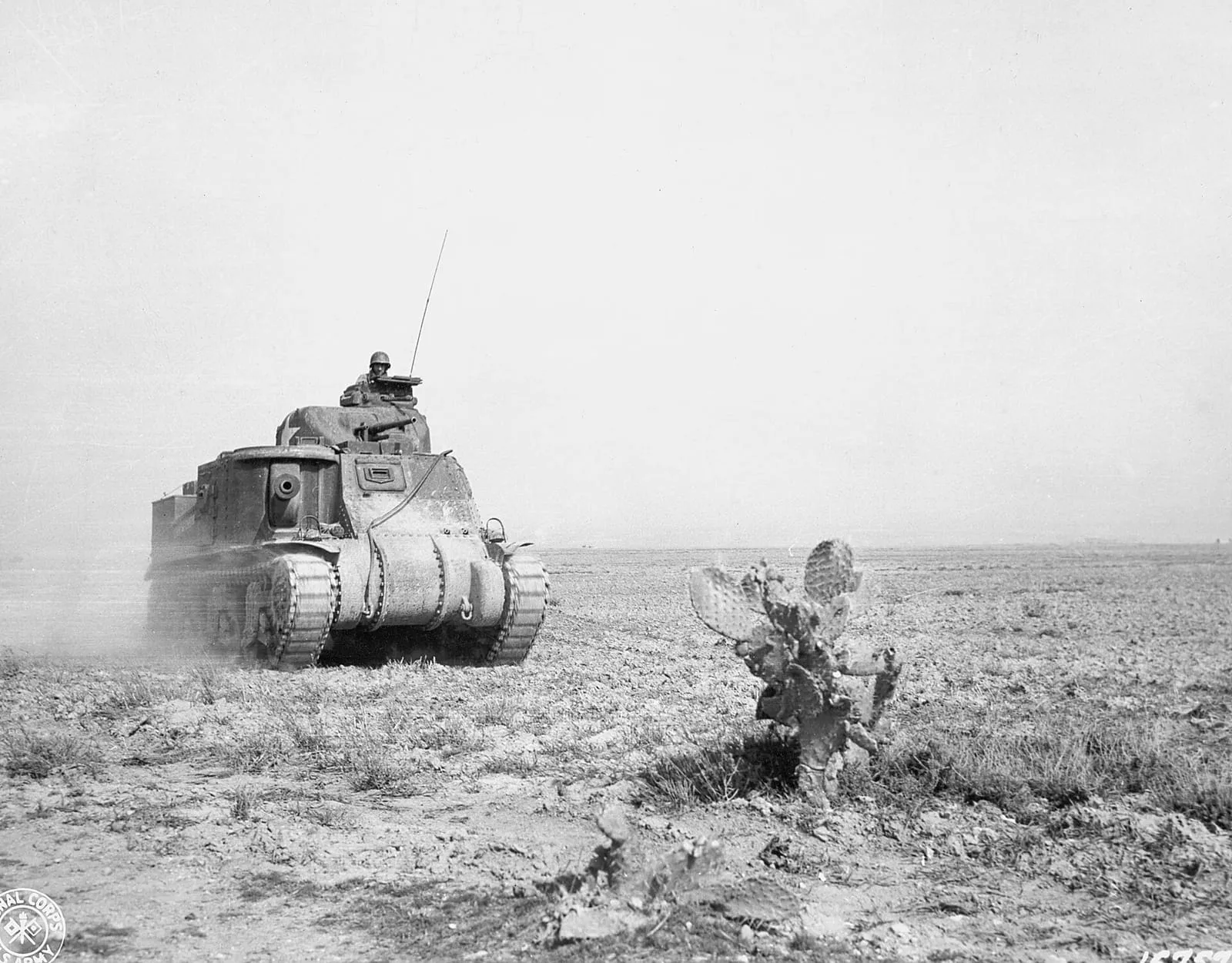
The Battle of the Kasserine Pass was the US Army’s first major clash with the Germans in the Second World War and its most painful defeat of the entire Tunisian campaign. In ten days of February 1943 two German panzer divisions from the north and an Afrika Korps battle group from the south shattered the American II Corps in central Tunisia, seized the Allies’ former positions on the plain between two mountain ranges and pushed westwards through the Kasserine Pass. Field Marshal Erwin Rommel hoped to strike at the Allied rear and force them to abandon the whole of Tunisia. He could not, however, break through the last defensive positions at Sbiba, Thala and Djebel el Hamra, and on 22 February he called off the attack. By 24 February the Axis forces had withdrawn behind the pass, having lost little but gained nothing lasting.
For the Americans it was a harsh school of war. Scattered units, inexperienced commanders and mistrust between the Allies cost them several thousand men and most of the tanks of an armoured division. The lessons drawn from the defeat – new commanders, a new command structure and a reform of training – shaped the US Army for the rest of the war.
Name and dates
The battle takes its name from a pass in the Western Dorsal, a narrow gap in the mountains about three kilometres wide near the small town of Kasserine, in Arabic Al-Qasrayn. In the strict sense the Battle of the Kasserine Pass means the fighting of 19–24 February 1943: the attack on the pass itself and on the neighbouring Sbiba Pass, the breakthrough of 20 February, the advance on Thala and towards Tébessa, and the Axis withdrawal. Many studies give these dates, while some accounts extend the battle to 25 February, when the Allies reoccupied the pass.
A broader definition, common in American writing, which speaks of the “Kasserine Pass battles”, covers the whole Axis February offensive in central Tunisia from 14 February, when German panzer divisions struck the American positions at Sidi Bou Zid in Operation Frühlingswind (Spring Wind) and Rommel’s battle group set off for Gafsa in Operation Morgenluft (Morning Air). This fighting, which lasted until 17 February, is also described separately as the Battle of Sidi Bou Zid, but without it the course and scale of the defeat at the Kasserine Pass make no sense: it was at Sidi Bou Zid that the Americans lost most of their tanks and the Axis won the ground from which it then struck west. The battle is taken to have ended on 24 February, when the last German and Italian units withdrew eastwards through the pass under attack from Allied aircraft.
Place names appear in several versions in the sources. The French forms – Sbeitla, Gafsa, Fériana, Thala, Le Kef, Tébessa – became established in the literature of the war; modern transcriptions from the Arabic differ.
Background
After the Allied landings in Morocco and Algeria in November 1942, the Axis powers rushed troops to Tunisia, which in December halted the Allied advance on Tunis. Around the turn of the year the front froze along the mountains. In Tunisia the Atlas splits into two ranges: the Eastern Dorsal, running roughly parallel to the coast, and the Western Dorsal, closer to the Algerian border. Between them lies a high, dry plain with the small towns of Sidi Bou Zid, Sbeitla and Kasserine. Whoever held the passes of the Eastern Dorsal could descend to the coastal plains towards Sousse and Sfax and cut the only road linking the Axis forces in the north with Rommel’s army, which was retreating from Libya.
On the Allied side the northern part of the front was held by the British First Army under General Kenneth Anderson. In the centre stood the poorly armed French XIX Corps of General Louis-Marie Koeltz, subordinate to General Alphonse Juin; the French had old guns and almost no anti-tank weapons. In the south the American II Corps of General Lloyd Fredendall was deployed, with General Orlando Ward’s 1st Armored Division and elements of the 1st and 34th Infantry Divisions. The chain of command was tangled. Only at the end of January was Anderson given the task of coordinating the whole front, while General Dwight Eisenhower, Allied commander-in-chief in North Africa since 1942, meddled in the deployment of units from distant Algiers. Fredendall ran his corps from a bunker hewn into the rock near Tébessa, far behind the front; he rarely visited the front line and issued detailed orders by telephone, often in a jargon his subordinates could not understand. The 1st Armored Division was split into combat commands (Combat Commands A, B and C) scattered over more than a hundred kilometres, and the infantry was placed on isolated hills that could not support one another.
Nor did the Axis forces have a single commander. In the north General Hans-Jürgen von Arnim was in command, with the staff of the Fifth Panzer Army. In the south Rommel, who after the defeat at El Alamein and the loss of Tripoli had settled his German-Italian army on the Mareth Line, was awaiting the arrival of the British Eighth Army. At the end of January Rome informed him that he would be recalled on health grounds and that his army would pass to General Giovanni Messe. Both commanders took their orders from the Italian Comando Supremo, at whose head General Vittorio Ambrosio replaced the dismissed Marshal Ugo Cavallero on 1 February. Overseeing the whole was Field Marshal Albert Kesselring, German Commander-in-Chief South, who nevertheless had no direct power of command. Arnim and Rommel disliked and distrusted each other.
At the end of January the Axis wrested part of the Eastern Dorsal from the Allies. On 30 January the 21st Panzer Division routed the French at the Faïd Pass, and the belated, badly handled counter-attacks of the American 1st Armored Division broke down in front of German anti-tank guns. The pass stayed in German hands, but the Americans still held the plain behind it and could at any moment strike towards the sea.
At the beginning of February Rommel proposed to forestall that blow. He wanted to gather both of Arnim’s panzer divisions and his own mobile units, smash the inexperienced Americans and then strike at their depots and airfields around Tébessa, already on Algerian territory. Arnim preferred a limited attack on Sidi Bou Zid that would improve his own positions. Comando Supremo agreed to a compromise: Arnim was to carry out Operation Frühlingswind through the Faïd and Maizila passes against Sidi Bou Zid, and Rommel, with the Afrika Korps battle group and Italian units, Operation Morgenluft against Gafsa. No further objectives were set, and each of the two groups answered to a different commander. This lack of clarity was to weigh on the entire battle.
The Allies knew from decrypted signals that the Axis was preparing an attack, but intelligence at Eisenhower’s headquarters wrongly concluded that the main blow would fall further north, at Fondouk. The reserves were sent there, while at Sidi Bou Zid the scattered groups of the American division waited. As late as 13 February Eisenhower toured the front and visited the positions at Sidi Bou Zid; he left them a few hours before the attack.
Course of the battle
Sidi Bou Zid and Gafsa (14–17 February)
The attack at Sidi Bou Zid in Operation Frühlingswind was led by Arnim’s deputy, General Heinz Ziegler. At four in the morning on 14 February, in a sandstorm, four German battle groups from the 10th and 21st Panzer Divisions, some 140 tanks in all, including a dozen or so heavy Tigers, emerged from the Faïd and Maizila passes. The columns of the 10th Division swung round the hill of Djebel Lessouda from the north, while those of the 21st Division wheeled round from the south and west. Combat Command A, which tried to counter-attack, was smashed within a few hours; according to German reports 44 American tanks, 59 half-tracks and 26 guns were destroyed. In the evening the Germans took Sidi Bou Zid, and two battalions of Colonel Thomas Drake’s 168th Infantry Regiment and a detachment on Djebel Lessouda were cut off on the hills. Fredendall forbade them to withdraw and promised relief.
The relief came on 15 February and ended in disaster. Colonel James Alger’s Combat Command C advanced across the flat, open plain straight at Sidi Bou Zid, like a textbook cavalry charge. Under air attack, it drove between two German panzer divisions and their anti-tank guns. Of the tank battalion’s 52 M4 Shermans six survived, and Alger himself was taken prisoner. The cut-off infantry tried to break out westwards on the night of 16–17 February; most of the men, Drake among them, were captured.
In the south Anderson decided that Gafsa could not be held and on the night of 14–15 February ordered it evacuated. On 15 February the Afrika Korps battle group entered the town without a fight, and on 17 February it took Fériana and the airfield at Thélepte, where the Americans had managed to burn the fuel and damaged aircraft. Meanwhile Anderson, with Eisenhower’s approval, ordered a withdrawal from the whole Eastern Dorsal to the line of the Western Dorsal. On the evening of 16 February German tanks reached Sbeitla (Subajtila); during the night panic gripped some American units, but General Paul Robinett’s fresh Combat Command B covered the retreat. On 17 February the Americans abandoned Sbeitla and fell back to the Kasserine and Sbiba passes. The first phase cost II Corps some 2,500 men and more than a hundred tanks.
The dispute over the next move (17–19 February)
The victory at Sidi Bou Zid opened an opportunity for the Axis, but its commanders could not agree on how to exploit it. Ziegler, following Arnim’s cautious instructions, made no move to pursue for a full day after taking the town. Rommel, who had personally toured the battlefield and seen for himself how weak the Americans were, wanted to strike at once and deep: through the Kasserine Pass to Tébessa, where the American fuel and ammunition dumps and the airfield at Youks-les-Bains lay, and from there into the rear of the First Army. Arnim refused to hand over his divisions, as he was planning an attack in the north himself.
On 18 February Rommel put his plan to Kesselring, who backed it and forwarded it to Rome. Comando Supremo’s reply, which arrived on 19 February, was a compromise worse than either proposal. Rommel was given command of the 10th and 21st Panzer Divisions, but he was to strike not at Tébessa but northwards, through the Kasserine and Sbiba passes towards Thala and Le Kef (Al-Kaf), where the attack was bound to run into British reserves. Rommel judged this direction too shallow and too predictable, but obeyed the order. Arnim complied only in part: he kept back the Tiger battalion and part of the 10th Panzer Division. Rommel could therefore commit to the attack only some of the forces he had formally been given.
Kasserine and Sbiba (19–20 February)
On the morning of 19 February the Afrika Korps battle group attacked the Kasserine Pass, and the 21st Panzer Division the Sbiba Pass, a few dozen kilometres to the north-east. At Sbiba the attack bogged down at once. The defenders there were the British 1st Guards Brigade, the American 18th Infantry Regiment of the 1st Infantry Division, battalions of the 34th Infantry Division and French units, supported by strong artillery and minefields. By 20 February the 21st Division had been halted and thrown back.
The Kasserine Pass was defended by an improvised force under Colonel Alexander Stark: a battalion of the 26th Infantry Regiment, the 19th Engineer Regiment, which had never before fought as infantry, and American and French artillery; on the hills to the west stood General Welvert’s Franco-American force. On the first day the defenders held. An attempt by the Afrika Korps reconnaissance unit to take the pass by surprise failed, and the German grenadiers and tanks advanced slowly under artillery fire. During the night, however, the Germans climbed the slopes on both sides of the pass and cut off the American sub-units on the hills.
On 20 February Rommel threw into the fight two battalions of the 10th Panzer Division from Colonel Fritz von Broich’s group and Italian Bersaglieri of the 131st Armoured Division “Centauro”. After a day-long attack in which its commander, Colonel Bonfatti, was killed, the 5th Bersaglieri Regiment captured key positions on the slopes. In the afternoon the defence collapsed: the engineers and infantry fell back in disorder, abandoning their equipment, and German and Italian columns emerged from the pass onto the plain beyond. The British “Gore Force”, sent from Thala to help the defenders, lost all eleven of its tanks. The roads to Thala and to Tébessa lay open.
Thala and Djebel el Hamra (21–22 February)
Beyond the pass the road forked: north towards Thala (Tala), and west along the valley of the Hatab river towards Tébessa. Instead of concentrating his forces, Rommel struck in both directions at once. On 21 February the Afrika Korps battle group set off towards Tébessa, but at Djebel el Hamra it ran into General Robinett’s Combat Command B and the 16th Infantry Regiment of General Terry Allen’s 1st Division. The attack broke down, and on 22 February, when the Germans and Italians renewed their assault towards the Bou Chebka Pass, the Americans launched a counter-attack that threw them back and took more than 400 prisoners.
The heaviest fighting took place on the road to Thala. Rommel himself led the main body of the 10th Panzer Division there. The British 26th Armoured Brigade under Brigadier Charles Dunphie, together with the remnants of the American 26th Infantry Regiment, fought from ridge to ridge, paying for every hour with dozens of tanks. The Germans used a captured British Valentine, which drove into the British positions at the head of a column. On the evening of 21 February the attack came to a halt just short of the town. During the night the artillery of the American 9th Infantry Division reached Thala – 48 guns that had driven some 1,300 kilometres from Morocco since 17 February. Anderson ordered it to continue to Le Kef, but General Ernest Harmon, sent to the front by Eisenhower, held it at Thala.
On the morning of 22 February massed fire from British and American guns, directed by General Stafford LeRoy Irwin, pre-empted the renewal of the German attack, destroying tanks and vehicles and cutting communications. Broich halted the attack, while more reinforcements kept reaching the Allies. That same day Rommel concluded that his forces were spent: fuel and ammunition were short, the attack had stalled at Sbiba, Thala and Djebel el Hamra, and in the south General Bernard Montgomery’s Eighth Army was approaching the Mareth Line.
The withdrawal (22–24 February)
On the afternoon of 22 February Kesselring and his chief of staff, General Siegfried Westphal, arrived at Rommel’s headquarters near Kasserine. They tried to persuade him that the attack still had a chance, but Rommel would not agree and Kesselring eventually gave way; some studies date this meeting to 23 February. Comando Supremo formally called off the offensive, ordering a return to the starting positions. The Axis forces withdrew efficiently, mining the roads and blowing up bridges, but on 23 and 24 February, as the weather improved, American aircraft bombed their columns around Fériana and the pass. The Allies, wary after their recent defeats, followed only after a delay. By the evening of 24 February the last Axis units had left the pass, and American patrols entered it that same day and the following morning. Over the next few days the Allies recovered Fériana, Sbeitla and Sidi Bou Zid, but the Eastern Dorsal, with the Faïd Pass, remained in Axis hands.
Losses
Figures for losses are incomplete and vary with the source and with whether one counts only the fighting for the pass or the whole offensive from 14 February. For the US II Corps the most commonly cited figures, following the official army history, are about 300 killed, about 3,000 wounded and about 3,000 missing and captured; some 7,000 men had to be sent to bring the units back up to strength. The Sidi Bou Zid phase alone (14–17 February) cost, by American reckoning, 2,546 men and 103 tanks. In a summary report of 24 February the Germans claimed 4,026 prisoners. II Corps’ equipment losses over the whole battle are estimated at 183 tanks, 104 half-tracks, 208 guns and more than 500 motor vehicles; the Germans captured some of these and used them for a time. Stocks of fuel and ammunition also fell into their hands.
The British 26th Armoured Brigade lost several dozen tanks at Thala, and the French 34th Division – according to French figures – about 50 killed, 200 wounded and 250 missing. German losses in the fighting for Kasserine amounted, according to German reports, to 201 killed, 536 wounded and 252 missing – just under a thousand men – as well as 20 tanks; Italian losses were not compiled as precisely. The Allies took 73 Germans and 535 Italians prisoner.
Significance
Rommel won a tactical success but achieved nothing strategically. He took neither Tébessa nor its depots, did not force the Allies out of Tunisia and lost time that he needed in the south. The dispute with Arnim and the orders from Rome, which scattered the attack in several directions, showed how badly the Axis command in Africa worked. An attempt to remedy this was the creation on 23 February of Army Group Africa under Rommel, with Arnim and Messe as army commanders. Rommel now turned against Eighth Army, but his attack at Medenine on 6 March 1943 broke on the prepared defences of Montgomery, who had been forewarned by decrypted signals. Three days later Rommel left Africa for good, and in May the Axis forces in Tunisia surrendered.
For the Allies the defeat became a turning point in command. Under decisions taken at the Casablanca Conference, General Harold Alexander took command on 19–20 February, in the very middle of the battle, of the new 18th Army Group, which brought together the British First and Eighth Armies and the American and French forces in Tunisia, while Eisenhower kept supreme command over the whole theatre. Alexander was shocked by the disorder he found and for the first few weeks did not trust American units. Eisenhower, who himself admitted his mistakes, replaced his chief of intelligence and on 6 March removed Fredendall; command of II Corps passed to General George Patton, with General Omar Bradley as his deputy. Fredendall returned to the United States, where he trained troops. General Ward soon lost his post as well. Historians lay part of the blame on Anderson, who had dispersed the forces of the 1st Armored Division and reacted too late to the coming attack.
The most important outcome was the lessons learned by the army as a whole. The Americans began to use their armoured divisions as concentrated formations rather than in scattered groups, moved command posts closer to the front, and learned to dig deep foxholes, to concentrate artillery fire and to cooperate better with the air forces. The training programme at home was changed. Years later Bradley called the battle the worst performance by the US Army in its history, yet as early as March and April II Corps fought far more effectively at El Guettar. Rommel, who had previously looked down on the Americans, later acknowledged that they learned mobile warfare quickly. The experience of Kasserine proved its worth in Sicily, Italy and Normandy.