- Category:
- Military operations
- Front:
- Mediterranean
- Date:
- 8 November 1942
- Author:
- Łukasz
- Battle:
- Operation Torch
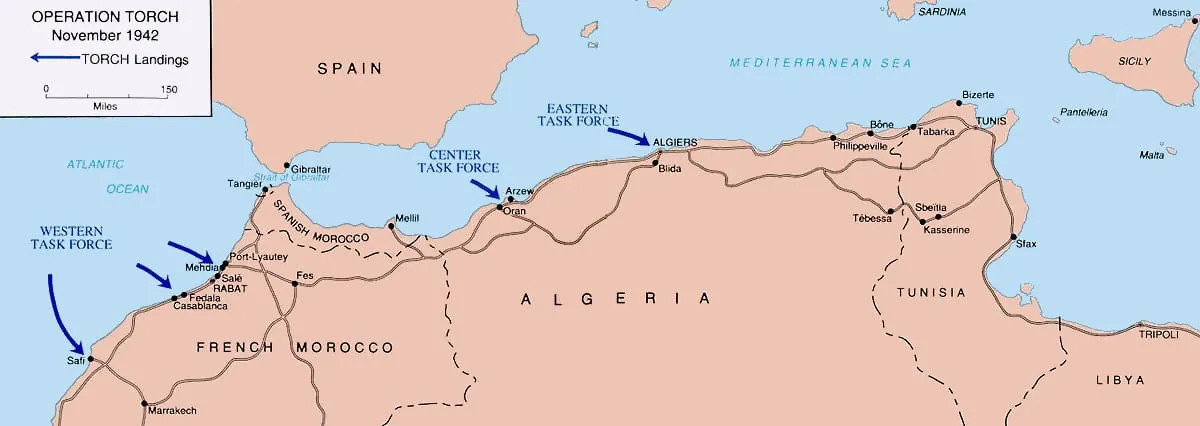
On the night of 7/8 November 1942 several hundred warships and merchant ships appeared off the coast of French North Africa. Before dawn American and British soldiers began to come ashore on the beaches of Morocco and Algeria. Operation Torch had begun – the first great joint offensive of the Western Allies and the first landing by the US Army on the far side of the Atlantic. A first wave of more than seventy thousand men was put ashore simultaneously at three widely separated points, and in the following days and weeks their numbers grew rapidly.
The enemy that day was neither the Germans nor the Italians, but the French. Morocco, Algeria and Tunisia were subject to the Vichy government of Marshal Philippe Pétain, which after the armistice of 1940 had kept an army of some 120,000 men there, as well as an air force and part of the fleet. The Allies were counting on the French not to fire on the Americans, or at least not for long. That hope was only partly fulfilled.
The plan and the forces
The decision to land was taken in the summer of 1942, after a long dispute between the Americans, who wanted to strike at France as soon as possible, and the British, who were convinced that it was still too early for that. The Supreme Commander of the expedition was Lieutenant General Dwight Eisenhower, who on 5 November moved his command post into the tunnels beneath the Rock of Gibraltar. From there, with poor communications, he followed the course of the landings.
The forces were divided into three task forces. The Western Task Force, entirely American, with about 35,000 men under Major General George Patton, sailed straight from Virginia with Rear Admiral Henry Kent Hewitt’s fleet. It was to land at three points on the Atlantic coast of Morocco and take Casablanca. The Centre Task Force, with about 18,500 Americans under Major General Lloyd Fredendall, sailed from Britain under the protection of the Royal Navy and was to take Oran. The Eastern Task Force, with about 20,000 American and British troops, carried by the fleet of Vice Admiral Harold Burrough, was to seize Algiers. Until the city was taken it was commanded by the American Major General Charles Ryder; after that command was to pass to the British General Kenneth Anderson and his First Army, destined for the march on Tunisia. The convoys put to sea at the end of October and crossed the Atlantic and passed through the Strait of Gibraltar unnoticed by the U-boats.
For political reasons the expedition was meant to look American. After Mers-el-Kébir and Dakar, the French in Africa regarded the British as enemies, and the Americans, who maintained relations with Vichy, as potential friends. For that reason the first waves at Algiers were mainly American, and the British commandos of No. 6 Commando wore American uniforms. Some Fleet Air Arm aircraft were painted with American stars.
The Allies also tried to secure help from within. The American diplomat Robert Murphy had spent months building up a network of officers and civilians in Algiers ready to go over to the Allies, and Major General Mark Clark had met secretly with General Charles Mast near Cherchell. The French army on the Allied side was to be headed by General Henri Giraud, who had escaped from German captivity. The submarine HMS Seraph picked him up from the French coast on 5–6 November, but on 7 November in Gibraltar Giraud demanded of Eisenhower the supreme command of the whole operation. The dispute went on into the night, and when the landings began Giraud was still sitting in Gibraltar.
Algiers
Things went most easily at Algiers. At around one in the morning the conspirators went into action in the city. Several hundred volunteers from the French underground, mostly young civilians, occupied government offices, telephone exchanges and police stations and surrounded the villa where the commander of the land forces in North Africa, General Alphonse Juin, lived. Murphy came to him with a message from President Roosevelt and asked that the army receive the Americans as friends. Juin replied that the decision was not his, because his superior was in Algiers: Admiral François Darlan, commander-in-chief of the Vichy armed forces and Pétain’s designated successor. Darlan had flown in a few days earlier to visit his son, who was gravely ill with polio. Summoned to the villa, he flew into a rage and also refused.
Meanwhile, on three stretches of beach, two west of the city and one to the east beyond Cape Matifou, the British 11th Brigade of the 78th Infantry Division, the American 168th and 39th Regimental Combat Teams and commandos came ashore. Many landing craft lost their way or were wrecked in the surf, and companies landed on the wrong beaches, but almost no one fired on them. According to the conspirators’ accounts, the fort at Sidi Ferruch covering one of the beaches had earlier been taken over by the company of Colonel Baril, who had come over to their side, and its guns stayed silent. At six in the morning the Americans took Maison Blanche airfield (today Algiers airport), where British fighters from Gibraltar began to arrive before noon. Resistance came only from some of the forts and coastal batteries.
Operation Terminal, on the other hand, ended in bloodshed. Two British destroyers, HMS Broke and HMS Malcolm, were to force their way into the harbour and land American infantry of Lieutenant Colonel Edwin Swenson’s 135th Infantry Regiment to prevent the destruction of the quays and the scuttling of ships. Malcolm, badly hit, turned back. Broke broke through the boom at her fourth attempt and landed some 250 men, but under fire from the batteries she had to withdraw before noon. Damaged, she sank the following day. The soldiers left in the harbour held out until midday and then, surrounded by French infantry and armoured cars, laid down their arms.
By evening the Americans had surrounded the city. Darlan, freed early in the morning by a squadron of the French Garde Mobile, concluded that further fighting was pointless and authorised Juin to negotiate. According to the US official history, at about 6.40 p.m. Juin agreed with General Ryder to cease fighting in Algiers, and in the evening Allied troops began to enter the city. The ceasefire, however, covered only Algiers. At Oran and in Morocco the fighting went on.
Oran
At Oran the Centre Task Force landed on three beaches: two west of the city, at Les Andalouses and Mersa Bou Zedjar, and one to the east, in the Gulf of Arzew. Contrary to earlier fears, the beaches themselves turned out to be almost undefended. Lieutenant Colonel William Darby’s 1st Ranger Battalion seized the batteries above the port of Arzew while it was still dark, and behind it the regiments of Major General Terry Allen’s 1st Infantry Division came ashore.
Combat Command B of the 1st Armored Division under Brigadier General Lunsford Oliver, brought from Britain, also landed on both sides of Oran. Its light column from the western beach set off for Lourmel, and a stronger one from the eastern beachhead at Arzew for the airfields at Tafaraoui and La Sénia south of the city. The tanks and half-tracks drove several dozen kilometres inland and during the day took the airfield at Tafaraoui, where the first Spitfires from Gibraltar landed shortly afterwards.
Paratroopers were supposed to be waiting at the airfields where the aircraft were to land. The 2nd Battalion of the 509th Parachute Infantry Regiment took off from Cornwall on the evening of 7 November to fly over Spain and seize the airfields near Oran. This flight of almost two thousand kilometres is regarded as the longest airborne operation of the war. It ended in failure. Scattered in bad weather and not guided in by the radio beacon on a ship, which was transmitting on the wrong frequency, most of the aircraft landed on a dry salt lake west of Oran. Several strayed as far as Morocco, and those that came down in the Spanish zone were interned together with the soldiers.
In Oran harbour the Algiers scenario was repeated in a worse form. In Operation Reservist two former US Coast Guard cutters, transferred to the Royal Navy as the sloops HMS Walney and HMS Hartland, entered the harbour at about three in the morning with nearly four hundred soldiers of the 6th Armored Infantry Regiment. The French were already fully alert. Fire from the batteries, destroyers and ships lying at the quays wrecked both vessels. According to the historian Rick Atkinson, of the 393 American soldiers 189 were killed and 157 wounded; the Royal Navy lost more than a hundred dead. The officer in command, Captain Frederick Thornton Peters, survived the action but was killed five days later in an air crash; he was awarded a posthumous Victoria Cross.
In the morning French destroyers came out of the harbour and attacked the invasion fleet. British cruisers and destroyers sank them or forced them to run aground. At St. Cloud, on the road from Arzew to Oran, the infantry of the 1st Division was held up all day in front of a fiercely defended village. Oran was not to surrender until 10 November.
Morocco and the naval battle of Casablanca
In Morocco, too, there was an attempt to take power from within, and it too failed. During the night General Émile Béthouart, a divisional commander at Casablanca who was privy to the Allied plans, surrounded the residence of the Resident-General, General Charles Noguès, in Rabat with his troops and sent him a call to receive the Americans. Noguès asked Admiral Michelier, commanding the navy at Casablanca, whether a fleet could be seen at sea. Michelier, whose reconnaissance had detected nothing, replied that it could not. Noguès concluded that the whole thing was a bluff, ordered the coast to be defended and had Béthouart arrested. The general faced a court martial.
Patton’s task force landed at three places. The main force, the 3rd Infantry Division, went ashore at Fedala (today Mohammedia), some 25 kilometres north-east of Casablanca. The first wave reached the beaches before dawn without a shot being fired, but in the darkness and the surf dozens of boats were wrecked on the rocks. When it grew light, the coastal batteries opened fire. They were silenced by the cruisers USS Augusta and USS Brooklyn, and in the afternoon Fedala surrendered.
Meanwhile, off Casablanca itself, the most serious naval engagement of the whole operation took place. At about seven in the morning the El Hank battery opened fire, together with the only working turret of the unfinished battleship Jean Bart, lying in the harbour. They were answered by the battleship USS Massachusetts with two heavy cruisers. After a few salvoes Jean Bart’s turret fell silent, and aircraft from the carrier USS Ranger bombed the harbour, sinking submarines at the quays and several merchant ships. At about nine o’clock Rear Admiral Gervais de Lafond’s French light squadron came out of the harbour under cover of a smokescreen and headed for the transports off Fedala. It was an attack doomed from the start: the light cruiser Primauguet, two large destroyers and several smaller ones fought for hours against a battleship, cruisers and aircraft. By evening most of them had been sunk or, ablaze, had run themselves aground. Only a few returned to harbour. Of the submarines that put to sea some were lost, and their torpedoes missed their targets.
In the south, at Safi, two old destroyers, USS Bernadou and USS Cole, entered the harbour and landed infantry, who seized the quays before the French could destroy them. Safi surrendered in the afternoon. The port was needed because the tanks intended for the assault on Casablanca were to be landed there. In the north, at Mehdia, where the objective was the Port-Lyautey airfield (today Kenitra), the landing was delayed and the later waves came ashore in daylight, under fire. Here the French infantry, artillery and air force put up stubborn resistance, and reinforcements were coming up from Rabat, which were shelled by the battleship USS Texas. The airfield was taken only on 10 November.
Messages and orders
When the landings began, the radio broadcast a message from President Franklin Delano Roosevelt, recorded by him in French. He assured the French that the Americans had not come to take their land but to fight the Germans and Italians, and asked them not to hinder the liberation of France. That same day a personal letter from the President reached Pétain. The marshal replied that France had been attacked and would defend herself, and that this was the order he was giving. The Vichy government, in which real power lay with the prime minister, Pierre Laval, broke off diplomatic relations with the United States. In Berlin and Rome thoughts turned at once to Tunisia. As early as the night of 8/9 November Vichy agreed to let the Luftwaffe use the airfields there, and on 9 November the first German aircraft landed near Tunis.
On the evening of 8 November the Allied position was mixed. Algiers was in their hands, and with it an airfield and a port, but the fighting continued at Oran and Casablanca, and the French command in Morocco and at Oran obeyed no one but Vichy. Giraud, who had eventually agreed to support the Allies without the supreme command, flew to Algiers only on 9 November and failed to command the obedience that had been expected. The key turned out to be Darlan, for whom no one’s plans had allowed.
Place in the war
The landings took more than just the French by surprise. The Germans had seen ships gathering at Gibraltar, but they expected another convoy to Malta or a landing in Libya, behind the lines of Rommel, who was just then retreating from El Alamein. The Allies, for their part, feared that General Francisco Franco’s Spain would let the Germans through its territory or attack Gibraltar. Nothing of the kind happened, and Franco received an assurance from Roosevelt that the expedition was not directed against Spain.
French resistance was short-lived, but it cost many lives on both sides, among them hundreds of French sailors at Casablanca and Oran. It ended in an agreement with Darlan: on 10 November the admiral ordered a ceasefire throughout North Africa, and on 11 November Casablanca surrendered. In response Adolf Hitler ordered the occupation of the hitherto unoccupied part of France, and German and Italian troops began to pour into Tunisia by air and sea. The British First Army set off eastwards to forestall them, but it lost the race for Tunis, and the fighting in Tunisia went on until May 1943, when some quarter of a million Axis soldiers went into captivity.
The deal with Darlan, a Vichy man and former advocate of collaboration with Germany, caused a storm in Britain and the United States and sharpened the Allies’ quarrel with General Charles de Gaulle, who had not been let into the preparations at all. Darlan himself was killed by an assassin in Algiers on Christmas Eve 1942, after which Giraud and de Gaulle vied for power over French Africa.
Militarily, Torch was both a school and a portent. The US Army was conducting a great amphibious operation for the first time and made many mistakes: landing craft got lost and were wrecked, communications failed, and the attacks on the ports ended in slaughter. The lessons learned were put to use in Sicily, in Italy and in Normandy. For Winston Churchill and Roosevelt it was a way of opening a joint front against Germany while it was still 1942, although it was not the second front in Europe that Joseph Stalin had been demanding for months. A few months later North Africa became the base for the invasion of Sicily and Italy, and the Mediterranean was once again open to Allied convoys.
Sources
Meanwhile
(04)Elsewhere, within a week.
- 10 November 1942 · Western FrontOperation AntonOn the evening of 10 November 1942 Hitler ordered the occupation of unoccupied France. On 11 November the Germans marched in, and the Italians from the east.
- 10 November 1942 · Politics“The end of the beginning”On 10 November 1942 Churchill called El Alamein “the end of the beginning”. Montgomery was knighted and made a full general; on 15 November the bells rang.
- 5 November 1942 · Eastern FrontThe Germans at OrdzhonikidzeIn early November 1942 the Germans took Alagir and stood outside Ordzhonikidze. A Soviet counter-attack at Gizel ended their drive on the oil of Grozny.
- 12 November 1942 · Eastern FrontThe last German assault in StalingradOn 11 November 1942 the 6th Army began its last assault in Stalingrad, reaching the Volga by Barrikady and cutting off Lyudnikov, but the 62nd Army held.
Related events
(04)The same battle, people or subject.
- 10 November 1942 · MediterraneanDarlan and the armistice in North AfricaOn 10 November 1942 Admiral Darlan, under pressure from General Clark, ordered the Vichy forces in North Africa to stop fighting. Oran surrendered the same day.
- 24 December 1942 · PoliticsThe assassination of Admiral DarlanOn 24 December 1942 in Algiers, 20-year-old Fernand Bonnier de La Chapelle shot Admiral Darlan. He was executed two days later; Giraud took power.
- 5 August 1942 · MilitaryPlanning Operation TorchIn August 1942 the Allies began planning a landing in North Africa. Patton moved from Washington to Eisenhower's headquarters in London.
- 22 October 1942 · MediterraneanClark's mission to AlgeriaOn the night of 21–22 October 1942 General Mark Clark landed from a submarine near Cherchell to agree French help for the landings with General Mast.