- Category:
- Military operations
- Front:
- Scandinavia
- Date:
- 15 February 1940
- Author:
- Łukasz
- Battle:
- Breaking of the Mannerheim Line
- Tags:
- Finland, Red Army, Winter War, Semyon Timoshenko
At 3 p.m. on 15 February 1940 Marshal Carl Gustaf Emil Mannerheim issued the order he had been trying to avoid for two and a half months: II Corps of the Finnish Army of the Isthmus was to abandon the main defensive position in the western part of the Karelian Isthmus and fall back to the intermediate line, a dozen or so kilometres closer to Viipuri (Vyborg). Four days earlier the Soviet 123rd Rifle Division had broken through the fortifications at Lähde, and Finnish counter-attacks had failed to close the breach. On the same day that the decision to retreat was taken, Soviet troops entered the village of Summa, which the Finns were abandoning and which had become a symbol of the defenders’ victories in December. That night and over the next two days the Finnish divisions withdrew to their new positions, and on 17 February the Red Army’s spearheads came up against the intermediate line. The Mannerheim Line, on which the Soviet attacks had foundered in December, had ceased to exist on its most important sector.
The date: 11, 13 or 15 February?
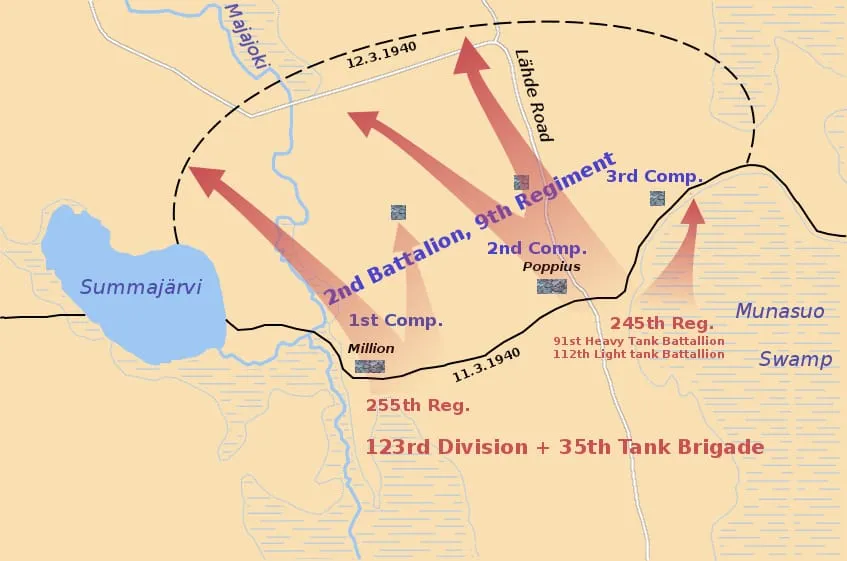
War chronologies usually state that on 15 February the Red Army “took Summa, an important defensive point, and broke through the Mannerheim Line”, and that on 17 February the Finns “continued their retreat”. Both statements need explaining. The breakthrough itself took place on 11 February, and not at the village of Summa but a few kilometres to the east of it, on the Lähde sector, between Lake Summajärvi and the Munasuo bog. On 12 and 13 February the Russians widened and deepened the breach, and on 13 February the Soviet command reported that the entire main position had been broken. At Summa itself, on the road from Leningrad to Viipuri, the Finnish regiments beat off attacks to the end. The village was occupied only on 15 February, when the defenders began to withdraw following Mannerheim’s order, although Soviet accounts presented it as having been taken by storm. The breakthrough was thus the culmination of the whole battle for the main position in the west of the Isthmus, which lasted from the offensive launched on 1 February to the Finnish withdrawal to the intermediate line on 15–17 February.
Preparations and forces
After the December defeats Moscow entrusted command of the North-Western Front to Komandarm 1st Rank Semyon Timoshenko. Throughout January divisions, heavy artillery, tanks and aircraft were brought up to the Isthmus, and the troops rehearsed on mock-ups of the Finnish fortifications the assault that had gone so badly in December. Timoshenko’s front consisted of two armies: the 7th Army of Komandarm 2nd Rank Kirill Meretskov in the west of the Isthmus, and the 13th Army of Komkor Vladimir Grendal in the east, on the Vuoksi river and at Taipale. Historians’ figures vary, since some count only the front-line troops and others every unit on the Isthmus. According to Finnish studies, by mid-February the Red Army had some 460,000 men here, about 3,300 guns and more than 1,500 tanks. Russian and Finnish estimates that include the entire rear speak of as many as 600,000 men and 25–26 divisions.
The main blow was to be struck by the 7th Army’s 50th Rifle Corps on a sector some six kilometres wide, between the village of Summa and the Munasuo bog. It was precisely here, by the road and railway to Viipuri, that Meretskov’s attacks had collapsed in December. This time, by Finnish reckoning, there were 50 to 100 guns to every kilometre of front, and the fire was to destroy the bunkers one by one over many days, with direct shots into the embrasures, instead of blanketing the area with shells according to a timetable.
On the Finnish side the Isthmus was defended by the Army of the Isthmus under Lieutenant General Hugo Österman. The most important sector, Summa and Lähde, had been held since the beginning of January by II Corps under Lieutenant General Harald Öhquist, and within it by the 3rd Division of Colonel Paavo Paalu, renumbered from the former 6th Division, which had taken part in the failed counter-attack in December. Its three regiments held a front some 20 kilometres long, with 41 concrete structures. The eastern part of the Isthmus was covered by III Corps under Major General Erik Heinrichs. The defenders, who had fallen back to this line at the beginning of December, were exhausted after two months in the trenches; the artillery was short of shells, and there were almost no anti-tank weapons. By their own reckoning, the Finns had some 150,000 men and a few hundred guns on the whole Isthmus.
1–10 February: ten days of fire
On 1 February the Soviet artillery and air force opened a bombardment, the heaviest since the start of the war, and five divisions of the 7th and 13th Armies attacked along the entire front of II Corps. Russian studies state that over the following days more than ten thousand shells a day fell on the Finnish positions. The attacks by companies and battalions supported by tanks were not yet meant to break the line. Timoshenko ordered frequent attacks during the first ten days of February in order to mislead the enemy about the direction of the main blow, improve his own positions, reconnoitre the Finnish defences and wear down their garrisons.
That aim was achieved. As early as 1 February the Russians broke into the Finnish trenches at Summa and took the area around the concrete bunker Sk 2, which was finally lost the next day. On 5 February, according to Finnish reports, between 100 and 150 tanks took part in two great attacks, and on 6 February the attacks were renewed three times. The Finns beat them all off, destroying 11 vehicles on 6 February alone, but at the cost of ever heavier losses. The Soviet artillery smashed bunkers and dugouts, and harassing fire at night made repairs impossible. The men sat day and night in shattered positions in frosts of more than 30 degrees below zero and could not sleep. On 7 February a single heavy shell hit a shelter of the 9th Infantry Regiment, killing 18 soldiers. The relief of the exhausted front-line units, planned for the beginning of the month, succeeded only on 10 February, company by company, under fire. The Soviet attacks also tied down the Finnish division’s reserves in the front line.
From these days, too, comes one of the best-known images of the war. On 8 February at Summa, Soviet infantry advanced to the attack behind armoured shields mounted on runners, which they pushed before them over the snow. The attack was repulsed, and the Finns collected almost 150 of these shields in front of their positions.
11 February: the breakthrough at Lähde
At 8.40 a.m. on 11 February the Soviet artillery opened fire along the entire sector of the 3rd Division with a force the Finnish soldiers had never known. The morning was misty but later cleared, and the frost held at around 20 degrees below zero. Just before noon the infantry attacked with hundreds of tanks: the Soviet 100th Rifle Division struck at Summa, Colonel Filipp Alabushev’s 123rd Division at Lähde, and parts of the 138th Division at the neighbouring Suokanta sector. At the same time divisions attacked across the whole Isthmus, and the 13th Army struck again at Taipale.
The 123rd Division was the same one that had failed to get through the trenches at Lähde in December. Throughout January it had rehearsed the assault on mock-ups, and its reconnaissance had pinpointed several dozen bunkers and positions. This time the infantry advanced close behind the artillery fire, the tanks were covered by their own infantry, and sappers crept up to the bunkers with demolition charges. According to Finnish figures, the sector, some four kilometres wide, was held by only about 600 men of the II Battalion of the 9th Infantry Regiment and the 3rd Independent Battalion. Supported by two tank battalions, the Soviet troops quickly broke into the Finnish position. Around noon or shortly after – by 1 p.m., according to the Finnish divisional history – they captured bunker Sj 4, known as “Poppius”, one of the most modern structures on the line, together with the neighbouring strongpoints. The American historian Allen F. Chew called it the key to the whole sector and to the entire line west of Lake Muolaanjärvi. The other great bunker in the area, Sj 5, called the “Millionaire” because it had cost more than a million marks to build, was blown up by Soviet sappers, according to most accounts, during the night or early on the morning of 12 February.
By the evening of 11 February the Russians were already standing on the support line behind the main position. The breach was about four kilometres wide and a kilometre deep. To plug it, the Finnish command had to throw in the last free units it had to hand: two companies of sappers. The Soviet infantry dug in at once, and a hasty counter-attack achieved nothing. At Summa and on other sectors the Finnish regiments held their positions. According to Chew, the Army of the Isthmus lost some 1,200 men on that one day, an alarming figure by Finnish standards.
12–14 February: failed counter-attacks
On 12 February the Russians widened the breach by another kilometre to the west, along Summajärvi. On the Lähde sector the exhausted Finnish units were falling back to the support line; communications had broken down and units were so intermingled that orders often failed to reach the front line. Mannerheim released his reserve, Colonel Selim Isaksson’s 5th Division, to II Corps; it was to throw the enemy back and relieve the 3rd Division. Its regiments, however, were scattered and arrived one after another. The first to arrive was the 13th Infantry Regiment, one of whose battalions occupied the support line on the morning of 12 February, relieving the sappers.
At 6.30 a.m. on 13 February the 14th Infantry Regiment launched a counter-attack from the north of Summajärvi. At first it advanced almost unopposed, but then it ran into heavy fire, and Soviet tanks drove into the gap between its battalions. The other units that were to take part in the attack barely moved, and the Finnish artillery, though concentrated in the area, had no ammunition. In the evening the regiment returned to its starting positions. Meanwhile, around noon, Soviet tanks broke through the support line by the Lähde road and halted at a road fork about three kilometres behind it, waiting for the infantry. One of the Finnish heavy artillery batteries lost all its guns when the tanks unexpectedly drove in among its emplacements. The Russians, however, went no further. According to Chew, they feared further counter-attacks and stopped to consolidate the ground they had won, and the breach was not fully exploited.
At 4.25 a.m. on 14 February the commander of the 5th Division received permission to abandon the support line on the threatened sector, and during the day he took over responsibility for the whole front, while the bled-out 3rd Division was withdrawn behind the line. That day Öhquist conferred with Mannerheim, Österman, the Army of the Isthmus chief of staff Colonel Kustaa Tapola, and the Quartermaster General at General Headquarters, Colonel Aksel Airo, on an orderly withdrawal to the intermediate line. In Moscow that same day the Presidium of the Supreme Soviet of the USSR awarded the 123rd Division and its commander the Order of Lenin, and Alabushev was promoted to Kombrig.
15 February: the order to retreat and Summa
At 2.30 p.m. on 15 February the Russians broke into the positions of the Finns defending the road fork near Lähde. Half an hour later Mannerheim’s order arrived: II Corps was to disengage and fight a delaying action, and then occupy the intermediate line, which ran from Samolanlahti bay through Lakes Näykkijärvi, Muolaanjärvi and Äyräpäänjärvi to the Vuoksi. III Corps in the east of the Isthmus was to stay in its positions. Mannerheim had long since concluded that an army without reserves could not afford a battle of attrition for every bunker, and he preferred to preserve the army rather than ground. The intermediate line, however, had been under construction only since the start of the war, and on many sectors it consisted of single trenches and wire entanglements.
That day Soviet troops entered Summa. The head of the Red Army’s artillery, Nikolai Voronov, described in his memoirs how he watched from a forward observation post the final bombardment of the village, the attack of tanks and infantry and the fall of the strongpoint. According to his account, when he returned to 7th Army headquarters, Meretskov was on the telephone to the People’s Commissar for Defence, who did not believe that Summa had been taken and three times asked Voronov whether it was true. Finnish sources show that Summa fell rather because its defenders were leaving in accordance with orders, and that the 15th Regiment defending it had still been beating off every attack on 14 February. For Moscow, however, which in December had had to explain to the world a defeat at Summa of all places, what mattered was that the village’s name at last appeared in a victory communiqué.
16–17 February: retreat to the intermediate line
The retreat began on the night of 15–16 February. First to be abandoned were the positions east of the breach, between Muolaanjärvi and the Vuoksi, where units were in danger of being cut off. On 16 February the Inkilä sector on the Gulf of Finland was given up without a fight. The Finnish units fell back in darkness and frost through forests and burnt-out villages, leaving behind them concrete bunkers that had been built since the 1920s. The February days were frosty and cloudless, which allowed the Soviet air force to attack the columns and made any march by daylight difficult. On 16 February the Russians took Kämärä railway station, and the 7th Army’s breakthrough zone was by now some 11–12 kilometres wide and as many deep. Russian studies record that on 15 February the 123rd Division for the first time carried infantry on the hulls of its tanks, and by 17 February it had covered 12 kilometres, becoming the first to reach the intermediate line.
On 17 February Soviet units advanced slowly towards the new Finnish positions, and on the flank of the 5th Division one battalion had to fall back to a fortified line by the small lake of Mustalampi. In the evening the first Soviet patrols made contact with the Finns west of Näykkijärvi. The retreat succeeded in the sense that the Finnish divisions were neither destroyed nor encircled. On the coast the Finns held on for a few more days in the coastal artillery forts: Humaljoki was abandoned on 19 February and the Saarenpää battery on the island of Koivisto on 23 February.
At the eastern end of the Isthmus the fighting went differently. The Finnish 7th Division, formerly the 10th, beat off heavy attacks by the 13th Army at Taipale from 11 to 20 February and held its positions until the end of the war. The order to retreat thus applied only to the western half of the Isthmus – but that was where the road to Viipuri ran.
Changes in command
The breakthrough cost the commander of the Army of the Isthmus his post. On 19 February Lieutenant General Hugo Österman, a former commander of Finland’s armed forces, stepped down. Finnish sources say that he himself asked to be relieved after the front collapsed and after a dispute with Major General Paavo Talvela, the victor of Tolvajärvi, whom Mannerheim had sent to the Isthmus to assess the situation. Western studies speak simply of his dismissal. He was replaced on 19 February by Erik Heinrichs, promoted to lieutenant general. Talvela took over III Corps from him, and on 25 February I Corps under Major General Taavetti Laatikainen was formed from part of II Corps. Tapola remained the army’s chief of staff.
Place in the war
The breakthrough at Lähde decided the outcome of the Winter War. The intermediate line, weakly fortified and held by exhausted divisions, lasted only about ten days. On 21 February the Russians drove deep into it at Näykkijärvi, and on 26 February a Finnish counter-attack at Honkaniemi, in which the Finns used tanks for the first time in this war, failed. On 26 February Timoshenko ordered the capture of Viipuri, and on 27 February Mannerheim agreed to a withdrawal to the rear line, running through Viipuri and Tali and on along the Vuoksi. At the beginning of March Soviet divisions crossed the ice of the Bay of Viipuri and cut the road from Viipuri to Helsinki, and seized a bridgehead on the Vuoksi. Finnish losses were rising to a thousand men a day, and the commanders on the Isthmus reported that the front could hold for another week, a little longer at most.
The news from the Isthmus also changed the political calculation. In those same days London and Paris were planning to send an expeditionary corps through Norway and Sweden, and volunteers were arriving in Finland. Such help, however, would have come too late and in too little strength to stop the offensive, and in mid-February Sweden refused to send troops. The Foreign Minister, Väinö Tanner, was conducting talks with Moscow through Stockholm, and on 23 February Vyacheslav Molotov set out the Soviet terms: the whole Karelian Isthmus with Viipuri and the lands around Lake Ladoga. On 29 February the government of Risto Ryti agreed to open negotiations. Mannerheim, aware of the state of the army, supported making peace while the army was still fighting. Peace was signed in Moscow on 12 March 1940, and the guns fell silent on 13 March. Finland lost the Isthmus and Viipuri, but kept its independence and an army that had not been destroyed.
For the Red Army the February victory became a model: a breakthrough achieved by massed artillery, careful preparation and an assault rehearsed on mock-ups. In March Timoshenko and Meretskov were made Heroes of the Soviet Union, and in May Timoshenko replaced Kliment Voroshilov as People’s Commissar for Defence. Yet the success was paid for at an enormous price. According to Russian archival research, some 127,000 Soviet soldiers were killed or went missing in the Winter War as a whole, and some historians give even higher figures. The Finns lost about 26,000 killed and missing. Abroad, what was remembered above all was that a huge state had needed more than two months and many times the enemy’s strength to break the defences of a small country. This picture confirmed Adolf Hitler in his conviction that the Red Army, after the purges, was weak. Finnish bitterness over the loss of Karelia, in turn, became one of the reasons why in June 1941 Finland entered the Continuation War at Germany’s side. In 1944 the Red Army again broke through the Finnish defences on the Karelian Isthmus and retook Viipuri.
Sources
Meanwhile
(03)Elsewhere, within a week.
- 17 February 1940 · Western FrontManstein presents his plan to HitlerOn 17 February 1940 Manstein, removed from planning, put his Ardennes idea to Hitler. On 24 February the OKH shifted the main thrust to Army Group A.
- 11 February 1940 · DiplomacyThe German–Soviet commercial agreementOn 11 February 1940 Germany and the USSR signed a trade agreement in Moscow. Soviet grain, oil and ores were to flow to the Reich for machinery and arms.
- 10 February 1940 · PolandFirst deportation from the eastern landsOn 10 February 1940 the NKVD began deporting families of military settlers and foresters from the Kresy. NKVD documents put the total at nearly 140,000.
Related events
(04)The same battle, people or subject.
- 12 March 1940 · DiplomacyThe Moscow Peace TreatyOn 12 March 1940 Finland signed the peace ending the Winter War in Moscow. It ceded the Karelian Isthmus and Viipuri but kept its independence.
- 7 January 1940 · ScandinaviaTimoshenko takes command in FinlandOn 7 January 1940 Moscow formed the North-Western Front under Komandarm Timoshenko. After the defeats of December, he was to break the Mannerheim Line.
- 5 December 1939 · ScandinaviaThe Red Army attacks the Mannerheim LineIn early December 1939 the Red Army reached the Mannerheim Line. Its attacks on the Taipale and at Summa broke down with heavy losses.
- 17 January 1940 · ScandinaviaSoviet air raids on Finnish townsIn mid-January 1940 Soviet bombers struck Turku, Tampere, Helsinki and dozens of other towns, while north of Lake Ladoga the Finns encircled two divisions.