1940–1941: The East African campaign
Italian invasion of British Somaliland
- Dates:
- 3–19 August 1940
- Front:
- Africa
- Location:
- The protectorate of British Somaliland on the Gulf of Aden: Zeila (Saylac) and the coast road, Hargeisa, the Karrim Pass, Odweina and Adadle, the Tug Argan gap in the Assa hills (Black, Knobbly, Mill, Observation and Castle Hills, the Mirgo Pass), Barkasan, Nasiyeh and the port of BerberaOn the battle map →
- Sides:
- Italy (with colonial troops from Eritrea, Somalia and Ethiopia)Guglielmo Nasi, Carlo De SimoneUnited Kingdom (with units from British India, East Africa, Northern Rhodesia and Somaliland, and an Australian cruiser)Archibald Wavell, Alfred Reade Godwin-Austen, Arthur Chater
- Result:
- Italian victory. After the four-day battle of Tug Argan (11–15 August) the British withdrew and evacuated 7,140 people, including 5,690 soldiers, by sea to Aden. On 19 August the Italians entered Berbera, and Mussolini annexed the colony to Italian East Africa.
- Author:
- Łukasz
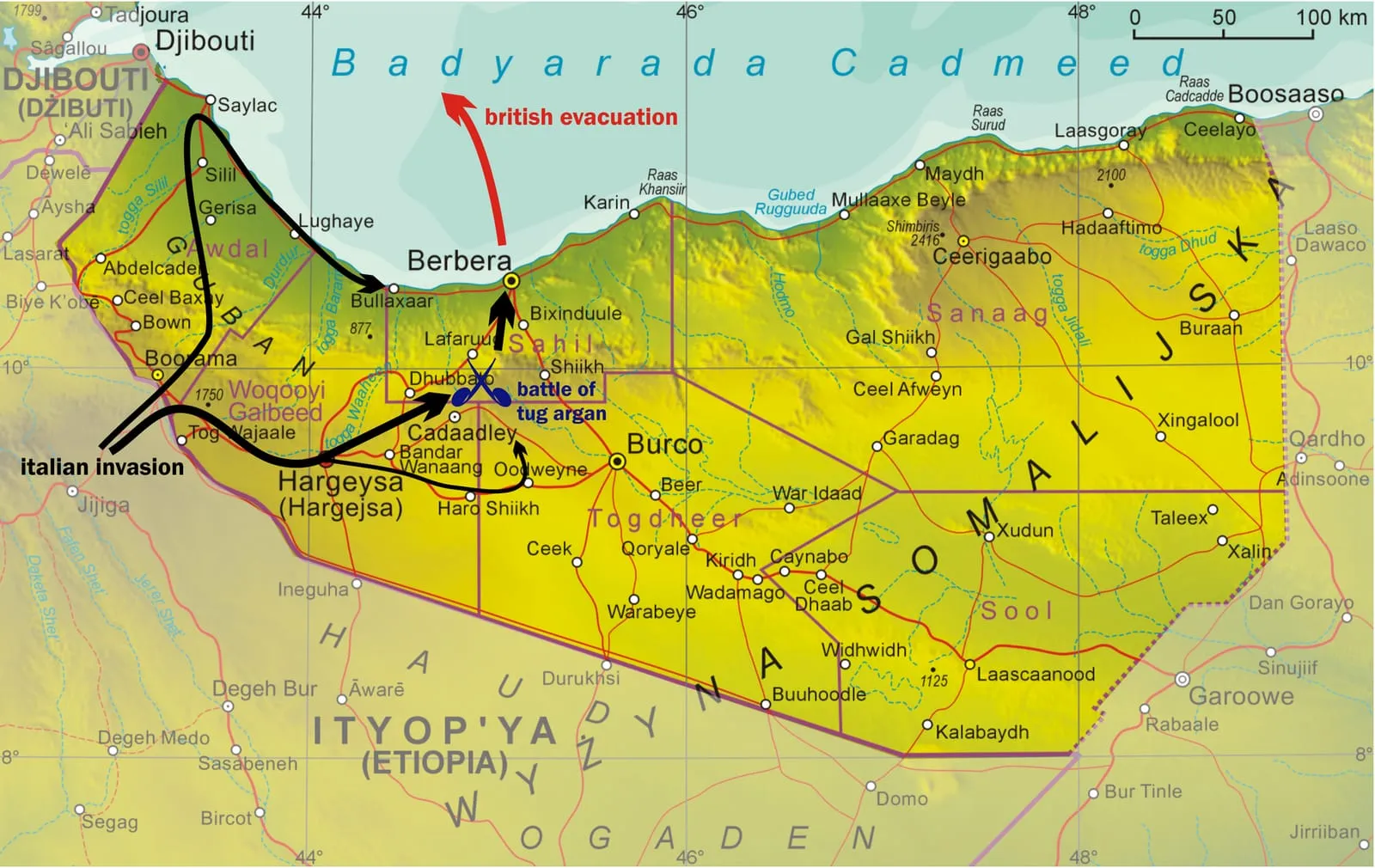
The Italian invasion of British Somaliland was the only major offensive mounted by the forces of Italian East Africa during the Second World War, and the only occasion on which the Italians conquered an entire British territory without German help. On 3 August 1940 three columns under General Guglielmo Nasi crossed the frontier of the protectorate. Within two weeks, with a numerical superiority of several times over and an overwhelming advantage in artillery, they broke the defence of a few thousand British, Indian and African troops in the Tug Argan gap, and on 19 August they entered the abandoned port of Berbera. The British, however, managed to get almost all their troops away by sea to Aden. For Fascist propaganda it was a great triumph; for Winston Churchill it was a humiliation for which he never forgave the Commander-in-Chief Middle East, General Archibald Wavell. Strategically the victory changed little, and seven months later the British recovered the colony almost without a fight.
Name and dates
English-language literature speaks of the Italian invasion or the Italian conquest of British Somaliland; Italian writers refer to the conquista del Somaliland britannico. The campaign is taken to have begun on 3 August 1940, the day Italian troops crossed the frontier, and to have ended on 19 August, when in the evening the Italians entered Berbera, the capital and only port of the colony. It formed part of the wider East African campaign.
The most important engagement was the battle of Tug Argan, which all sources date to 11–15 August. On the earlier dates the accounts differ somewhat. Ian Playfair’s British official history states that Zeila was taken on 5 August and that the defenders of Hargeisa withdrew on the same day. Some studies place the capture of Hargeisa on 6 August, others have the western column reaching Zeila only around 10 August. The British official history is the main source for these events.
Background
The empire’s poorest colony
British Somaliland was a protectorate on the Gulf of Aden, lying opposite British Aden and close to the Bab el-Mandeb strait, the gateway to the Red Sea. Its area of about 176,000 square kilometres was home to some 320,000 people, most of them nomadic Somali herdsmen. Inland from the coast stretched a desert plain between a few dozen and a hundred kilometres wide, and beyond it a range of mountains averaging about 1,200 metres in height. Berbera, the largest town, had about thirty thousand inhabitants in the cool season and half as many in summer. The port had a good anchorage but no quays: ships were unloaded by lighter, which took ten days for a medium-sized vessel and was almost impossible in July and August, when the hot monsoon wind blew. The British had ruled the territory since the end of the nineteenth century, but they broke the resistance of the Dervish movement only in 1920, partly with the help of aircraft.
After the Italian conquest of Ethiopia in 1936 during the Second Italo-Ethiopian War, the colony found itself almost entirely surrounded by Italian East Africa. Of more than 1,200 kilometres of frontier, only about 70 kilometres bordered neighbouring French Somaliland; the rest was an Italian border. For a long time British plans assumed that the colony would not be defended in the event of war. Only in December 1939 did the Chiefs of Staff, at Wavell’s request, decide that it should be defended, or as a last resort that Berbera should be held, chiefly for reasons of prestige. Disputes over costs between the Colonial Office, the Foreign Office and the War Office meant that the first reinforcing battalion did not arrive until May 1940.
The loss of the ally in Djibouti
The whole defence scheme rested on co-operation with the French. Djibouti held a stronger French garrison under General Paul Legentilhomme, who in the event of war was to command the forces of both countries. After the fall of France and the Franco-Italian armistice, which provided for the demilitarisation of French Somaliland and free Italian access to the port and the railway to Addis Ababa, Legentilhomme tried for several more weeks to carry on the fight. He failed, however, to win over the navy, the air force and the administration. At the end of July the colony was taken over by supporters of the Vichy government, and on 5 August Legentilhomme left for Aden. The British were left alone in Somaliland, and the Italians gained a free hand on the protectorate’s western border.
The Viceroy of Italian East Africa, the Duke of Aosta, Prince Amedeo of Savoy, had feared since June that Djibouti would become a springboard for a British offensive against Harar. After Italy declared war, Rome counselled caution in East Africa, and in July it approved only limited attacks along the border, such as the capture of Kassala, Gallabat and Moyale. The Duke had put his plan for occupying British Somaliland to Mussolini as early as 18 June, and he received approval at the turn of July and August. Taking the protectorate would close the eastern route into Ethiopia to the British, push them away from Djibouti and give the regime a spectacular victory just as the Germans were opening the Battle of Britain.
Forces and plans
The defenders
The troops in Somaliland were commanded by Arthur Chater of the Royal Marines, at first as a lieutenant colonel and from the summer as a brigadier, who had previously commanded the Somaliland Camel Corps. The Corps numbered 631 men, mainly Somalis under British officers, armed with old single-shot rifles, machine guns and anti-tank rifles. At the beginning of August Chater had five battalions: the 1st Battalion of the Northern Rhodesia Regiment; the 2nd (Nyasaland) Battalion of the King’s African Rifles; two Indian battalions from the Aden garrison, the 1/2nd and 3/15th Punjab Regiment; and the Scottish 2nd Battalion of the Black Watch, which had been sent from Egypt to Aden at Legentilhomme’s request and which landed at Berbera on 8 August. The artillery consisted of a single battery from Kenya with four light 3.7-inch mountain howitzers. Instead of anti-tank guns the defenders received from the captain of the Australian cruiser HMAS Hobart (a Leander-class ship) a 47 mm saluting gun with a crew of three and a few dozen rounds; on 13 August two Bofors guns arrived. The British official history describes a “collection of units of four different races” with no real base, staff, signals or transport.
Air support could come only from Aden, more than three hundred kilometres’ flight away. The Blenheim squadrons had at the same time to cover convoys in the Red Sea and defend Aden itself, and the few Gladiators sent to landing grounds in Somaliland were soon destroyed or withdrawn. At sea the British cruisers Ceres and Carlisle, the destroyer Kimberley, the sloop Auckland and the Australian Hobart were in action.
Chater concluded that the long, open frontier could not be held. Three roads led to Berbera: the coast road from Zeila, the main road from Hargeisa and the eastern road from Burao. Vehicles could cross the mountains only by the last two: the road from Hargeisa through the broad Tug Argan gap and the road from Burao through the narrow Sheikh pass. The main force was therefore concentrated at Tug Argan, a single battalion covered the other approaches, and the Camel Corps and patrols of the Somali frontier police (the illalo) formed a thin screen in front to watch and delay the enemy.
The attackers
Nasi, the Viceroy’s deputy and commander of the eastern sector of Italian East Africa, had at his disposal, according to Playfair, forces equivalent to an army corps: three Italian (Blackshirt) battalions and twenty-three colonial battalions, twenty-one artillery batteries, half a company of M11/39 medium tanks, a squadron of tankettes, armoured cars and five groups of irregulars (bande). They were supported by 57 aircraft of the Regia Aeronautica, concentrated in a special tactical command at Dire Dawa. Estimates of the strength of these forces range from a little over twenty thousand to about 35,000 men, the overwhelming majority of them askari from Eritrea, Somalia and Ethiopia. The Italian superiority was thus at least fivefold, and in artillery overwhelming.
The plan provided for an advance in three columns. The western column under General Sisto Bertoldi was to take Zeila (Saylac), cut the colony off from French Somaliland and then advance east along the coast road. The eastern column under General Arturo Bertello, made up mainly of irregulars, was to march on Odweina and Burao and cover the right flank. The main column – the Harrar Division with eleven colonial battalions in three brigades, Blackshirt battalions and tanks – was led by General Carlo De Simone. He was to take Hargeisa, set up a base there, break through the defences in the gap and drive straight on Berbera. In their appreciation of 14 July the Duke of Aosta and Nasi expected the decisive fighting to take place between the Karrim and Jerato passes, and if the defenders did not give way the Italians would outflank them. This forecast proved accurate.
Course of the campaign
The march on Hargeisa and Zeila (3–10 August)
On 3 August 1940 British air reconnaissance spotted the Italians crossing the frontier. The forward patrols of the Camel Corps fell back without losing contact with the columns, attacking them wherever they could. At Hargeisa they briefly held up the main column, but on 5 August De Simone renewed his attack with the support of light tanks. The Somali troops and a company of Rhodesians knocked out several vehicles with anti-tank rifles and then had to withdraw. On the same day Bertoldi took Zeila and began to advance cautiously eastwards along the coast road, harried by aircraft from Aden, naval gunfire and Camel Corps patrols. Bertello’s column reached Odweina on 6 August, but instead of heading for Burao it turned north-west towards Adadle on the bed of the Tug Argan – that is, onto the flank of the main British force.
There followed a pause of several days. The Italians built up supplies at Hargeisa, and when the Duke of Aosta pressed him, Nasi replied that the only road was in a dreadful state because of the rains and the exceptional traffic. The advance resumed on 8 August, and for two days the Italians approached the British positions through the Karrim Pass while their aircraft bombed Berbera, the landing grounds and the passes. On 8 August Italian fighters caught the Gladiators on the ground at Berbera; one was burnt out, another damaged, and the rest were sent back to Aden. From then on the defenders had practically no fighter cover over the battlefield.
When it became clear that the Italians were advancing in strength, Wavell ordered a field artillery regiment and two anti-tank guns to be sent from Egypt, and India was asked for a battalion, a battery and a field company of sappers from the 5th Indian Infantry Division. These reinforcements did not arrive in time and were diverted to the Sudan. Wavell also appointed General Alfred Reade Godwin-Austen, who was then on his way to Kenya to take over the 2nd African Division, to command the enlarged force. Godwin-Austen was to stop the Italians on the main position, but at the same time to prepare a plan of evacuation in secret. He reached Berbera on 11 August and took command that evening. Chater remained in charge of the defence of the gap. Wavell himself had been in London for talks since 7 August, and in Cairo his place was taken by General Henry Maitland Wilson.
The battle of Tug Argan (11–15 August)
The Tug Argan gap, named after the dry sandy watercourse (tug in Somali) that cut across the front, lay where the road from Hargeisa passes through the Assa hills and turns east. Its floor was a flat, stony plain dotted with sparse thorn bushes, with several rocky hills standing less than two kilometres apart. The defenders named them, from the north, Black, Knobbly, Mill and Observation Hill; some three kilometres behind Mill Hill lay Castle Hill. Each was a small fortress with machine-gun nests and modest wire entanglements. At the western end of the Assa hills stood a ridge called Punjab Ridge, and north of the road the Punjabis held their positions. The position had good observation, but it was too wide for four battalions, had no depth, and the hills could be bypassed between them. The Assa hills east of the bend in the road also proved passable for infantry along camel tracks over the Mirgo and Jerato passes, which lengthened the front still further.
On 11 August, after an air raid and an artillery bombardment, at least a colonial brigade attacked Punjab Ridge, drove off the company of the 3/15th Punjab Regiment holding it and beat off a counter-attack. Attacks on Mill and Knobbly Hills failed. On 12 August the Italians attacked all the main strongpoints at once. Towards evening, after heavy fighting, the weakest of them, Mill Hill, held by the Rhodesians, fell; the crews had to disable and abandon two of the four precious howitzers. More dangerous than the loss of the hill was the fact that the Italians had established themselves in the Assa hills and from then on dominated the southern part of the gap. On 13 August the defenders of Knobbly Hill repelled another attack, but small Italian detachments were infiltrating through the Mirgo Pass, and that night they ambushed a convoy carrying water and ammunition to Castle Hill, which nevertheless fought its way through. On 14 August Castle and Observation Hills were bombed and shelled all day, and another assault on Observation Hill broke down. A counter-attack by two companies of the King’s African Rifles towards the Mirgo Pass achieved a brief success before being thrown back.
That same day Mussolini cabled the Duke of Aosta to throw all available reserves and the entire air force of the empire into Somaliland. Godwin-Austen, meanwhile, could see that the Italians were on the point of cutting the only road by which water and ammunition were brought up, and that their artillery, which outranged his howitzers, could destroy the strongpoints one after another with impunity. After four days of fighting the troops were exhausted, and behind Tug Argan there was no position that could not easily be outflanked. On 14 August he reported to Wilson that if the gap fell the only course would be evacuation, which might save perhaps 70 per cent of the force; he was ready to fight to the end if so ordered. Early on the morning of 15 August he sent his appreciation, and soon after noon he received Wilson’s order to evacuate. Wavell, informed in London, approved the decision after the event.
On 15 August, after a day-long bombardment, an Italian brigade took Observation Hill in the late afternoon. Holding out there to the last with the Somali machine-gun crews, wounded in the shoulder and the eye and sick with malaria, was Captain Eric Wilson of the East Surrey Regiment, attached to the Camel Corps. His post fell at about 5 p.m. Believed killed, he was awarded a posthumous Victoria Cross in October 1940, although in fact he had survived as a prisoner of the Italians in Eritrea. After dark the Rhodesians abandoned Black, Knobbly and Castle Hills, and the Punjabis their positions north of the road. The gap passed into Italian hands.
Barkasan and the evacuation from Berbera (16–19 August)
Godwin-Austen planned a withdrawal through two rearguard positions, at Barkasan and at Nasiyeh, about 53 and 27 kilometres from Berbera respectively. Over three successive nights first the civilians and then the troops were to be embarked. The operation was spread over three days because ships had to be assembled and the monsoon made it difficult to ferry men out in boats at night and in the morning. At Barkasan the Black Watch battalion took up position, reinforced by two companies of the King’s African Rifles and part of the 1/2nd Punjab Regiment. The units from Tug Argan withdrew through their lines.
The Italians followed slowly and did not attack Barkasan until 17 August. The brunt of the fighting fell on the Scots, who counter-attacked several times and held the position all day, although it was clear that the enemy would eventually get round it. On the same day the cruiser Ceres shelled Bertoldi’s column near Bulhar, about 60 kilometres west of Berbera, and brought it to a halt. The embarkation, meanwhile, was going faster than expected. The Royal Navy built a jetty usable at any state of the tide, and fighter Blenheims from Aden patrolled over the port and largely protected it from bombing. Godwin-Austen therefore dispensed with the Nasiyeh position and after dark on 17 August withdrew the rearguard from Barkasan.
Loading was completed at 2 p.m. on 18 August. The British destroyed buildings, vehicles, fuel and stores they could not take with them; about 350 vehicles were abandoned. The only vessel lost was the tug Queen, scuttled by her own crew, which the Italians later raised. HMAS Hobart, with the staff on board, waited for stragglers until the morning of 19 August and only then sailed for Aden. According to British figures 7,140 people were embarked: 5,690 soldiers, 1,266 civilians and 184 sick. On the evening of 19 August Italian troops entered burning Berbera. Most of the Somali soldiers of the Camel Corps were sent home to await the return of the British; earlier plans for them to wage a guerrilla war were dropped.
The Italians did not seriously interfere with the evacuation. A planned landing of some three hundred troops on the airfield near Berbera was called off when it turned out to be still occupied, and the pace of the pursuit was slowed by the rains and the damaged roads. Some writers link this restraint to an order the Duke of Aosta is said to have given Nasi on 15 August: to let the British go without unnecessary fighting, in the hope of a peace brokered by the Vatican. This claim, however, is not generally accepted.
Losses
According to the British official history the defence of Somaliland cost 260 men, most of them from the Northern Rhodesia battalion and the Camel Corps machine-gun crews, who bore the brunt of the fighting in the gap. The most commonly cited breakdown is 38 killed, 102 wounded and 120 missing; some authors, such as Harold Raugh, give 38 killed and 222 wounded. The RAF lost seven aircraft, and ten more were badly damaged.
Playfair estimated Italian losses at 2,052 men. The Italian official historian Alberto Rovighi gave for the whole campaign 465 killed, 1,530 wounded and 34 missing, a total of 2,029 men, of whom only 161 were Italians and 1,868 askari. An earlier Italian return from 1952 lists fewer, about 1,100 killed, wounded and missing, including airmen. According to Italian figures the Regia Aeronautica lost four aircraft. The losses of the Somali irregulars, who fought on both sides, and of the civilian population are not known.
Significance
The disparity in losses gave rise to one of the sharpest disputes within the British high command of the war. News of the evacuation came as a shock to British opinion: yet another defeat, and this time at the hands of the Italians, in the very weeks when the decisive air battles were being fought over England. Churchill took the light casualties as proof that the colony had not been defended with sufficient determination. He demanded Godwin-Austen’s suspension and a court of inquiry. Wavell refused. He wrote that Godwin-Austen had judged the situation correctly, that Wilson had taken the right decision, and that the withdrawal in the face of such superior forces had been carried out in exemplary fashion. In his cable to the Prime Minister he added a sentence that has gone down in history: “A big butcher’s bill is not necessarily evidence of good tactics.” According to the Chief of the Imperial General Staff, General John Dill, Churchill flew into a greater rage than he had ever seen. Wavell not only stood by Godwin-Austen but in September gave him a division in Kenya. From then on the Prime Minister’s relations with his commander in the Middle East were irreparably damaged, and in July 1941 Churchill replaced Wavell with General Claude Auchinleck. Some historians now judge that, with such slender forces, the defenders held out longer than could have been expected.
For Italy the conquest of British Somaliland was the greatest success of the East African campaign. Mussolini annexed the colony to Italian East Africa and boasted that Italy had conquered an area the size of England, counting together with Somaliland the border gains in the Sudan and Kenya: Kassala, Gallabat, Kurmuk, Karora, Moyale and Buna. The Italian columns had shown that they could co-ordinate operations over distances of hundreds of kilometres, and the askari had fought bravely. Yet the victory brought no strategic benefit. The Red Sea remained open to British convoys, and an army cut off from the mother country had used up fuel, ammunition and spare parts that it had no means of replacing. After August 1940 the Duke of Aosta’s forces went over to the defensive and never again undertook a major offensive. The British had lost, as it was maliciously put, chiefly the privilege of maintaining an expensive garrison in the poorest of their colonies, and the five battalions evacuated from Berbera survived to fight again.
The occupation was short-lived. On 16 March 1941, during the great British offensive against Italian East Africa, two Indian battalions from Aden landed on either side of Berbera in Operation Appearance, meeting little resistance, and within a few weeks the British had recovered the entire protectorate. Chater once again became military governor. Eric Wilson, found in a prisoner-of-war camp, received his Victoria Cross in 1942 and died as the last surviving British Army holder of the decoration from the Second World War. Guglielmo Nasi, regarded by the historian Angelo Del Boca as the best officer of the Italian army in East Africa, held out at Gondar until the end of November 1941 as the last Italian commander in the region. In 1960 the former British Somaliland united with the former Italian Somaliland to form independent Somalia.