United Kingdom
Henry Maitland Wilson
Commander of British Troops in Egypt (1939–1941), commander of W Force in Greece (1941), Commander-in-Chief Middle East (1943) and Supreme Allied Commander Mediterranean (1944), field marshal (1944)
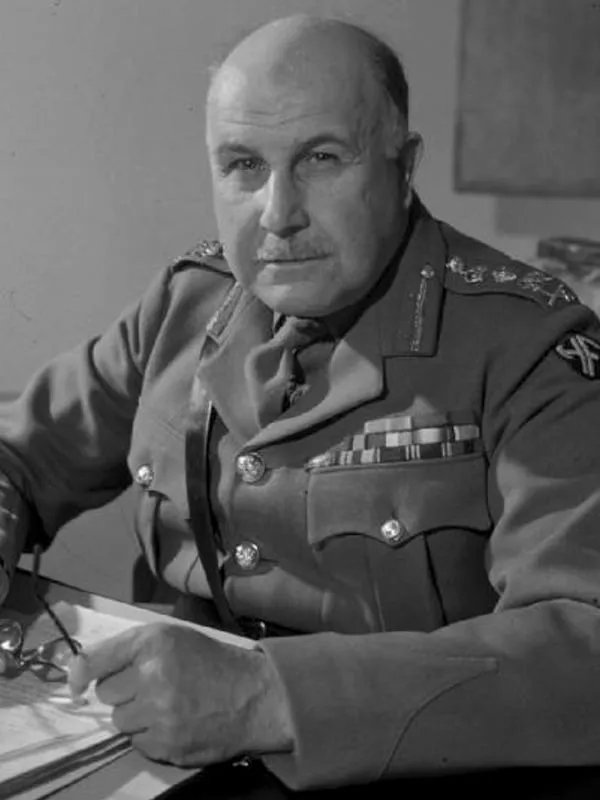
- Born:
- 5 September 1881, London
- Died:
- 31 December 1964, Chilton (Buckinghamshire, England)
- Author:
- Łukasz
- Photo:
- uploaded to Wikipedia in February 2006 by Op. Deo (log), domena publiczna, Wikimedia Commons

Henry Maitland Wilson, nicknamed “Jumbo” on account of his massive build, was one of those British generals who served far from home throughout the Second World War. He spent eight years outside England, from Egypt in 1939 to Washington in 1947. As commander of British troops in Egypt he prepared in 1940 the blow that shattered the Italian army in Libya. In the spring of 1941 he commanded the British, Australian and New Zealand corps sent to help Greece and carried out its evacuation, and a few weeks later he occupied Syria and Lebanon, which were defended by Vichy troops. He went on to command in Persia and Iraq, in the Middle East and, as Supreme Allied Commander, in the Mediterranean, and finally represented the British Chiefs of Staff in Washington. He was no great battlefield commander, but Winston Churchill trusted him as he trusted few of his generals, and gave him commands in which prudence, patience and a talent for reconciling allies counted for more than brilliance.
Early years and the Boer War
He was born on 5 September 1881 in London, the eldest son of Arthur Maitland Wilson, an army officer and owner of the Stowlangtoft Hall estate in Suffolk, and Harriet, née Kingscote. Some accounts give Stowlangtoft itself, with which the family was associated, as his birthplace, while English and German biographical entries give London. He was educated at Eton College and then at the Royal Military College, Sandhurst. On 10 March 1900 he was commissioned as a second lieutenant in the Rifle Brigade, the regiment with which his entire career was bound up.
He began his service at war. With the 2nd Battalion of his regiment he fought in South Africa in the Second Boer War, and after it ended in 1902 he sailed with the battalion to Egypt, which he then saw for the first time. In 1907 the battalion was moved to India. In 1908 Wilson was promoted to captain and served in England and Ireland, and in 1911 he became adjutant of the Officers’ Training Corps at Oxford University. In 1914 he married Hester Wykeham; their son Patrick served at his father’s side in the Second World War as an intelligence officer.
The First World War
After the outbreak of war, in October 1914 Wilson became brigade major – in effect chief of staff – of the 48th Infantry Brigade, and in December 1915 he went to France. On the Western Front he was a staff officer with the 41st Division at the Battle of the Somme and with XIX Corps at Passchendaele. In October 1917 he became chief of staff of the New Zealand Division with the rank of lieutenant colonel. In 1941 New Zealanders would once again come under his command, in Greece. For his war service he received the Distinguished Service Order and was three times mentioned in dispatches.
Between the wars
After the war Wilson attended the first post-war course at the Staff College, Camberley, then commanded a company of cadets at Sandhurst and served with battalions of his regiment. In 1927 he took command of the 1st Battalion, Rifle Brigade, on the North-West Frontier of India. From 1930 he taught at Camberley, where he worked on cooperation between motorised infantry and armour. In 1934 he took command of the 6th Infantry Brigade. In 1935 he was promoted to major general, and in 1937 he took over the 2nd Division at Aldershot.
Egypt (1939–1940)
On 15 June 1939, amid the mounting crisis over Gdańsk (Danzig), Wilson was appointed, as a lieutenant general, Commander of British Troops in Egypt. He had at his disposal an armoured division then being formed – the future 7th Armoured Division – and eight infantry battalions. He concentrated them in a fortified camp at Mersa Matruh, some 160 kilometres from the Libyan frontier, and negotiated with the Egyptian government on implementing the treaty of 1936, which obliged Egypt to cooperate with the British in the event of war. When General Archibald Wavell became Commander-in-Chief Middle East in the summer of 1939, Wilson became his subordinate, responsible for the defence of Egypt itself. From the autumn of 1939 the force at Mersa Matruh was commanded by General Richard O’Connor, whose headquarters became the Western Desert Force in June 1940.
When Wavell went to London for talks in August 1940, Wilson deputised for him in Cairo, and it was he who had to approve decisions in the British Somaliland campaign after the Battle of Tug Argan and the evacuation of Berbera. After the Italians advanced into Egypt in September, Wavell instructed him to prepare a short blow against the Italian camps around Sidi Barrani. From this plan grew Operation Compass, launched on 9 December 1940. It was carried out by O’Connor, but Wilson, as his superior, was responsible for planning and supply. Churchill, in a radio broadcast at the time, described him as the general who “actually commands the Army of the Nile” and who was reputed to be “one of our finest tactical soldiers”. In February 1941, after the conquest of Cyrenaica, Wilson became its military governor and handed over command in Egypt to O’Connor.
Greece (1941)
When the British decided to help Greece against a German attack, Wavell chose Wilson to command the expeditionary corps, and at the conference at the Tatoi palace on 22 February 1941 the Greeks welcomed the appointment. In Cyrenaica he was replaced by General Philip Neame. Wilson flew to Athens on 4 March, just in time for three days of argument with General Alexandros Papagos over where Greece should be defended. As a result he was to take command of all British and Greek troops on the line of the Aliakmon river. From 7 March his troops landed at Piraeus: the 1st Armoured Brigade, General Bernard Freyberg’s New Zealand Division and General Iven Mackay’s 6th Australian Division. The Greeks, who did not want to provoke the Germans, asked him to remain incognito, so for a month he went about in civilian clothes as “Mr Watt” and could not show himself to his own soldiers. Only on 5 April was he able to assume command openly.
The next day Germany attacked Yugoslavia and Greece, and its panzer divisions, just as Wilson had feared, outflanked the Aliakmon Line from the direction of Bitola in Yugoslavia. Wilson withdrew the corps in stages: to the Olympus–Servia line, and then through Thessaly to Thermopylae. On 16 April Papagos himself suggested that the British consider leaving Greece in order to spare the country destruction. From the night of 24–25 April the Royal Navy took off troops from the ports and beaches of Attica and the Peloponnese. Wilson closed his headquarters in Athens on 25 April, crossed the Corinth Canal during the night a few hours before the German parachute landing there, and on 26 April flew to Crete, leaving command of the remaining troops to Freyberg. Of the roughly 62,000 soldiers shipped to Greece, about 50,000 were evacuated, but all the heavy equipment was lost. On Crete, as the senior officer present, he commanded the troops assembled there for a few days and assessed how the island should be defended. On 30 April Wavell flew in, entrusted the defence of Crete to Freyberg and told Wilson to go to Jerusalem and “relieve Baghdad”.
Iraq, Syria and Lebanon
At the beginning of May 1941 Wilson became commander of British troops in Palestine and Transjordan. He found himself in the middle of a new crisis. In Iraq the pro-German Rashid Ali al-Gaylani had seized power, and Iraqi troops were besieging the British air base at Habbaniya. A relief column set out across the desert from Palestine and, together with troops from Basra, brought about the fall of the government in Baghdad at the end of May. German aircraft helping the Iraqis had staged through Vichy-controlled Syria, and this settled the next campaign.
On 8 June 1941 Wilson’s troops – the 7th Australian Division, an Indian brigade, two Free French brigades and columns advancing from Iraq – entered Syria and Lebanon in Operation Exporter. The French troops of General Henri Dentz put up a stubborn resistance for more than a month. An armistice was signed at Acre on 14 July. Its terms, which allowed French soldiers to choose repatriation to France and restricted Free French access to them, angered General Charles de Gaulle, who regarded them as a disregard of his rights in the Levant, and they had to be supplemented by further agreements. In 1941 Wilson was promoted to full general, and in October he took command of the Ninth Army, stationed in Syria and Palestine.
Persia, Iraq and the Middle East (1942–1943)
In the summer of 1942 Churchill considered Wilson for command of the Eighth Army in the desert, but the Chief of the Imperial General Staff, General Alan Brooke, thought otherwise, and the army eventually went to Bernard Montgomery. Wilson was instead given the independent Persia and Iraq Command, created on 21 August 1942. The Germans were then advancing on the Caucasus and Stalingrad, and his task was to defend the oilfields and oil installations of Persia and Iraq at all costs against attack by land and air, and to protect the route through Persia by which supplies flowed to the Soviet Union. In the territory under his command, in northern Iraq, General Władysław Anders’s Polish Army in the East, which had come from the USSR through Persia, was stationed at this time, and was trained and re-equipped there.
After the victory at El Alamein the threat from the north receded. In February 1943 Wilson succeeded Harold Alexander as Commander-in-Chief Middle East. In the autumn of 1943, after the Italian surrender, Wilson, at Churchill’s insistence, sent small forces to the Italian-held Dodecanese islands to take them over from Germany’s former ally. Without fighter cover and without the support of the Americans, who did not want to disperse their forces, the operation ended in defeat: the Germans retook Kos at the beginning of October and Leros in mid-November. Wilson was sharply criticised for it.
Supreme Allied Commander Mediterranean (1944)
When General Dwight Eisenhower left for England to prepare the invasion of France, Wilson succeeded him on 8 January 1944 as Supreme Allied Commander Mediterranean, with his headquarters first in Algiers and then at Caserta. Wilson bore strategic responsibility for the Italian campaign, including the landing at Anzio in Operation Shingle on 22 January 1944 and the fighting for Monte Cassino, in which the 2nd Polish Corps captured the ruins of the monastery in May 1944. In 1944 Wilson was awarded the Silver Cross of the Virtuti Militari. His command supported the Yugoslav and Greek partisans, and in the autumn of 1944 sent British troops to Greece as it was being liberated.
In the summer of 1944 Wilson, like Churchill, preferred to continue the offensive in Italy towards the Danube, but the Americans pushed through the landing in southern France, Operation Dragoon of 15 August 1944, and the weakened armies in Italy stalled on the Gothic Line in the autumn.
Washington and the final years
On 4 November 1944 Field Marshal John Dill, head of the British Joint Staff Mission in the United States and one of the pillars of cooperation with the Americans, died in Washington. Churchill named Wilson as his successor; he was promoted to field marshal on 29 December 1944 and took up the post in Washington in January 1945. He represented the British Chiefs of Staff on the Combined Chiefs of Staff and sat on the committee that coordinated Anglo-American work on the atomic bomb within the Manhattan Project. On 4 July 1945 it was he who announced to that committee that the British government agreed to the use of the bomb against Japan, as the Quebec Agreement of 1943 required. He remained in Washington until 1947.
In 1946 he was created Baron Wilson “of Libya and of Stowlangtoft” and took his seat in the House of Lords. He published his wartime memoirs under the title Eight Years Overseas, 1939–1947. From 1955 to 1960 he was Constable of the Tower of London. He died on 31 December 1964 at Chilton in Buckinghamshire and was buried at Stowlangtoft. His son inherited the barony.
Significance
Wilson’s name is associated above all with the failed Greek expedition of 1941. Historians, however, rarely blame the corps commander himself for its defeat: he was given too few troops, too few aircraft and too little time, and the decision to send the troops was taken by politicians and commanders-in-chief. The retreat from Greece, conducted in the face of German air superiority, and the evacuation of most of the soldiers are counted to his credit. More successful were his campaigns in Iraq and Syria, which in 1941 barred the Germans’ way into the Middle East.
In 1943 and 1944 Wilson was above all a coalition commander. He directed the troops of many nations, Polish among them, and defended, not always successfully, the British view of the war in the Mediterranean. His biographers agree that he did not go down in history as a great field commander, but as a soldier who for eight years of war served without a break in the most difficult theatres and was able to bring men of different nations to act together.
Sources
Commanded in battles
(03)Mentioned in battles
(07)Often appears with
People who appear in the same events.
On the timeline
(43)The 40 most important of 43 events. All tagged “Henry Maitland Wilson” (3) →