United Kingdom
John Dill
Commander of I Corps, BEF (1939–1940), Chief of the Imperial General Staff (1940–1941), head of the British Joint Staff Mission in Washington (1942–1944)
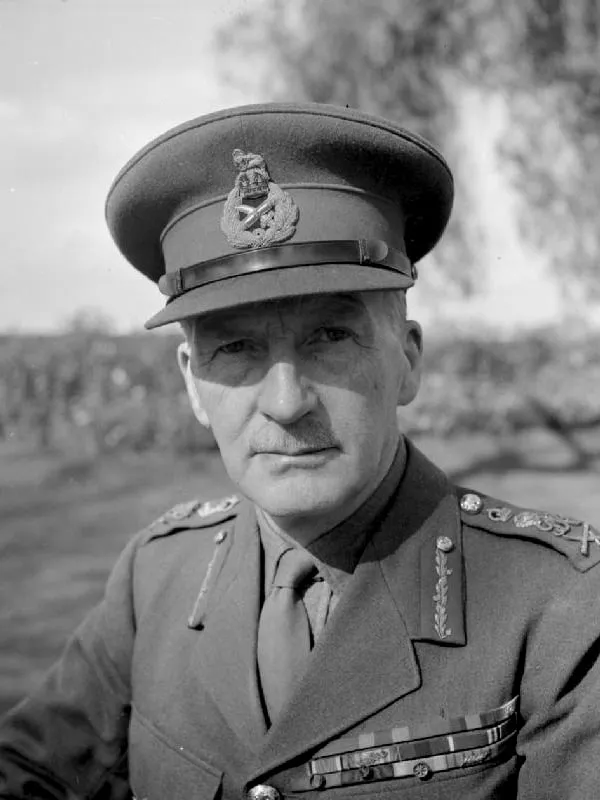
- Born:
- 25 December 1881, Lurgan (Ireland, now Northern Ireland)
- Died:
- 4 November 1944, Washington (United States)
- Author:
- Natalia
- Photo:
- Jarche, J (Mr), domena publiczna, Wikimedia Commons

Sir John Dill was one of those British commanders of the Second World War whose importance is better seen from the standpoint of the whole coalition than from the battlefield. For a year and a half, in the most difficult period of the war – from Dunkirk to Pearl Harbor – he was Chief of the Imperial General Staff, the most senior soldier in the British Army. In that post he could never find common ground with Winston Churchill, and at the end of 1941 the Prime Minister removed him. It seemed the end of his career; instead, in Washington, as head of the British military mission, he became one of the most important links in the Anglo-American alliance. He died there on 4 November 1944 and was laid to rest in the American national cemetery at Arlington.
From Ulster to the army
John Greer Dill was born on 25 December 1881 in Lurgan, County Armagh, in what is now Northern Ireland. His father, the manager of the local branch of a bank, died when the boy was twelve; his mother died soon afterwards. Dill was educated in Belfast, then at Cheltenham College and at the Royal Military College, Sandhurst. In 1901 he was commissioned as a second lieutenant into the Leinster Regiment, an Irish infantry regiment, and was just in time to take part in the final phase of the Second Boer War in South Africa.
He spent the years before the First World War in ordinary regimental service, among other things as a battalion adjutant. In 1907 he married Ada Maud Le Mottée; they had one son. Shortly before the outbreak of war he passed through the Staff College at Camberley, which settled the course of his career: he would make his way not as a line commander but as a staff officer.
Staff officer on the Western Front
During the First World War Dill fought in France and Flanders. In 1915, as brigade major (chief of staff of a brigade) in the 8th Division, he took part in the fighting at Neuve-Chapelle and was wounded. He then rose rapidly through successive staff appointments until in 1918, at the age of 36, he became a brigadier general in the operations branch of the headquarters of the British forces in France under Field Marshal Douglas Haig. He served there during the German Spring Offensive and the Allied counter-offensive that ended the war. He emerged from it with the Distinguished Service Order (DSO), numerous mentions in dispatches and a reputation as one of the ablest staff officers of his generation.
Between the wars
In the inter-war years Dill was regarded as a model officer of the regular army: intelligent, hard-working, tactful and liked by his subordinates. He taught at the Staff College at Camberley and at the Imperial Defence College, and from 1931 to 1934 was Commandant at Camberley. From 1934 to 1936 he was Director of Military Operations and Intelligence at the War Office. In September 1936 he took command of the British forces in Palestine, where an Arab revolt (PL) against the mandatory authorities and Jewish settlement had been under way for several months; the reinforced troops under his command helped to bring the first phase of the rebellion to an end in the autumn of 1936.
In 1937 he returned home as General Officer Commanding-in-Chief, Aldershot Command, the most important concentration of troops in Britain. He was then considered the natural candidate for Chief of the Imperial General Staff, but the Secretary of State for War, Leslie Hore-Belisha, who was looking for younger men more open to reform, gave the post to Lord Gort in December 1937. Dill stayed at Aldershot. In those same years his wife fell gravely ill; after a series of strokes she was partly paralysed, and she died in December 1940.
I Corps in France
When war broke out in September 1939 Gort took command of the British Expeditionary Force, and Dill of its I Corps (II Corps was commanded by Alan Brooke). Through the months of the Phoney War the corps fortified positions on the Franco-Belgian border and trained, without seeing action. Dill was critical of the army’s state of readiness, above all of the shortage of tanks, anti-tank weapons and aircraft for army co-operation. In April 1940 he was recalled to London as Vice-Chief of the Imperial General Staff, and on 27 May 1940, in the days of the evacuation from Dunkirk, he succeeded General Edmund Ironside as Chief of the Imperial General Staff.
Chief of the Imperial General Staff
Dill took over an army that had been defeated in France, had lost much of its equipment and faced the threat of a German invasion. In the summer and autumn of 1940 his main tasks were the defence of the British Isles and the rebuilding of the land forces, while holding on to the British position in the Middle East. From the very start, however, his relations with the Prime Minister were poor. Churchill, who wanted to direct the war personally, expected vigorous offensive ideas and quick decisions from his soldiers; Dill, cautious, methodical and reserved by nature, answered him above all with calculations of what could not be done. According to those around the Prime Minister, Churchill privately called him “Dilly-Dally”. Dill, for his part, complained to those close to him about the late-night meetings at Chequers and about the Prime Minister’s meddling in the details of operations.
Their disputes concerned fundamental questions of strategy. At the beginning of 1941 Dill accompanied the Foreign Secretary, Anthony Eden, on a mission to the Middle East and Athens which led to the decision to send British troops to Greece; he had doubts at first but in the end supported it, and in April the campaign ended in defeat and evacuation. In May 1941 he presented the Prime Minister with a memorandum arguing that the defence of Britain, and after it of Singapore, mattered more than holding Egypt, and warning against the dispersal of forces. Churchill received it very badly. Dill also resisted the Prime Minister’s pressure for premature offensives in North Africa, which in June 1941 led to the failed Operation Battleaxe and to the replacement of Archibald Wavell by Claude Auchinleck.
In August 1941 Dill was a member of the delegation that met the Americans aboard ship in Placentia Bay off Newfoundland; during those talks, which ended with the proclamation of the Atlantic Charter, he got to know the US Army Chief of Staff, General George Marshall. By the autumn, however, it was clear that Churchill wanted to replace him, and Dill himself was worn out by work and by his wife’s illness; she had died the year before. On 18 November 1941 he was promoted to field marshal, and on 25 December 1941 – his 60th birthday, the retirement age for officers of his rank – he was succeeded by Alan Brooke. An honourable retirement as Governor of Bombay was planned for him. In the autumn of 1941 he remarried, to Nancy Furlong.
In Washington
Dill never went to Bombay. After the United States entered the war Churchill took him to the Arcadia Conference in Washington (December 1941 – January 1942), at which it was decided that the strategy of the two countries would be directed by a joint body, the Combined Chiefs of Staff. Since the British chiefs of staff worked in London, they needed a permanent representative in Washington. That representative was Dill: he headed the British Joint Staff Mission, was the senior British member of the Combined Chiefs of Staff and at the same time Churchill’s personal representative as Minister of Defence.
It proved one of the most successful appointments of the war. The qualities that had counted as weaknesses in London – tact, patience, a readiness to listen and a lack of taste for showy gestures – became assets in Washington. Dill quickly won Marshall’s trust; the two men were of similar age, similar style and a similar sense of duty, and their acquaintance grew into a close friendship. They often met privately, and Dill had direct access to President Franklin Delano Roosevelt. Historians stress that he explained British reasoning to the Americans and American reasoning to the British, gave warning of tensions before they turned into open disputes, and more than once softened conflicts over the direction of strategy, among them those over the date of the cross-Channel invasion and the importance of operations in the Mediterranean. He shared with Marshall information that London did not always wish to pass on, which irritated Churchill but strengthened American trust in their British partner.
Dill took part in all the great Allied conferences of the period: at Casablanca in January 1943, in Washington at the Trident Conference in May 1943, at Quebec in August 1943, at Cairo and Tehran at the end of 1943, and at the second Quebec Conference in September 1944. Churchill, though he never changed his opinion of Dill as a chief of staff, kept him in the post until his death.
Death and Arlington
From 1943 Dill’s health declined markedly. In the autumn of 1944, shortly after the second Quebec Conference, he was admitted to the Walter Reed army hospital in Washington, where he died on 4 November 1944; the cause of death was aplastic anaemia. He was 62.
A funeral service was held on 8 November in the National Cathedral, after which Dill was buried at Arlington National Cemetery – the resting place of American servicemen, where foreigners were buried only in exceptional cases. According to American accounts, permission was made possible by a joint resolution of Congress, and Marshall personally pressed the matter. Contrary to an often repeated claim, Dill was not the only foreigner then resting at Arlington: since 1941 the coffin of Ignacy Jan Paderewski had lain in the vault beneath the mast of the battleship USS Maine; it was moved to Poland in 1992. Dill’s successor in Washington, from January 1945, was Field Marshal Henry Maitland Wilson.
On 1 November 1950 an equestrian statue of Dill was unveiled on his grave in the presence of President Harry Truman and George Marshall. It is one of only two equestrian statues at Arlington – the other depicts General Philip Kearny, who was killed in the American Civil War.
His place in the history of the war
Dill commanded in no great battle and left no memoirs. Opinions of him as Chief of the Imperial General Staff in 1940–1941 differ: some historians see him as a sensible professional who restrained the Prime Minister from risky ventures and protected the army from the dispersal of its forces; others as a chief of staff too tired and too irresolute either to stand up to Churchill effectively or to win him over to his views. On his role in Washington, however, there is agreement. It was largely thanks to the trust between Dill and Marshall that the Combined Chiefs of Staff worked as a genuine organ of joint command rather than merely an arena in which the interests of two great powers clashed. Marshall stressed Dill’s services to the alliance for the rest of his life – the grave at Arlington and the monument above it remain a testimony to that conviction.
Sources
Mentioned in battles
(04)Often appears with
People who appear in the same events.