1940–1943: The North African campaign
Rommel’s first offensive
- Dates:
- 24 March – 15 April 1941
- Front:
- Mediterranean
- Location:
- Cyrenaica (eastern Libya) and the Libyan–Egyptian frontier: El Agheila (Al-Uqaylah) and Mersa Brega (Marsa al-Brega) on the Gulf of Sirte, Agedabia (Ajdabiya), Benghazi, Msus, Mechili, Derna, Tobruk, Bardia, Sollum (As-Sallum) and Fort CapuzzoOn the battle map →
- Sides:
- Nazi Germany and ItalyErwin Rommel, Italo Gariboldi, Johannes StreichUnited Kingdom (with troops from Australia and British India)Archibald Wavell, Philip Neame, Richard O'Connor, Leslie Morshead
- Result:
- Axis victory. Within three weeks Rommel’s German and Italian forces recovered almost all of Cyrenaica lost in Operation Compass, destroyed the British 2nd Armoured Division, captured Generals Neame, O’Connor and Gambier-Parry and several thousand soldiers, and reached the Egyptian frontier at Sollum. They did not, however, take Tobruk, whose Australian and British garrison repulsed the first assault on 14 April and tied down Axis forces for months to come.
- Author:
- Łukasz
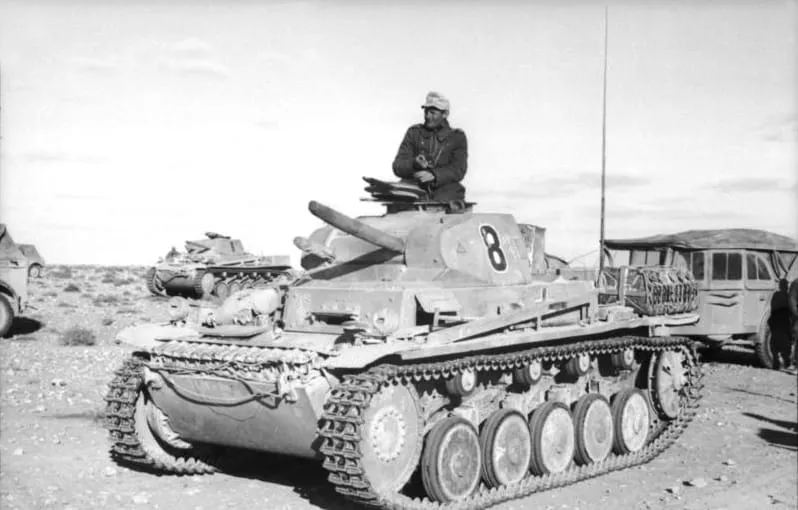
Rommel’s first offensive was a three-week campaign in which the German Afrika Korps, newly arrived in Libya, together with Italian forces, took back from the British almost everything they had won during the winter in Operation Compass. Generalleutnant Erwin Rommel, who had orders to defend Tripolitania and to wait until May for a second panzer division, took El Agheila (Al-Uqaylah) on 24 March 1941 and struck at Mersa Brega on 31 March; when he saw that the enemy was falling back, he set off in pursuit against the wishes of his Italian superiors and the German high command. Within a fortnight or so his columns had crossed Cyrenaica, taken Benghazi, surrounded British units at Mechili and captured three British generals, among them General Richard O’Connor, the victor of Beda Fomm. On 11 April the Germans closed the ring around Tobruk, and on 12 and 13 April their spearheads took Bardia, Fort Capuzzo and the barracks at Sollum on the Egyptian frontier.
The British army in Cyrenaica was not, however, destroyed. Major General Leslie Morshead’s 9th Australian Division withdrew into Tobruk and on the night of 13–14 April repulsed the first German assault on the fortress. Besieged and supplied by sea, the port prevented Rommel from advancing on the Suez Canal for months to come. For Rommel the campaign brought fame; for the British Commander-in-Chief in the Middle East, General Archibald Wavell, it was one of his most painful defeats.
Name and dates
In German and English writing the campaign is often described under the code name Sonnenblume (Sunflower). That, however, was the name for the dispatch of German troops to Libya from February 1941; the offensive itself had no separate code name. British historiography speaks of the loss of Cyrenaica, and Australian soldiers ironically called the retreat across Cyrenaica the “Benghazi Handicap”, after the name of a horse race. The name “Rommel’s first offensive” distinguishes it from his attacks of 1942.
The start is taken to be 24 March 1941, the day El Agheila, the gateway between Tripolitania and Cyrenaica, was taken. This was still only a reconnaissance raid, and some authors date the start of the offensive from the attack at Mersa Brega on 31 March, but from 24 March Rommel was already in his start positions for the advance. The end is taken to be 15 April. By that day the Germans and Italians had reached the Egyptian frontier, and the first assault on Tobruk, on the night of 13–14 April, had failed. The subsequent attacks on the fortress, from 16 April onwards, belonged to the long siege of Tobruk, which lasted until December 1941.
Background
Cyrenaica “with minimum forces”
After the surrender of the remnants of the Italian 10th Army at Beda Fomm on 7 February 1941, the British stood at the gates of Tripolitania. The government in London, however, decided to go no further. After the death of Prime Minister Ioannis Metaxas the Greeks were ready to accept British help against the Germans, who were entering Bulgaria, and in mid-February the Defence Committee ordered that Cyrenaica be held, as a shield for Egypt, with the minimum forces the commanders considered necessary, and that everything else be made ready to go to Greece. The best units, which had conquered Cyrenaica, departed: the exhausted 7th Armoured Division returned to Egypt to refit, and the 6th Australian Division, an armoured brigade and the New Zealanders sailed for Greece in March.
Two incomplete and inexperienced divisions remained in Cyrenaica. On 27 February command over them was taken by Lieutenant General Philip Neame, a sapper who had won the Victoria Cross in the First World War, sent from Palestine. His Cyrenaica Command at Barce (Al-Marj) was in essence the staff of a military governor, without the communications needed to direct a mobile battle. The British 2nd Armoured Division, which had arrived from England in January, had given up two regiments to the 7th Armoured Division and a whole armoured brigade to the Greek expedition, and its commander had died suddenly; he was replaced by Major General Michael Gambier-Parry. Its sole remaining 3rd Armoured Brigade had a weak light tank regiment, a regiment being re-equipped with captured Italian M13/40 tanks, and a cruiser tank regiment which in the second half of March arrived from the Tobruk area with barely about twenty-four of its 52 tanks. All the British tanks had already exceeded their expected engine life. The support group consisted mainly of a motorised infantry battalion, the Tower Hamlets Rifles, and an artillery regiment, while reconnaissance was carried out by the 1st King’s Dragoon Guards in poorly armed armoured cars.
The other major formation was Morshead’s 9th Australian Division. Two of its brigades had been exchanged for less well equipped brigades of the 7th Division so that the best-prepared troops could go to Greece. The division lacked anti-tank weapons, signals equipment and, above all, motor transport: according to the Australian official history, Morshead could use only five of his eight battalions. In mid-March Wavell and the Chief of the Imperial General Staff, General John Dill, visited Cyrenaica and agreed that keeping almost immobile infantry on the open plain in the forward area was too dangerous. From 20 March the forward area was taken over by the 2nd Armoured Division, and the Australians fell back more than 150 kilometres to the north, to the edge of the escarpment above Benghazi, between Tocra (Tukrah) and the Er Regima pass (Ar-Rajmah).
Wavell instructed Neame that in the event of an attack he should fight a delaying action, not hesitate to give up ground, even Benghazi, and above all conserve his tanks, because there would be no reinforcements before May. For lack of lorries the troops were to rely on dumps scattered across the desert, including those at Msus, Mechili and Timimi. At the end of March the 3rd Indian Motor Brigade arrived – cavalry in lorries, without tanks or artillery.
Wavell and his staff believed that the Germans would not be ready for a serious attack before mid-April, and more probably not before May, by which time the British tanks would be out of the workshops and further divisions would have reached Cyrenaica. On 27 March Wavell reported to Winston Churchill that the enemy at El Agheila was mainly Italian with a small German “stiffening”. As he wrote after the war, after his experience of the Italians he had not taken Rommel into account.
The Afrika Korps on the Gulf of Sirte
Rommel flew into Tripoli on 12 February with the task of defending Tripolitania. He was formally subordinate to the Italian Commander-in-Chief in Libya, General Italo Gariboldi, successor to Marshal Rodolfo Graziani. His reconnaissance units immediately pushed east and in February clashed with the British for the first time near El Agheila. The main fighting strength of the Afrika Korps was Generalmajor Johannes Streich’s 5th Light Division, formed from units of the 3rd Panzer Division. Its 5th Panzer Regiment was unloaded at Tripoli between 8 and 11 March; according to the British official history it had about 70 light and 80 medium tanks armed with 50 or 75 mm guns, while other tallies give between 120 and 155 tanks. The 15th Panzer Division was due to arrive in April and May. Of the Italian forces, Rommel had under his command the incomplete Ariete Armoured Division with light tanks, and poorly motorised infantry divisions, including the Brescia and the Pavia. Air support was provided by the Fliegerführer Afrika, General Stefan Fröhlich, who had about fifty Ju 87 dive-bombers and twenty Bf 110 heavy fighters.
Rommel quickly concluded that there were few British troops in the forward area and that they had no intention of attacking. He proposed to Gariboldi an offensive in May, aimed at recovering Cyrenaica and then marching on the Suez Canal. On 19 March he flew to Germany. On 20 March Adolf Hitler presented him with the Oak Leaves to the Knight’s Cross for the French campaign, but at the Army High Command he was told by Field Marshal Walther von Brauchitsch and General Franz Halder that apart from the 15th Panzer Division he would receive no reinforcements. The directive of 21 March ordered him to defend Tripolitania and prepare to recover Cyrenaica, and only after the arrival of the 15th Panzer Division, around mid-May, to occupy the area of Agedabia (Ajdabiya) as a base for further operations. The army was already preparing for war with the Soviet Union, and to it Africa was a secondary theatre.
Course of the campaign
El Agheila (24 March)
Rommel returned to Africa on 23 March and learned that, according to radio intercepts, the British were withdrawing some of their forces from around Agedabia. Streich confirmed that El Agheila was very weakly held and planned a reconnaissance raid. Rommel approved it at once and ordered him to take El Agheila with its fort, landing ground and wells, which his troops badly needed. The capture of El Agheila could still be reconciled with the directive of 21 March, since it improved the defensive position of Tripolitania; any further advance east was contrary to its spirit. The British kept no permanent garrison there, only light covering forces: the armoured cars of the King’s Dragoon Guards drove up to the fort every morning and withdrew at dusk, and an ambush had been planned for 24 March west of the fort, at a causeway across a salt lake.
At dawn on 24 March a platoon commander of the Tower Hamlets Rifles, Lieutenant Cope, who was to report that the fort was clear, approached it on foot and saw that the Germans were already inside. According to the squadron chronicle, he shot two of them and escaped under a hail of bullets. The crew of a British armoured car and an Australian anti-tank gun knocked out a German armoured car, but the Australian gunlayer was killed. Patrols reported ten tanks and twenty vehicles east of the fort; soon an Italian flag was flying over it, and in the evening the King’s Dragoon Guards squadrons withdrew to Mersa Brega. The Germans lost a few men, an armoured car and two tanks damaged on mines. The attack was carried out by the reinforced 3rd Reconnaissance Battalion.
For the following week the front was quiet. Sandstorms immobilised both armies. On 30 March Cyrenaica Command assessed that the enemy showed no intention of advancing further. Rommel, meanwhile, watched with concern as the British strengthened their position at Mersa Brega. He judged that if he gave them time to lay wire and minefields he would not take it without heavy losses, and there was also more plentiful water at Mersa Brega. On 30 March he ordered Streich to take it the following day. Gariboldi agreed, but forbade any further advance without his consent.
Mersa Brega (31 March – 1 April)
The position at Mersa Brega, about 13 kilometres wide, closed the gap between the sea and the salt lakes. It was held by the 2nd Armoured Division’s support group under Brigadier H. B. Latham, with the Tower Hamlets Rifles battalion and a Free French company on the flank; the 3rd Armoured Brigade stood a few kilometres to the north-east, on the flank. The Germans attacked with a main column along the coast road and a weaker one through the desert from the south, which, however, got bogged down in difficult terrain.
At about 10 a.m. on 31 March the Germans made contact with the position. Before noon they took a hill the British called Cemetery Hill, but two tank attacks in the afternoon were repulsed by field and anti-tank artillery. Latham asked for the 3rd Armoured Brigade to strike the German flank. Gambier-Parry replied that he could not get the tanks into action before dark. After two dive-bomber raids, at about 6 p.m., the 8th Machine Gun Battalion, which Rommel had personally directed north of the road, through the dunes along the shore, struck the right flank of the Tower Hamlets Rifles and broke into their position. A counter-attack by carriers made it possible to withdraw the threatened company, but at about 7 p.m. German vehicles drove into Mersa Brega. The support group lost 55 infantrymen, eight carriers and many vehicles, and during the night it fell back with the 3rd Armoured Brigade towards Agedabia. The British official history notes that the commanders, anxious to spare their only armoured brigade at all costs, did not use it at all.
On 1 April the ground was quiet, but airmen reported long columns of vehicles stretching from El Agheila far to the west. The Germans occupied the abandoned Mersa Brega and prepared to advance further.
Agedabia and Benghazi (2–4 April)
On the morning of 2 April the 8th Machine Gun Battalion set off after the British, followed by the main body of the 5th Light Division and the Ariete and Brescia divisions. Gariboldi warned Rommel against becoming involved in a major battle prematurely, but Rommel ordered the capture of Agedabia and the small port of Zuetina. In the afternoon the support group disengaged with difficulty near Agedabia; the Tower Hamlets Rifles lost more than a company. The withdrawal was covered by a squadron of the 5th Royal Tank Regiment, which fought an action with the II Battalion of the 5th Panzer Regiment: according to the British official history five British and three German tanks were destroyed. Gambier-Parry reported that he had only 22 cruiser and 25 light tanks left and expected a breakdown every sixteen kilometres.
That same afternoon an anxious Wavell flew into Barce. Neame, convinced that the Germans would advance across the desert on Mechili and Tobruk, was prepared to let the armoured division move away from the coast road. Wavell objected and ordered that the advance on Benghazi be delayed for as long as possible. The order reached the division during the night, when it could no longer be carried out. That evening Wavell summoned O’Connor from Egypt, intending to hand him command in Cyrenaica. O’Connor flew in on 3 April with Brigadier John Combe, former commander of the 11th Hussars, but after a discussion Wavell decided not to change commanders in the middle of a crisis and kept Neame, instructing O’Connor to advise him.
On 3 April Gambier-Parry reported that the 3rd Armoured Brigade was scattered and short of petrol, and withdrew the whole division through Sceleidima onto the escarpment. Benghazi was left uncovered. Neame ordered the dumps in the town to be blown up, among them some 4,000 tons of Italian ammunition, and the Australians prepared to defend the passes on the edge of the escarpment. A false report of Germans near Msus led a French company to burn the armoured division’s main fuel dump there.
On 3 April Rommel, ignoring Gariboldi’s protests, sent Lieutenant Colonel Gerhard von Schwerin’s battle group across the desert towards Msus and Ben Gania, and the 3rd Reconnaissance Battalion towards Benghazi. When the 5th Light Division reported that it needed four days to refuel, he ordered all the lorries to be unloaded and the petrol brought up within twenty-four hours. That evening Gariboldi came to his headquarters and demanded that the advance be halted without his consent. Rommel replied that as a German general he had to issue orders appropriate to the situation, and demanded complete freedom of action. According to his own account, the dispute was settled by a signal from the German high command granting him that freedom; some historians point out that its wording was less clear-cut than he made out. That day he wrote to his wife that his superiors in Tripoli, Rome and perhaps Berlin would be “tearing their hair”, because he had gone against directives and orders and taken ground that was not supposed to be captured until the end of May – but the British were running.
On the night of 3–4 April the 3rd Reconnaissance Battalion drove into Benghazi. On 4 April, at the Er Regima pass, it was held up until the following day by the Australian 2/13th Battalion, which lost 98 men. German aircraft, on the other hand, destroyed three British fuel columns on 4 and 5 April, and the 3rd Armoured Brigade was dwindling by the hour: the heavier tanks running out of fuel were refuelled from others, which were then blown up. By the end of 5 April it had eight cruiser and fourteen light tanks left and had ceased to exist as a fighting formation.
The pursuit across the desert (4–6 April)
On 4 and 5 April Rommel formed several columns from whatever units he had to hand and sent them across the desert, across the base of the Cyrenaican bulge, to cut off the British line of retreat: Schwerin’s battle group towards Timimi; the Italian Fabris detachment of motorcyclists and artillery, followed by the Ariete Division, towards Mechili; Streich with the 8th Machine Gun Battalion towards Tobruk; and Lieutenant Colonel Herbert Olbrich with the 5th Panzer Regiment through Msus towards Mechili. General Heinrich Kirchheim, who had come to Africa on a visit, was ordered to lead the Brescia Division along the road through the Jebel Akhdar mountains. Rommel flew over them in a Fi 156 Storch, urging his commanders on. The columns, however, stretched out over dozens of kilometres, got stuck in the sand and came to a halt without fuel or water. On the evening of 5 April Rommel personally led Lieutenant Colonel Gustav Ponath’s 8th Machine Gun Battalion through the night towards Mechili, and on the morning of 6 April he sent Ponath with a handful of men further on, to the coast road near Derna.
The British command was receiving contradictory reports. On 5 April Neame ordered the 9th Australian Division to withdraw, then countermanded the order, and Morshead had great difficulty turning his battalions round in the dark. On the morning of 6 April airmen spotted German columns in the desert, and the 3rd Indian Motor Brigade repulsed a first attack at Mechili. O’Connor, who in Neame’s absence was issuing orders in his name, concluded that the expected great outflanking manoeuvre had begun and ordered a general withdrawal. The Australians, gathering every vehicle that could still move, set off east in the evening and reached Timimi early on 7 April. The commander of the 3rd Armoured Brigade, Brigadier Reginald Rimington, who had driven ahead to Derna for fuel, fell into enemy hands after a car accident.
Generals captured, Derna and Mechili (6–8 April)
Neame and O’Connor left their headquarters at Maraua on the evening of 6 April, travelling in the same car as Brigadier Combe. In the darkness they took the wrong road and, instead of heading east towards Timimi, drove north towards Derna. During the night, near Martuba, the car ran into Ponath’s men. The half-asleep generals had no chance of escape. In the morning the chief of staff, Brigadier John Harding, moved the headquarters to Tobruk.
Before noon on 7 April Ponath gathered his detachment by the airfield near Derna and cut one of the lines of retreat. Lieutenant Colonel H. D. Drew’s battle group beat off two attacks, and its last four tanks were lost in a counter-attack that enabled the rest to withdraw. In the evening the 9th Australian Division and the support group blocked the coast road at Acroma, about 25 kilometres west of Tobruk.
At Mechili, an old fort at a junction of desert tracks, the headquarters of the 2nd Armoured Division with General Gambier-Parry, most of Brigadier Edward Vaughan’s 3rd Indian Motor Brigade, a battery of horse artillery and Australian anti-tank gunners were stranded. Rommel was unable to attack on 7 April because his units were scattered and out of fuel. Twice he called on the defenders to surrender and twice he was refused. Gambier-Parry had orders to withdraw to El Adem and decided to break out at dawn on 8 April. Only small groups got through, among them a squadron of the Indian 18th Cavalry; the rest, when their ammunition ran out, surrendered together with Gambier-Parry and Vaughan. According to various sources, between two and three thousand British, Indian and Australian soldiers were taken prisoner.
Tobruk surrounded (8–11 April)
On 6 April in Cairo the Foreign Secretary, Anthony Eden, General Dill and the three commanders-in-chief decided to stop the enemy as far west as possible, and Tobruk offered the best chance: a port with large stocks, water and a ring of Italian fortifications. On 7 April Churchill telegraphed that Tobruk seemed a place to be held “to the death without thought of retirement”. On 8 April Wavell flew into Tobruk with General John Lavarack, to whom he entrusted command in Cyrenaica with the task of holding the fortress for about two months. Morshead, who took command of the fortress, is credited with the words: “There’ll be no Dunkirk here.”
The defence rested on fortifications built by the Italians: a double ring of concrete posts 13–15 kilometres from the port, more than 45 kilometres long, with an unfinished anti-tank ditch. The 9th Australian Division was joined by the 18th Australian Brigade, brought in by sea, British artillery and the 3rd Armoured Brigade, rebuilt from its remnants. There were some 36,000 men in the fortress, a third of them rear-echelon troops, Libyan refugees and prisoners.
On 10 April Rommel announced that the British were collapsing and must be pursued without respite, and that the objective was the Suez Canal. He ordered that the Tobruk garrison must not be allowed to escape. That day the commander of the 15th Panzer Division, General Heinrich von Prittwitz und Gaffron, who had gone on ahead of his division and had at once been given one of the columns by Rommel, was killed outside the fortress. On 11 April the ring closed: the 5th Light Division stood to the south-east, Prittwitz’s former group, now under Schwerin, to the south, and the Brescia Division to the west.
The Egyptian frontier and the first assault on Tobruk (12–15 April)
Rommel sent part of his forces further east. On the morning of 12 April the 3rd Reconnaissance Battalion drove into the abandoned Bardia, and Lieutenant Colonel Knabe’s battle group with a motorcycle battalion set off for the frontier. On the afternoon of 13 April, Easter Sunday, the Germans took Fort Capuzzo, and two hours later the barracks above the pass at Sollum. Brigadier William Gott’s British Mobile Force was to delay the enemy, not to defend the frontier at all costs. It did, however, hold the Halfaya Pass, the only convenient route from the plateau down to the Egyptian coast; the Germans took it only at the end of April. There the weak spearheads of the Afrika Korps had to halt: without Tobruk and its port Rommel could not supply troops any further east.
That same day leaflets fell on Tobruk calling on the garrison to lay down its arms and ending with the words “Remember Mechili”. On the night of 13–14 April the 8th Machine Gun Battalion, with sappers, tried to seize a bridgehead beyond the anti-tank ditch west of the El Adem road, in the sector of the Australian 2/17th Battalion. In the fight for post R33 Corporal John Edmondson, though badly wounded, fought with the bayonet and saved his officer; he died of his wounds and became the first Australian of the war to be awarded the Victoria Cross, posthumously. Towards dawn the Germans made a small breach and passed through it about 38 tanks of the 5th Panzer Regiment, which turned north towards the port. The Australian infantry did not withdraw, but let the tanks through and cut the German infantry off from them. The tanks ran into the fire of the 25-pounders of the 1st Regiment, Royal Horse Artillery, firing over open sights from a few hundred metres, and of anti-tank guns, while British cruiser tanks fired on them from cover. The regiment turned back, losing 16 of its 38 tanks according to the British official history. The 8th Machine Gun Battalion lost more than three-quarters of its strength. By noon on 14 April it was all over. The defenders counted about 150 German dead in front of their positions and took 250 prisoners, for the loss of 26 killed and 64 wounded.
On 15 April the front on the Egyptian frontier and around Tobruk froze, and Rommel prepared further attacks on the fortress, this time from the west.
Losses
There are no complete figures for the losses of either side over these three weeks. The heaviest British losses were in prisoners. At Mechili, according to various sources, between two and three thousand soldiers surrendered, and during the retreat three generals (Neame, O’Connor and Gambier-Parry) and Brigadiers Combe, Rimington and Vaughan were captured. The 3rd Armoured Brigade lost almost all its tanks, most of them not to enemy fire but to breakdowns, lack of fuel and demolition by their own crews. The Tower Hamlets Rifles battalion, according to Gambier-Parry’s report, was reduced to half its strength at Mersa Brega and Agedabia. The British also abandoned or destroyed huge dumps in Benghazi and in the desert.
German and Italian losses in the pursuit were light, although the gruelling advance cost many vehicles. The costliest action was the assault on Tobruk on 13–14 April, in which the 5th Panzer Regiment lost 16 tanks, some of them recoverable, and the 8th Machine Gun Battalion was almost destroyed. General von Prittwitz was killed and General Kirchheim wounded.
Significance
In three weeks Rommel’s offensive undid almost all the gains of Operation Compass. The British official history identifies the main cause of the defeat: the only armoured brigade in Cyrenaica was a brigade in name only, and when the enemy attacked there was no force capable of counter-attacking, while the best units were on their way to Greece. Wavell took the blame on himself. The campaign also showed what Rommel would be in the desert: a commander who led from the front, ready to act against orders, to risk running out of fuel and to disperse his forces, as long as he gave the enemy no respite. On 23 April Halder wrote in his diary that Rommel had not sent a single clear report, that he spent “all day rushing about between his widely scattered units” and was “frittering away” his forces; at the end of April General Friedrich Paulus was sent to Africa to look into the situation.
Tobruk proved to be the limit of Rommel’s capabilities. On 16 and 17 April attacks by the Ariete Division from the west were repulsed, and the assault of 30 April – 4 May gained the Germans only a small breach. The garrison, supplied by ships of the Mediterranean Fleet, withstood the siege until December 1941; from August the Polish Independent Carpathian Rifle Brigade fought in the fortress. British relief attempts in May and June, Operations Brevity and Battleaxe, failed; only Operation Crusader in November and December forced Rommel to retreat. In the spring of 1941 the British suffered three defeats in quick succession – in Cyrenaica, in Greece and on Crete – and North Africa, which Hitler had treated as a rescue operation for Benito Mussolini, became for two years a front that tied down ever more German forces.