United States
Lucian Truscott
Commander of the 3rd Infantry Division (1943–1944), VI Corps (1944), the Fifth Army (1944–1945) and the Third Army (1945–1946), General (1954)
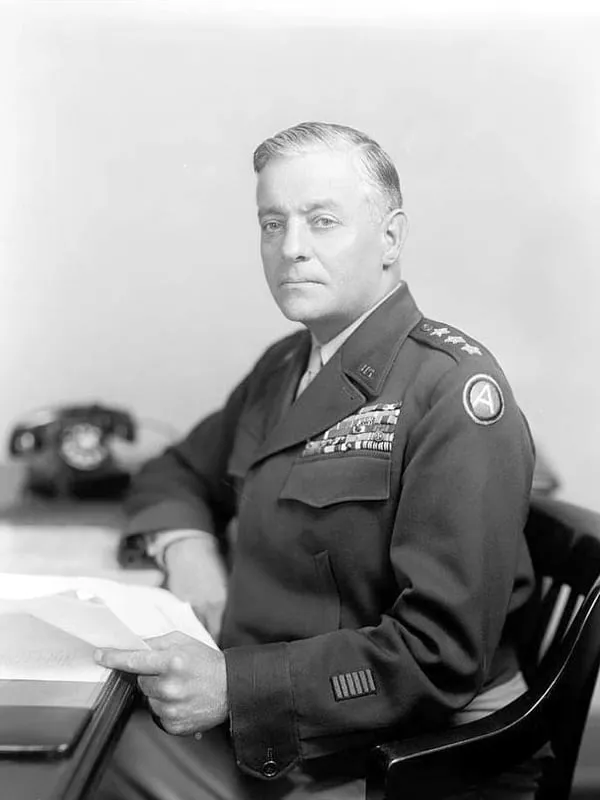
- Born:
- 9 January 1895, Chatfield (Texas, United States)
- Died:
- 12 September 1965, Alexandria (Virginia, United States)
- Author:
- Łukasz
- Photo:
- Harris & Ewing photo studio, domena publiczna, Wikimedia Commons

Lucian King Truscott Jr. was one of the finest American field commanders of the Second World War, although his name is known to far fewer people today than those of Patton or Bradley. A provincial schoolteacher who won his officer’s commission without a high-school diploma and then served for twenty years in the cavalry, he rose during the war from founder of the American Rangers to army commander. He led the 3rd Infantry Division in Sicily and Italy, in February 1944 took over the besieged Anzio beachhead from John Lucas, in August commanded the landings in Provence, and ended the war at the head of the Fifth Army in the Po valley. Together with Alexander Patch, he was the only American general to command in combat a division, a corps and an army in succession.
The teacher from Oklahoma
He was born on 9 January 1895 in Chatfield, Texas (some sources give 6 January), the son of a country doctor. He spent his childhood and youth in Oklahoma, which became a state only in 1907. He completed just one year of high school. At sixteen he passed himself off as an older high-school graduate to get onto a teacher-training course in Norman, qualified, and taught for several years in rural schools, eventually becoming a school principal. According to family tradition, he owed his distinctive rasping voice to accidentally drinking acid as a child.
When the United States entered the First World War in April 1917, Truscott volunteered for the army. Once again overstating his education, he got onto an accelerated officers’ course and in October 1917 was commissioned a second lieutenant of cavalry. He never reached France: with the 17th Cavalry Regiment he patrolled the Mexican border in Arizona. In March 1919 he married Sarah Randolph, a descendant of a well-known Virginia family; they had three children.
A cavalryman between the wars
In the interwar years Truscott stayed in the army, even though it had shrunk to a small professional force in which promotion came very slowly. Among other postings he served in Hawaii, was an instructor at the Cavalry School at Fort Riley, and in the early 1930s commanded a squadron of the 3rd Cavalry Regiment at Fort Myer near Washington, the capital’s ceremonial unit. He was a keen and respected polo player – in the cavalry of the day polo was regarded as a school of courage and quick reflexes. In 1934–1936 he completed the Command and General Staff School at Fort Leavenworth and then stayed on there as an instructor.
In 1940, as the American army began to expand rapidly, he was posted to the newly formed armoured force at Fort Knox, and in 1941 to the staff of IX Corps at Fort Lewis. There he became friends with the corps chief of staff at the time, Dwight Eisenhower. The acquaintance proved decisive for Truscott’s later career.
The Rangers and Dieppe
In the spring of 1942 Truscott, by then a colonel, was sent to Britain as the US Army’s representative at Lord Louis Mountbatten’s Combined Operations Headquarters. His task was to transfer the experience of the British Commandos to the American army. On his initiative the 1st Ranger Battalion under Major William Darby was formed in Northern Ireland in June 1942; according to his memoirs, Truscott himself chose the name – a reference to the colonial-era ranger companies – because “Commandos” were a British formation. On 19 June he was promoted to brigadier general.
On 19 August 1942 he was the senior American observer at the Dieppe Raid. Some 50 Rangers took part, distributed among British Commando units and Canadian regiments – they were among the first American soldiers to fight the Germans on land in Europe in this war. The failure of the raid taught Truscott, and the Allied high command as a whole, a lesson later applied in planning amphibious landings.
North Africa
In Operation Torch Truscott, now a general, commanded the northern group of George Patton’s Western Task Force: about 9,000 men of the 60th Infantry Regiment of the 9th Division and the 66th Armored Regiment of the 2nd Armored Division, who landed near Mehdia in Morocco on 8 November 1942. Their objective was Port-Lyautey airfield. The landing ran late, units became disorganised on the beaches, and the French in the kasbah overlooking the mouth of the Sebou river put up a stubborn defence; the airfield was taken only on 10 November, shortly before the ceasefire in Morocco. Soon afterwards Truscott was promoted to major general.
In the winter of 1942–1943, during the fighting in Tunisia, Eisenhower made him his representative at the advanced command post in Constantine. From there Truscott watched the chaos of Allied command that in February 1943 led to defeat at the Kasserine Pass.
The 3rd Division: Sicily and Italy
In March 1943 he took over the 3rd Infantry Division in Morocco and spent four months training it with relentless rigour. He introduced the so-called “Truscott trot” – a march at five miles an hour for the first mile and four miles an hour thereafter, much faster than the regulation pace. On 10 July 1943 the division landed in Sicily near Licata, and ten days later, crossing bare, sun-scorched mountains on foot, it was already advancing on Palermo. On 17 August its soldiers were the first to enter Messina. Patton rated him at the time as one of the best division commanders in the army.
In September the 3rd Division joined General Mark Clark’s Fifth Army at Salerno. As part of General John Lucas’s VI Corps it forced the Volturno in October, and in November fought in the mountains of the Winter Line near Mignano, paying a high price for small gains. On 22 January 1944 it was one of the two divisions that carried out the landing at Anzio. A week later its attack on Cisterna collapsed, and the Ranger battalions under Truscott’s command – including the one he himself had helped create two years earlier – were almost entirely destroyed.
Anzio
In mid-February, as the German Fourteenth Army was preparing Operation Fischfang, Clark and General Harold Alexander, commander of the Allied forces in Italy, decided to replace Lucas. On 17 February Truscott became deputy corps commander and handed the 3rd Division over to Brigadier General John O’Daniel. On 22 February Clark relieved Lucas and Truscott took over VI Corps. He was 49 and one of the youngest corps commanders in the American army. In the memoirs he published after the war he to some extent defended Lucas’s cautious decisions in the first days of the landing.
On the beachhead, where gloom had set in, the new commander quickly changed the atmosphere. He moved his headquarters out of the cellars at Nettuno, went to the front line himself and improved the coordination of the artillery. The last German offensive, launched on 29 February from the direction of Cisterna, broke down within a few days. For the following months Truscott prepared the breakout from the beachhead. On 23 May 1944, as part of the great offensive in which General Władysław Anders’s Polish II Corps captured Monte Cassino, VI Corps broke through the German ring. Two days later, as its spearheads were approaching Valmontone, where they could cut off the retreat of the German Tenth Army, Clark ordered him to turn towards Rome. Truscott was taken aback by the order and considered it a mistake, but carried it out. On 4 June units of the Fifth Army entered Rome, and the Tenth Army escaped to the north.
Provence
Immediately after the capture of Rome, VI Corps was withdrawn from the Italian front and earmarked for the landings in southern France. On 15 August 1944 Truscott’s three American divisions – the 3rd, 36th and 45th – landed on the coast of Provence between Cavalaire and Saint-Raphaël against light resistance. Truscott at once sent inland an improvised motorised force under Brigadier General Frederic Butler, which was to cut the German Nineteenth Army’s line of retreat up the Rhône valley at Montélimar. In the fighting of 21–28 August the Americans inflicted heavy losses in men and equipment on the Germans, but failed to close the trap completely, and most of the Nineteenth Army withdrew northwards. In September VI Corps linked up in Burgundy with the forces advancing from Normandy and reached the foothills of the Vosges. On 2 September Truscott was promoted to lieutenant general.
Commander of the Fifth Army
In the autumn of 1944 he briefly took over the Fifteenth Army, which was then being formed, and in December he returned to Italy to succeed Clark, who had taken over the 15th Army Group, as commander of the Fifth Army. His troops spent the winter in the Apennines on the Gothic Line, weakened by the transfer of forces to France. In April 1945, in the final offensive of the Italian campaign, the Fifth Army came down from the mountains onto the plain: on 21 April, together with troops of the Eighth Army, including the Polish II Corps, Bologna was taken, and a few days later the Allies crossed the Po. On 2 May 1945 the surrender of the German forces in Italy came into effect.
Bavaria and leaving the army
In the autumn of 1945 Eisenhower stripped Patton of command of the Third Army and of military government in Bavaria after remarks in which he played down denazification. His successor was Truscott, who took over the Third Army at the beginning of October and led it until the spring of 1946. He was responsible for the occupation administration of the largest part of the American zone in Germany and had to carry out the removal of former Nazis from office, which his predecessor had neglected. In the spring of 1946 he returned to the United States, and on 30 September 1947 he retired. In 1954 Congress, rewarding commanders who had held responsibilities above their rank during the war, promoted him to full general on the retired list.
The CIA and later years
In 1951 the Director of Central Intelligence, General Walter Bedell Smith, sent Truscott to Frankfurt am Main as “special consultant” to the US High Commissioner for Germany. In reality he was head of the CIA station in West Germany, one of the most important places in the Cold War of the intelligence services; this was revealed only in the 1990s. In 1953 the new Director of the CIA, Allen Dulles, with President Eisenhower’s approval, appointed him Deputy Director for Coordination. According to some biographers he influenced the decision to provide air support for the operation to overthrow the government of Guatemala in 1954; another biographer, Wilson Heefner, believes his involvement cannot be documented. He left the agency in 1958.
After the war he wrote his memoirs, Command Missions (1954), still valued for their matter-of-fact tone and critical view of Allied command in Italy, and a book on the twilight of the American cavalry, published posthumously by his son in 1989. He died on 12 September 1965 in Alexandria, Virginia, and was buried at Arlington National Cemetery.
Significance
Truscott was the model of the commander the American army needed in 1942–1945: demanding in training, personally present at the front, capable of quick decisions and at the same time sober in his assessment of what was possible. His division was considered the best trained in the Seventh Army in Sicily, and his taking over of VI Corps at Anzio brought a change that even the official American history acknowledges. He remained in the shadow of more colourful generals because he fought on the Mediterranean front, which the public regarded as secondary, and did not court the press. Military historians, including his biographer Wilson Heefner, count him among the most outstanding American field commanders of the Second World War.
Sources
Commanded in battles
(03)Mentioned in battles
(02)Often appears with
People who appear in the same events.