1943–1945: The Italian campaign
Battle of Monte Cassino
- Dates:
- 17 January – 18 May 1944
- Front:
- Mediterranean
- Location:
- Cassino and the hill of Monte Cassino (Lazio, Italy): the valleys of the Rapido (Gari), Liri and Garigliano and the Monte Cairo and Monti Aurunci massifs along Route 6 (the Via Casilina) from Naples to RomeOn the battle map →
- Sides:
- Allies (United Kingdom, United States, France, Poland, New Zealand, India, Canada)Harold Alexander, Mark Wayne Clark, Oliver Leese, Bernard Freyberg, Alphonse Juin, Władysław AndersNazi GermanyAlbert Kesselring, Heinrich von Vietinghoff, Fridolin von Senger und Etterlin
- Result:
- Allied victory, bought at a very heavy cost. The first three assaults (January–March 1944) failed, and on 15 February bombers destroyed the Benedictine abbey. Only the fourth, Operation Diadem (from 11 May), broke the Gustav Line: the French crossed the Monti Aurunci, the British and Canadians pushed into the Liri valley, and on 18 May soldiers of the Polish II Corps occupied the ruins of the monastery. The road to Rome lay open; the Fifth Army entered the city on 4 June, but the German Tenth Army escaped encirclement.
- Author:
- Łukasz
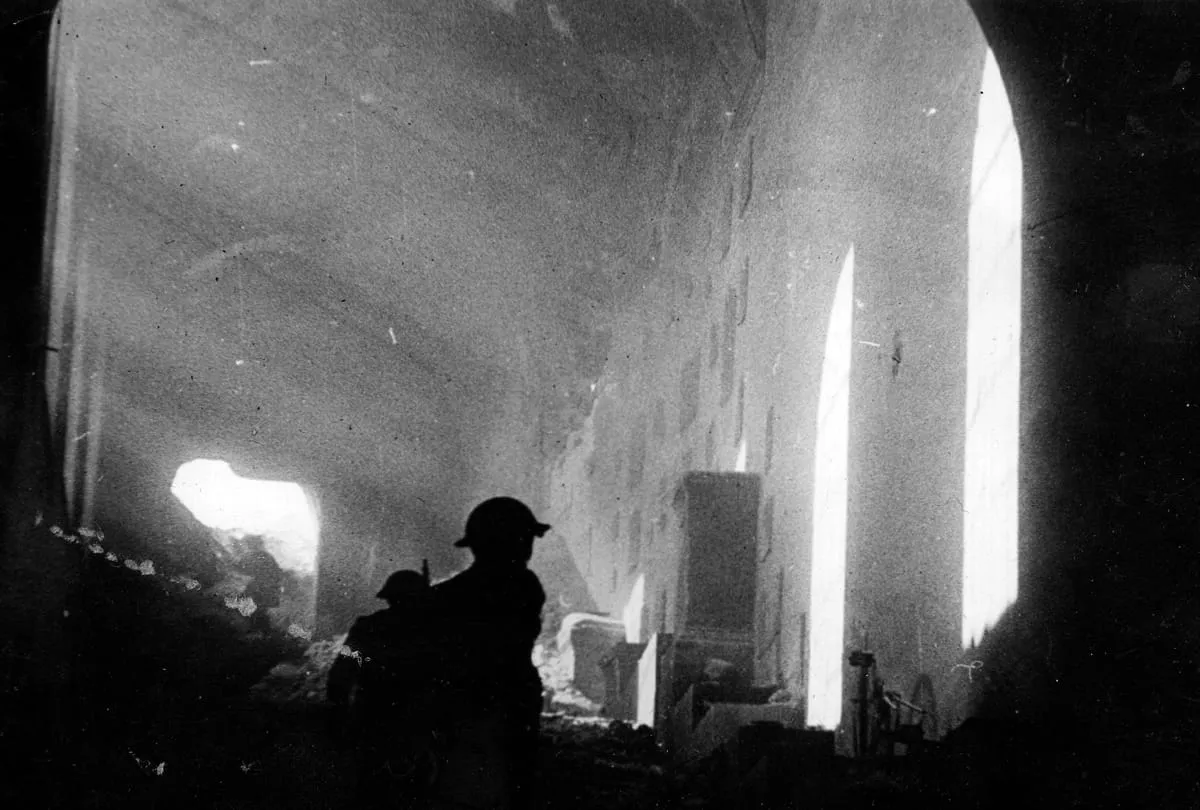
The Battle of Monte Cassino was in fact four successive offensives by which, between January and May 1944, the Allies tried to break the German Gustav Line at its narrowest and most strongly defended point – the mouth of the Liri valley, along which ran the shortest road from Naples to Rome. Above the valley and the small town of Cassino rises the hill of Monte Cassino, crowned by the abbey founded in the 6th century by St Benedict of Nursia – the cradle of Western monasticism. For four months Americans, British, French troops with units from North Africa, New Zealanders, Indians and Gurkhas, Canadians and Poles fought here. In February the monastery was razed by Allied bombers, and on 18 May 1944 its ruins were taken by soldiers of General Władysław Anders’s Polish II Corps. For Poles the name Monte Cassino became a symbol of the whole journey of the soldiers who had reached Italy by way of the Soviet labour camps and the Middle East.
Name and dates
The name “Battle of Monte Cassino” covers four separate operations, usually called the first, second, third and fourth battles. The battle is taken to begin on 17 January 1944, when the British X Corps crossed the lower Garigliano near its mouth. The first battle lasted until 11 February, the second – with the bombing of the abbey – from 15 to 18 February, the third from 15 to 23 March, and the fourth, named Operation Diadem, began on 11 May. The battle is considered to have ended on 18 May 1944, when the Polish flag was raised over the ruins of the monastery and the Germans abandoned Cassino. Fighting for the next defensive line, the Hitler Line (renamed the Senger Line at Hitler’s demand), continued until 25 May, but it belongs to the next stage of the campaign.
Some historians, especially British and American ones, date the first battle from 12 January, when the French corps went into action in the mountains north of Cassino, and others from 15 January, when the Fifth Army, having taken the last hills before the Rapido, came up against the Gustav Line. In German writing the fighting is sometimes called the battles for Cassino (Schlachten um Cassino), and in English also the “Battle for Rome”, since what was at stake in the whole winter and spring campaign was opening the road to the Italian capital.
Background
After the Salerno landings and the capture of Naples, the Allies expected Rome to fall in the autumn of 1943. Reality proved otherwise. Field Marshal Albert Kesselring, commanding the German forces in southern Italy, persuaded Hitler that the peninsula could be held far south of Rome, on successive belts of fortifications running across the country from sea to sea. Every river and every mountain ridge became a line of resistance: the fighting on the Volturno was followed by the autumn downpours, mud and frost, and in November and December General Mark Clark’s Fifth Army bled itself white on the Bernhardt Line – in the mountains around Monte Camino, San Pietro and Monte Sammucro. The last eleven kilometres before Cassino cost the Americans and British some 16,000 killed, wounded and missing. On the other side of the Apennines the British Eighth Army crossed the Sangro and, after bloody fighting by the Canadians, took Ortona in December, but winter blizzards brought it to a halt there too.
Behind the Bernhardt Line the Germans spent the whole autumn building their main position – the Gustav Line. It ran from the mouth of the Garigliano on the Tyrrhenian Sea along that river and its upper course, known as the Gari (which the Allies mistakenly called the Rapido, after the stream flowing through Cassino), through Cassino and the Apennine massifs to the Adriatic coast. Its strongest sector closed the Liri valley, the only convenient route to Rome for tanks and lorries: Route 6, the old Via Casilina. The entrance to the valley was barred by the swollen river, beyond which lay mined and deliberately flooded meadows, and the whole was dominated by the Monte Cassino massif (516–520 m above sea level), with ridges leading on to Monte Cairo (1,669 m).
On the summit stood the Benedictine abbey, one of the most precious sites of Christian Europe, destroyed and rebuilt many times since St Benedict’s day. In the autumn of 1943 officers of the Hermann Göring Division, with the consent of Abbot Gregorio Diamare (PL), removed its archives, library and works of art, including collections from Neapolitan museums stored there; most of it reached the Vatican, although some of the paintings were appropriated for Göring along the way. In December Kesselring assured the Holy See – and, through it, the Allies – that his troops would not occupy the monastery itself, and a zone around its walls was declared off limits to soldiers. German positions, however, lay on the slopes just below the abbey. A few monks remained in the buildings with the abbot, together with several hundred refugees from the surrounding villages and the town.
At the beginning of 1944 the Allied command changed. After the Tehran Conference the landing in France became the priority, and Dwight Eisenhower, appointed to command the invasion, and Bernard Montgomery left the Mediterranean to prepare it. Supreme command in the theatre passed to the British General Henry Maitland Wilson, General Oliver Leese took over the Eighth Army, and General Harold Alexander remained in charge of both armies in Italy – the former 15th Army Group, soon renamed the Allied Armies in Italy. Alexander and Churchill wanted to take Rome that winter, before the landing craft sailed for England for Operation Overlord. The plan was to strike from two directions: the Fifth Army was to break the Gustav Line at Cassino while the US VI Corps under General John Lucas, landed at Anzio behind the German lines (Operation Shingle), cut their supply routes and forced them to retreat. The offensive at Cassino was launched a few days before the landing in order to draw German reserves south from the Rome area.
The Gustav Line was held by General Heinrich von Vietinghoff’s German Tenth Army, and its western sector, including Cassino, was commanded by General Fridolin von Senger und Etterlin’s XIV Panzer Corps – a cavalry officer, a Catholic and a Benedictine lay oblate who knew the value of the abbey well. In the first weeks of January the sector was held by exhausted infantry and panzergrenadier divisions; in time the key positions at Cassino were taken over by the paratroopers of General Richard Heidrich’s 1st Parachute Division, the toughest defenders of the whole battle.
The first battle: the Garigliano, the Rapido and the mountains north of Cassino (17 January – 11 February)
Clark’s plan called for an attack on a front of about 30 kilometres. On the right wing, in the mountains north of Cassino, the French Expeditionary Corps of General Alphonse Juin, made up of the 2nd Moroccan and 3rd Algerian Infantry Divisions, had been attacking since 12 January. On the left wing, by the sea, General Richard McCreery’s British X Corps was to cross the lower Garigliano. In the centre General Geoffrey Keyes’s US II Corps was to cross the Gari at Sant’Angelo, below Cassino, and pass the tanks of the 1st Armored Division into the Liri valley.
On the night of 17–18 January 1944 the British 5th and 56th Infantry Divisions crossed the Garigliano near Minturno and Castelforte. The attack took the weak German 94th Infantry Division by surprise; the British seized a bridgehead and within a few days occupied the hills above the river. Senger judged the situation dangerous, and Kesselring sent him two reserve divisions from the Rome area – the 29th and 90th Panzergrenadier Divisions – which had stabilised the front by 21 January. In this sense the plan worked: German reserves had been drawn away from Rome a few days before the Anzio landing. The 46th Division, however, which was to cross the river nearer the mouth of the Liri on the night of 19–20 January and cover the Americans’ left flank, failed to hold on the far bank. X Corps lost some 4,000 men in the first battle.
The main blow was delivered on the evening of 20 January by General Fred Walker’s US 36th Infantry Division – a Texas National Guard formation still weakened by Salerno and the fighting on the Bernhardt Line. Its men were to carry boats in darkness and fog across mined marshland and cross a fast, icy river straight into the positions of the 15th Panzergrenadier Division. Preparations were hurried, and Walker himself had regarded the task as hopeless from the outset. Only isolated battalions of the 141st and 143rd Regiments reached the far bank; no bridges were built, the tanks did not get across, and the cut-off groups were destroyed by artillery, mortar and machine-gun fire. A renewed attempt on 21 January ended the same way. Within 48 hours the division lost, according to the US official history, 1,681 killed, wounded and captured (other tallies give about 2,100); the Germans recorded in their reports merely that a local attack had been repulsed. After the war the division’s veterans secured hearings in the United States Congress on Clark’s responsibility for the crossing; the committee brought no charges against him.
From 24 January Keyes tried another route. General Charles Ryder’s 34th Infantry Division crossed the flooded Rapido valley north of the town, where the river could be forded and tanks could move only along tracks laid with steel matting. After eight days of fighting the Americans took the village of Cairo and forced their way into the mountains, then turned south along the ridges towards the monastery. At the same time the French, in fierce fighting, took Colle Belvedere and Colle Abate but failed to capture Monte Cifalco, from which the Germans could overlook their rear. Juin was convinced that by pressing on through the mountains Cassino could be outflanked from the north, but his request for reserves was turned down; by 31 January the French attack had stalled, and the two divisions had lost about 2,500 men.
At the beginning of February men of the 34th Division reached Point 445, less than 400 metres from the abbey walls, and their patrols got right up to the escarpment below the monastery. They could not, however, take Point 593 (Monte Calvario), the key point on the ridge, which was held by paratroopers. Senger, alarmed at the rate of losses, asked at this point for the battle to be broken off and for a withdrawal to a new line, but Kesselring refused and sent reinforcements. The last three-day assault on the monastery hill and the town collapsed on 11 February. The infantry battalions of the 34th Division had lost up to 80 per cent of their strength; in all the division lost some 2,200 men.
The first battle brought no breakthrough, and the Anzio landing of 22 January, instead of forcing the Germans to abandon the Gustav Line, itself became bogged down in a beachhead surrounded by the hastily formed German Fourteenth Army under General Eberhard von Mackensen. From then on the roles were reversed: the attacks at Cassino were meant to relieve the threatened beachhead. The exhausted II Corps was replaced by the fresh New Zealand Corps, formed from divisions brought over from the Adriatic front under the command of General Bernard Freyberg.
The second battle: the destruction of the abbey (15–18 February)
The New Zealand Corps consisted of the 2nd New Zealand Division, now commanded by General Howard Kippenberger, and General Francis Tuker’s 4th Indian Infantry Division – veterans of the fighting in North Africa, in which Gurkhas and a British battalion of the Royal Sussex served alongside Hindu and Muslim battalions. It had only a few days to prepare, because at Anzio the Germans were preparing a major counter-offensive. Freyberg intended to continue the American plan: the Indians were to take the ridges above the monastery and the monastery hill itself, while the New Zealanders crossed the Rapido along the railway embankment and seized the station on the southern edge of the town, opening the way for tanks into the Liri valley. He himself rated the chances of success at roughly fifty-fifty.
Before a shot was fired, a dispute broke out over the abbey. Tuker, who had fallen ill and been sent to hospital, argued that whether or not the Germans were in the monastery, the massive building with walls several metres thick could become a fortress for them at any moment, and that his men could not be asked to storm a hill crowned by an intact building; he demanded that it be destroyed with the heaviest bombs. Freyberg backed the request. Clark and his staff were opposed, and General Keyes, who had flown over the monastery several times, maintained that he had seen no Germans in it. The airmen – the commander of the Mediterranean Allied Air Forces, General Ira Eaker, and Wilson’s deputy, General Jacob Devers – claimed on the contrary, after flying over the hill, that they had seen troops there. The decision lay with Alexander, who agreed to the bombing. It is now known that the Germans kept their undertaking and did not occupy the monastery itself, although their positions lay just below its walls.
On the morning of 15 February 1944, 142 B-17 heavy bombers appeared over Monte Cassino, followed by several dozen B-25 and B-26 medium bombers. According to the most commonly cited calculations they dropped about 1,150 tons of high-explosive and incendiary bombs; between the raids artillery shelled the hill. The abbey was turned into a heap of rubble with fragments of wall jutting from it. Allied soldiers and war correspondents cheered at the sight of the explosions; Juin is said to have remarked at the time that nothing would be achieved this way. Some 230 Italian civilians who had taken refuge in the monastery were killed; there is no evidence that a single German soldier died in the abbey, whereas some bombs fell on Allied positions and even on Fifth Army headquarters at Presenzano. The raid had not been co-ordinated with the ground forces either: the Indians, who had only just taken over positions from the Americans, were not ready for an immediate assault, and the paratroopers’ positions on Point 593 remained untouched. On 17 February Abbot Diamare, a few surviving monks and the last refugees came down from the ruins; once the monastery had been destroyed, the Germans had no qualms about setting up defensive positions in the rubble, and the ruins proved better cover for them than the intact building would have been.
On the night after the raid a company of the 1st Battalion, Royal Sussex Regiment, attacked Point 593 from a distance of a few dozen metres and lost half its strength. The following night the whole battalion repeated the attack – again without success, and shells from its own artillery, passing low over the ridge, also fell on its ranks. On the night of 17–18 February the main assault went in: the Rajputs of the 4th Battalion, 6th Rajputana Rifles, against Point 593, and two Gurkha battalions – one against Point 444, the other straight up the ravines towards the monastery. The fighting was hand to hand on bare rock, but the paratroopers held their positions. In the valley two companies of the 28th (Maori) Battalion of the New Zealand Division crossed the Rapido and took the railway station, but the sappers failed to build a crossing for the tanks in time. In the afternoon of 18 February a German counter-attack supported by tanks forced the Maori back across the river. Freyberg called off the attack. After the war Senger admitted that he had feared a thrust by the French Moroccan and Algerian divisions through the mountains more than another frontal assault on Cassino.
The destruction of the abbey provoked outrage in the Vatican. Pope Pius XII remained publicly silent, but the Cardinal Secretary of State, Luigi Maglione, called the raid a colossal blunder in conversation with an American diplomat. German propaganda exploited the destruction as proof of Allied “barbarism”, and the abbot, at the Germans’ request, signed a statement that there had been no soldiers in the monastery. The debate over whether the bombing was necessary continues to this day; most historians regard it as a mistake, both moral and military.
The third battle: the destruction of the town (15–23 March)
After the failure of the February attack Freyberg decided to strike at Cassino from the north, down the Rapido valley: the New Zealanders were to take the town itself, while the Indians advanced along the slopes of the monastery hill. Once the gap between the town and the hill had been cleared, the British 78th Infantry Division was to enter the Liri valley. The key to success was to be an unprecedented bombing raid that would crush the town’s defences. The operation required three days without rain so that the tanks could cross the sodden ground, and for three weeks the troops waited in freezing mud for the weather to improve. During that time General Kippenberger lost both feet on a mine, which badly depressed the New Zealanders. Heidrich’s paratroopers meanwhile took over the defence of Cassino and the monastery hill.
The third battle began at 8.30 a.m. on 15 March 1944. For three and a half hours heavy and medium bombers dropped delayed-action bombs on the town – from about 750 to over 1,000 tons, according to different calculations; the raid was inaccurate, and some of the loads fell on Allied positions and even on Venafro, more than ten kilometres away, where soldiers and civilians were killed. Then more than 700 guns opened fire on the ruins, and the 6th New Zealand Brigade advanced with tanks behind the barrage. Of the roughly 300 paratroopers in the town about half were killed, but the survivors quickly emerged from the cellars and began to shoot. Rubble and bomb craters blocked the streets so that the tanks could not get through, and in the evening, contrary to the forecasts, rain poured down, flooding the craters and turning the town into a quagmire. By destroying Cassino, the Allies had created ideal fighting ground for its defenders.
Even so, the New Zealanders took Castle Hill with the ruins of its medieval fortress, and the 1st Battalion, 9th Gurkha Rifles, fought its way on to Hangman’s Hill (Point 435), only about 250 metres from the ruins of the monastery, where it held out surrounded for nine days, supplied by air drops. On 17 March the New Zealanders, with tanks, took the railway station. On 19 March the paratroopers counter-attacked from the monastery ruins against Castle Hill and thwarted the assault on the abbey; the same day the tanks that sappers had secretly brought up a mountain track (the “Cavendish Road”) as far as Albaneta Farm behind the monastery were destroyed, having no infantry support.
On 23 March Alexander conferred with his commanders. The New Zealand and Indian Divisions were exhausted, and Freyberg concluded that further attacks were pointless. The battle was called off; over the following days the Gurkhas and the cut-off New Zealanders were evacuated from Hangman’s Hill. The New Zealand Corps was disbanded on 26 March and the sector was taken over by units of the British XIII Corps. On the Cassino front the 4th Indian Division lost about 3,000 men in all, and the 2nd New Zealand Division about 1,600 killed, wounded and missing. The German paratroopers also paid a high price – according to the XIV Corps war diary, the front-line battalions numbered between 40 and 120 men each on 23 March – but they held Cassino and the monastery. Their defence passed into legend, and the paratroopers themselves earned the nickname “the green devils of Cassino”.
The fourth battle: preparations for Operation Diadem
After three failed attacks Alexander and his chief of staff, General John Harding, concluded that blows by single divisions on a narrow sector would not break the Gustav Line. They decided to wait until spring, when the ground had dried out, and to regroup so that two armies could attack simultaneously along the front from the sea to Cassino. Leese’s Eighth Army was moved in secret from the Adriatic to Cassino; its XIII Corps (General Sidney Kirkman) was to cross the Gari and enter the Liri valley, while the I Canadian Corps waited in reserve, ready for the pursuit. Clark’s Fifth Army concentrated on the narrow strip from the lower Garigliano to the sea: on the left the US II Corps, on the right Juin’s French corps, reinforced to four divisions plus groups of mountain tabors, which was to cross the wild Monti Aurunci, considered by the Germans all but impassable. At the right moment VI Corps was to break out of the Anzio beachhead. Staff deception measures and dummy radio traffic were meant to convince Kesselring that the Allies were preparing a new landing at Civitavecchia, north of Rome; the Germans did indeed keep some of their reserves there.
The hardest task – the capture of the Monte Cassino massif, on which all the earlier attacks had broken – fell to the Polish II Corps. The corps had grown out of the army that Anders had formed in the USSR in 1941 and 1942 from Polish citizens released from the labour camps and prisons, and had led out through Iran to the Middle East. It comprised General Bolesław Duch’s 3rd Carpathian Rifle Division, in which veterans of Tobruk from the Independent Carpathian Rifle Brigade also served, and General Nikodem Sulik’s 5th Kresowa Infantry Division, together with the 2nd Armoured Brigade, the corps artillery and reconnaissance regiments. The corps had arrived in Italy around the turn of 1943 and 1944 and from February had held a sector on the Sangro. Each division had only two brigades, and there was no way to replace losses – there was no recruitment in occupied Poland, and no one could get out of the USSR any longer.
On 24 March Leese proposed to Anders that the corps take Monte Cassino and Piedimonte. Anders, well aware of the risk, accepted the task without consulting the Commander-in-Chief, General Kazimierz Sosnkowski, who opposed a frontal assault that would bleed white the only Polish corps at the front. Anders believed that, after Moscow had broken off relations with the Polish government in April 1943 and in the face of Soviet propaganda accusing the Poles of shirking the fight against the Germans, victory in a battle the whole world was talking about would do more for the Polish cause than any diplomatic note. The German positions in the massif formed two rings of hills joined in a figure of eight – Point 593, Massa Albaneta, Colle Sant’Angelo, Phantom Ridge (Widmo) and Point 569 covered one another, so that every point under attack came under fire from several others. The Polish plan provided for a simultaneous attack by the 3rd Carpathian Division on Point 593 and Albaneta and by the 5th Kresowa Division on Phantom Ridge and Sant’Angelo, followed by a descent behind the monastery to link up with the British in the Liri valley on Route 6.
Facing the Poles once again were units of the 1st Parachute Division, while the whole sector from Cassino to the sea was held by the Tenth Army’s XIV Panzer Corps and LI Mountain Corps. At the beginning of May Senger was on leave in Germany, and many other senior German commanders were away from their posts – the Allies took the enemy by surprise with the timing of the attack.
The fourth battle: the breakthrough (11–18 May)
At 11 p.m. on 11 May 1944 some 1,600 guns of the two armies opened fire along the whole front from Cassino to the sea. The Poles went in at 1 a.m. on 12 May. They advanced into unknown ground, because Eighth Army headquarters, wishing to hide the corps’ presence from the Germans, had forbidden any earlier patrolling of the approaches. Battalions of the 3rd Carpathian Division took Point 593 and beat off several counter-attacks, but fire from Albaneta and Point 569 decimated them; men of the 5th Kresowa Division broke on to Phantom Ridge but were stopped short of Sant’Angelo by fire from the ravines. The artillery had not destroyed the concrete bunkers. In the afternoon Anders pulled his units back to their start lines. The first attack cost the corps several hundred killed and wounded, but it tied down a large part of the German reserves in the massif while the outcome of the battle was being decided in the valley and in the mountains to the south.
For it was there that the breakthrough came. The British XIII Corps seized bridgeheads over the Gari with difficulty, and on 13 May the 8th Indian Division built bridges for the tanks. The French attack proved even more important: on 13 May the 2nd Moroccan Infantry Division took Monte Maio, and Moroccan goumiers and mountain troops crossed the Monti Aurunci where the Germans expected no attack at all, and from 14 May began working round to the rear of the Gustav Line. On the coast the Americans, after heavy fighting, took Santa Maria Infante and pushed on towards Formia. South of the Liri the Gustav Line had ceased to exist, and the defenders of Cassino were in danger of being cut off.
The second Polish attack began on the night of 16–17 May. A Lwów battalion of the 5th Kresowa Division took and held Phantom Ridge; on 17 May the Poles captured Point 593 and, towards evening, the northern part of Colle Sant’Angelo and Albaneta, beating off counter-attacks in fighting with grenades and bayonets. The same day the British 78th Division cut Route 6 in the Liri valley. Kesselring, faced with the encirclement of the divisions in the massif, agreed to a withdrawal to the Hitler Line. On the night of 17–18 May the paratroopers abandoned the ruins of the abbey and the town. On the morning of 18 May a patrol of the 12th Podolian Uhlan Regiment under Second Lieutenant Kazimierz Gurbiel entered the ruins of the monastery, took prisoner a dozen or so wounded Germans and their medical orderlies, and hoisted the regimental pennant on the walls, followed soon afterwards by the white and red Polish flag; beside it, on Anders’s orders, the British flag was also raised. At noon Lance Sergeant Emil Czech played the Hejnał – the trumpet call of St Mary’s Church in Kraków – on the ruins. The same day the British 4th Division finally cleared the rubble of Cassino.
On the night of 17–18 May the poet and actor Feliks Konarski, who was attached to the corps, wrote the words of the song “The Red Poppies on Monte Cassino”, which, set to music by Alfred Schütz, was first performed as early as 18 May. The Poles fought on: on 19 May they cleared the last hills of the massif, and by 25 May they had taken Piedimonte, breaking the Hitler Line in their sector, and Monte Cairo. Meanwhile, on 23 May, the Canadians attacked the Hitler Line in the Liri valley and VI Corps broke out of the Anzio beachhead. Instead of cutting off the retreating German Tenth Army, Clark sent most of his forces towards Rome, which the Fifth Army entered on 4 June 1944. The Germans fell back northwards to the Gothic Line.
Losses
Casualty figures vary depending on whether they cover only the four battles at Cassino or the whole operation including Anzio and the advance on Rome. According to the American historian Alan Axelrod, the Allies lost some 55,000 killed, wounded and missing in the battles for Cassino, and the Germans some 20,000 killed and wounded. Matthew Parker puts Allied losses in the four battles and the fighting at Anzio, up to the capture of Rome, at more than 105,000, and those of the Axis at no fewer than 80,000. According to James Holland, in Operation Diadem alone (11 May – 6 June) the Allies lost about 43,700 men and the Germans about 51,700. The losses of the Polish II Corps in the fighting for Monte Cassino and Piedimonte amounted, according to Polish tallies, to 923 killed, 2,931 wounded and 345 missing. The Polish dead were buried on the slope between the monastery and Point 593, in the Polish War Cemetery at Monte Cassino, opened on 1 September 1945; in 1970 Anders, too, was laid to rest there.
Civilians were also victims of the fighting: according to Italian figures some 2,000 of Cassino’s 20,000 pre-war inhabitants were killed, in addition to people from the surrounding villages killed by bombing and shelling, by mines and during forced evacuations, and the refugees who died in the abbey. After the front was broken in May, mass rapes and killings were committed in the area of the Monti Aurunci and in Ciociaria by soldiers of French colonial units, mainly Moroccan ones; in Italy these crimes came to be known as the “marocchinate”. The number of victims is disputed – estimates range from several hundred to several thousand women and men – and the French command was slow to respond.
Significance
The Battle of Monte Cassino was the longest and bloodiest battle fought by the Western Allies against the Germans on the Italian front. For four months a few German divisions, exploiting the mountains, the rivers, the winter and their opponents’ mistakes, held off much stronger armies backed by an air force that commanded the skies. The first three attacks – mounted in haste, by single divisions and under pressure from events at Anzio – exposed the limits of frontal assault in the mountains. Only the fourth, a carefully prepared offensive by two armies on a broad front, achieving surprise in both time and place, broke the defence. The French outflanking move through the Monti Aurunci proved decisive, while the Polish assault on the massif tied down the best German troops and closed the final chapter of the battle.
The strategic verdict remains contested. Supporters of the Italian campaign stress that it tied down more than a dozen German divisions in Italy, and that the capture of Rome on 4 June, on the eve of the Normandy landings, was an important political success. Critics – from J.F.C. Fuller to John Ellis – write of a campaign devoid of strategic sense, and accuse Clark of throwing away, for the sake of taking Rome, the chance to encircle the German Tenth Army, which withdrew to the Gothic Line and held out in Italy until the spring of 1945. The destruction of the abbey became a warning against bombing historic monuments; the monastery was rebuilt after the war to its original plans, and in 1964 Pope Paul VI reconsecrated the basilica.
For Poles Monte Cassino became a symbol. The victory of soldiers who had passed through Soviet prisons and labour camps brought the Polish Army worldwide renown but did not change the country’s fate: a few months later the Yalta Conference placed Poland in the Soviet sphere of influence, and most of the soldiers of II Corps remained in exile after the war. For years the authorities of communist Poland played down the importance of the battle and of its commander, and its memory was kept alive by the song “The Red Poppies”, the books of Melchior Wańkowicz and the émigré community. The inscription in the cemetery below the monastery reads: “Passer-by, tell Poland that we fell faithful in her service.”