- Category:
- Politics
- Date:
- 5 June 1945
- Author:
- Łukasz
- Tags:
- Germany, Soviet Union, United States, United Kingdom
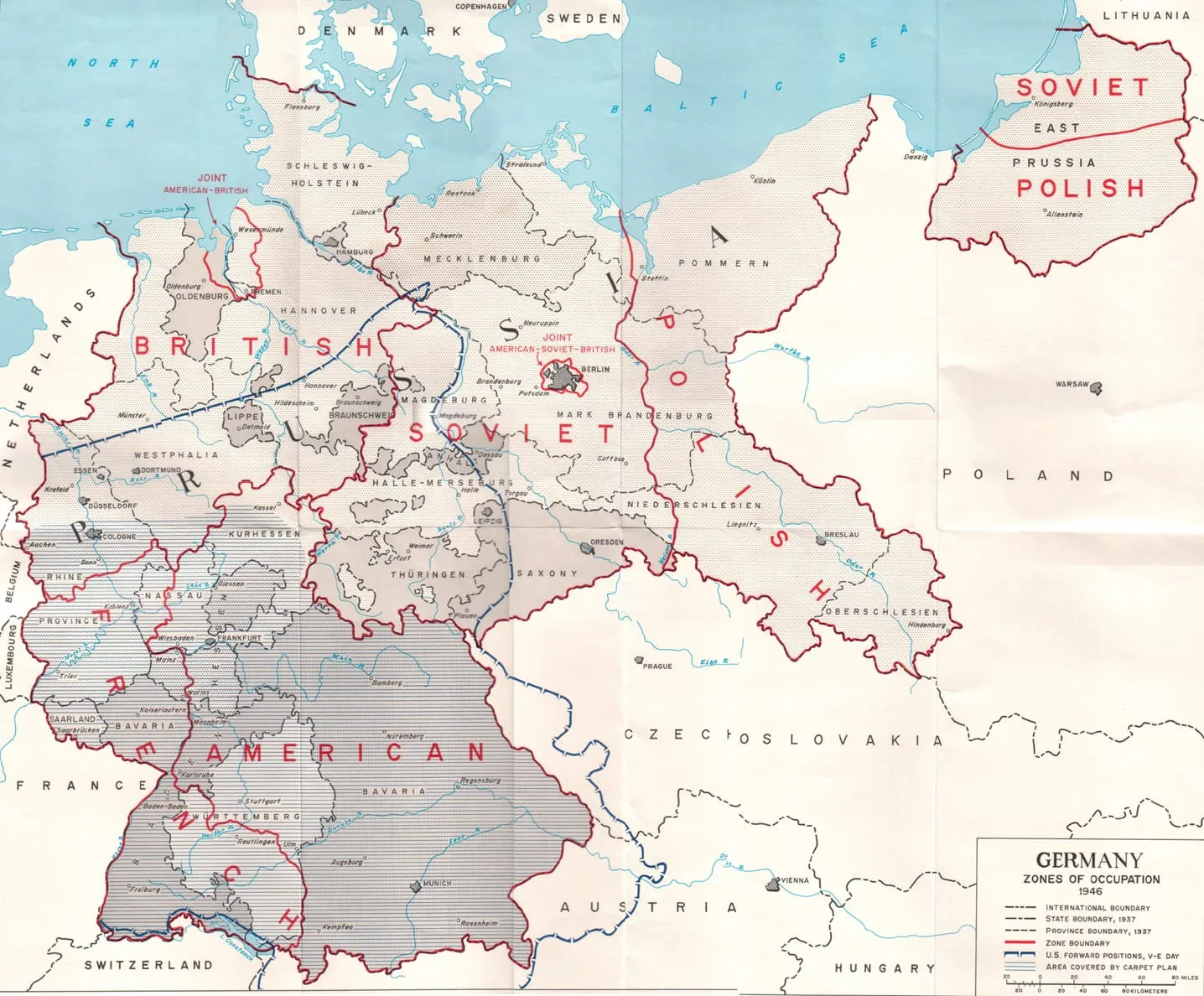
On 5 June 1945, at the headquarters of Marshal Georgy Zhukov in Wendenschloss, a suburban part of the Berlin district of Köpenick, the four Allied commanders-in-chief – General Dwight Eisenhower for the United States, Zhukov for the Soviet Union, Field Marshal Bernard Montgomery for the United Kingdom and General Jean de Lattre de Tassigny for the Provisional Government of the French Republic – signed the “Declaration regarding the defeat of Germany and the assumption of supreme authority with respect to Germany”, known as the Berlin Declaration. In it the governments of the four powers announced that there was no central government or authority in Germany capable of maintaining order, administering the country and complying with the demands of the victors, and that they therefore assumed supreme authority in Germany themselves – together with all the powers of the Reich government, the High Command of the Wehrmacht and the state, municipal and local authorities.
On the same day three statements accompanying the declaration were published: on the zones of occupation, on the control machinery – that is, the Allied Control Council – and on consultation with the governments of other states. War chronologies often sum up the day by saying that the Allies “agreed on the division of Germany into four zones of control: American, British, French and Soviet”. That is a simplification. The division into zones itself had been negotiated much earlier in London, and the boundaries of the French zone were not settled until July. Yet 5 June 1945 was the first time the division was announced publicly and given a legal basis – and, above all, the day on which the four victors formally took power over a state whose government had ceased to exist.
The act that replaced the German government
The surrender signed at Reims on 7 May and repeated at Berlin-Karlshorst on the night of 8–9 May 1945 was a purely military act. It was signed by representatives of the High Command of the Wehrmacht, and its subject was the laying down of arms by the German armed forces. Article 4 of the Karlshorst instrument provided that it would be superseded by a general instrument of surrender imposed on Germany by the United Nations. Such a text existed: it had been drawn up in 1944 in London by the European Advisory Commission, made up of representatives of the United States, the United Kingdom and the USSR, and from November 1944 of France as well. It had been assumed at the time that the surrender would be signed by some German government – for instance a cabinet formed after Hitler had been overthrown by the military.
That never happened. Nazi rule lasted to the end, Hitler took his own life on 30 April, and the Allies judged the government of his appointed successor, Grand Admiral Karl Dönitz, incapable of representing the German state. On 23 May the British, on Eisenhower’s orders, arrested the members of the Flensburg government. There was thus no one with whom an agreement could be concluded. The surrender text prepared in London was reworked into a unilateral declaration by the victors, supplemented by a lengthy preamble. The powers signed nothing with the Germans – they stated a fact and announced the terms that Germany was to carry out.
The preamble stated that the German armed forces on land, at sea and in the air had been completely defeated and had surrendered unconditionally, and that Germany, “which bears responsibility for the war”, was no longer capable of resisting the will of the victorious powers. Immediately afterwards came a reservation that would matter in later legal disputes: the assumption of supreme authority “does not effect the annexation of Germany”. At the same time the four governments announced that they would in future determine the boundaries of Germany or any part of it and the status of Germany or of any area then forming part of German territory.
Zones agreed long before the surrender
The division of Germany into zones of occupation was the fruit of more than a year’s work by the European Advisory Commission. On 12 September 1944 its members signed a protocol in London that divided Germany within its frontiers of 31 December 1937 into three zones and set aside a special area of Greater Berlin, to be occupied jointly by the three powers. The eastern zone was assigned to the USSR from the outset; the British and Americans were still arguing over which of them would take the north-western zone and which the south-western. The dispute was settled at the Second Quebec Conference: Britain received the north-west with the Ruhr, the United States the south with Bavaria, Hesse and Württemberg, together with the right to use the ports of Bremen and Bremerhaven. The amended agreement was signed on 14 November 1944, along with an agreement on control machinery providing for a joint body of the commanders-in-chief.
In February 1945, at the Yalta Conference, the leaders of the Big Three approved this division, and Winston Churchill secured a share for France: it was to receive a zone carved out of the areas intended for the British and Americans, as well as a seat on the Control Council. Joseph Stalin agreed on condition that this would not come at the expense of the Soviet zone. On 1 May 1945 the Commission amended the control machinery agreement to include France, but the boundaries of the French zone and of its sector in Berlin could not be fixed before the surrender. The Commission signed the relevant agreement only on 26 July 1945: the French received the south-western part of Germany along the French border (the Palatinate, the Saar, southern Baden and Württemberg, and part of the Rhineland), and in Berlin two northern districts taken from the British sector.
The statement on zones of 5 June therefore introduced nothing new in principle. It declared that Germany within its frontiers of 31 December 1937 would be divided into four zones – an eastern one for the USSR, a north-western one for Britain, a south-western one for the United States and a western one for France – and that the area of Greater Berlin would be occupied by forces of each of the four powers. The exact lines of division followed from the earlier protocols. What was new was that they became public knowledge and that from then on the four governments acted in Germany on the basis of a jointly proclaimed act.
The signing at Wendenschloss
The day of the signing was a tense one. Eisenhower flew in from Frankfurt am Main in the morning, expecting to return to his headquarters in the afternoon. Montgomery and de Lattre arrived separately. The Western commanders were driven to a former villa on the Spree that housed Zhukov’s headquarters and told to wait. According to Eisenhower’s account, Zhukov held up the ceremony because one of the declaration’s articles covered the forces and nationals of states at war with any of the Allies, and thus also Japanese present in Germany – whereas the USSR was not at war with Japan, and the Soviet marshal could not commit himself to this without Moscow’s consent. Eisenhower at once agreed that the disputed wording should not bind the Soviet side, which, as he wrote, surprised Zhukov; accounts differ as to the form in which this was recorded, since the published text kept the general article on the forces of states “at war with any of the Allies”. The following hours were spent agreeing details and waiting for approval from Moscow.
In the end the four commanders signed the document in four copies – in English, Russian, French and German – in the presence of photographers and newsreel cameramen. After the signing Zhukov gave a reception. Eisenhower left early so as to return to Frankfurt the same day. Before leaving, he asked whether the staffs of the four commanders could begin work at once as the Control Council. Zhukov refused: in his view the Council could start work only once the forces of all the powers had withdrawn into their own zones. This brief exchange foreshadowed the most important dispute of the weeks that followed.
What the declaration laid down
The declaration had 15 articles. The first of them concerned the completion of the military surrender: all German armed forces, including the SS, the SA and the Gestapo, were to be completely disarmed, and their members treated as prisoners of war pending the victors’ decision. Germany had to hand over its weapons, ships, aircraft, fortifications and stores, disclose minefields, surrender military and intelligence records, and keep its means of transport and communication intact. It was to release forthwith Allied prisoners of war and political prisoners, as well as all foreigners detained or compelled to work in Germany. By June 1945 these obligations had already largely been fulfilled, either by the Allied armies themselves or under their supervision.
Two articles mattered most for Germany’s future. Article 11 required the arrest and handing over to Allied representatives of the principal Nazi leaders and of all persons they named as suspected of having committed, ordered or abetted war crimes. This was the legal basis for the later arrests and trials – from the Nuremberg trial of the major war criminals to hundreds of trials in the individual zones. Article 13 gave the four governments the right to take whatever steps, “including the complete disarmament and demilitarization of Germany”, they deemed necessary for future peace and security, and to impose additional political, administrative, economic, financial and military requirements on Germany. This article later underpinned denazification, the dismantling of industry for reparations and, in the Soviet zone, land reform and the restructuring of the entire economy.
The declaration did not, however, contain the clause on the dismemberment of Germany that the Big Three had added to the draft instrument of surrender at Yalta. By May 1945 plans to split Germany into several states had in practice been abandoned – Stalin announced in his address of 9 May that the USSR intended neither to dismember nor to destroy Germany – and the country’s future was to depend on the common policy of the occupiers.
Lawyers later argued over what had actually become of the German state. The Allies held that, in the absence of any German authority, they assumed full sovereignty, but without annexation; some German lawyers maintained that the Reich had survived as a subject of international law and that the victors were merely exercising authority within it. The compatibility of the sweeping powers in Articles 11 and 13 with the Hague Conventions, which limited an occupier’s rights in wartime, was also questioned. The Allies replied that the occupation of Germany was exceptional, since its aim was the lasting eradication of Nazism and militarism. The dispute had a long life: even after German reunification in 1990 courts heard claims by descendants of landowners expropriated in the Soviet zone, and in 2005 the European Court of Human Rights described the occupation as a situation of a special kind that had vested sovereign powers in the occupying powers.
The Control Council and the Kommandatura
The second statement of 5 June set out the machinery for exercising authority. During the period in which Germany was carrying out the basic requirements of unconditional surrender, supreme authority was to be exercised by the four commanders-in-chief – each in his own zone on the instructions of his own government, and jointly in matters affecting Germany as a whole. For this purpose they formed the Control Council, which took its decisions unanimously. The Council was to be supported by a Co-ordinating Committee made up of the commanders’ deputies and by an executive staff divided into directorates. The administration of Greater Berlin was to be directed by an inter-Allied authority – the Kommandatura – made up of the four sector commandants and working under the Council’s supervision.
The unanimity rule meant that each power could block a joint decision, while the division of authority by zones gave each of them a free hand in its own area. Both features weighed heavily on Germany’s fate. The Control Council met for the first time on 30 July 1945, and on 30 August issued a proclamation announcing its establishment. Over the following years it issued dozens of laws and directives – on the dissolution of the NSDAP, the repeal of Nazi laws and disarmament – but on economic and political matters it increasingly became bogged down in disputes. Each power governed its zone in its own way, and in March 1948 the Soviet representative walked out of a session and the Council ceased to function. The third statement announced that the Council would consult the governments of other United Nations on matters concerning them; in practice the smaller allies, Poland among them, had no voice in it.
The demarcation line and the zonal boundaries
Zhukov’s refusal touched on an issue that had divided the West for weeks. At the moment of surrender, American and British troops stood far to the east of the boundary of the future Western zones – on the Elbe and the Mulde, where on 25 April they had met the Red Army, in Thuringia, in western Saxony with Leipzig and Halle, in part of Saxony-Anhalt and in western Mecklenburg with Wismar and Schwerin. This was territory that under the London protocols belonged to the Soviet zone. Berlin, on the other hand, which under the same protocols was to be administered jointly, had been captured and was held solely by the Red Army – Eisenhower had deliberately given up the drive on Berlin in March 1945.
Churchill wanted to exploit this situation. On 12 May, in a telegram to President Harry Truman, he wrote of an “iron curtain” drawn down upon the Soviet front and urged that troops should not be withdrawn to the zonal boundaries until the questions of Poland, Austria and the Balkans had been cleared up and the leaders of the Big Three had met. The Americans took a different view. They believed that the zonal agreements had to be honoured, that delay would undermine Stalin’s trust and his participation in the war against Japan, and that entry into Berlin and the functioning of the Control Council depended on withdrawal to the agreed lines. Zhukov’s refusal on 5 June showed that the Russians regarded the two matters as a single package.
On 12 June Truman informed Churchill that he could not delay the withdrawal and proposed that it should begin on 21 June, simultaneously with the entry of the Western garrisons into Berlin and transit through the Soviet zone. Stalin asked for the date to be put back to 1 July, because his commanders were to be in Moscow for the session of the Supreme Soviet and the Victory Parade on 24 June. The withdrawal of American and British troops from Thuringia, Saxony and Mecklenburg began on 1 July 1945; in the same days American and British units entered the western sectors of Berlin, followed in August by French ones. From this division of the city grew West Berlin – a Western enclave in the middle of the Soviet zone, which during the Cold War became one of its main flashpoints.
Zhukov, appointed commander-in-chief of the Soviet occupation forces, took charge on 9 June 1945 of the Soviet Military Administration in Germany. As early as 10 June an order of the administration permitted “anti-fascist” political parties and trade unions to operate in the Soviet zone – earlier than in the Western zones – which opened the way to the rebuilding of the Communist Party of Germany under the direction of men brought from Moscow. Each of the zones began to lead a life of its own before the Control Council had met even once.
Poland and the Oder–Neisse frontier
Poland was not a party to the declaration, but it concerned Poland directly. The powers assumed authority over Germany “within her frontiers as they were on 31 December 1937”, and under the London protocols all the territory of the Reich east of the demarcation line, including Pomerania, Silesia and East Prussia, formally belonged to the Soviet zone. In reality, since March 1945 a Polish administration had already been operating, with the consent of the Soviet authorities, in the lands east of the Oder and the Lusatian Neisse, while the northern part of East Prussia with Königsberg was held by the USSR. The declaration did not settle this question – it merely stipulated that Germany’s frontiers would be determined in future by the four powers.
The question of where Poland’s western frontier would run thus remained open until the Potsdam Conference. Its decisions, announced on 2 August 1945, placed the lands east of the Oder and the Lusatian Neisse and the former Free City of Danzig under Polish administration, and deferred the final delimitation of the frontier to a peace conference. That conference never took place. The Oder–Neisse line was recognised by the GDR in 1950, by the Federal Republic in a treaty of 1970, and by reunified Germany in the treaty concluded after the “Two Plus Four” negotiations in 1990 and in the Polish–German border treaty of the same year.
The declaration also concerned Poles in another way. In summer 1945 – according to various estimates – more than a million Polish displaced persons were living in the Western zones of occupation: former forced labourers, concentration camp prisoners and prisoners of war. The article ordering Germany to release foreigners held in the Reich gave them formal protection, but their fate was now decided by the occupation authorities and by repatriation policy. In the British zone occupation duties were performed by General Stanisław Maczek’s 1st Armoured Division; in May 1945 the inhabitants of the small town of Haren on the Ems were expelled, and as Maczków it became for several years a centre of Polish life in Germany.
Significance
The Berlin Declaration brought the war with Germany in Europe to a legal close: the surrender of the army was followed by the takeover of the state. From 5 June 1945 until the creation of two German states in 1949, supreme authority in Germany was exercised solely by the victors, and some of their rights – those concerning Berlin and Germany as a whole – expired only in 1991, when the “Two Plus Four” treaty came into force. The model of joint authority laid down in the declaration, based on unanimity, presupposed lasting cooperation between the powers. Yet as early as June 1945 the dispute over the demarcation line and Berlin showed that each side was thinking first and foremost of its own zone. The Potsdam Conference in July and August was meant to give this system political substance; in practice the division into zones, conceived as temporary, became for more than forty years the division of Germany and of Europe.
Sources
Meanwhile
(04)Elsewhere, within a week.
- 10 June 1945 · PacificThe landing in Brunei BayOn 10 June 1945 the Australian 9th Division landed on Labuan and the coast of Brunei, and on 13 June it took the town of Brunei.
- 11 June 1945 · Western FrontThe liberation of SchiermonnikoogOn 11 June 1945 the last German soldiers left Schiermonnikoog, the last scrap of the Netherlands under occupation, over a month after the surrender.
- 29 May 1945 · Middle EastThe Levant crisisOn 29 May 1945 French troops attacked the parliament in Damascus and shelled the city. British intervention forced the French back to their barracks.
- 29 May 1945 · PacificThe raid on YokohamaIn late May 1945 B-29s burned Tokyo (nights of 23/24 and 25/26 May) and Yokohama (29 May, 454 bombers escorted by P-51s). Thousands of civilians died.
Related events
(04)The same battle, people or subject.
- 7 May 1945 · Western FrontThe surrender at ReimsAt 2.41 a.m. on 7 May 1945, at Eisenhower's headquarters in Reims, General Alfred Jodl signed the unconditional surrender of all German armed forces.
- 25 April 1945 · Western FrontThe meeting on the ElbeOn 25 April 1945 patrols of the US 69th Infantry Division met Red Army soldiers on the Elbe near Strehla and at Torgau. The Reich was cut in two.
- 17 July 1945 · DiplomacyThe Potsdam Conference beginsOn 17 July 1945 Truman, Churchill and Stalin opened the last Big Three conference at Cecilienhof Palace in Potsdam, devoted to Germany and Poland.
- 8 May 1945 · Eastern FrontThe surrender at KarlshorstOn 8 May 1945 in Berlin-Karlshorst, Keitel, Friedeburg and Stumpff signed Germany's final act of unconditional surrender before Zhukov and Tedder.