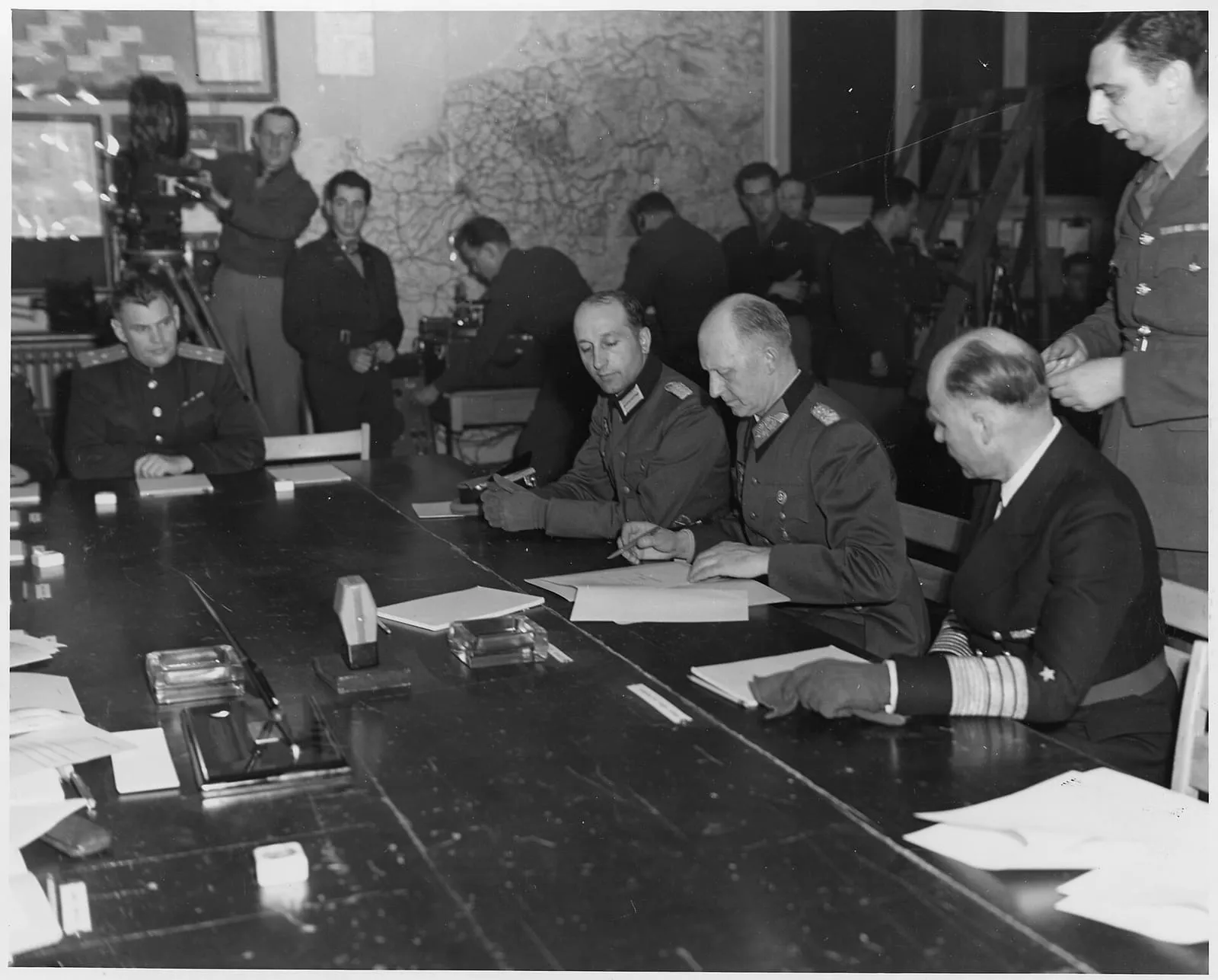
At 2.41 a.m. on 7 May 1945, in a small room of a technical school in Reims that housed General Dwight Eisenhower’s headquarters, the chief of the operations staff of the Wehrmacht High Command, Colonel General Alfred Jodl, signed the instrument of unconditional surrender of all German armed forces. He did so on the authority of Karl Dönitz, who had become President of the Reich after the death of Hitler. The guns were to fall silent on all fronts at 11.01 p.m. Central European Time on 8 May.
The signature at Reims was preceded by two days of talks. On 5 May Admiral Hans-Georg von Friedeburg arrived there in order – as he had with Montgomery the day before – to negotiate a surrender limited to the Western Front. The word “negotiations”, however, is an overstatement: from the outset Eisenhower refused any conditions and demanded a simultaneous surrender to all the Allies, the Soviet Union included. The Germans could only play for time. Nor did the Reims document settle the matter entirely – at Stalin’s demand the ceremony was repeated in Berlin the following day.
The Dönitz government and the tactic of partial surrenders
Hitler’s suicide on 30 April 1945 passed power to Grand Admiral Dönitz, named in the political testament as President of the Reich and Supreme Commander of the Wehrmacht. Dönitz was based at first at Plön in Schleswig-Holstein, and from 3 May at Flensburg-Mürwik, near the Danish border. The government was formally headed by Count Lutz Schwerin von Krosigk, until then finance minister. Field Marshal Wilhelm Keitel remained chief of the Wehrmacht High Command (OKW), and Jodl chief of its operations staff.
Dönitz knew the war was lost. He decided, however, not to surrender at once and everywhere, but to draw the end out: to surrender to the British and Americans sector by sector while holding out in the east long enough for as many soldiers and refugees as possible to get through to the west instead of falling into Soviet captivity. In a radio address on 1 May he spoke of continuing the struggle against Bolshevism. There was nothing new in this policy – Heinrich Himmler had earlier tried a similar game with his offer conveyed through Bernadotte, which the Western Allies rejected.
Partial surrenders did indeed follow one after another. On 29 April the surrender of the German forces in Italy was signed at Caserta, taking effect on 2 May. On that same day Berlin surrendered. On 4 May Admiral von Friedeburg signed at Bernard Montgomery’s headquarters the surrender of the forces in north-west Germany, the Netherlands and Denmark, effective from the morning of 5 May. That day General Hermann Foertsch signed the surrender of Army Group G before the American General Jacob Devers at Haar near Munich, and at Wageningen General Johannes Blaskowitz accepted the terms of surrender for the forces in the Netherlands. As early as 4 May Dönitz had also ordered the U-boats to cease operations.
Montgomery could accept the surrender of the forces facing his army group, but not the surrender of the entire Wehrmacht. That was a matter for Eisenhower as Supreme Commander of the Allied Expeditionary Force – which was why Friedeburg travelled on from Lüneburg to Reims.
The “red school” at Reims
Since February 1945 Supreme Headquarters Allied Expeditionary Force (SHAEF) had had its forward headquarters at Reims, in Champagne. Eisenhower and his staff occupied the building of a vocational and technical school for boys (the Collège moderne et technique) – a red-brick building that the Americans called the “little red schoolhouse”. A war room was set up on the ground floor: its walls were covered with maps of the fronts and charts of casualties and supply levels. It was in this room, at a plain table, that the instrument of surrender was to be signed.
Friedeburg at Reims (5 May)
Admiral von Friedeburg, who on 1 May had succeeded Dönitz as Commander-in-Chief of the Kriegsmarine, flew into Reims with Colonel Fritz Poleck of the OKW on the afternoon of 5 May. Eisenhower refused to meet him and entrusted the talks to his chief of staff, Lieutenant General Walter Bedell Smith, and to SHAEF’s chief of intelligence, the British General Kenneth Strong, who spoke German and acted as interpreter.
Friedeburg presented Dönitz’s proposal: the surrender of the forces fighting the Western Allies, without a surrender in the east. Bedell Smith replied that only the unconditional surrender of all German forces on all fronts was possible, simultaneously to the Western Allies and to the Red Army, with units remaining in the positions they held. This followed from the principle of unconditional surrender proclaimed by Roosevelt and Churchill at Casablanca in January 1943, and from the undertakings given to Moscow that none of the allies would conclude a separate peace with Germany. According to American accounts, the Germans were shown situation maps that left no illusions about the Reich’s position.
Friedeburg declared that he had no authority to sign such a document and passed the terms on to Dönitz. Dönitz, instead of giving way, decided to send to Reims someone with greater standing in the Wehrmacht – Jodl.
Jodl and Eisenhower’s ultimatum (6 May)
Colonel General Jodl, one of Hitler’s closest collaborators throughout the war, arrived at Reims on the evening of 6 May with his aide, Major Wilhelm Oxenius. Dönitz had instructed him to try again: to obtain a surrender in the west only, or, failing that, the longest possible interval between the signature and the surrender taking effect. Jodl argued to Bedell Smith and Strong that the German command needed time for orders to reach scattered units, and that in the east German soldiers would not lay down their arms before the Russians in any case.
Eisenhower saw this as playing for time. On the evening of 6 May he presented Jodl with an ultimatum: if the Germans did not sign a full surrender immediately, the Allies would close their lines in the west – they would no longer take prisoners or let through soldiers and refugees coming from the east – and would resume air raids on the territory still under German control. He agreed only to a 48-hour delay before the ceasefire, counted in practice from the start of the talks, so that the guns would fall silent at midnight on 8–9 May.
Jodl telegraphed Flensburg that, as he put it, the choice was simple: chaos or signature. The reply – Dönitz’s consent to sign the surrender on the terms presented – came after midnight, in the early hours of 7 May.
The signing (7 May, 2.41 a.m.)
The ceremony was set for the early hours of 7 May. Three Germans were shown into the war room: Jodl, Friedeburg and Oxenius. At the table sat the Allied representatives: Bedell Smith, who signed on Eisenhower’s behalf; the Soviet Major General of Artillery Ivan Susloparov, head of the Soviet military mission in France, attached to SHAEF at Eisenhower’s request as the representative of the Red Army High Command; and the French General François Sevez, deputy chief of staff to General Alphonse Juin, who signed the document as a witness. Also present were, among others, SHAEF’s British deputy chief of staff, General Frederick Morgan; Admiral Harold Burrough, the Allied naval commander; the American air commander General Carl Spaatz; and Kenneth Strong as interpreter. The ceremony was watched by a group of some fifteen war correspondents flown in from Paris, and newsreel cameramen filmed it.
Eisenhower himself did not enter the room. He considered it unfitting for the Supreme Commander to speak with German emissaries before they had surrendered, and waited in his office with his deputy, Air Chief Marshal Arthur Tedder.
At 2.41 a.m. Jodl signed the instrument of surrender in several copies. After him Bedell Smith, Susloparov and Sevez added their signatures. When the formalities were over, Jodl stood up and said in German – Strong translated his words into English – that with this signature the German people and the German armed forces were, for better or worse, delivered into the victors’ hands; that in this war, which had lasted more than five years, both had achieved and suffered more than perhaps any other people in the world; and that at this hour he could only express the hope that the victor would treat them with generosity. Bedell Smith made no reply.
The Germans were then taken to Eisenhower’s office. The Supreme Commander asked briefly whether they understood the terms of surrender and were ready to carry them out, and reminded them that the German commanders were to appear for a formal confirmation of the instrument before representatives of the Soviet command. Jodl answered in the affirmative and left. The meeting lasted a few minutes.
The text of the document
The instrument signed at Reims was short – five articles, fitting on a single page. It was not the text prepared by the European Advisory Commission, on which the British, Americans and Russians had been working since 1944 and which also covered political matters. Eisenhower’s staff used a simplified, purely military formula modelled on the Caserta document.
In it the German High Command surrendered unconditionally – to the Supreme Commander of the Allied Expeditionary Force and simultaneously to the Soviet High Command – all land, sea and air forces under German control. It was to issue orders to cease active operations at 11.01 p.m. Central European Time on 8 May; units were to remain in their positions, and no ship, vessel or aircraft was to be scuttled or damaged. The Germans undertook to carry out any further orders issued by the two Allied commands. The fourth article stipulated that the instrument was without prejudice to, and would be superseded by, any general instrument of surrender imposed on behalf of the United Nations. The last article threatened severe punitive action for any failure to comply with its provisions.
Under an understanding between Eisenhower and Susloparov, who had no confirmation that Moscow accepted the text, Jodl also signed a separate undertaking: the chief of the Wehrmacht High Command and the commanders-in-chief of the army, navy and air force would appear with full powers at a place and time set by Eisenhower and the Soviet command in order formally to ratify the surrender. This additional document opened the way to the second ceremony in Berlin.
“The mission of this Allied force was fulfilled”
After the Germans had left, photographs were taken in Eisenhower’s office – the Supreme Commander held up the pens used to sign the document, arranging them in a V. His aides proposed solemn, multi-sentence texts for the report to the Combined Chiefs of Staff in Washington. Eisenhower rejected them and dictated a single sentence: “The mission of this Allied force was fulfilled at 0241, local time, May 7th, 1945.” This laconic report went down in history as one of the best-known documents of the war.
For Eisenhower it was the end of a road that had begun with the landings in North Africa in November 1942 and led through Sicily, Italy, Normandy and the Ardennes to the Elbe. Less than a year after the Normandy landings the armies of the Western Allies stood in the heart of Germany, in Austria and in western Bohemia.
Moscow objects
The text of the instrument was sent to Moscow, to the chief of the Red Army General Staff, General Aleksei Antonov, only during the night of 6–7 May, and no confirmation had come back by the time of the signing. When the reply finally arrived a few hours after the ceremony, it turned out that Susloparov had had no right to sign anything. The Soviet command challenged the document, pointing out that its text differed from the one the Allies had agreed earlier and that Susloparov had not been authorised to sign it.
The real reason was different. Joseph Stalin held that Germany’s surrender should be a single, solemn historic act reflecting the Soviet Union’s decisive contribution to victory, and that it should take place not on the territory of liberated France but in Berlin, from where German aggression had come. According to the memoirs of Marshal Georgy Zhukov, Stalin said that the agreement signed at Reims could not be annulled, but neither could it be recognised; it should be treated as a preliminary protocol of surrender. The Western Allies agreed without much resistance – they were anxious not to give Moscow a pretext for accusing them of a separate deal with Germany behind its back.
It was agreed that the act would be repeated in Berlin on 8 May with Keitel and the commanders of the armed services, and that victory would be officially announced in the Allied capitals simultaneously, after the second ceremony. Tedder was to fly to Berlin on Eisenhower’s behalf. Until then the news of the surrender signed at Reims was under embargo. Susloparov himself, despite criticism from Moscow, suffered no serious consequences.
Edward Kennedy’s leak
The embargo did not last even a day. In the early afternoon of 7 May the Flensburg radio station, still controlled by the Dönitz government, broadcast a speech by Schwerin von Krosigk announcing to the Germans the unconditional surrender of all German armed forces. The OKW was also sending out orders to cease fighting.
Among the correspondents present at Reims was Edward Kennedy, head of the Paris bureau of the Associated Press. Like the other journalists, he had promised not to report the news before SHAEF’s official announcement. He concluded, however, that since the Germans themselves had announced the surrender on the radio, the embargo no longer had any military purpose and had become purely political. Bypassing the censors, he telephoned the AP’s London bureau from Paris and dictated a dispatch. The news of Germany’s surrender spread around the world that same day; in many cities, including New York and London, people came out into the streets, although the governments were still silent.
SHAEF suspended the transmission of AP dispatches from Europe for several hours, and Kennedy was stripped of his accreditation and sent back to the United States. His fellow correspondents, beaten to the biggest story of the war, mostly condemned him; the agency eventually dismissed him. Only in 2012 did the Associated Press officially apologise, admitting that the matter had been handled in the worst possible way.
The last hours of the war
Almost 45 hours passed between the signature at Reims and the surrender taking effect. Dönitz and the OKW used them as they had planned: units in the east were to break away from the Red Army as quickly as possible and get through to the west, while warships and merchant vessels were to evacuate as many soldiers and civilians as possible from the Baltic coast. Fighting was still going on in Bohemia, where the Prague uprising had broken out on 5 May, in Courland, on the Hel Peninsula and at the mouth of the Vistula. On 6 May Festung Breslau (Wrocław) surrendered. The Americans were fighting their last battles in Europe in Austria and Bohemia, and in Amsterdam German sailors fired on a celebrating crowd on Dam Square.
Significance
The surrender at Reims was the first document in which the Germans unconditionally surrendered the whole of their armed forces on all fronts. Together with the instrument signed a day later in Berlin, it ended the war in Europe that had begun on 1 September 1939. Taking the signature from a representative of the High Command rather than from politicians was no accident: the Allies remembered that the Armistice of Compiègne in 1918 had been signed by German civilians, which later allowed the generals to spread the legend of the “stab in the back”. This time the Wehrmacht itself had to acknowledge defeat. Five years after Hitler had humiliated France with an armistice signed in the same railway carriage at Compiègne, the Germans surrendered in a city in Champagne, with a French general signing the instrument as a witness.
The dispute over Reims also foreshadowed the divisions of the coming peace. Because of the second ceremony and the difference in time zones, the West celebrates the end of the war on 8 May, while the Soviet Union and its successor states do so on 9 May. Soviet historiography long passed over the Reims document or called it a preliminary protocol, emphasising only the Berlin instrument. The Dönitz government, which had signed the surrender, was not recognised by the Allies and survived for another two weeks at Flensburg. Friedeburg took his own life on the day it was dissolved, 23 May. Jodl was tried before the International Military Tribunal at Nuremberg; sentenced to death on all four counts of the indictment, he was executed on 16 October 1946.
Nor did the war end everywhere. In the Pacific and in Asia Japan fought on, and Harry Truman, announcing victory in Europe on 8 May, declared that the United States would not rest until Japan laid down its arms. The school building in Reims later became the Museum of the Surrender (Musée de la Reddition); the room in which Jodl signed has been preserved almost unchanged, with the maps of May 1945 on its walls.
Sources
Meanwhile
(04)Elsewhere, within a week.
- 8 May 1945 · SocietyVictory in Europe DayOn 8 May 1945 the West celebrated Germany's surrender in London, Paris and New York. The guns fell silent at 11.01 p.m.; in Poland, joy was clouded by doubt.
- 8 May 1945 · Eastern FrontThe surrender at KarlshorstOn 8 May 1945 in Berlin-Karlshorst, Keitel, Friedeburg and Stumpff signed Germany's final act of unconditional surrender before Zhukov and Tedder.
- 8 May 1945 · Eastern FrontThe surrender of CourlandOn 8 May 1945, on Dönitz's orders, General Carl Hilpert's Army Group Courland surrendered to the Leningrad Front. Some 190,000 men went into captivity.
- 8 May 1945 · Central and Eastern EuropeThe surrender of the Tiso governmentOn 8 May 1945, at Kremsmünster in Austria, Prime Minister Štefan Tiso's fugitive government of the Slovak Republic submitted to the US XX Corps.
Related events
(04)The same battle, people or subject.
- 25 April 1945 · Western FrontThe meeting on the ElbeOn 25 April 1945 patrols of the US 69th Infantry Division met Red Army soldiers on the Elbe near Strehla and at Torgau. The Reich was cut in two.
- 23 May 1945 · PoliticsThe arrest of the Flensburg governmentOn 23 May 1945 at Flensburg-Mürwik, British troops acting on Eisenhower's orders arrested Dönitz, Jodl and the ministers of the Third Reich's last government.
- 30 April 1945 · Eastern FrontHitler's suicideOn 30 April 1945 Hitler and Eva Braun, whom he had married the day before, killed themselves in the bunker beneath the Reich Chancellery in encircled Berlin.
- 24 April 1945 · PoliticsHimmler's offerIn Lübeck on the night of 23/24 April 1945 Himmler offered, via Count Bernadotte, to surrender to the Western Allies alone. Truman and Churchill refused.