- Category:
- Military
- Front:
- Eastern Front
- Date:
- 8 May 1945
- Author:
- Łukasz
- Tags:
- Third Reich, Wehrmacht, Georgy Zhukov, Wilhelm Keitel
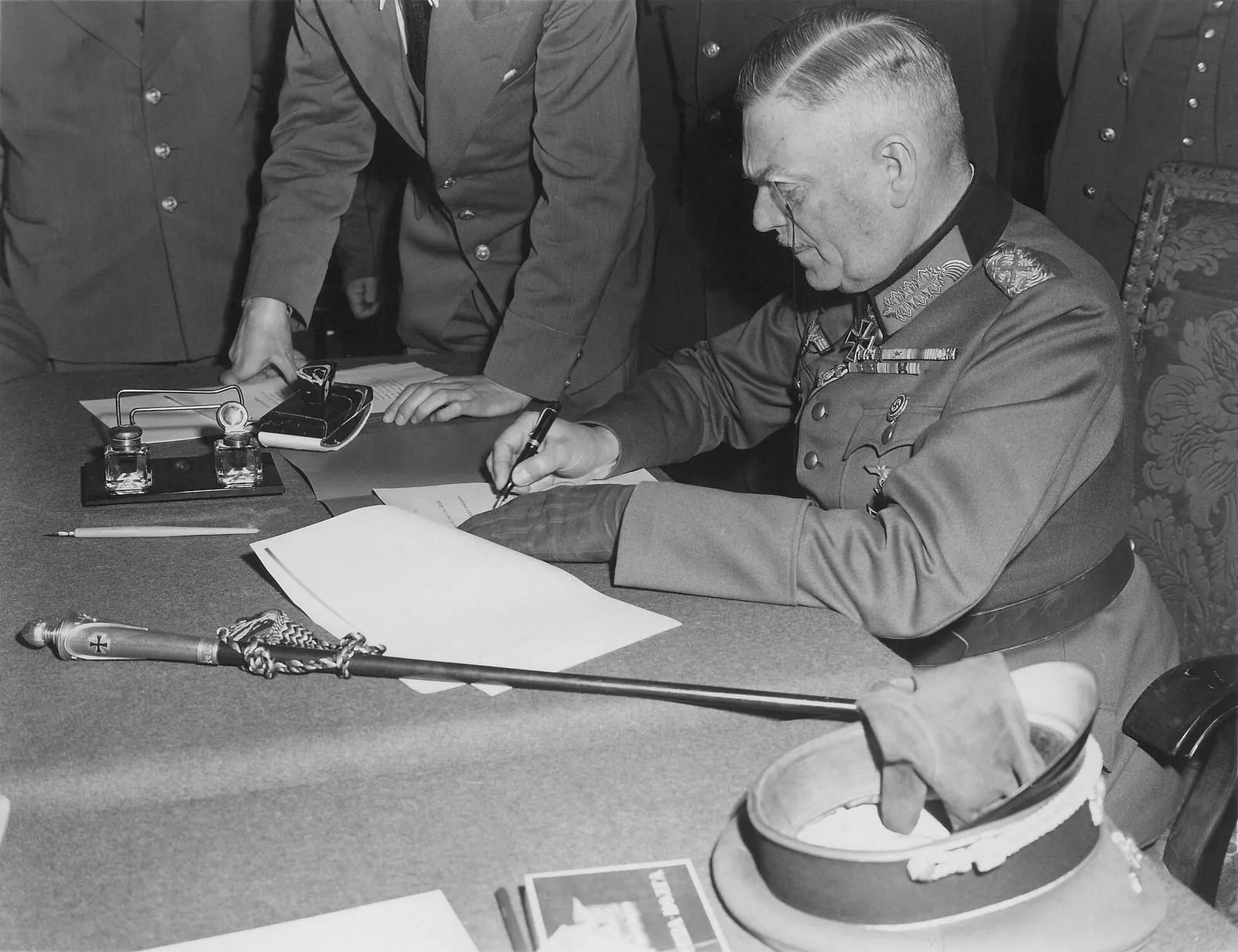
Late in the evening of 8 May 1945, in the officers’ mess hall of a former military engineering school in the Berlin district of Karlshorst, Field Marshal Wilhelm Keitel, Chief of the High Command of the Wehrmacht, put his signature to the act of unconditional surrender of the German armed forces. Beside him, Admiral Hans-Georg von Friedeburg signed for the Kriegsmarine and Colonel General Hans-Jürgen Stumpff for the Luftwaffe. The surrender was accepted by Marshal of the Soviet Union Georgy Zhukov on behalf of the Supreme High Command of the Red Army and by the British Air Chief Marshal Arthur Tedder, General Eisenhower’s deputy, on behalf of the Supreme Commander, Allied Expeditionary Force. The American General Carl Spaatz and the French General Jean de Lattre de Tassigny signed as witnesses.
According to the official Soviet record, the signatures were affixed at 10.43 p.m. Central European Time, which was already 12.43 a.m. on 9 May Moscow time. The document is dated 8 May. It was Germany’s second general surrender in less than two days – the first had been signed at Reims by Colonel General Alfred Jodl in the early hours of 7 May. The Karlshorst act is sometimes described as a surrender to the Red Army, but, like the Reims document, it was a surrender to all the Allies at once; the difference was that this time the Soviet side hosted the ceremony and the document was signed in the captured capital of the Reich. It is precisely the time difference on that night that explains why the West celebrates the end of the war on 8 May, while Russia and the former countries of the Eastern Bloc celebrate it on 9 May.
Why a second signature
The surrender at Reims did not satisfy Moscow. The Soviet representative at Eisenhower’s headquarters, Major General Ivan Susloparov, had signed the document on behalf of the Supreme High Command of the Red Army even though he had not received instructions from Moscow in time – the text had only been sent to the Chief of the General Staff, General Aleksei Antonov, during the night, and no reply had arrived before the ceremony. Eisenhower had foreseen this: Jodl had to undertake in writing that the commanders of all three branches of the German armed forces would appear for a formal ratification of the surrender at a place and time to be set by the Allied commands.
A few hours after the Reims act was signed, Moscow’s answer arrived: the document was unacceptable because its text differed from the one agreed by the European Advisory Commission, and Susloparov had not had full powers. Historians point out that these were formal arguments. For Joseph Stalin something more was at stake – the end of the war with Germany should not take place at the headquarters of a Western commander, with a second-rank Soviet representative, but in Berlin, which the Red Army had taken in the Berlin offensive, and with a Soviet commander of the first rank taking part. According to Zhukov’s memoirs, Stalin told him by telephone on 7 May that the Reims agreement could not be annulled, but neither could it be recognised, and that the surrender should be accepted “in the place from which the fascist aggression came”.
Moscow also had a substantive argument. The Reims act ordered German forces to cease fighting and remain in their positions, but it did not explicitly speak of laying down their arms and going into captivity. Meanwhile, in the east the fighting went on. The government of Grand Admiral Karl Dönitz at Flensburg was using the almost 45 hours between the signature at Reims and the surrender coming into force to move as many units and refugees as possible to the west. Field Marshal Ferdinand Schörner, commander of Army Group Centre in Bohemia, was still telling his soldiers on 8 May that reports of a surrender to the Russians were false. In Prague the uprising was in progress, and German units were fighting the insurgents and the approaching Red Army.
Dwight Eisenhower accepted the Soviet position at once. He called the Reims act a “short instrument of unconditional military surrender” and agreed to a more formal signing of an amended text in Berlin, presided over by Zhukov. He also warned that German units that went on fighting the Russians after the deadline would lose their status as soldiers and, if they crossed to the west, would be handed over to the Red Army. He did not go to Berlin himself: as Supreme Commander he outranked Zhukov, so the Western Allies were represented by his deputy, Tedder.
8 May in Berlin
On the morning of 8 May the Deputy People’s Commissar for Foreign Affairs, Andrei Vyshinsky, flew into Berlin with documents prepared in Moscow; formally he was Zhukov’s political adviser, but in fact he was there to ensure that the ceremony went as the Kremlin wished. Throughout the day correspondents from newspapers and agencies from all over the world kept arriving. At Tempelhof airfield the Allied delegations were welcomed by the deputy commander of the 1st Belorussian Front, General of the Army Vasily Sokolovsky, the commandant of Berlin, Colonel General Nikolai Berzarin, and a member of the front’s military council, Lieutenant General Fyodor Bokov (PL). In the afternoon the German delegation flew in from Flensburg to the same airfield, escorted by British officers. From the airfield it was driven to Karlshorst, where it waited for many hours in a separate building to be summoned.
The ceremony was prepared in the building that had until recently housed the officers’ mess of the German military engineering school and was now Zhukov’s headquarters. It was delayed, however, for reasons that essentially concerned prestige rather than substance. When it turned out that General de Lattre de Tassigny was arriving with a mandate from General Charles de Gaulle, who demanded that France sign the act as a power in its own right, the Americans replied that in that case an American signature could not be missing either. The Soviet side, for its part, wanted no more than three Allied signatures, one of which had to be Zhukov’s. In the end it was agreed that Zhukov and Tedder would accept the surrender, while Spaatz and de Lattre would sign as witnesses. Every change meant retyping and retranslating the document, which took many hours. The dispute extended even to flags: alongside the Soviet, American and British flags on the wall of the hall a French one was eventually hung as well – one that, according to participants, had to be sewn in a hurry.
The ceremony
According to Zhukov’s memoirs, he opened the session at midnight Moscow time, that is at 10 p.m. Central European Time. The Allied representatives sat at a long table in the hall, with the Soviet generals behind them and journalists and cameramen to one side. On Zhukov’s instructions the German delegation was brought in. Keitel, in full dress uniform, raised his field marshal’s baton in greeting. Asked whether he had read the text and had the authority to sign it, he produced a document signed by Dönitz as President of the Reich and Supreme Commander of the Wehrmacht. He then went up to the table and signed the copies of the act one after another; after him Friedeburg and Stumpff did the same. Those present remembered that on seeing the French general, Keitel is said to have asked whether the French had defeated Germany too.
According to the official Soviet account and Zhukov’s memoirs, the signing was completed at 10.43 p.m. (12.43 a.m. Moscow time), after which the German delegation was led out of the hall. Some Western historians, relying on the accounts of participants, believe that because of the disputes over the signatures and the retyping of the text the document was not signed until after midnight Central European Time, at around 1 a.m. on 9 May, and was dated 8 May to bring it into line with the Reims act and with the times already announced in the West. The question had no legal significance: in accordance with Reims, the surrender came into force at 11.01 p.m. Central European Time on 8 May in any case.
Keitel tried to negotiate an additional twelve hours before German troops who did not learn of the surrender in time would become liable to the sanctions provided for in Article 5. He had to make do with a verbal assurance from Zhukov. After the Germans had been led out, a reception was held in the same hall which, according to Zhukov’s memoirs, went on until morning; toasts were drunk and the Soviet generals danced.
How the Berlin act differed from Reims
The Karlshorst text essentially repeated the Reims document, but with a few important changes. It was signed not by a staff representative but by the commanders of all three branches of the armed forces, authorised by Dönitz – Keitel as Chief of the High Command of the Wehrmacht and at the same time as representative of the army, Friedeburg as Commander-in-Chief of the navy, and Stumpff on behalf of the Luftwaffe. Article 2 was expanded: German forces were not only to cease operations at 11.01 p.m. Central European Time on 8 May and remain where they were, but also to hand over their weapons and equipment to the local Allied commanders – in other words, to disarm and go into captivity. The destruction of ships, aircraft, weapons and installations was forbidden. The act was drawn up in English, Russian and German, with only the English and Russian texts being authentic.
As at Reims, Article 4 provided that the document would be superseded by a general instrument of surrender imposed on Germany by the United Nations. In practice that instrument was the declaration of the four powers of 5 June 1945, also issued in Berlin, in which the United States, the USSR, Britain and France assumed supreme authority in Germany. From then on it was exercised by the Allied Control Council.
Poland absent
There was no representative of Poland at the table in Karlshorst, although the Poles had fought Germany from the first to the last day of the war in Europe. Soldiers of the Polish 1st Army took part in the Berlin offensive, and units of the 1st Infantry Division fought in the very centre of the city until the garrison surrendered on 2 May. In the west General Stanisław Maczek’s 1st Armoured Division ended the war at Wilhelmshaven, and General Władysław Anders’s II Corps in Italy.
The reason for this absence was political. The Western powers still recognised the Polish government-in-exile in London, with which Moscow had broken off relations in 1943. The USSR, on the other hand, recognised the communist-created Provisional Government of the Republic of Poland in Warsaw, which the West did not recognise. The joint government agreed at the Yalta Conference had not yet been formed, and at the beginning of May Moscow had admitted that it was holding the leaders of the Polish Underground State arrested in March. In this situation neither side proposed that the Poles take part in the ceremony, just as they had not been present at Reims.
The last shots
The signing at Karlshorst did not end the fighting overnight. On the same day, 8 May, Army Group Courland surrendered, but Army Group Centre in Bohemia and Moravia was still trying to break through to the west, to the Americans. The fighting against it went on until 11 May. The German garrisons in the Atlantic fortresses surrendered over the following days – Lorient on 10 May, Saint-Nazaire on 11 May. In Yugoslavia, German and Croatian units retreating northwards fought on until the middle of May.
Keitel returned to Flensburg. On 13 May he was arrested by the British, and on 23 May the whole Dönitz government fell into Allied hands. Friedeburg, the only German officer present at all three of the great surrenders – at Lüneburg Heath, Reims and Karlshorst – then took his own life. Keitel stood before the International Military Tribunal at the Nuremberg trials; found guilty on all four counts of the indictment and sentenced to death, he was hanged on 16 October 1946.
8 or 9 May
The time difference on that night had lasting consequences. In the West the end of the war had already been announced on 8 May: in his 3 p.m. broadcast Winston Churchill said that the surrender had been signed at Reims the previous morning and would merely be “ratified and confirmed” in Berlin, and that day Victory in Europe Day was celebrated. Stalin had asked London and Washington to hold back their announcements until the surrender came into force, but Churchill and Harry Truman refused – the announcements had already been prepared, and the news from Reims had long since leaked to the press. Soviet citizens learned of the surrender from a radio announcement broadcast during the night, at around 2.10 a.m. Moscow time on 9 May, and it was that day that became the Soviet victory holiday. In his address of 9 May Stalin called the Reims document merely a “preliminary protocol of surrender”, whereas in the West Reims was regarded as the actual surrender and Karlshorst as its ratification. Throughout the Cold War Western Europe marked the anniversary on 8 May, and the Eastern Bloc, including the Polish People’s Republic, on 9 May.
Significance
The Karlshorst act also brought the war in Europe to a formal close. The Wehrmacht ceased to exist as an armed force, and the German state as an entity with which anyone would have to negotiate. The surrender was unconditional, in accordance with the principle announced by Roosevelt and Churchill at Casablanca in January 1943: it was accompanied by no government and no treaty. Germany did not make peace with the USSR – the Presidium of the Supreme Soviet formally ended the state of war with Germany only on 25 January 1955.
The dispute over who would accept the surrender, and where, also foreshadowed the post-war division. Moscow did not want the victory to be associated with the headquarters of a Western commander; France – thanks to de Gaulle’s persistence – signed the act as a witness and a month later took its seat on the Allied Control Council as the fourth occupying power. Poland, although it had fought since 1939, was present neither at Reims nor in Berlin. The building in Karlshorst soon became the headquarters of the Soviet Military Administration in Germany, and the hall in which Keitel signed is now part of the Berlin-Karlshorst Museum. In Europe the war was over; in the Pacific it went on for more than three months.
Sources
Meanwhile
(04)Elsewhere, within a week.
- 8 May 1945 · SocietyVictory in Europe DayOn 8 May 1945 the West celebrated Germany's surrender in London, Paris and New York. The guns fell silent at 11.01 p.m.; in Poland, joy was clouded by doubt.
- 8 May 1945 · PacificThe division of Indochina at the 16th parallelOn 8 May 1945 in San Francisco the US assured France it did not dispute French sovereignty over Indochina. The 16th-parallel division was agreed in July.
- 7 May 1945 · Western FrontThe surrender at ReimsAt 2.41 a.m. on 7 May 1945, at Eisenhower's headquarters in Reims, General Alfred Jodl signed the unconditional surrender of all German armed forces.
- 7 May 1945 · PoliticsGöring taken prisonerOn 7 May 1945 Hermann Göring, freed from SS arrest, surrendered to the Americans in Austria. He hoped to meet Eisenhower but ended up in prison and in the dock.
Related events
(04)The same battle, people or subject.
- 25 April 1945 · Western FrontThe meeting on the ElbeOn 25 April 1945 patrols of the US 69th Infantry Division met Red Army soldiers on the Elbe near Strehla and at Torgau. The Reich was cut in two.
- 23 May 1945 · PoliticsThe arrest of the Flensburg governmentOn 23 May 1945 at Flensburg-Mürwik, British troops acting on Eisenhower's orders arrested Dönitz, Jodl and the ministers of the Third Reich's last government.
- 30 April 1945 · Eastern FrontHitler's suicideOn 30 April 1945 Hitler and Eva Braun, whom he had married the day before, killed themselves in the bunker beneath the Reich Chancellery in encircled Berlin.
- 20 April 1945 · Eastern FrontHitler's last birthdayOn 20 April 1945 Hitler turned 56 in the bunker beneath the Reich Chancellery. The leaders offered their wishes, and that evening most of them left Berlin.