- Category:
- Military operations
- Front:
- Western Front
- Date:
- 25 April 1945
- Author:
- Łukasz
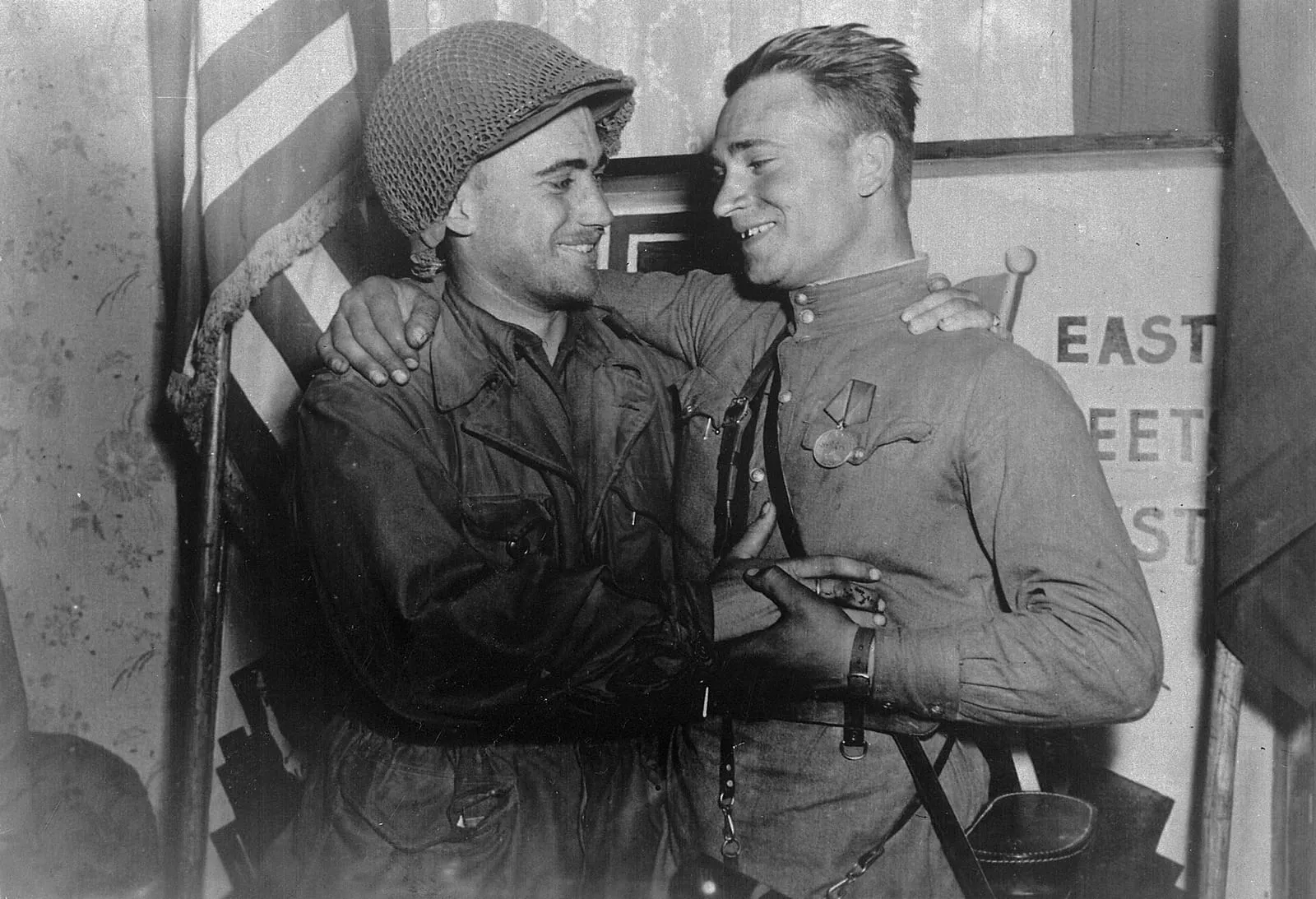
On Wednesday 25 April 1945, shortly before noon, a few American jeeps drove into the Saxon village of Leckwitz, less than three kilometres from the Elbe. At the end of the street the soldiers spotted a horseman turning into a farmyard. As they drew closer, there was no doubt: he was a Soviet cavalryman. A few hours later further patrols of the US 69th Infantry Division shook hands with Red Army soldiers on the eastern bank of the river near Strehla and on the wrecked bridge at Torgau. Armies that had been advancing towards each other from opposite ends of Europe since June 1944 had met in the very heart of Germany.
The meeting on the Elbe, known in the English-speaking world as Elbe Day, was not a battle and decided no operation. Yet it had enormous military and symbolic significance: it cut what was left of the Third Reich into a northern and a southern part, and photographs of soldiers embracing went round the world as an image of the victorious coalition. Chronicles usually speak in shorthand of a meeting “at Torgau”; in fact the first contact was made some 30 kilometres upstream, near Strehla, and Torgau was the scene of the second meeting that day – the one that passed into history.
Two armies between the Mulde and the Elbe
Where the Western and Soviet forces would meet had been settled by decisions taken at the end of March. On 28 March General Dwight Eisenhower informed Joseph Stalin that the main Western Allied thrust would be directed not at Berlin but across central Germany towards Leipzig and Dresden, to meet the Red Army (this decision caused a storm in London). Once the Ruhr Pocket had been closed, the US 12th Army Group under General Omar Bradley set off eastwards. By mid-April its leading units had reached the Mulde and the Elbe, and on 15 April Eisenhower finally halted General William Simpson’s Ninth Army on the Elbe, although its commander was convinced he could reach Berlin.
In the Leipzig area the First Army of General Courtney Hodges was advancing. Its V Corps (General Clarence Huebner) took Leipzig and reached the Mulde, which flows a few dozen kilometres west of the Elbe. There the Americans were ordered to halt: the line of the Mulde was to separate the two armies so as to avoid accidental clashes between allies who had neither a common command nor communications at front level. Recognition signals were agreed – flares of specified colours – along with markings on vehicles. The headquarters of General Emil Reinhardt’s 69th Infantry Division forbade its patrols to venture more than eight kilometres (five miles) beyond the Mulde.
From the east came the forces of the 1st Ukrainian Front under Marshal Ivan Konev. On 16 April this front began its part of the Berlin offensive: it forced the Lusatian Neisse and, while its tank armies swung towards Berlin, pushed on to the Elbe with its left wing (in Soviet historiography this part of the fighting is known as the Spremberg–Torgau operation (PL)). The Elbe in the Torgau and Riesa area was reached by the 5th Guards Army of General Aleksey Zhadov, including the 34th Guards Rifle Corps and Major General Vladimir Rusakov’s 58th Guards Rifle Division. Soviet units had orders to stop on the Elbe; they did not yet know about the Mulde as the demarcation line.
Between the two rivers lay a strip of no man’s land 30–40 kilometres wide. Roaming it were broken Wehrmacht units looking for a chance to surrender to the Americans rather than the Russians, crowds of German refugees fleeing the Eastern Front, and thousands of liberated prisoners of war and forced labourers from all over Europe – the people Eisenhower had addressed in his proclamation of 31 March. On 23 and 24 April a three-man patrol of the 104th Infantry Division under Lieutenant Harlan Shank got as far as Torgau and spent the night in the town, but left without seeing a single Red Army soldier. Tension was mounting: everyone knew the meeting was a matter of hours, and almost every patrol leader wanted to be the first.
Lieutenant Kotzebue’s patrol
On the afternoon of 24 April the commander of the 273rd Infantry Regiment, Colonel Charles Adams, impatient at the lack of news, sent Lieutenant Albert Kotzebue with 35 men in jeeps with orders to “make contact with the Russians”. The patrol spent the night in the village of Kühren, a few kilometres beyond the Mulde, and on the morning of 25 April Kotzebue decided that his orders were broad enough to justify pressing on eastwards. According to the official history of the US Army, at 11.30 a.m. in Leckwitz his men came upon a lone Soviet cavalryman. Wary, he pointed to the east, left them a Polish forced labourer as a guide and rode off. Corporal Stephen Kowalski, who spoke Russian, talked with the soldier.
A few hundred metres north of Strehla the Americans saw uniformed figures on the eastern bank beside the remains of a destroyed column and the wreckage of a pontoon bridge. Kotzebue’s driver fired green flares, the Polish guide shouted across the river, and the lieutenant himself blew the moorings of a boat with a grenade and crossed to the other bank with five soldiers. The bank was strewn with bodies – victims of shelling of a column of refugees, women and children among them. The welcome was at first guarded, but once Kotzebue explained who he was the mistrust vanished. The commander of the 175th Rifle Regiment, Lieutenant Colonel Aleksandr Gordeyev, arrived on the bank, and then General Rusakov himself, who raised toasts to Roosevelt, Truman, Churchill, Stalin and both armies. Stalin’s order of 27 April stated that the troops had made contact “in the Torgau area” at 1.30 p.m.; at about that time Kotzebue signed his report to the regiment: “Mission accomplished”.
That report proved his undoing. In it the lieutenant gave the wrong coordinates, pointing to the area of Riesa, and the message reached the regiment only after almost two hours. General Reinhardt, angered that his ban had been broken, at first wanted to hold back the news until he could confirm it; an observation aircraft sent out came under anti-aircraft fire over Riesa and turned back. Meanwhile a second patrol of the 273rd Regiment, in practice led by Major Frederick Craig, met Soviet cavalry and cyclists on the road to Leckwitz at 4.45 p.m. and then joined Kotzebue on the far side of the Elbe.
A flag made from a bedsheet
The third patrol was not supposed to be looking for the Russians at all. Second Lieutenant William Robertson, intelligence officer of the 1st Battalion, 273rd Regiment, set out from Wurzen in the morning with three soldiers to round up surrendering Germans and liberated prisoners. A group of freed British prisoners told him there were wounded American prisoners in Torgau, so he drove to the Elbe. In the town he found only two Americans among liberated prisoners of various nationalities. Hearing shots from the river, Robertson decided to make it known who he was: in a pharmacy he found red and blue paint, with which his men painted a crude American flag on a white bedsheet, and he hung it from the tower of Hartenfels Castle (PL).
The far bank answered with fire – the Red Army men later explained that a few days earlier a group of Germans had hung out an American flag to halt Soviet fire and escape. Only when one of the liberated prisoners, a Russian, shouted from the tower that these were Americans did the shooting stop. Robertson and his men went out onto the wrecked road bridge and began to clamber along its twisted girders above the current; a Soviet soldier came towards them from the other side. According to the official history of the US Army this was at about 4 p.m.; many later accounts give 4.40 p.m. On the Soviet side the Americans were received by Lieutenant Aleksandr Silvashko of the 173rd Rifle Regiment of the same 58th Guards Division.
After an hour of toasts Robertson returned to Wurzen with four Soviet soldiers in his overcrowded jeep – a major, two officers and a sergeant. This tangible proof settled the matter. Reinhardt, who for a moment had even considered court-martialling Robertson, reported the contact to corps, and since nobody knew exactly where Kotzebue was, the official ceremonies were set for Torgau. Kotzebue and Craig waited on their bank until late in the evening of 26 April, when they learned that “history had passed them by”. Even so, the order of events is undisputed today: first contact was made by Kotzebue’s patrol near Strehla, and Torgau was the second – and best-known – meeting place.
Embraces, toasts and a photograph
At 4 p.m. on 26 April General Reinhardt met General Rusakov on the eastern bank opposite Torgau. This was the first official ceremony marking the link-up: badges, cigarettes and watches were exchanged, there was dancing in the street and vodka was drunk, and at a hastily prepared feast – as the Americans remembered – fried eggs were served. That same day Associated Press photographer Allan Jackson took a picture of American and Soviet soldiers shaking hands on the sagging spans of the wrecked bridge. The photograph that became the most famous image of the meeting on the Elbe was thus staged, a re-enactment for the cameras of a scene from the previous day; the identity of one of the Americans in it was finally established only in 2008. The handshake between Robertson and Silvashko was also photographed that day; in the USSR it was Torgau and that handshake that became the symbol of the meeting.
On 27 April General Huebner met the commander of the 34th Guards Rifle Corps, and on 30 April General Hodges met General Zhadov. On 5 May Bradley visited Konev’s headquarters.
News of the link-up was held back so that it could be announced simultaneously in three capitals. This happened on the evening of 27 April – at 6 p.m., according to the official history of the US Army. President Harry Truman, in office for two weeks since Roosevelt’s death, declared that the Anglo-American armies under General Eisenhower “have met the Soviet forces where they intended to meet – in the heart of Nazi Germany. The enemy has been cut in two.” He added that this was not yet the hour of final victory in Europe, but that the hour was drawing near. Prime Minister Winston Churchill spoke of a meeting “in true and victorious comradeship of arms”. In an order of the day Stalin announced that the troops of the 1st Ukrainian Front had joined up with the Allied forces “in the very centre of Germany”, and ordered the event to be celebrated in Moscow with a salute of 24 salvoes from 324 guns.
The Oath of the Elbe
For the soldiers of both armies it was a deeply emotional moment. The Americans remembered the warmth of the Red Army men, their medals, accordions and endless toasts; the Russians remembered the jeeps, the cigarettes and the newcomers’ easy-going manner. Private Joseph Polowsky of Chicago, the son of Jewish immigrants from near Kiev, who crossed the Elbe that day as an interpreter, later recounted that the soldiers, standing over the bodies of murdered civilians – among them a little girl with a doll in her hand – swore to one another to do everything they could to prevent another war. This “Oath of the Elbe” became Polowsky’s life’s cause: for decades, during the Cold War, he stood every 25 April on a bridge in Chicago, appealing for peace between the United States and the USSR. He died in 1983 and, in accordance with his wishes, was buried in Torgau.
The meeting also had a darker side, of which little was said in 1945. Thousands of German civilians and soldiers crowded at the bridges over the Mulde, trying to reach the American side; officially the Americans were supposed to turn them back, though many soldiers turned a blind eye. Among those liberated between the Mulde and the Elbe were also prisoners of war and forced labourers from Poland, France, the USSR and other countries, whose fate – especially that of Soviet citizens, sent home under the agreements of the Yalta Conference – was yet to be decided.
The same day in Berlin and San Francisco
25 April was a turning point elsewhere too. West of Berlin, near Ketzin, tanks of the 1st Ukrainian Front linked up with troops of Marshal Georgy Zhukov’s 1st Belorussian Front, closing the ring around the Reich capital. In the bunker beneath the Reich Chancellery Adolf Hitler, who two days earlier had stripped Hermann Göring of power, was still counting on relief; he did not yet know that behind his back Heinrich Himmler had tried, through Count Folke Bernadotte, to offer the Western Allies a surrender – an offer Truman and Churchill were just then rejecting, insisting on surrender to all the Allies, the USSR included.
That same day a conference of representatives of 46 states (others joined later) opened in San Francisco, convened to adopt the charter of the United Nations. Poland, whose authorities were not recognised by all the great powers at once, was given no seat. The press stressed the coincidence of dates: at the very moment when soldiers were shaking hands on the Elbe, politicians were trying to carry the wartime alliance over into peacetime.
Significance
Militarily, the meeting on the Elbe meant that the Reich had been cut in two. The division of command that Hitler had provided for on his last birthday now took effect: in the north, Grand Admiral Karl Dönitz was to take charge, in the south Field Marshal Albert Kesselring. German forces in northern Germany, Denmark and Norway were cut off from those in Bavaria, Austria, Bohemia and northern Italy; any coordinated defence was now out of the question. Two weeks remained until the surrender of the Third Reich.
The line on which the armies met was not the boundary of the future occupation zones. Saxony and Thuringia, taken by the Americans in April, belonged under earlier Allied agreements to the Soviet zone; at the beginning of July 1945 American troops withdrew westwards, and Torgau found itself in the zone from which the GDR was created in 1949. The friendship of April 1945 quickly gave way to the Cold War. In 1949 the Soviet film Meeting on the Elbe was made, in which the shared victory already served as propaganda contrasting “good” Soviet soldiers with American officers and agents.
The memory of Elbe Day nevertheless outlasted the divisions. A Soviet monument to the meeting was erected in Torgau as early as 1945, and after German reunification 25 April became a day of annual ceremonies attended by veterans and diplomats of both countries. In 2010 Presidents Barack Obama and Dmitry Medvedev issued a joint statement invoking the “spirit of the Elbe” as an example of what the two countries can achieve together. For historians the meeting remains a symbol both of the victorious coalition and of its fragility: the armies that drank to their common victory on 25 April 1945 were, a few years later, facing each other along the very border that divided Germany and Europe.
Sources
Meanwhile
(04)Elsewhere, within a week.
- 24 April 1945 · Eastern FrontThe encirclement of BerlinOn 24 April 1945 Zhukov's and Konev's troops met south-east of Berlin, and on 25 April they closed the ring around the capital of the Reich.
- 24 April 1945 · PoliticsHimmler's offerIn Lübeck on the night of 23/24 April 1945 Himmler offered, via Count Bernadotte, to surrender to the Western Allies alone. Truman and Churchill refused.
- 23 April 1945 · PoliticsGöring's telegramOn 23 April 1945 Göring asked Hitler if he should take over power in the Reich. Hitler called it treason and stripped him of office; Greim took the Luftwaffe.
- 22 April 1945 · Eastern FrontHitler's breakdownOn 22 April 1945, on learning that Steiner's attack had not begun, Hitler admitted the war was lost and declared that he would stay in Berlin to the end.
Related events
(04)The same battle, people or subject.
- 7 May 1945 · Western FrontThe surrender at ReimsAt 2.41 a.m. on 7 May 1945, at Eisenhower's headquarters in Reims, General Alfred Jodl signed the unconditional surrender of all German armed forces.
- 20 April 1945 · Eastern FrontHitler's last birthdayOn 20 April 1945 Hitler turned 56 in the bunker beneath the Reich Chancellery. The leaders offered their wishes, and that evening most of them left Berlin.
- 30 April 1945 · Eastern FrontHitler's suicideOn 30 April 1945 Hitler and Eva Braun, whom he had married the day before, killed themselves in the bunker beneath the Reich Chancellery in encircled Berlin.
- 9 May 1945 · Central and Eastern EuropeThe Red Army in PragueOn the morning of 9 May 1945 Konev's tanks entered Prague. By 11 May Army Group Centre had surrendered, while the Americans halted on a line near Plzeň.