Battle of Białystok–Minsk
- Dates:
- 22 June – 9 July 1941
- Front:
- Eastern Front
- Location:
- Western Belarus and the north-eastern lands of pre-war Poland: the Białystok salient with Białystok, Łomża and Bielsk, Grodno and the Augustów Canal, Brest-on-the-Bug, Wołkowysk, Słonim and the River Shchara, Lida and Nowogródek, Baranowicze, the Naliboki Forest, Minsk, and further east Borisov and Bobruisk on the BerezinaOn the battle map →
- Sides:
- Nazi GermanyFedor von Bock, Heinz Guderian, Hermann HothSoviet UnionDmitry Pavlov
- Result:
- German victory. Two German panzer groups broke through the front on the flanks of the Białystok salient and closed the ring around Minsk, taken on 28 June, while the infantry of the 4th and 9th Armies cut the encircled forces into pockets at Białystok, Wołkowysk and Nowogródek. According to Russian data the Soviet Western Front lost some 418,000 men, including more than 340,000 killed, missing and captured; German communiqués spoke of 288,000–324,000 prisoners and of between about 2,600 and 3,300 tanks captured or destroyed. The front commander, General of the Army Dmitry Pavlov, was shot. The road to Smolensk and Moscow lay open.
- Author:
- Natalia
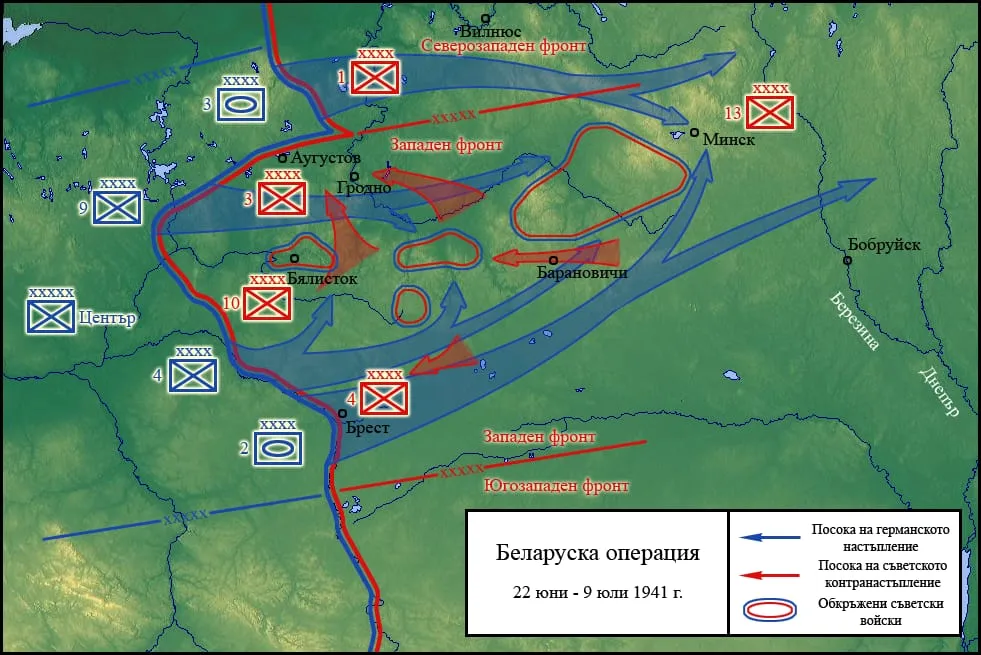
The Battle of Białystok–Minsk was the first great battle of encirclement of the German–Soviet war and one of the Red Army’s worst defeats of the entire war. It began at dawn on 22 June 1941, when Field Marshal Fedor von Bock’s Army Group Centre struck across the demarcation line drawn after the partition of Poland in 1939 against the Soviet Western Front of General of the Army Dmitry Pavlov. Pavlov’s troops stood in a salient jutting westwards around Białystok, on lands that only two years earlier had belonged to Poland. The Germans did not strike the face of this salient but its base: from the north, from the Suwałki area, came Colonel General Hermann Hoth’s 3rd Panzer Group; from the south, from around Brest, Colonel General Heinz Guderian’s 2nd Panzer Group.
The armoured pincers closed around Minsk, the capital of Soviet Belarus, which fell on 28 June, the seventh day of the war. At the same time the German infantry was cutting the encircled forces into smaller pockets at Białystok, Wołkowysk (Vawkavysk) and Nowogródek (Navahrudak). Cut off from supplies, without fuel or air cover, the Soviet soldiers tried for two weeks to break out to the east; the fighting died down only on 8–9 July. The German command announced that it had taken more than 320,000 prisoners. The Western Front ceased to exist as an organised force, Joseph Stalin had its commander arrested and shot, and the German panzer divisions stood on the Berezina and the Dnieper, on the road to Smolensk and Moscow. Behind the front, meanwhile, began what set this war apart from the earlier campaigns: the mass murder of Jews, the starvation of prisoners of war and the devastation of the lands the armies passed through.
Name and dates
In Polish historiography the battle is known as the Battle of Białystok–Minsk or the Battle of Białystok and Minsk. The Germans spoke of the “double battle of Białystok and Minsk” (Doppelschlacht bei Białystok und Minsk) or of a battle of encirclement (Kesselschlacht); Soviet and Russian historiography calls it the Belostok–Minsk frontier battle (Belostoksko-Minskoye srazheniye), the first phase of the Belorussian strategic defensive operation. The name is somewhat misleading, because the encircled Soviet forces were trapped not in Białystok or Minsk themselves but in several pockets between them; the largest took in the forests and marshes between Wołkowysk, Słonim and Nowogródek and reached as far as the Naliboki Forest.
The battle is taken to have begun on 22 June 1941, the first day of the German invasion, and to have ended on 9 July, when, according to most studies, organised resistance ceased in the pockets west of Minsk. Russian tallies of losses cover precisely the period 22 June – 9 July. Some sources end the battle earlier: on 3 July, when the German panzer divisions moved on eastwards, or on 8 July, when the headquarters of Army Group Centre issued an order summarising the spoils. The battle also includes, as a separate episode, the defence of the Brest Fortress, whose organised resistance was broken on 29–30 June, although isolated groups of soldiers fought on in the ruins into July.
Differing dates can be found for the fall of Minsk (26, 28 or 29 June) and for the closing of the pincers (from 27 to 30 June). They arise because Hoth’s first tanks reached the city as early as 25–26 June, Guderian’s leading units approached from the south on 27–28 June, the German 20th Panzer Division burst into Minsk on the afternoon of 28 June, and a continuous ring around the encircled forces formed only at the turn of June and July. Following the German war diaries and Russian studies, 28 June can be accepted as the date on which Minsk fell.
Background
The battlefield had been marked out in 1939. After the Soviet invasion of Poland and the German–Soviet agreement on the partition of its territory, the new border ran along the Bug and the Narew and then in an arc west of Grodno towards East Prussia. Białystok, Grodno, Łomża and Brest ended up on the Soviet side – in Brest Guderian had even handed the town over to a Soviet tank brigade during a joint parade. In the autumn of 1939 these lands were incorporated into the Belorussian SSR. For a year and a half the Soviet authorities nationalised the economy and arrested and deported tens of thousands of inhabitants into the interior of the USSR, including during the June deportations, which were still under way in the week before the German attack.
The border formed the so-called Białystok salient (or “balcony”) – a wedge of Soviet territory driven between East Prussia and the General Government. For the Red Army it was a springboard from which, in the event of war, it could strike at the German rear; for the Germans it was a trap that needed only to be closed at its base. Russian studies compare it to a bottle with its neck pointing east: all supplies and any retreat depended on a single highway and a single railway line running from Białystok through Wołkowysk to Słonim and Baranowicze (Baranavichy). From 1940 fortifications known as the Molotov Line were being built along the new border, but in June 1941 most of the bunkers still had neither armament nor communications.
The German plan
Directive No. 21 of December 1940 entrusted the main thrust to Army Group Centre: it was to destroy the Soviet forces in Belarus with strong armoured groupings on its flanks and then advance on Smolensk. It was the strongest of the three German army groups. According to Russian calculations it numbered some 50 divisions and nearly 1.5 million men, including nine panzer divisions and several motorised divisions. It was supported by Field Marshal Albert Kesselring’s Luftflotte 2.
The plan was a classic double envelopment. Hoth’s panzer group (XXXIX and LVII Motorised Corps: the 7th, 12th, 19th and 20th Panzer Divisions) was to pass through southern Lithuania, force the Neman and turn on Minsk from the north. Guderian’s panzer group (XXIV, XLVI and XLVII Motorised Corps: the 3rd, 4th, 10th, 17th and 18th Panzer Divisions) was to cross the Bug on both sides of Brest and advance through Słonim and Baranowicze on Minsk from the south. The two groups were to meet in the area of the Belarusian capital, some 300 kilometres from the border. The infantry – Colonel General Adolf Strauss’s 9th Army from the north and Field Marshal Günther von Kluge’s 4th Army from the south – was to close a smaller, inner ring east of Białystok. Colonel General Maximilian von Weichs’s 2nd Army stood in reserve.
Soviet forces
Facing them was the Western Special Military District (PL), renamed the Western Front on the outbreak of war. It had been commanded since June 1940 by Pavlov – a hero of the Spanish Civil War, where he had led a tank brigade, later head of the Red Army’s armoured forces and a veteran of the Winter War, but a commander who had never directed anything larger than a brigade in battle. Three armies stood in the first echelon: Lieutenant General Vasily Kuznetsov’s 3rd Army near Grodno, Major General Konstantin Golubev’s 10th Army, the strongest, in the Białystok salient itself, and Major General Alexander Korobkov’s 4th Army near Brest. Lieutenant General Pyotr Filatov’s new 13th Army existed only as a headquarters. The front’s chief of staff was Major General Vladimir Klimovskikh, and Pavlov’s deputy was Lieutenant General Ivan Boldin.
According to data declassified in the 21st century, on the morning of 22 June the front numbered some 600,000 soldiers plus more than 70,000 reservists on exercises, some 2,900 tanks (of which fewer than 2,200 were serviceable, including only a few hundred modern T-34s and KV-1s) and more than 1,700 aircraft. These figures exceeded the German strength in tanks and matched it in aircraft, but they were deceptive. The mechanised corps were still being formed and lacked lorries, communications, ammunition and spare parts; many divisions were far from their assigned positions, and the artillery of some of them was away at firing ranges. The second-echelon troops were only just setting off towards the border. Stalin, convinced that the Germans would not attack before they had dealt with Britain, forbade any steps that might be taken as a provocation; the directive putting the troops on alert reached the headquarters only during the night of 21–22 June, and for many units it did not arrive before the first shots were fired.
Course of the battle
The first days: breakthrough on the flanks (22–25 June)
The attack began on 22 June at around 3.15 a.m. with an artillery bombardment and air raids on Soviet airfields. That day the Western Front’s air force suffered a defeat from which it never recovered: according to Soviet reports, it lost more than 700 aircraft on the first day, most of them destroyed on the ground. The 9th Mixed Air Division alone, based in the Białystok salient, lost 347 of its 409 aircraft. Seeing the scale of the losses, the front’s air commander, Major General Ivan Kopets (PL), shot himself in his office (on 23 June, according to some sources). From then on the Luftwaffe ruled the battlefield, smashing columns, bridges and railway junctions, while the German dive-bombers acted as flying artillery.
In the north the 3rd Panzer Group reached the Neman on the very first day and captured intact bridges at Alytus and Merkinė. At Alytus the 7th Panzer Division fought a hard battle with the Soviet 5th Tank Division, after which Hoth’s corps smashed the left wing of the Northwestern Front and cut it off from the Western Front. On 24 June Hoth’s tanks took Wilno (Vilnius) and turned south-east, through Mołodeczno (Maladzyechna) towards Minsk. They met almost no resistance, because they were moving through the empty space between two Soviet fronts. The infantry of the 9th Army meanwhile attacked the Soviet 3rd Army, forced the Augustów Canal and on 23 June took Grodno, although for the first day the Soviet 11th Mechanised Corps had held up its advance effectively.
In the south Guderian took his corps across the Bug north and south of Brest. The town was taken at around seven in the morning, but the garrison of the Brest Fortress – the remnants of two rifle divisions, border guards and NKVD troops – held out for a week, tying down the German 45th Infantry Division. The panzer divisions bypassed the fortress and pressed on through Kobryń and Prużany towards Słonim and Baranowicze. The Soviet 4th Army, many of whose units had been destroyed in their barracks and camps around Brest, was unable to stop them; its 14th Mechanised Corps counter-attacked on 23 June and was destroyed. At the same time three corps of the German 4th Army broke through the southern edge of the salient and on 24 June took Bielsk.
For a long time Moscow did not understand what was happening. On the evening of 22 June the People’s Commissar for Defence, Marshal Semyon Timoshenko, and the Chief of the General Staff, General of the Army Georgy Zhukov, issued Directive No. 3, which ordered the fronts to destroy the enemy with powerful counter-strikes and carry the fighting onto his territory – the Western Front was to take Suwałki by 24 June. Marshals Boris Shaposhnikov and Grigory Kulik flew to Pavlov’s headquarters, followed by Kliment Voroshilov. Pavlov formed a cavalry-mechanised group under Boldin – Major General Mikhail Khatskilevich’s 6th Mechanised Corps, one of the best equipped in the Red Army, with more than a thousand tanks, including, according to Russian studies, more than three hundred T-34s and KVs, together with the 6th Cavalry Corps – and on 24 June threw it from the Białystok area against Grodno.
The counter-attack at Grodno became a symbol of the whole battle. Pavlov believed he was striking at a German armoured grouping; in reality his tanks ran into the infantry of the German VIII and XX Corps with strong artillery and anti-tank guns, while Hoth’s and Guderian’s tanks were already far to the east. The corps went into battle straight from the march, without reconnaissance, without anti-aircraft cover and with dwindling fuel, under constant attack from VIII Air Corps. Individual units reached the outskirts of Grodno, but on 25 June the attack petered out. Khatskilevich was killed, and most of the tanks were abandoned for lack of fuel or destroyed. On 24 June the Chief of the German Army General Staff, Colonel General Franz Halder, noted that the Russians were not thinking of retreat but were throwing everything they had against the German spearheads – which in practice made it easier to encircle them.
At noon on 25 June, faced with reports of Guderian’s tanks near Słonim and Hoth’s north of Minsk, Pavlov ordered the 3rd and 10th Armies to retreat: the first towards Nowogródek, the second behind the River Shchara near Słonim. It was already too late. That evening the German XLVII Motorised Corps drove in between Słonim and Wołkowysk, cutting the only road out of the salient. Most of the divisions were unable to disengage from the enemy, and those that did had to go on foot – their lorries and tractors stood idle without fuel, and the ammunition and food depots had fallen into German hands.
Minsk and the closing of the pockets (26 June – 1 July)
Meanwhile Hoth’s tanks had reached Minsk. On 25 June XXXIX Motorised Corps came out on the approaches to the city; on 26 June the Germans took Mołodeczno, Wołożyn and Radoszkowicze, and the 7th Panzer Division swung round Minsk from the north and during the night of 26–27 June cut the Minsk–Moscow highway at Smolevichi. The city had been bombed since 24 June; fires had consumed a large part of its wooden buildings and its centre, and the party authorities and the front headquarters had left in haste, moving further east. Minsk was defended by two rifle corps in an unfinished fortified district, from 27 June under the command of the 13th Army headquarters, which had itself barely escaped the German thrust at Mołodeczno. Timoshenko forbade the city to be given up even if it were completely surrounded.
Guderian was approaching from the south. On 26 June XLVII Corps took Baranowicze, on 27 June Stołpce, and on 28 June Dzerzhinsk (formerly Kojdanów). That same day, at around 5 p.m., Hoth’s 20th Panzer Division burst into Minsk from the north-west. The Soviet divisions holding positions west of the city were cut off. Over the following days the tanks of the two panzer groups made contact east of Minsk, closing the outer ring.
The victory exposed a dispute that was to recur throughout the summer. Adolf Hitler and the Commander-in-Chief of the Army, Field Marshal Walther von Brauchitsch, feared that too wide a ring would let the encircled troops slip through, and around 25 June they pressed for the panzer groups to close the pocket nearer, at Nowogródek. Bock, backed by Guderian and Hoth, defended the march on Minsk, and the panzer commanders wanted to go further still, to the Berezina and the Dnieper, before the Russians could organise a new defence. The result was a compromise, but also an order that the panzer divisions halt and hold the encirclement front until the infantry came up. For several days Guderian and Hoth sent only part of their forces eastwards, convinced that they were losing precious time.
At the same time the infantry was carving up the salient. On 27 June the Red Army abandoned Białystok, and the first German units entered the city. On 28 June the Germans took Wołkowysk, and the 9th and 4th Armies made contact east of Białystok. The Soviet forces were split into two groups: a smaller one, with the remnants of the 10th Army, between Białystok and Wołkowysk, and a larger one, with the 3rd Army and parts of the 13th and 4th Armies, in the forests between Słonim, Nowogródek and the Naliboki Forest. The heaviest fighting took place on 29 and 30 June around Wołkowysk, Zelwa, Mosty and Słonim, where columns retreating from the salient tried to break through German divisions deployed with a “reversed front”, facing west. Halder quoted reports in his diary that the Russians were defending themselves to the last man, and that the German divisions, intermingled in the confusion of the fighting, were struggling to hold the inner ring. A second Soviet counter-attack, launched from the east by the 20th Mechanised Corps and the 4th Airborne Corps, also failed. On 1 July units of the 4th and 9th Armies linked up along the whole line, and the encirclement became watertight.
Reducing the pockets (2–9 July)
The last week of the battle was the hardest for the encircled troops. Massed in the forests and marshes between the Neman and the Shchara, the divisions no longer had any communication with front headquarters or any supplies, and their movements were tracked by German aircraft. Some units tried to break out at night in small groups, some surrendered once their ammunition ran out, and many soldiers scattered into the villages and forests, throwing off their uniforms. The German command handed over the guarding of the pockets to the infantry of Weichs’s 2nd Army and Strauss’s 9th Army, and on 3 July it placed both panzer groups under Kluge’s headquarters, redesignated the 4th Panzer Army. While the fighting in the pockets was still going on, Guderian’s and Hoth’s spearheads seized bridgeheads over the Berezina at Borisov and Bobruisk, and from 3 July they pushed on towards the Dnieper.
Organised resistance in the pocket west of Minsk ceased on 8 July, and the last larger groups laid down their arms or dispersed by 9 July. Not all the encircled troops were captured. According to estimates some of the divisions – 11 out of 46 in one German study – managed to withdraw behind the Berezina, and perhaps as many as a quarter of a million men slipped out of the pockets, taking advantage of the fact that the German infantry was moving on foot and could not keep up with the tanks. General Boldin, cut off in the first days of the war, led through the German rear a detachment that grew to more than a thousand soldiers, and a month and a half later reached the Soviet lines. Scattered soldiers who remained in the forests of Belarus later became one of the seeds of the partisan movement.
The fate of Pavlov and his staff
The defeat of the Western Front shook the Soviet leadership. According to the memoirs of Anastas Mikoyan, on 29 June, when there was not even reliable news in Moscow of what had happened to Minsk, Stalin went with members of the Politburo to the People’s Commissariat for Defence, berated Timoshenko and Zhukov and, on leaving, remarked that Lenin had left them a great legacy and they had squandered it all. The Sovinformburo did not report the fall of Minsk.
On 30 June Pavlov was recalled to Moscow. Command of the front passed briefly to Lieutenant General Andrei Yeremenko, and on 2 July to Timoshenko himself. On 4 July Pavlov was arrested. His interrogators tried to force him to confess to conspiracy and treason and to implicate him in the case of Mikhail Tukhachevsky; Pavlov admitted only to errors of command. In the end he was charged with cowardice, inaction, loss of command and abandoning territory without authorisation. On 22 July 1941 the Military Collegium of the Supreme Court of the USSR sentenced him to death together with his chief of staff Klimovskikh, the front’s chief of signals Major General Andrei Grigoryev and the commander of the 4th Army, Korobkov; all of them were shot the same day. The front’s chief of artillery and the commander of the 14th Mechanised Corps were later executed as well, and Pavlov’s family was sent into exile. He was the highest-ranking Soviet commander executed for the defeats of the first weeks of the war. All those convicted were posthumously rehabilitated after Stalin’s death, Pavlov in 1957.
Pavlov made serious mistakes – he threw his best reserves into a hopeless counter-attack at Grodno and ordered the retreat too late – but historians point out that the main causes of the disaster lay higher up: in the deployment of troops in an exposed salient, in the ban on “provoking” the Germans, in unrealistic orders from Moscow and in the state of the Red Army after the purges. The trial was above all an exemplary punishment.
Losses
Bock’s order of 8 July put the spoils of Army Group Centre at 287,704 prisoners, 2,585 tanks, 1,449 guns and 246 aircraft. The Wehrmacht communiqué of 11 July gave higher figures: 323,898 prisoners, 3,332 tanks and 1,809 guns. These numbers may have been inflated – detained civilians were also counted as prisoners, and tractors and light tracked vehicles were sometimes counted as tanks – but the scale of the defeat is beyond doubt. The Russian tally of the armed forces’ losses (edited by Grigoriy Krivosheev) gives 417,790 men for the Western Front in the period 22 June – 9 July, including 341,073 killed, died, missing and captured and 76,717 wounded and sick, not counting border guards and NKVD troops. According to the same data the front also lost some 4,800 tanks, more than 9,000 guns and mortars and between about 1,200 and more than 1,700 aircraft. Several corps and division commanders were killed or captured in the pockets.
German losses were many times smaller, but higher than in earlier campaigns. The 2nd Panzer Group lost some 7,000 men by 4 July and the 3rd Panzer Group some 1,800 by 2 July, while the costliest fighting was that of the infantry on the inner ring, where the encircled troops attacked again and again, at night as well. The total losses of Army Group Centre in this battle cannot be given precisely; estimates range from over ten thousand to several tens of thousands killed, wounded and missing.
Occupation and crimes
As it withdrew, the NKVD murdered prisoners. In Grodno several dozen inmates were shot on 22 June; prisoners from Wilejka were driven east towards Borisov on 24 June, and according to estimates several hundred of them were killed on the way; the Minsk prisons were evacuated in columns heading east, and near Cherven, on 24–27 June, the escorts shot at least a thousand people. The victims included Poles, Belarusians, Jews and Lithuanians, many of them arrested in 1939–1941 for pro-independence activity or merely for their “class origin”.
From the first days police units and Einsatzgruppen followed behind the German front – in the rear of Army Group Centre operated Arthur Nebe’s Einsatzgruppe B. On 27 June, the day the Germans entered Białystok, men of Police Battalion 309 of the Ordnungspolizei, together with Wehrmacht soldiers, staged a round-up in the Jewish quarter, shot people in the streets and herded several hundred Jews – according to various sources from about 700–800 to 2,000 – into the Great Synagogue, which they set on fire. The flames spread to neighbouring houses; the total number of people killed that day is estimated at some 2,000–3,000. In July the German police shot thousands more Jewish men in Białystok and Minsk, and in the small towns of the Łomża region, amid German acquiescence and encouragement, murders were committed by part of the local Polish population – in Radziłów on 7 July and in Jedwabne on 10 July, where, according to the findings of the Institute of National Remembrance (IPN), at least 340 people were killed.
Prisoners from the Białystok and Minsk pockets were taken to makeshift camps in the open air, among them one near Minsk, where thousands of people lacked water and food. Under the Commissar Order captured political commissars were shot, and many Jewish prisoners were singled out and murdered. By the spring of 1942 most of the Soviet prisoners taken in the summer of 1941 had died of hunger, disease and cold.
Significance
The Battle of Białystok–Minsk was the Wehrmacht’s greatest victory since the Battle of France, and it confirmed the effectiveness of the German method: armoured groupings supported by aircraft broke through the front on the flanks and closed their pincers deep in the enemy’s rear, while the infantry finished off the encircled forces. In eighteen days the Western Front – the strongest Soviet grouping on the Moscow axis – ceased to exist, and the Germans advanced some 450 kilometres eastwards. In Berlin the conviction took hold that the war was as good as won; on 3 July Halder wrote that the campaign against Russia had probably been won within two weeks.
The victory, however, was less complete than it seemed. The encircled troops resisted more fiercely than the Poles or the French had done, tied down the infantry for two weeks and forced the panzer divisions to halt, and tens of thousands of soldiers slipped out of the pockets. In the meantime the Red Army managed to bring up new second-echelon armies from the interior and deploy them on the Dvina and the Dnieper. At Smolensk, towards which Army Group Centre set off in July, the Germans again closed a great pocket, but they paid a much higher price for it and lost weeks. The dispute between Hitler and his commanders over whether to march straight on Moscow or first to destroy the encircled armies and conquer Ukraine, which had already emerged at Minsk, was settled in Hitler’s favour in August – and delayed the march on Moscow until the autumn.
For the lands of the former Second Polish Republic and for Belarus, the battle meant exchanging one occupation for another. On 1 August 1941 the Germans detached the Białystok region as a separate district under the civil administration of East Prussia, and Minsk became the capital of the General Commissariat of Belorussia (Generalkommissariat Weißruthenien). Behind the front, which had moved east, began the extermination of the local Jews, the mass death of prisoners of war and – in time – a partisan war that was to make Belarus one of the most devastated countries in Europe. The shooting of Pavlov showed, moreover, that Stalin would shift the responsibility for the catastrophe of the summer of 1941 onto his commanders rather than take it upon himself.