Germany
Dietrich von Choltitz
Commander of the 16th Infantry Regiment (1940–1942), commander of LXXXIV Army Corps in Normandy (1944), Commander of Greater Paris (August 1944), General of Infantry (1944)
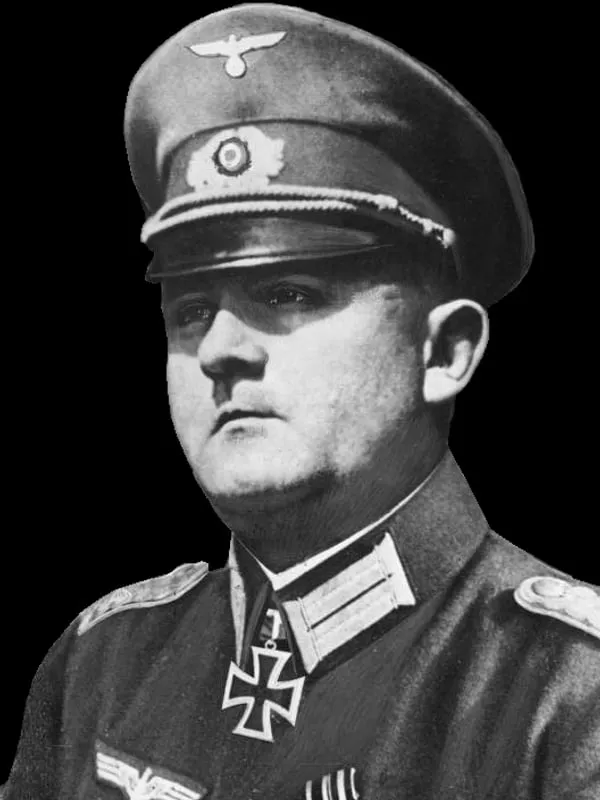
- Born:
- 9 November 1894, Gräflich Wiese, now Łąka Prudnicka (Silesia, Kingdom of Prussia)
- Died:
- 5 November 1966, Baden-Baden (West Germany)
- Author:
- Łukasz
- Photo:
- PawełMM, CC BY-SA 3.0 DE, Wikimedia Commons

Dietrich von Choltitz was a professional officer who rose from Saxon cadet to General of Infantry in the Wehrmacht. He fought in both world wars: in 1940 he landed outside Rotterdam, in 1942 he stormed Sevastopol, and in 1944 he commanded a corps in Normandy. He went down in history, however, above all as the last German commander of Paris, who in August 1944 failed to carry out Adolf Hitler’s order to reduce the city to ruins and surrendered the garrison to French troops. After the war he presented himself as the “saviour of Paris”. Historians judge his role far more cautiously, and the recordings of his conversations in captivity that came to light later cast a shadow over him that his memoirs left unmentioned.
Silesia and the Saxon army
He was born on 9 November 1894 on the family estate of Gräflich Wiese near Neustadt in Upper Silesia – today Łąka Prudnicka, near Prudnik. He came from an old Silesian noble family with a long military tradition. His father, Hans, was a major in the Prussian army and commanded an uhlan regiment during the First World War. In 1907, aged thirteen, Dietrich entered the cadet corps in Dresden and for a time served as a page at the Saxon royal court. In March 1914 he joined the Saxon 107th Infantry Regiment in Leipzig as an officer cadet (Fahnenjunker).
He served with this regiment throughout the First World War on the Western Front. In October 1914 he was commissioned as a second lieutenant and was wounded soon afterwards; later he commanded a company and served as a battalion adjutant and as commander of a machine-gun unit. He fought in Flanders and on the Somme. For reconnoitring forward positions during the Third Battle of Ypres he was awarded the Saxon Military Order of St Henry, one of the kingdom’s highest decorations.
After the war he served in the eastern frontier defence units, and in 1919 he was accepted into the Reichswehr. He spent most of the 1920s and the early 1930s in the Saxon 12th Cavalry Regiment, where he commanded a squadron. In 1929 he was promoted to Rittmeister (cavalry captain). When the army began to expand rapidly after Hitler came to power, he transferred back to the infantry. From 1937 he commanded a battalion of the 16th Infantry Regiment in Oldenburg, part of the 22nd Infantry Division, and in the autumn of 1938, as a lieutenant colonel, he took part in the occupation of the Sudetenland following the Munich Agreement.
Rotterdam and Sevastopol
In September 1939 his division fought in Poland, including briefly in the Battle of the Bzura. The 22nd Division was then retrained as an air-landing formation, to be flown into action. On 10 May 1940, the first day of the campaign in the Netherlands, Lieutenant Colonel Choltitz’s battalion landed at Waalhaven airfield outside Rotterdam and pushed on towards the bridges over the Maas in the city centre. For several days the Germans held their bridgehead under constant Dutch counter-attacks. On 14 May, after the bombing of Rotterdam, Choltitz took part in the talks on the city’s surrender. When General Kurt Student was shot in the head during them, Choltitz – according to accounts cited in the literature – prevented German soldiers from taking revenge on the surrendering Dutch officers. For the fighting at Rotterdam he received the Knight’s Cross of the Iron Cross, and in September 1940 he took command of the whole 16th Regiment.
In 1941 the regiment fought as part of General Erich von Manstein’s 11th Army on the southern wing of the Eastern Front: it forced the Dnieper at Beryslav, broke through the Perekop Isthmus and from the autumn besieged Sevastopol. In June 1942, during the final assault on the fortress, the regiment suffered enormous losses – according to frequently cited figures, of some 4,800 men fewer than 350 remained. After the city fell, Choltitz was promoted to Generalmajor.
At the same time the Crimea was also the scene of mass murder. In 1941–1942 Einsatzgruppe D, working with units of the 11th Army, murdered tens of thousands of Jews, including in Sevastopol. What part, if any, Choltitz’s regiment played in this has not been established from the documents. The question resurfaced years later, however, because of his own words, recorded in British captivity.
From the Don to Normandy
In the autumn of 1942 Choltitz briefly commanded the 260th Infantry Division on the central sector of the Eastern Front, and in December – at the moment of crisis after the encirclement of the Sixth Army at Stalingrad – he took acting command of XVII Army Corps, fighting on the River Chir. In the spring of 1943, by now a Generalleutnant, he commanded the 11th Panzer Division in the final phase of the fighting for Kharkiv, and then, briefly, XLVIII Panzer Corps. After several months in the officer reserve and a course for corps commanders, at the turn of February and March 1944 he took over LXXVI Panzer Corps in Italy, which was fighting the Allies at the Anzio beachhead. After six weeks he was recalled.
After the Allied landings in Normandy he was sent to France. In the second half of June 1944 he took over LXXXIV Army Corps, whose commander, General Erich Marcks, had been killed on 12 June. The corps defended the western part of the front, from Saint-Lô to the west coast of the Cotentin, and for several weeks held up the Americans in the Battle of the Hedgerows. When Operation Cobra began on 25 July, it was his divisions that took the main blow and were shattered. At the end of July Field Marshal Günther von Kluge relieved him of his command.
Commander of Greater Paris
His dismissal did not end his career. On 1 August Choltitz was promoted to General of Infantry, and on 7 August Hitler received him at his headquarters in East Prussia and appointed him Commander of Greater Paris in place of General Hans von Boineburg-Lengsfeld, who had been removed after the 20 July plot. Choltitz had a reputation as a tough and obedient officer, and his task was to hold the city and crush any resistance. In his memoirs he described the Hitler of that meeting as a sick and feverish man who spoke of the ruthless destruction of his enemies. He arrived in Paris on 8 or 9 August and took up residence in the Hôtel Meurice on the rue de Rivoli. Estimates of the garrison vary from 16,000 to 20,000 men, most of them from rear-echelon units.
When the Paris uprising broke out on 19 August, Choltitz agreed, through the Swedish consul general Raoul Nordling, to a ceasefire, which on 20 August was extended to the whole city. The truce collapsed, and from 22 August Paris was covered in barricades. Meanwhile further orders kept arriving from Hitler’s headquarters: defend the city to the last, suppress resistance by the harshest means and prepare demolitions. The best known of them, dated by most sources to 23 August, ended with the sentence: “Paris must not fall into the hands of the enemy except as a field of ruins.” Engineers laid explosive charges under the bridges over the Seine and in the more important public buildings.
Choltitz did not set them off. On 25 August, as the French 2nd Armoured Division and the US 4th Infantry Division entered the city, the French burst into the Hôtel Meurice at around 2.30 p.m. and took him prisoner. At around 3.30 p.m., at the Prefecture of Police, he signed the surrender of the garrison with General Philippe Leclerc, and at the Gare Montparnasse he signed ceasefire orders for the German strongpoints; it was there, too, that the leader of the uprising, Colonel Henri Rol-Tanguy, countersigned a copy of the instrument of surrender. So ended the liberation of Paris. The following day General Charles de Gaulle walked down the Champs-Élysées in the victory parade.
Saviour of Paris?
After the war Choltitz published two books: “…brennt Paris?” (1950) and “Soldat unter Soldaten” (1951). In them he portrayed himself as an officer who had deliberately refused to carry out the order to destroy the city – because it was militarily pointless, because Paris was the heritage of all Europe and because Hitler, as he claimed, had already lost his mind. He gave an important role to his talks with Nordling. This version was cemented by Larry Collins and Dominique Lapierre’s bestseller “Is Paris Burning?” (1965) and the 1966 film based on it, and later by the film “Diplomacy” (2014), built around a night-time conversation between the general and the consul whose course no other source confirms.
Historians working in the French and German archives tell a different story. They point out that in the last week before the surrender Choltitz no longer controlled much of the city, that his forces were too weak for systematic destruction, and that the commander of the engineers, Captain Werner Ebernach, never received an order to blow the bridges at all. They stress the role of Nordling and of staff officers who, according to French studies, delayed passing on the signals from Hitler’s headquarters. They also note that Choltitz had reasons not to defy Hitler openly: after the 20 July plot his family in Germany was at risk of collective punishment (Sippenhaft). Leclerc testified that at the moment of his capture the general was concerned above all with his own safety. How much of his conduct was calculation, how much helplessness and how much a wish to spare the city, the sources do not settle. What is certain is that Paris – unlike Warsaw, which the Germans were destroying district by district in those same weeks – came through the war almost untouched.
Trent Park
From Paris Choltitz was taken to Britain, to the camp for senior German officers at Trent Park in north London. British intelligence secretly recorded the prisoners’ conversations there in the hope of gaining military information; the transcripts were declassified only decades later. According to a surviving transcript of 29 August 1944, a few days after the surrender, Choltitz told his fellow prisoners: “The hardest task I have ever carried out – but I carried it out with the utmost consistency – was the liquidation of the Jews.” These words are usually linked to his service in the Crimea in 1941–1942. No other evidence of his personal involvement in the killings has been found. The historian Randall Hansen observes that the words are not corroborated by the documents, but considers Choltitz’s involvement possible, even probable, given that many German generals had a share in the crimes in the east. In other recorded conversations Choltitz spoke of the guilt of the entire senior officer corps, which had “gone along with everything” and taken the Nazis seriously.
He was never charged. From Britain he was transferred to Camp Clinton, a prisoner-of-war camp in Mississippi, from which he was released in April 1947. He settled in Baden-Baden, then the seat of the French occupation authorities in Germany, and wrote his memoirs. In 1956 he visited Paris and, as was reported, asked to be shown his old room at the Hôtel Meurice. He died in Baden-Baden on 5 November 1966 of emphysema, a consequence of old wartime illnesses – a few weeks after the premiere of the film “Is Paris Burning?”, in which he was played by Gert Fröbe. Senior German and French officers attended his funeral.
Significance
Choltitz belonged to the generation of officers who came out of the imperial army, served in the Reichswehr and followed Hitler without objection. He was a capable front-line commander, valued for his toughness, and for most of the war he was in no way different from other Wehrmacht generals. His biography is dominated by two weeks in Paris in August 1944, and the memory of them – shaped for decades by his own memoirs and by popular literature – made him one of the few German generals remembered in France with gratitude. The Trent Park recordings and archival research have undermined this legend: they reveal a man who acted in circumstances in which obedience had become almost impossible to carry out, who cared about his own fate and his family’s, and who in the Crimea was at the very least a witness to, and by his own account also a participant in, crimes against the Jews. The debate over whether he “saved Paris” remains open, but his life story is today less a tale of chivalrous disobedience than an example of how the post-war memoirs of German generals shaped the image of the war.
Sources
Mentioned in battles
(02)Often appears with
People who appear in the same events.